
On 20 November, the S&P 500 fell 3.7% and the Nasdaq Composite dropped 5.3% as investors questioned whether heavy spending on artificial intelligence would generate the profits implied by share prices. The S&P 500 ended more than 10% below its October high, putting it in correction territory.
For Singapore property, the question is what the sell-off changes for the next buyer. Can they still fund the down payment? What mortgage rate will the bank offer? How secure do they feel about their income? A bad week on Wall Street can make a buyer hesitate. A sustained rise in borrowing costs or a weaker job market can change what that buyer can afford.

What the 5% Treasury yield tells us
The 10-year US Treasury yield reached 5.15% on 13 November. It fell to 4.92% on 20 November as investors bought government bonds during the stock rout. The 30-year yield stood at 5.31%. Higher long-term yields raise the return available on government bonds and reduce the present value of profits expected far into the future. That makes it harder to justify high valuations for AI companies whose largest expected returns are still years away. The flight into Treasuries during the sell-off shows how quickly yields can reverse direction.
Market liquidity is how easily someone can trade without moving the price much. Funding liquidity is how easily they can raise cash or borrow. A stock sell-off marks down portfolio wealth, and the cash in each trade passes from buyer to seller. For Singapore property, the consequences depend on what happens next. Someone counting on selling shares for a down payment has less purchasing power. If lenders grow cautious, credit can become harder to obtain while government bond yields fall.
How global liquidity reaches Singapore homes
Bank funding and mortgages. MAS manages the Singapore dollar against a basket of currencies, while local interest rates are set in the market. MAS says Singapore’s overnight benchmark, SORA, generally tracks global rates such as US SOFR. Local funding conditions and expectations for the Singapore dollar affect the gap. Many floating home loans are priced at compounded SORA plus a bank margin, so borrowers feel changes at their next reset. Fixed-rate offers for new borrowers can also move as banks’ funding and hedging costs change.
Household cash and income. A Singapore buyer can fund a purchase with cash savings, eligible CPF Ordinary Account savings, proceeds from selling a home and a mortgage. A fall in share prices matters most to buyers relying on investments for their down payment. A broader downturn can affect more households through weaker bonuses, hiring and job security. MAS has identified a sharper pullback in AI investment as a risk to Singapore’s growth.
Cross-border capital. Money seeking safety in Singapore can go into bank deposits or government bonds. Buying a home involves a separate decision. The standard Additional Buyer’s Stamp Duty for foreign residential buyers is 60%, with treaty relief for qualifying buyers, including US nationals. A 2017 study found that larger foreign capital inflows were associated with faster private home price growth in Singapore after accounting for GDP growth and past price changes. That study covered aggregate inflows under an earlier policy regime.
Do US markets and Singapore property move together?
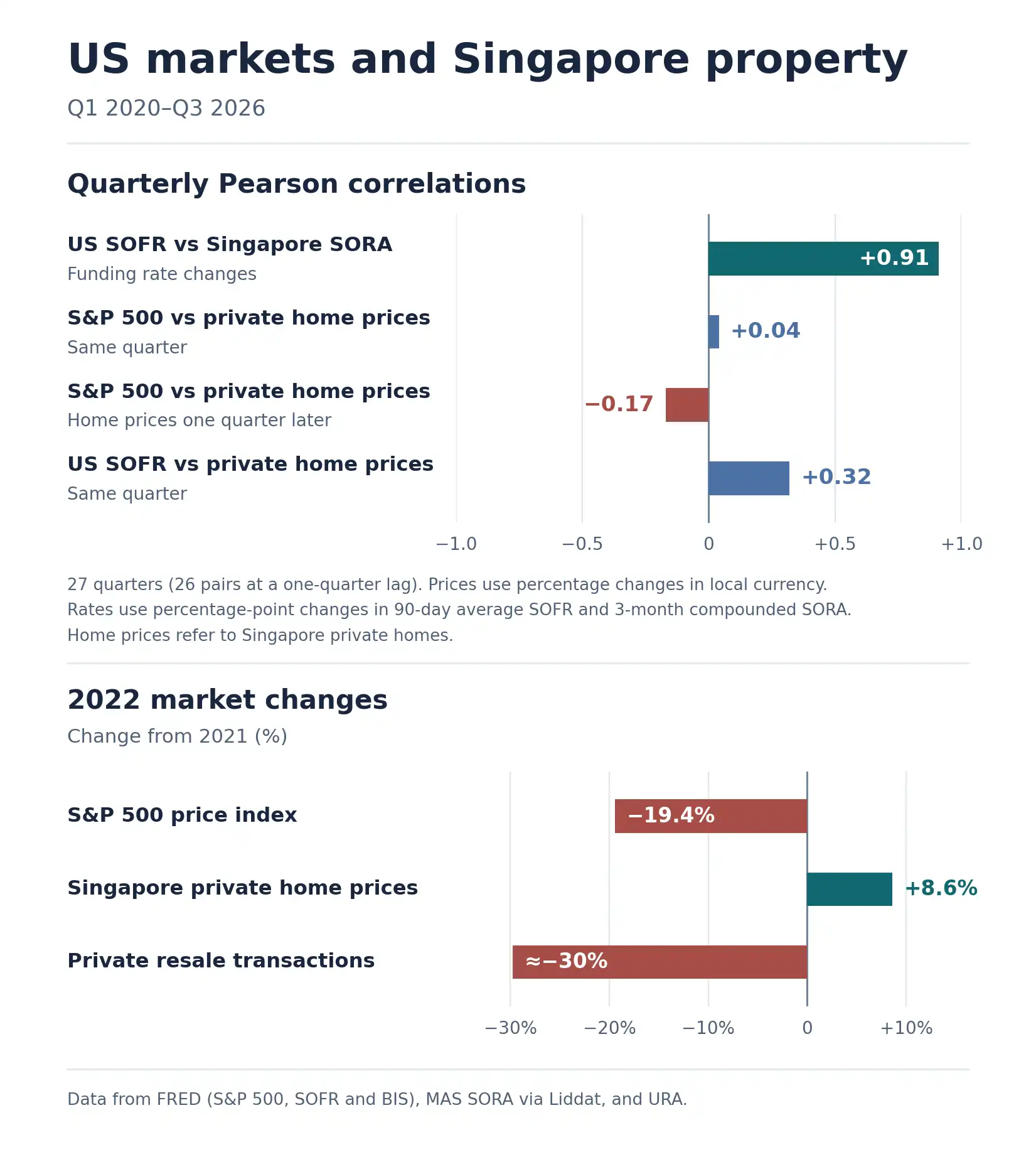
We compared quarterly changes from Q1 2020 to Q3 2026. The strongest relationship was only between US and Singapore funding rates. US stock returns had almost no same-quarter relationship with Singapore private home price growth, and the relationship remained weak one quarter later.
| Quarterly comparison | Correlation |
|---|---|
| Change in US 90-day average SOFR and Singapore 3-month compounded SORA | +0.91 |
| S&P 500 price return and Singapore private home price growth in the same quarter | +0.04 |
| S&P 500 price return and Singapore private home price growth one quarter later | −0.17 |
| Change in US 90-day average SOFR and Singapore private home price growth in the same quarter | +0.32 |
The Pearson correlations use 27 quarters of data, or 26 pairs for the lagged comparison. Rates are measured in percentage-point changes and asset prices in local-currency percentage changes. The home price series uses BIS data based on URA’s index through Q2 2026 and URA’s published index change for Q3. SOFR and SORA measure the cost of short-term funding. The correlations are descriptive and cannot isolate the effect of a rate move from changes in growth, supply or policy.
2022 shows how prices and transaction volumes can diverge. The S&P 500 fell 19.4%, and Singapore private home prices rose 8.6%, while private resale transactions fell about 30% from 2021. A property market can become harder to sell into even as the homes that do transact command higher prices.
Why mortgage rates matter more to a buyer’s budget
Three-month compounded SORA was 1.37% on 20 November, up from about 1.02% at end-April. On a S$1 million mortgage over 30 years, an illustrative rate increase from 2% to 3% raises monthly repayments from about S$3,696 to S$4,216. That is roughly S$520 more per month on the same loan.
Banks generally use at least a 4% interest-rate floor when assessing residential borrowers under debt-servicing rules. Where that floor applies, a cheaper package improves monthly cash flow while borrowing capacity is still assessed at the higher rate. Eligible buyers using an HDB concessionary loan have a separate cushion because the rate is pegged to the CPF Ordinary Account rate. HDB buyers using bank loans are exposed to market mortgage rates.
Cheaper oil helps most when supply improves
Brent crude settled at US$92.57 a barrel on 20 November, down 3.4% for the week in its third consecutive weekly decline. Improving Middle East shipments helped ease supply concerns. If that continues, cheaper energy can slow inflation and ease pressure on the Fed to raise rates further. Singapore can benefit through lower imported energy and transport costs over time, with the exchange rate and tariff adjustments influencing how quickly the savings reach households.
Oil could also fall as businesses and consumers cut back. In that scenario, lower energy prices and falling yields can arrive alongside weaker employment and tighter credit. The Fed held its policy rate at 3.75% to 4.00% in October and said inflation remained elevated. A sustained oil decline would carry more weight if underlying inflation also eased.
Where the impact would show up first
If the AI sell-off stays concentrated in equities and Singapore jobs and credit hold up, the first effects are more likely to be slower decisions and longer negotiations. Buyers can delay a purchase quickly. Owners with manageable mortgages can wait for an acceptable offer. Sustained increases in mortgage costs or widespread job losses would give buyers less room to bid and more sellers a reason to accept lower offers. Commercial property can feel financing pressure sooner, as owners need to refinance large loans.
The latest quarterly figures show why the type of transaction matters. Before the November sell-off, Singapore private home prices rose 1.4% in Q3 2026, even as sales fell from 6,148 to 5,146. Developer sales accounted for most of the decline. Resales were nearly steady at 3,801 versus 3,813. Over the coming months, a sustained drop in resale deals alongside higher bank mortgage quotes and weaker hiring would be a more credible sign of pressure on Singapore home prices than another volatile week on Wall Street.
Disclaimer. This article provides general market commentary for informational purposes only. The correlations describe how markets moved together during the period studied and have limited value for predicting future property prices or interest rates. The mortgage repayment figures are illustrative. Actual borrowing costs and loan eligibility depend on the lender’s terms and your individual circumstances. Seek independent professional advice before making any property, investment or financing decision.
Article contributed by Jerry Wong.

Jerry Wong is a realtor at Propnex Realty, bringing a rich background in interior and lighting design to his work. He loves exploring diverse spaces and observing the transformative power of real estate. Beyond his professional role, Jerry finds his greatest fulfillment in connecting people with the right properties, gaining immense satisfaction from helping clients achieve their dreams.
Let’s Discuss Your Property Plans
Interested in This Property?
Buying, selling or renting? Get a free consultation with realtors with a background in interior and lighting design. We’ll discuss your goals and help you assess your options—from pricing and timelines to layout practicality and space potential.
Share your contact details below, and we will get in touch to understand your needs and suggest the next steps. No pressure. No obligation to proceed.