
Two suburban mall sale processes are testing different propositions: the premium buyers will pay for a major transport-linked destination, and the value they see in a smaller neighbourhood centre.
A 50% interest in NEX is reportedly being offered for S$1.2 billion–S$1.25 billion, while Wisteria Mall is being marketed for around S$220 million. Together, the interests on offer carry asking prices of approximately S$1.42 billion–S$1.47 billion. These are marketing expectations, not completed transactions.
The distinction matters. A seller can ask for a premium, but only an agreed deal will show whether a buyer accepts the income prospects, risks and financing costs behind that price.
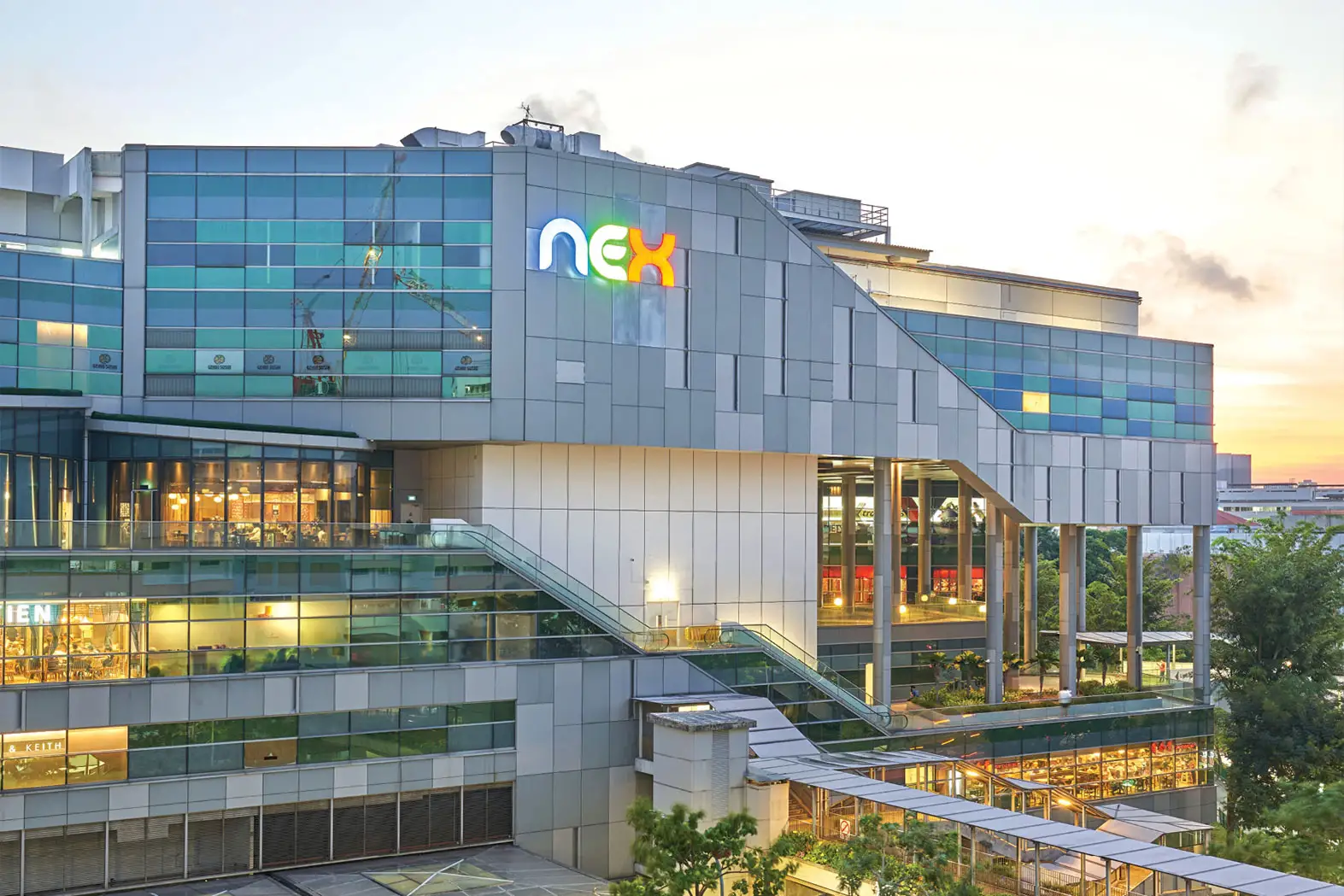
NEX is testing a premium to its latest valuation
China Investment Corporation and PGIM’s combined 50% interest implies a whole-mall value of S$2.4 billion–S$2.5 billion. Frasers Centrepoint Trust (FCT), which owns the other half, holds a right of first refusal, according to The Business Times.
The latest disclosed appraisal values NEX at S$2.262 billion as at 30 September 2026. The asking range therefore implies a premium of approximately 6.1%–10.5%. On a simple proportional basis, half the appraisal is S$1.131 billion, putting the sellers’ expectations S$69 million–S$119 million above that benchmark.
That premium is a useful starting point for negotiation. It is not, by itself, evidence that the mall is overpriced: a buyer may have different assumptions about future rents, expenditure or the value of consolidating ownership.
Why scale and transport connectivity could command more
NEX is a seven-level mall with approximately 634,631 sq ft of net lettable area and more than 300 stores. It is integrated with Serangoon Bus Interchange and Serangoon MRT station, connecting the North East and Circle lines.
Those features support an investment case extending beyond nearby residents. A transport interchange brings commuters past the property, while a broad tenant mix gives shoppers more reasons to visit and stay.
For an investor, the attraction is the potential to sustain tenant demand and rental income through that combination of convenience and scale. However, footfall must translate into sales that tenants can afford to pay rent from. Size and connectivity do not automatically justify any purchase price.
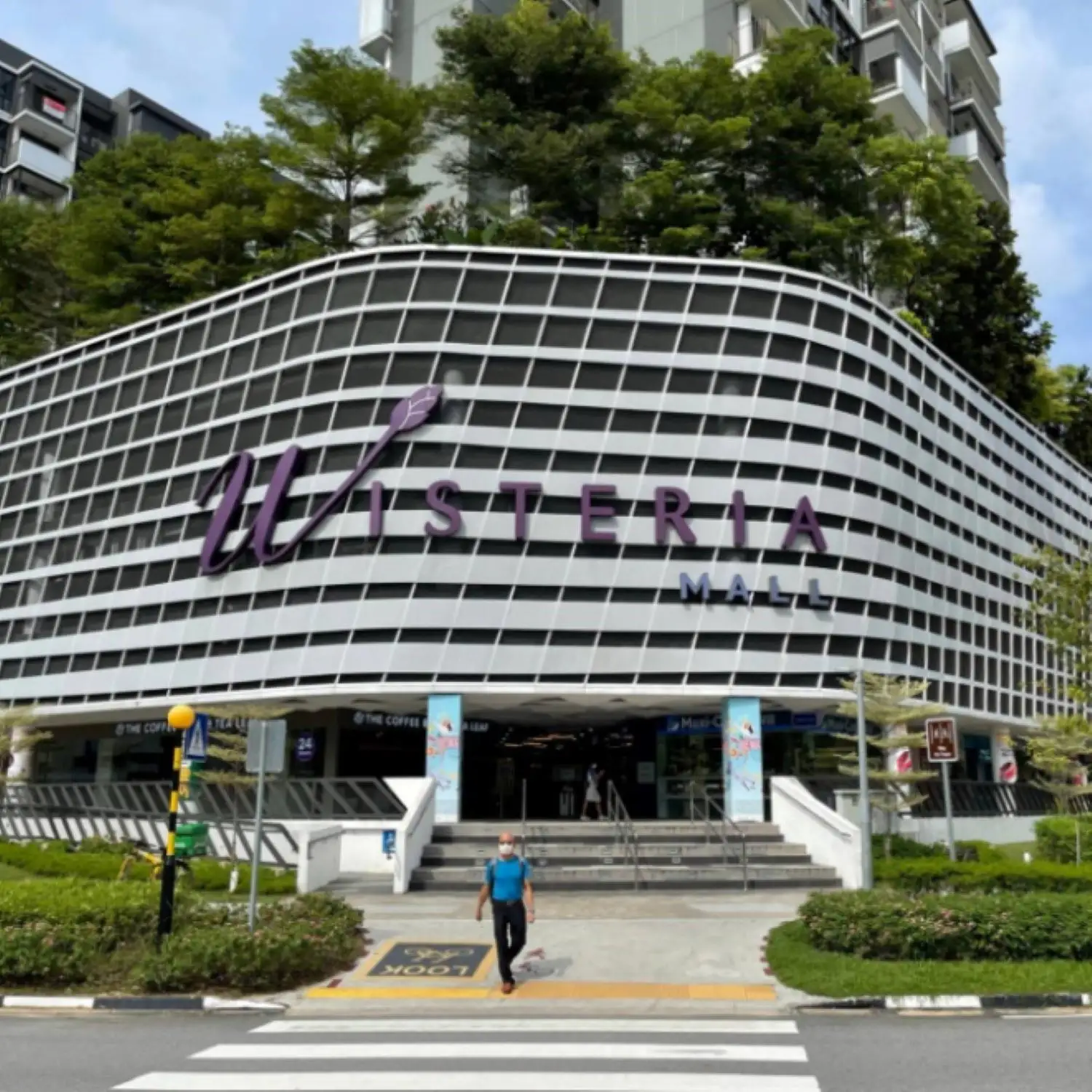
Wisteria’s modest price increase needs a different reading
Schroders has appointed Knight Frank and Savills to market Wisteria Mall for around S$220 million, with the expression-of-interest exercise reportedly closing in late November. The mall was acquired for S$208 million in 2022 and reportedly has 93% occupancy.
The asking price is S$12 million, or approximately 5.8%, above the earlier purchase price. Using the January 2022 sale announcement as a rough starting point, that is about 1.2% annualised to November 2026. The exact calculation would depend on actual completion dates.
This is modest headline capital appreciation, but it does not establish a poor investment return. Rental income earned during ownership also matters, as do financing expenses, transaction costs and capital expenditure. Without those cash flows, you cannot calculate the fund’s total return.
Likewise, 93% occupancy describes how much space is occupied; it does not establish profitability. Buyers would still need to examine rents, lease expiries, incentives, tenant quality and operating costs.
These percentages measure different things
| Measure | NEX | Wisteria Mall |
|---|---|---|
| Interest being marketed | 50% | Mall interest |
| Reported asking price | S$1.2b–S$1.25b | About S$220m |
| Comparison benchmark | September 2026 appraisal | 2022 purchase price |
| Headline difference | 6.1%–10.5% premium | 5.8% increase |
| What it tests | Buyers’ willingness to pay above appraisal | Buyers’ willingness to support the proposed exit price |
Comparing the percentages as though they measure the same performance would be misleading. NEX’s figure is a premium to a recent valuation. Wisteria’s is a change from a historical acquisition price. Neither is a realised investment return.
For FCT, full ownership must justify its funding cost
Acquiring the remaining interest could give FCT the full economic exposure to NEX and simplify ownership decisions. But the incremental benefit depends on the existing shareholder and management arrangements; FCT should not assume it currently lacks operational influence.
The central question is what the additional income would deliver after funding and transaction costs. Debt brings interest expense and uses borrowing capacity. An equity issue increases the number of units sharing future distributions. A mixed funding package must still work for existing unitholders.
The reported asking price is also not necessarily the final cash funding requirement. A transaction involving a property-holding company can require adjustments for existing debt, cash and other liabilities. Definitive terms would be needed to establish the actual amount payable.
A right of first refusal is an opportunity, not an obligation to buy. Its operation depends on the agreement, and it does not automatically make the sellers’ asking price a sensible acquisition price.
What the eventual outcomes will tell us
A NEX deal near the asking range would support the case that buyers attach additional value to this particular mall’s scale, connectivity and ownership opportunity. It would not establish the same premium for every suburban shopping centre.
At Wisteria, a sale near S$220 million would show support for the proposed exit value. It would still leave the owner’s total investment performance dependent on the income and costs accumulated during the holding period.
The clearest evidence will come from the final sale prices, the income the assets generate, and the investment needed to maintain those earnings. Until then, the two sale processes offer a measure of sellers’ expectations and a test of how carefully investors assess value in suburban retail.
Disclaimer: This article is for general information and commentary, not investment advice. Asking prices and marketing details are based on reports available as at 10 November 2026 and may change. Calculations are approximate and do not represent realised returns.
Article contributed by Jerry Wong.

Jerry Wong is a realtor at Propnex Realty, bringing a rich background in interior and lighting design to his work. He loves exploring diverse spaces and observing the transformative power of real estate. Beyond his professional role, Jerry finds his greatest fulfillment in connecting people with the right properties, gaining immense satisfaction from helping clients achieve their dreams.
Let’s Discuss Your Property Plans
Interested in This Property?
Buying, selling or renting? Get a free consultation with realtors with a background in interior and lighting design. We’ll discuss your goals and help you assess your options—from pricing and timelines to layout practicality and space potential.
Share your contact details below, and we will get in touch to understand your needs and suggest the next steps. No pressure. No obligation to proceed.