
A S$196 million acquisition sounds very different from a billion-dollar land commitment. Yet both figures describe Bukit Sembawang’s proposed purchase at Kallang Distripark.
On 16 October 2026, the developer announced a conditional agreement to acquire approximately 5.1 hectares from Tropical Warehousing for S$196.04 million. Including the specified lease-upgrade premium and land betterment charges, the estimated land cost reaches approximately S$1.01 billion. The proposed transaction remains subject to shareholder and government approvals.
The difference matters because the amount paid to an existing landowner does not necessarily represent the cost of securing land ready for its intended redevelopment.
For readers assessing redevelopment deals, the Kallang transaction offers a useful lesson: the vendor’s selling price is only one part of the economics.
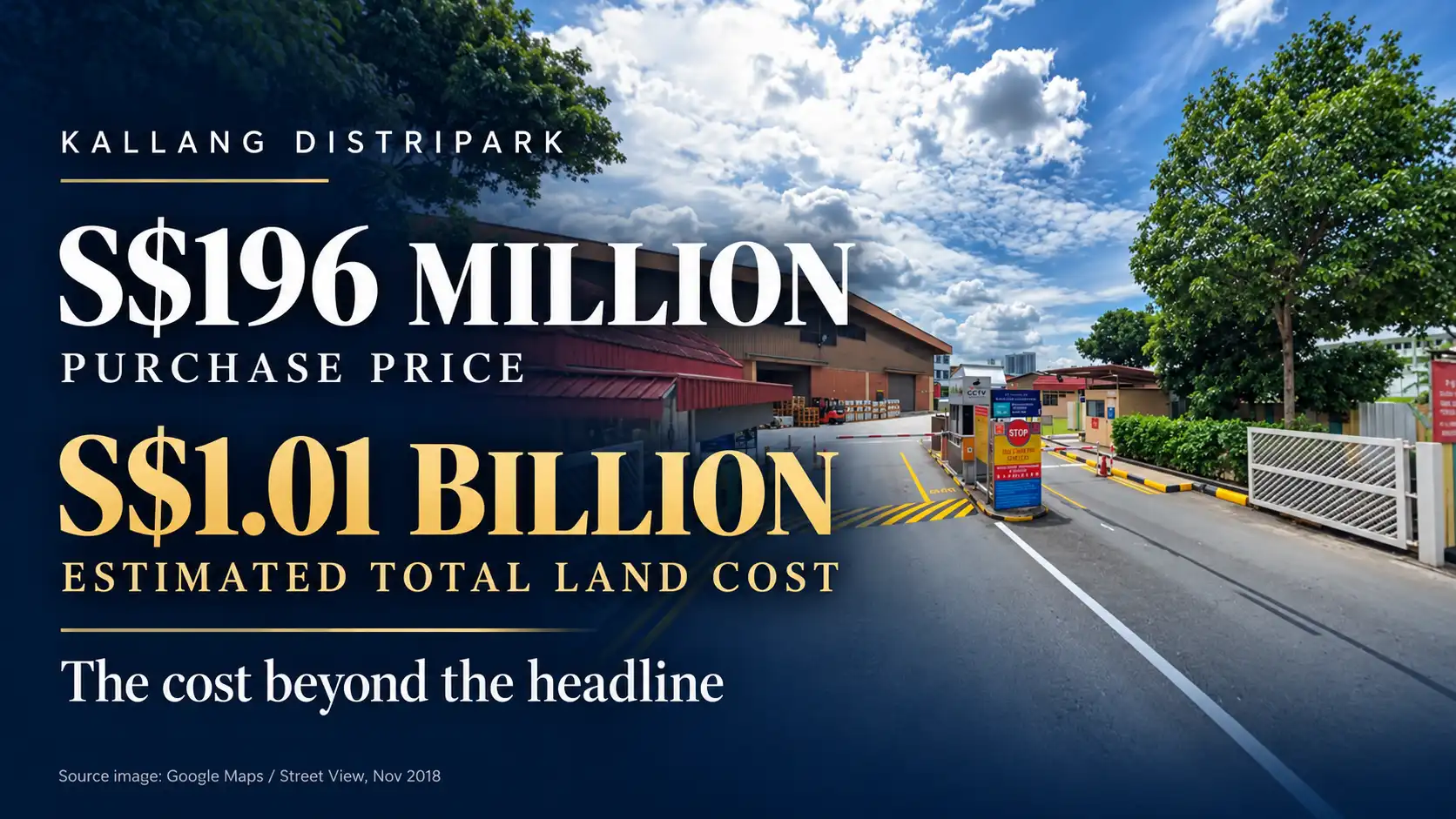
Nearly 81% of the estimated land cost sits outside the purchase price
Using the announced figures, the cost breakdown is quite surprising:
| Component | Approximate amount | Share of estimated land cost |
|---|---|---|
| Purchase consideration payable to the vendor | S$196.04 million | 19.4% |
| Specified lease-upgrade premium and land betterment charges combined* | S$813.96 million | 80.6% |
| Estimated total land cost | S$1.01 billion | 100% |
*Calculated by subtracting the purchase consideration from the rounded total land-cost estimate. This does not establish the individual amount of either charge.
The estimated land commitment is approximately 5.15 times the headline purchase price.
That does not mean the developer discovered an unexpected S$814 million bill after agreeing to buy the property. These components form part of the announced transaction economics. It means that describing the proposal solely as a S$196 million acquisition gives readers an incomplete picture of its scale.
What does the lease-upgrade premium pay for?
A leasehold interest has a remaining lifespan. Buying that interest does not automatically give the purchaser a new 99-year lease.
For Kallang Distripark, the proposed transaction involves obtaining a fresh 99-year lease from the Singapore Land Authority in exchange for surrendering the existing head lease. The lease-upgrade premium is the payment associated with that renewal.
SLA’s lease policy explains that lease renewal is subject to assessment and that granting a fresh lease can involve a land premium. Renewal should therefore not be treated as an automatic entitlement attached to a purchase.
Commercially, the distinction is substantial. A developer assessing a new residential project needs to consider the tenure it can eventually offer purchasers, rather than simply the remaining lease it acquires from the seller.
The premium is consequently part of securing the intended development opportunity.
What are land betterment charges?
Land betterment charges address a different source of value.
Land Betterment Charge, or LBC in short, is a tax on an increase in land value arising from a chargeable consent, such as planning permission. Its assessment considers the relevant pre- and post-consent land values, including permitted use and development intensity.
In practical terms, permission to redevelop land for a more valuable use can create value beyond the rights previously attached to it. The LBC captures part of that uplift.
The distinction is:
| Payment | What it relates to |
|---|---|
| Vendor consideration | Acquiring the seller’s existing property interest |
| Lease-upgrade premium | Obtaining the fresh lease |
| Land betterment charge | The land-value uplift associated with the relevant development consent |
These payments should not be collapsed into a single idea of “what the seller received”. Equally, a feasibility assessment cannot ignore the latter two simply because they are paid separately.
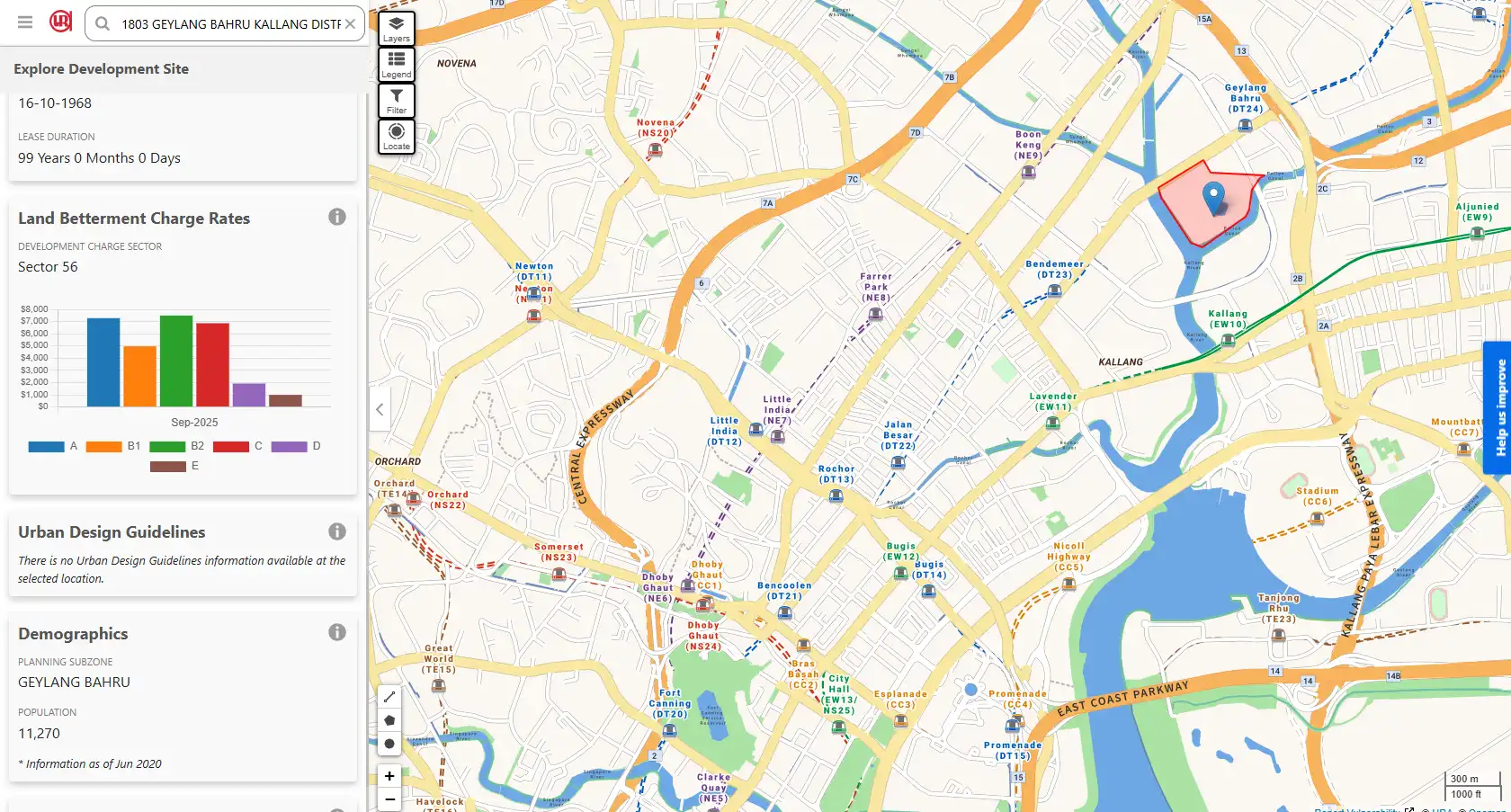
Why S$1,256 psf ppr is the more useful benchmark
The proposed residential development with first-storey commercial use has a permissible gross floor area of approximately 804,139 sq ft, subject to approvals. The often-cited estimate of 600–800 homes is an analyst estimate, rather than a confirmed final unit count.
Dividing the estimated land cost by that permissible GFA gives:
S$1.01 billion ÷ 804,139 sq ft ≈ S$1,256 psf per plot ratio
Using only the vendor consideration produces approximately S$244 psf ppr.
| Basis of calculation | Approximate land rate |
|---|---|
| Vendor consideration only | S$244 psf ppr |
| Estimated total land cost | S$1,256 psf ppr |
The lower number leaves out most of the estimated land commitment. It would therefore be a misleading basis for judging whether the development land was acquired cheaply.
The denominator also deserves attention. The cited GFA relates to the proposed development with first-storey commercial use; it should not automatically be described as entirely residential saleable area.
Land cost per square foot of GFA is not the same as an apartment’s selling price per square foot. Moving from one to the other requires assumptions about saleable area, commercial space, construction expenditure, financing and other costs.
The agreement provides protection against specified charge movements
The large difference between vendor consideration and total land cost might suggest that Bukit Sembawang bears unlimited exposure to changes in the two government charges. The announced terms are more nuanced.
If the actual lease-upgrade premium exceeds the specified amount, the vendor pays the difference to the purchaser; if it is lower, the purchaser pays the vendor. Differences in the specified LBC are offset through purchase-price adjustments. Another adjustment addresses final development area and approved plot ratio against the agreed land rate.
These provisions matter when assessing risk. A higher charge does not necessarily translate dollar-for-dollar into a higher economic land cost for the purchaser.
However, contractual protection on particular land-cost inputs does not establish the project’s eventual profitability. Construction costs, funding requirements, development timing and achievable sales revenue still need separate assessment.
The public park is an obligation—but the cost allocation matters
The proposal includes a two-hectare public park, a 15-metre-wide waterfront promenade and road infrastructure, alongside the housing development.
Crucially, the filing states that the vendor will undertake the specified infrastructure and demolition works on its own behalf and at its own expense. The purchaser is entitled to a fee of 3% of the defined construction costs.
It would therefore be inaccurate to simply add the entire public-works bill to Bukit Sembawang’s development costs.
Nevertheless, there is a practical distinction between who pays and who delivers. Coordinating public works, demolition and the residential development introduces interfaces that a project team must manage. Readers should assess those responsibilities without assuming that every obligation represents an unreimbursed expense.
S$1.01 billion is still not the total project budget
Correcting the headline acquisition figure is only the first step.
A residential development also requires expenditure on its buildings, consultants, financing, marketing and other applicable transaction and development costs. A proper feasibility model must identify which costs are already included, which remain additional and which are recoverable from another party.
The scale makes even modest changes meaningful. For example, an additional S$10 million of unrecovered project expenditure would equal about S$12.44 per sq ft of the cited GFA. This is a sensitivity calculation, not a forecast.
Time matters too. Delayed construction or slower sales can extend the period over which capital is tied up. The financial effect depends on the funding structure and timing of cash receipts.
Ultimately, a developer’s cost base does not guarantee that buyers will accept a particular launch price. Buyers will compare location, layouts, tenure, amenities and alternatives available when the project reaches the market.
Replenishing the pipeline as the remaining landed phases progress
Bukit Sembawang’s proposed Kallang acquisition comes while it still has a substantial landed housing programme. Its pipeline includes the remaining Luxus Hills phases, Pollen Collection II and the final Nim Road development. However, these projects represent a finite supply of future homes.
In its July 2026 shareholder responses, the group confirmed that it had no further unplanned land bank beyond Nim Phase 5 and Luxus Phase 12. Management also expected to develop the existing land bank progressively over the next four to five years, while continuing to seek suitable acquisitions.
Against that background, the Kallang proposal can reasonably be viewed as replenishing the development pipeline and creating another source of future home sales. Bukit Sembawang already has condominium experience through projects such as LIV @ MB, The Atelier and 8@BT. This acquisition would expand that business as its remaining landed phases move towards completion.
The strategic rationale is understandable: a developer needs new sites to sustain its business as existing projects are built and sold. But replenishing a land bank creates value only if eventual sales proceeds justify the acquisition, development, and financing costs.
That brings the assessment back to our article’s central distinction. S$196.04 million is the starting vendor consideration; approximately S$1.01 billion is the estimated land commitment. The proposed acquisition could strengthen Bukit Sembawang’s future pipeline, but its commercial success will depend on the returns achieved on that full investment.
Disclaimer: This article is provided for general information and commentary only and does not constitute investment, financial, legal or property advice. Information is based on publicly available announcements and sources available at the time of writing. The proposed Kallang Distripark acquisition remains conditional upon the relevant approvals, and its terms, development parameters and estimated costs may change.
Calculations are indicative and use rounded figures. The estimated S$1.01 billion land cost is not the total development cost, while the derived land rate is neither a projected selling price nor an indication of profitability. Interpretations of Bukit Sembawang’s strategy are the author’s analysis and should not be taken as statements of management’s intentions. Readers should verify information against the latest official disclosures and seek independent professional advice before making decisions.
Article contributed by Jerry Wong.

Jerry Wong is a realtor at Propnex Realty, bringing a rich background in interior and lighting design to his work. He loves exploring diverse spaces and observing the transformative power of real estate. Beyond his professional role, Jerry finds his greatest fulfillment in connecting people with the right properties, gaining immense satisfaction from helping clients achieve their dreams.
Let’s Discuss Your Property Plans
Interested in This Property?
Buying, selling or renting? Get a free consultation with realtors with a background in interior and lighting design. We’ll discuss your goals and help you assess your options—from pricing and timelines to layout practicality and space potential.
Share your contact details below, and we will get in touch to understand your needs and suggest the next steps. No pressure. No obligation to proceed.