
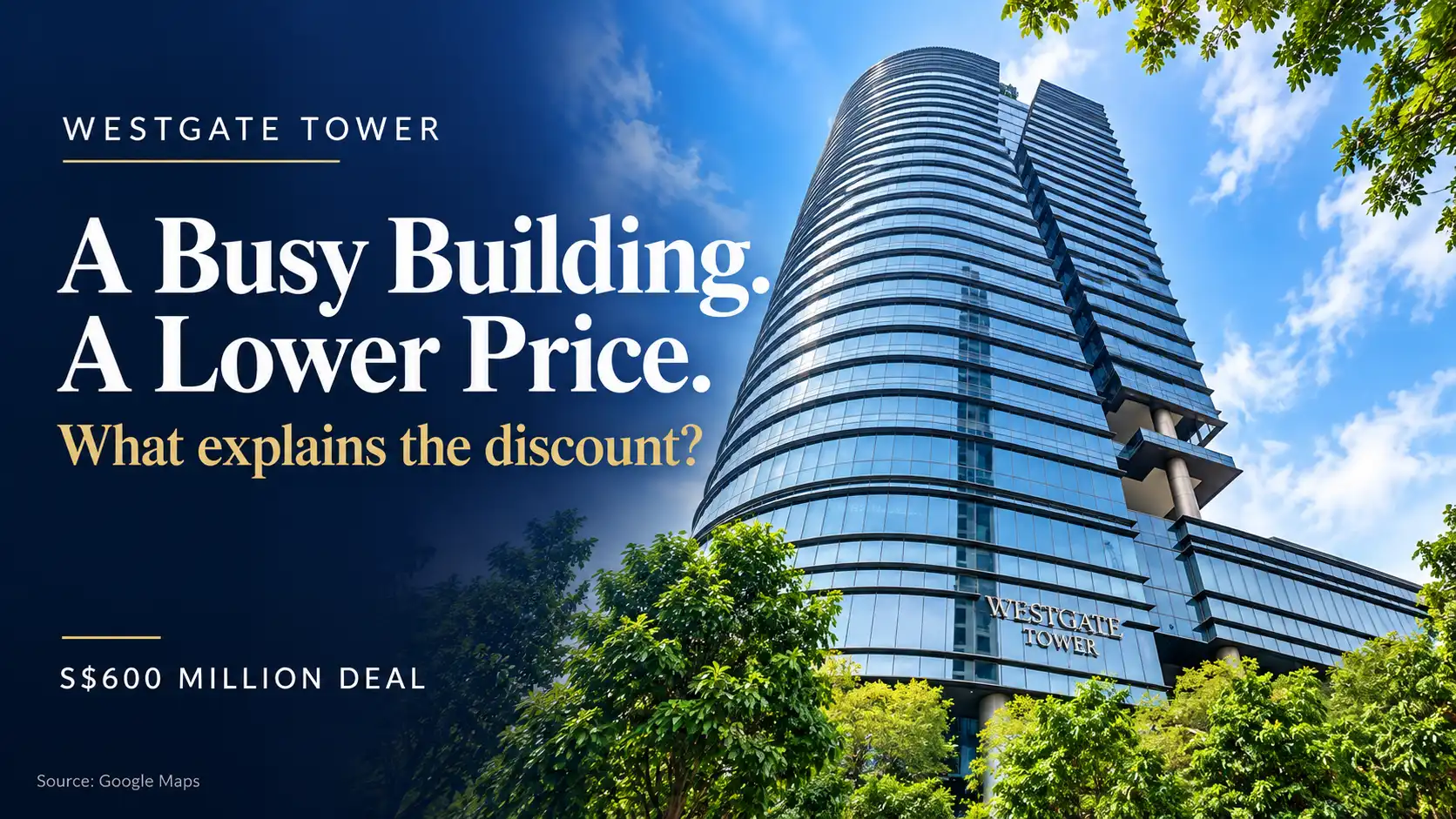
A largely occupied office tower might seem an unlikely candidate for a sale below its previous purchase price. Yet that is the question raised by Tuan Sing’s proposed S$600 million acquisition of Westgate Tower in Jurong.
The 20-storey office building has approximately 90% committed occupancy. Its agreed property value is nevertheless S$40 million below an independent valuation of S$640 million as at October 1, and S$80 million below the S$680 million that investment manager AEW paid in 2022.
That represents a 6.25% discount to valuation and an approximately 11.8% reduction from the previous transaction price.
For Tuan Sing, however, the attraction extends beyond buying an occupied building at a lower entry price. Westgate Tower comprises 295 strata-titled office units, giving the buyer flexibility to retain rental income or potentially sell individual offices.
This combination of existing income and different future sale options helps explain the acquisition’s appeal—even though it does not, by itself, explain why the seller accepted a lower price.
High Occupancy Does Not Guarantee a Higher Valuation
Occupancy measures how much space has been committed to tenants. It does not reveal how profitable that space is.
Two buildings with the same occupancy can produce very different returns. Rental rates, operating expenses, incentives, lease expiry dates and future capital expenditure all affect the income an owner ultimately receives.
Committed occupancy also does not necessarily mean every leased space is already generating its full contractual rent. Lease commencement dates and rent-free periods can affect cash flow.
Property values depend on how buyers assess that income and the risks attached to it. If a buyer requires a higher return, the price it is willing to pay can fall even when occupancy remains healthy.
The reported figures therefore do not establish that Westgate Tower’s leasing performance has deteriorated. Equally, 90% committed occupancy alone is insufficient to conclude that S$600 million is a bargain.
The more useful question is what Tuan Sing can earn from the building at its new entry price—and what options it has to improve or realise that value.
One Acquisition, 295 Strata-Titled Office Units
Westgate Tower’s ownership structure is central to that assessment.
The building contains 295 strata-titled office units across approximately 305,000 sq ft of net lettable area. Tuan Sing is acquiring the companies that collectively own all the commercial office units.
For an owner seeking recurring income, the straightforward strategy is to retain the offices, manage the leases and improve occupancy.
But the strata titles provide another possibility: individual units could be sold rather than requiring the owner to dispose of the entire office asset in one transaction.
That matters because buyers for a S$600 million office investment differ from buyers for an individual office. Smaller transactions could potentially appeal to businesses seeking their own premises or investors seeking rental income at a more manageable purchase quantum.
The structure gives Tuan Sing more ways to realise value over time. It could retain the asset, sell selected units, or consider a broader disposal strategy if conditions become attractive.
Management has not committed to individual sales. Its stated immediate priority is to improve occupancy.
Could Individual Sales Unlock Additional Value?
A potential attraction of strata ownership is the possibility that selling units separately could generate higher total proceeds than selling the asset in bulk.
However, that outcome is not assured.
Individual buyers will assess each office’s size, layout, floor level, tenancy, remaining lease and purchase price. Marketing, transaction costs and the time required to complete multiple sales would also affect the result.
Selling income-producing units reduces the rental income the owner retains. Introducing additional owners can also complicate future coordination over building management and improvements.
There is another important comparison issue. The reported acquisition rate of approximately S$1,967 psf is based on net lettable area. It should not be compared directly with individual office asking prices quoted on strata area without reconciling the different area measurements.
The strata structure offers flexibility. It does not establish a guaranteed resale margin.
The Remaining Space Offers a More Immediate Opportunity
Before any potential individual sales, Tuan Sing has a conventional route to improving performance: leasing more space.
At approximately 90% committed occupancy, around 30,500 sq ft falls outside committed occupancy, based on the reported net lettable area.
Securing additional tenants could increase income while spreading some existing building costs across a larger occupied area. Retaining tenants and managing lease renewals will be equally important.
The benefit depends on the rents achieved and the costs of securing those tenants. Leasing incentives, commissions and any required works could reduce the initial contribution.
For now, improving occupancy is the best operational objective the buyer has disclosed.
A Lower Purchase Price Still Comes With Financing Commitments
The acquisition also brings a balance-sheet trade-off.
Tuan Sing intends to fund the purchase using internal resources and bank financing. Its net gearing is expected to rise from 1.01 times to 1.40 times following the acquisition.
That makes the relationship between property income and financing costs particularly relevant. Buying below valuation provides a lower starting price, but the investment still needs to generate an adequate return after expenses and funding costs.
The disclosed information is insufficient to calculate that return reliably.
Similarly, the S$80 million difference from AEW’s 2022 purchase price should not be treated as its total investment loss. Rental income received during ownership, financing expenses, capital expenditure and transaction costs would all form part of that calculation.
What the Discount Really Tells Us
Westgate Tower illustrates why an occupied property can change hands at a lower price without those two facts contradicting each other.
The transaction reflects the price agreed today for the asset’s income, risks and future possibilities. The previous purchase price and current valuation provide context, but neither determines what a buyer must pay.
For Tuan Sing, the distinctive opportunity is to combine an existing rental business with the flexibility offered by 295 strata-titled offices.
Whether the acquisition proves attractive will depend on leasing performance, financing costs and how effectively that flexibility is used. The discount improves the entry point; the next step is turning it into a stronger return.
Article contributed by Jerry Wong.

Jerry Wong is a realtor at Propnex Realty, bringing a rich background in interior and lighting design to his work. He loves exploring diverse spaces and observing the transformative power of real estate. Beyond his professional role, Jerry finds his greatest fulfillment in connecting people with the right properties, gaining immense satisfaction from helping clients achieve their dreams.
Let’s Discuss Your Property Plans
Interested in This Property?
Buying, selling or renting? Get a free consultation with realtors with a background in interior and lighting design. We’ll discuss your goals and help you assess your options—from pricing and timelines to layout practicality and space potential.
Share your contact details below, and we will get in touch to understand your needs and suggest the next steps. No pressure. No obligation to proceed.