
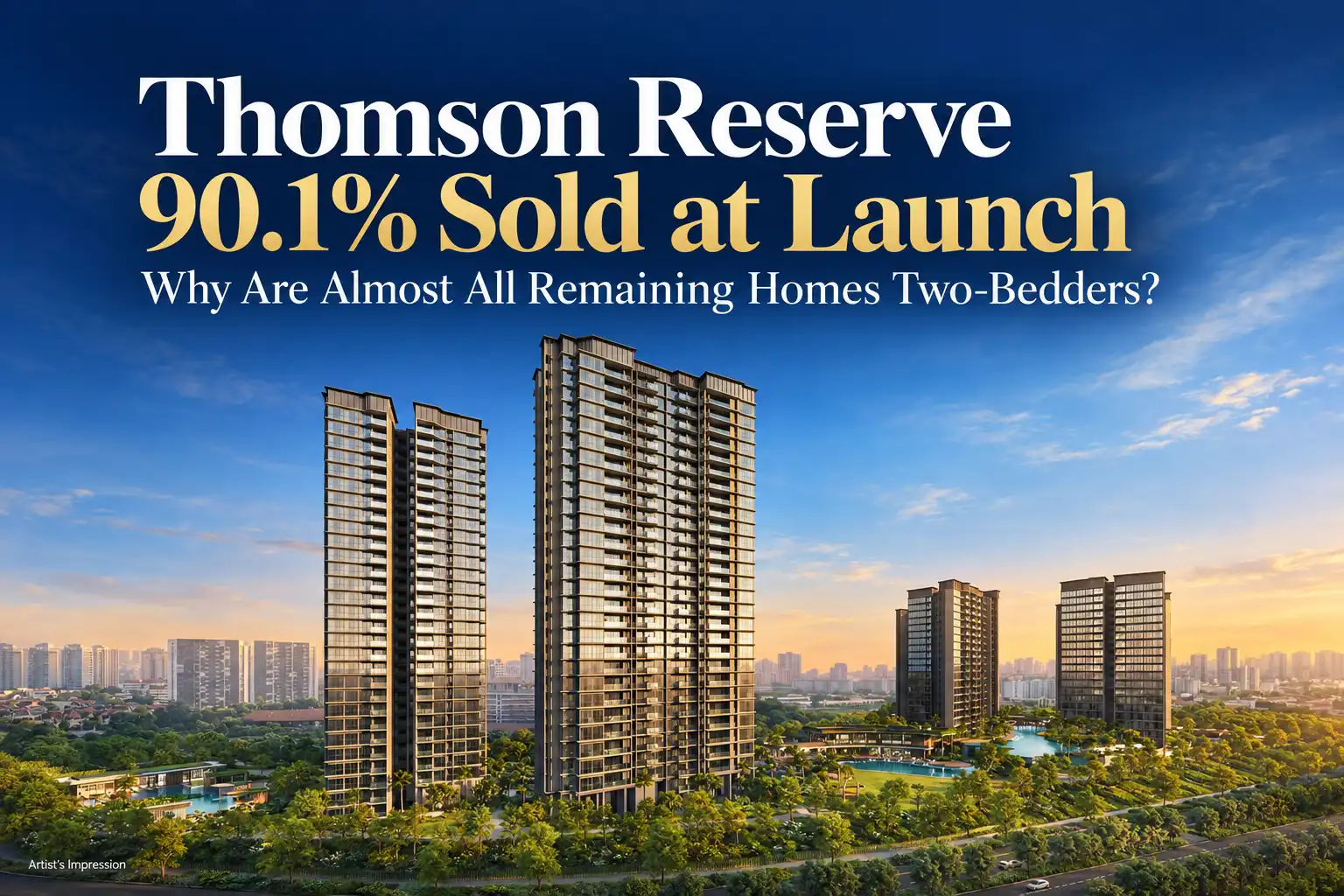
Thomson Reserve’s launch result comfortably exceeded the expectations we outlined before sales began. But the more revealing story lies in the homes buyers chose—and those still available.
The development sold 1,143 of its 1,268 units during the 30–31 October launch period, achieving a 90.1% take-up rate at an average selling price of approximately S$2,900 psf, according to the developers’ joint statement reported by EdgeProp.
That clears the 30%, 40% and 50% benchmarks discussed in our earlier preview analysis by a substantial margin.
Yet one figure deserves closer examination: 123 of the 125 remaining homes were smaller two-bedroom units. In other words, two-bedders accounted for 98.4% of the unsold inventory at the reported launch snapshot.
Does this suggest buyers are turning away from smaller homes? The answer is more nuanced—and potentially more useful for understanding Singapore’s housing market.
The Sales Mix Reveals More Than the Headline Percentage
Using the reported launch sales and the unit distribution on our Thomson Reserve project page, the breakdown is as follows:
| Unit category | Total units | Reported sold | Remaining | Take-up |
|---|---|---|---|---|
| Two-bedroom, including Premium, excluding study | 516 | 393* | 123 | 76.2%* |
| Two-bedroom Premium + Study | 200 | 200 | 0 | 100% |
| Three-bedroom types | 350 | 350 | 0 | 100% |
| Four-bedroom types | 174 | 174 | 0 | 100% |
| Five-bedroom suites | 28 | 26 | 2 | 92.9% |
| Total | 1,268 | 1,143 | 125 | 90.1% |
Calculated from the published unit mix and reported remaining inventory. These are launch-period figures, rather than a live availability count or a tally of lodged caveats.
The distinction between the two-bedroom categories matters. Every two-bedroom-plus-study unit sold, while inventory remained among the configurations without a study.
This makes it difficult to argue that buyers simply rejected two-bedroom homes. A more plausible interpretation is that additional usable space helped some layouts appeal to a broader range of households.
Two-Bedders Started With the Largest Supply
Before interpreting the remaining inventory as weak demand, we need to account for how much was available.
The 516 two-bedroom units without a study represented approximately 40.7% of the entire development. This was the largest category in the comparison.
Selling an estimated 393 of these homes is a substantial result. Indeed, more units sold in this category than in the entire three-bedroom category.
The difference is in the proportion absorbed: approximately 76.2% of the smaller two-bedders sold, compared with complete sell-outs for several other categories.
Both observations matter. Smaller two-bedders attracted considerable demand, but their larger starting inventory and lower sell-through rate left them dominating the remaining stock.
The headline therefore points to relative differences in demand and supply, rather than an outright rejection of compact homes.
Why a Higher Price Can Still Attract Greater Urgency
A lower purchase price does not automatically create the strongest motivation to buy.
For a household choosing its primary residence, the decision includes whether the home can accommodate children, working from home, visiting parents and changing needs over several years.
A cheaper apartment may fall outside that household’s shortlist if the layout would require another move too soon.
This helps explain why the sell-out of the two-bedroom-plus-study category is particularly interesting. A study can provide useful flexibility without requiring buyers to move into a full three-bedroom configuration. Its value depends on the actual layout, but the extra space may make a meaningful difference to daily living.
Our interpretation is that buyers were weighing the usefulness of the home alongside its price. The launch outcome is consistent with this explanation, although it does not establish which individual features drove each purchase.
ABSD May Be Reshaping the Smaller-Unit Buyer Pool
Additional Buyer’s Stamp Duty is another plausible part of the explanation.
ABSD directly raises the cost of buying an additional residential property. Under the prevailing rates, a Singapore citizen buying a second residential property generally pays 20% ABSD, subject to applicable reliefs or remissions. The Ministry of Finance describes the policy as moderating investment demand and prioritising owner-occupation.
For illustration, a S$1.6 million purchase subject to 20% ABSD would incur S$320,000 in additional stamp duty, before ordinary Buyer’s Stamp Duty and other costs.
That changes the investment calculation substantially. A relatively accessible entry price does not necessarily translate into an attractive rental investment once you include acquisition costs.
Our view is that ABSD can reduce the advantage smaller homes historically enjoyed as investment purchases. Where a compact unit relies more heavily on buyers acquiring an additional property, the policy may narrow its potential audience.
However, the Thomson Reserve sales figures alone cannot establish how much of the difference ABSD caused. Smaller units also serve owner-occupiers, while larger homes can attract investors.
Household Resources Matter More Than Bedroom Count Alone
The ability to combine household resources offers another possible explanation.
A couple buying a family home may bring two incomes, accumulated savings, and proceeds from an existing property to the purchase. That can support a higher total budget than a purchase funded by one person.
But this should not become a rigid assumption that smaller homes are supported by one income and larger homes by two. Couples also buy two-bedders, and some single-income households buy larger homes.
The useful distinction lies in the resources and needs of the buyer groups, not bedroom count alone.
A household buying a long-term residence may justify a higher price through years of personal use. An investor must evaluate that price against rental income, holding costs and the eventual resale outcome. Those motivations can produce different levels of urgency at the same launch.
An Established Neighbourhood Can Strengthen Family Demand
Thomson Reserve’s location also provides context.
Thomson Reserve is readily accessible to Upper Thomson MRT, nearby nature areas, and an established school network. These amenities give households several reasons to consider the location for everyday living.
For families already attached to an area, the search can be quite specific: a new home with sufficient space, within reach of familiar routines and relationships.
That creates a different competitive landscape from a buyer comparing investment apartments across many districts. A household determined to remain nearby may have fewer acceptable substitutes.
The launch result is consistent with strong demand for that combination of location and usable space. It does not, by itself, prove a wider shortage of large homes across Upper Thomson; that would require a fuller comparison of competing supply.
The Starting Price Was Never the Whole Pricing Story
The reported average selling price of approximately S$2,900 psf was above the advertised starting rate of S$2,608 psf.
That comparison should not be interpreted as a price increase of the same magnitude. A starting price refers to selected entry units, while the average reflects the mix of homes actually sold.
Floor level, configuration, facing and other attributes can all influence the final average. The heavy take-up of different unit categories makes the sales mix especially relevant.
For buyers assessing the remaining inventory, the useful comparison is therefore the actual price and layout of an available unit against realistic alternatives, rather than its distance from the original headline starting price.
What the Remaining Inventory Tells Us
Thomson Reserve’s launch challenges the assumption that the lowest-priced homes must always sell through fastest.
The clearest finding is that buyers absorbed the larger configurations and two-bedroom-plus-study homes more completely, while the smaller two-bedroom category still achieved substantial sales from a much larger starting supply.
ABSD, household purchasing resources, layout flexibility and attachment to the neighbourhood offer plausible explanations. Their individual contributions remain unproven.
The next question is how quickly the remaining two-bedders sell—and whether sales differ between the standard and Premium layouts. That will better indicate which configurations buyers favour than the remaining-stock percentage alone.
For the balance-unit chart and project information, visit our Thomson Reserve project page. Availability may have changed since the reported launch figures.
Disclaimer: This article is for general information only and does not constitute financial, investment, tax or legal advice. Sales figures reflect developer-reported launch bookings and may differ from subsequent caveats or completed transactions. Prices and unit availability are subject to change. Views on ABSD, household financing, and buyer preferences are the author’s interpretations, not confirmed reasons for individual purchases. Readers should verify current information and seek independent professional advice before making property decisions.
Article contributed by Jerry Wong.

Jerry Wong is a realtor at Propnex Realty, bringing a rich background in interior and lighting design to his work. He loves exploring diverse spaces and observing the transformative power of real estate. Beyond his professional role, Jerry finds his greatest fulfillment in connecting people with the right properties, gaining immense satisfaction from helping clients achieve their dreams.
Let’s Discuss Your Property Plans
Interested in This Property?
Buying, selling or renting? Get a free consultation with realtors with a background in interior and lighting design. We’ll discuss your goals and help you assess your options—from pricing and timelines to layout practicality and space potential.
Share your contact details below, and we will get in touch to understand your needs and suggest the next steps. No pressure. No obligation to proceed.