
Several pre-WWII places of worship flagged as being in critical need of protection
For almost 50 years until 1954, a jar filled with refreshing Chinese tea was placed outside Seng Wong Beo, a temple in Tanjong Pagar, for weary rickshaw pullers.
They would gulp down the brew gratefully before carrying on with their work barefooted in the humid Singapore weather.
The practice, as recalled by the temple’s long-time site manager, was started by its founding monk, Reverend Rui Yu. He set up the temple in 1905 for rickshaw pullers, port workers and coolies in central Singapore who were lonely and often thought of home.
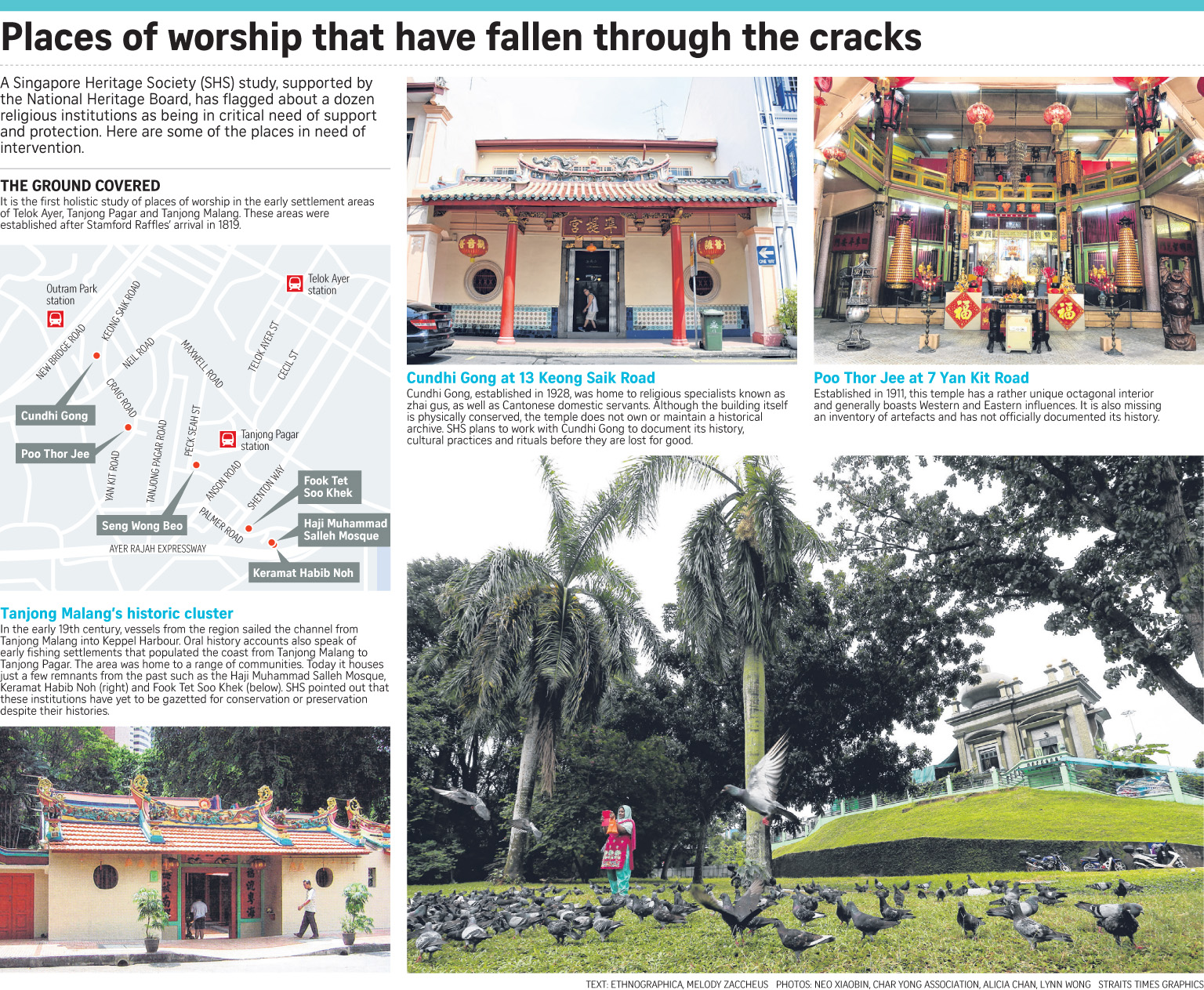
The 114-year-old temple, now dwarfed by skyscrapers such as Oasia Hotel and Icon Residence, continues to play a significant role in Singapore’s Taoist community. It is the headquarters of other temples dedicated to the city god.
It is also the main temple in Singapore where ghost marriages have been arranged over the past century. A thousand tablets from these unions are still housed there.
Yet, despite its rich and unusual cultural heritage, the temple has not received any form of official protection from redevelopment. Moreover, it operates under a temporary occupation licence that may or may not be renewed beyond March next year or 2021.
It is one of a dozen religious institutions flagged by three researchers from the Singapore Heritage Society (SHS) as being in critical need of support and protection following their two-year study of 21 pre-World War II places of worship.
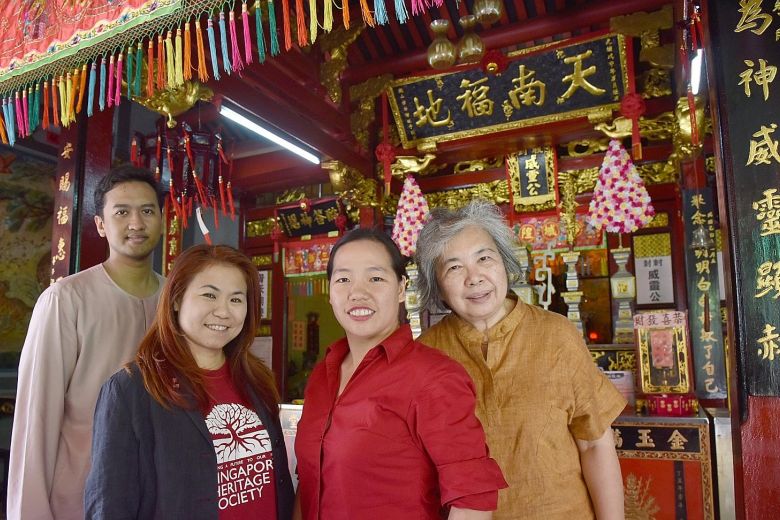
The study team was led by anthropologist Vivienne Wee. The other members were researchers Lynn Wong and Fauzy Ismail.
They studied Chinese temples, clan associations, Hindu temples, mosques and churches in what was the first holistic study of places of worship in the early settlement areas of Telok Ayer, Tanjong Pagar and Tanjong Malang. These areas were established after Stamford Raffles’ arrival.
The 321-page report, which is supported by the National Heritage Board, assessed the historic sites that have fallen through the cracks in terms of gaining conservation or preservation status, and explored ways of sustaining their tangible and intangible heritage.
In the case of Seng Wong Beo, the team documented its history, rituals and festivals, distinct architectural features, and temple artefacts, including a 79-year-old bell donated by hotelier Khoo Teck Puat’s family.
The team also captured little-known stories, including how Reverend Rui Yu and various prolific writers, such as Khoo Seok Wan and Lee Choon Seng, gathered to create and appreciate literary works under a banyan tree in its temple courtyard.
On why the temple has fallen through the cracks, Dr Wee said it has been a result of broad-brush urban zoning. She said: “Valuable heritage sites existing in areas zoned for commercial development have been forgotten…
“(Seng Wong Beo’s) history is significant for Singapore as it embodies a past of mutual social responsibility. Monks and literati built this temple for rickshaw pullers and other coolies. It is part of our heritage of philanthropy.”
Other institutions lacking protection include one of the oldest Chinese temples in Singapore – Fook Tet Soo Khek, which can trace its roots to 1819.
Despite its age and history, it has not joined the ranks of Singapore’s 72 national monuments and more than 7,000 conserved buildings. It operates in Palmer Road under a temporary occupation licence that is renewable annually despite its management committee’s efforts to get it listed as a national monument.
Similarly, the clock is ticking for its neighbours – the Haji Muhammad Salleh Mosque and Keramat Habib Noh, which sit on a wakaf land lease that expires in 2025, said Mr Fauzy. “There is a risk that they might have to move out any time if there are urgent development needs.”
As it is, the construction of Prince Edward MRT station, which is due to open in 2025, has resulted in the entrances to both the mosque and shrine being changed a few times.
The SHS hopes to work with some of these places to ensure that their cultural heritage is not lost for good.
For instance, it will propose a comprehensive documentation of Seng Wong Beo’s heritage in case its temporary occupation licence is not renewed. This includes measured drawings of the architectural structure and religious layout, audio-visual recordings of rituals and festivals, and the conservation, analysis and translation of a rare collection of fragile, handwritten Chinese manuscripts in the temple.
Later this year, the SHS plans to launch a walking tour of these areas.
“Source:[Historic but unprotected: Several pre-WWII places of worship flagged as being in critical need of protection] © Singapore Press Holdings Limited. Permission required for reproduction”

Let’s Discuss Your Property Plans
Interested in This Property?
Buying, selling or renting? Get a free consultation with realtors with a background in interior and lighting design. We’ll discuss your goals and help you assess your options—from pricing and timelines to layout practicality and space potential.
Share your contact details below, and we will get in touch to understand your needs and suggest the next steps. No pressure. No obligation to proceed.