
At first glance, the S$38 million guide price for 22–23 Mohamed Sultan Road can be framed as a simple property valuation: about S$2,621 psf on 14,497 sq ft of existing floor area.
But an income-producing mixed-use building should not be judged on its price per square foot alone. The more important question is: how much sustainable income must the property generate for a buyer to accept the asking price?
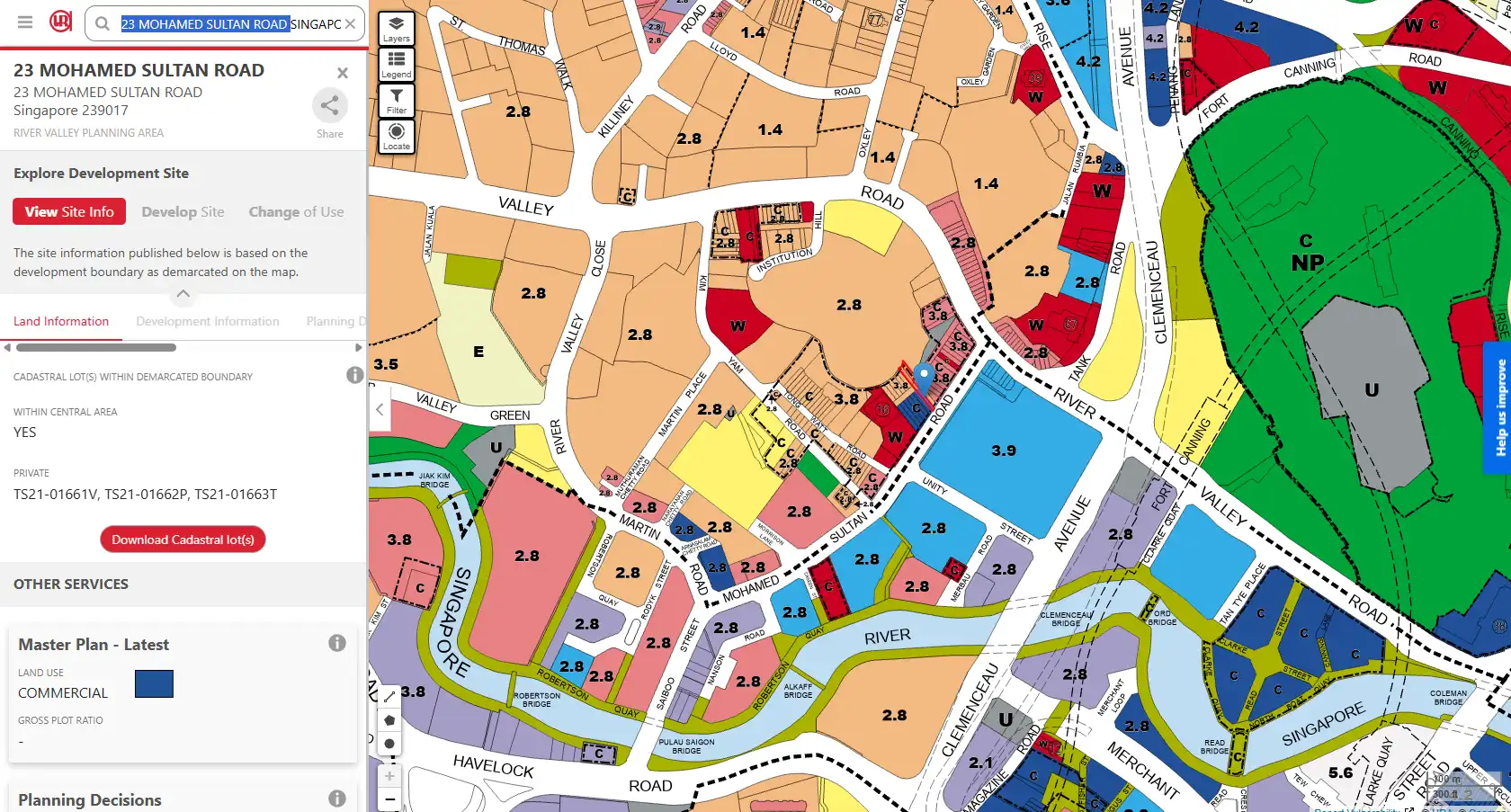
The answer depends on the return the buyer requires. At S$38 million, the property needs annual net income of S$1.14 million for a 3.0% net yield, or S$1.33 million for a 3.5% yield. Assuming landlord expenses consume 20% of gross income, that translates into roughly S$119,000 to S$139,000 in gross income every month.
The key issue: The buildings are marketed as fully tenanted, but the public sale information does not disclose the rent roll, operating expenses or detailed lease terms. The income case for S$38 million therefore remains unproven.
What is being offered for sale
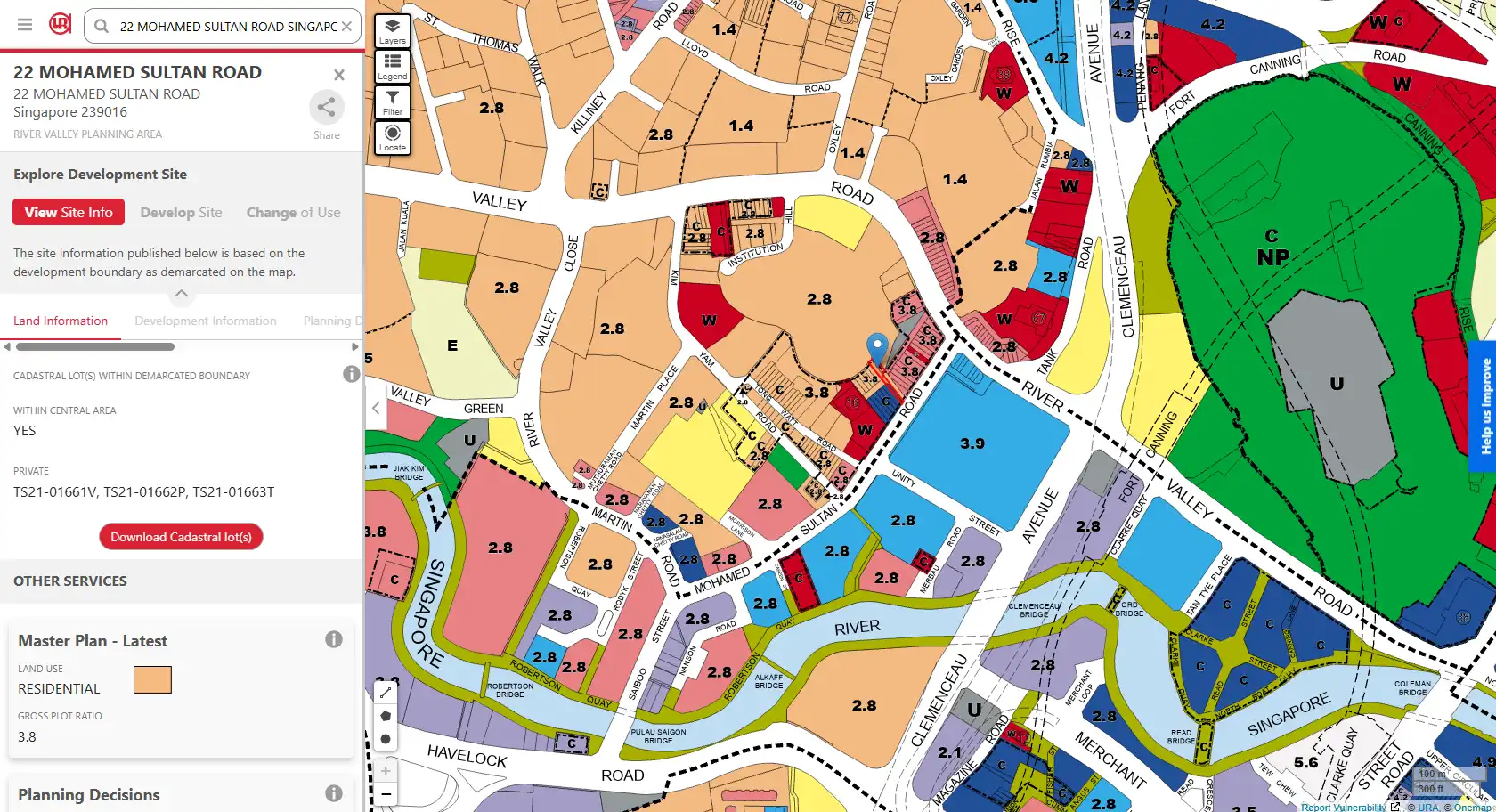
CBRE launched the freehold properties for sale by expression of interest on 23 September 2026. The exercise closes on 28 October 2026 at 3pm. No completed sale has been announced in the sources reviewed, so S$38 million remains the seller’s guide price rather than evidence of an accepted valuation.
The offering comprises two buildings on a combined land area of about 4,221 sq ft. The rear building at 22 Mohamed Sultan Road is an eight-storey block with Serviced Apartment (SA1) approval. The front building at 23 Mohamed Sultan Road has four storeys and a basement, with a basement shop, ground-floor restaurant and serviced apartments on the upper floors. The combined existing floor area is approximately 14,497 sq ft.
EdgeProp reports that Cove manages the accommodation. However, the published information does not explain how rent, operating costs and maintenance responsibilities are divided between the owner and operator.
That distinction is crucial. A building may be fully leased to an accommodation operator even when some individual rooms are vacant. In such an arrangement, the landlord receives contracted rent from the operator, while the operator collects payments from residents or guests.
For valuation purposes, buyers need to focus first on the income payable to the property owner—not simply the operator’s room revenue.
How much income must S$38 million produce?
Net property income, or NPI, is the effective property income remaining after recurring landlord expenses, but before financing costs, income tax, depreciation and major capital expenditure.
The calculation is straightforward: required annual NPI = purchase price × target net yield.
| Target net yield | Required annual NPI | Gross income needed annually at 20% expenses | Gross income needed monthly at 20% expenses |
|---|---|---|---|
| 2.5% | S$950,000 | S$1,187,500 | S$98,958 |
| 3.0% | S$1,140,000 | S$1,425,000 | S$118,750 |
| 3.5% | S$1,330,000 | S$1,662,500 | S$138,542 |
| 4.0% | S$1,520,000 | S$1,900,000 | S$158,333 |
Calculated figures. Monthly amounts are rounded to the nearest dollar. The 20% expense ratio is an illustrative assumption, not a reported figure for these properties.
The spread is substantial. A buyer satisfied with a 2.5% net yield needs S$950,000 in annual NPI. A buyer seeking 4.0% needs S$1.52 million—a difference of S$570,000 a year.
This is why the same rent roll can support very different valuations. A long-term investor who values freehold tenure and expects rental growth may accept a lower initial return. Another buyer may demand a higher yield to compensate for tenant concentration, lease-expiry risk or future maintenance.
Operating expenses can change the result
The 20% expense assumption means that the owner keeps 80 cents of NPI from every dollar of effective gross income. But the actual ratio could be lower or higher depending on the leases and on which costs the tenants must bear.
| Target net yield | Gross income at 15% expenses | Gross income at 20% expenses | Gross income at 25% expenses |
|---|---|---|---|
| 2.5% | S$1.118 million | S$1.188 million | S$1.267 million |
| 3.0% | S$1.341 million | S$1.425 million | S$1.520 million |
| 3.5% | S$1.565 million | S$1.663 million | S$1.773 million |
| 4.0% | S$1.788 million | S$1.900 million | S$2.027 million |
Calculated figures, rounded to three decimal places in millions. All three expense ratios are assumptions.
At a 3.5% target yield, required monthly gross income ranges from about S$130,392 at a 15% expense ratio to S$147,778 at a 25% ratio. Underestimating the owner’s costs could therefore make the yield appear materially stronger than it really is.
These expense ratios apply to landlord rental income. They should not be applied automatically to the accommodation operator’s room revenue. If a buyer also acquires or assumes the operating business, the analysis must separately account for staffing, housekeeping, booking commissions, utilities, management fees, and other hospitality expenses.
What does the required income mean per square foot?
Using the advertised 14,497 sq ft as a simple denominator, the 20% expense scenario requires the following building-wide monthly gross-income equivalents:
| Target net yield | Monthly gross income per sq ft of existing floor area |
|---|---|
| 2.5% | S$6.83 |
| 3.0% | S$8.19 |
| 3.5% | S$9.56 |
| 4.0% | S$10.92 |
These are calculated building-wide equivalents, not quoted or achieved rents.
This comparison is useful, but it has limits. Existing floor area is not the same as net lettable area: corridors, service areas and other common spaces may not earn rent directly. The restaurant, shop and accommodation floors also have different rental economics.
A buyer should therefore rebuild the income by component. Applying a restaurant rent or serviced-apartment room rate to the entire 14,497 sq ft would be misleading.
What nearby transactions and yields tell us
Comparable evidence around the Singapore River is useful, but it does not provide a single market yield. The examples involve different tenures, operating structures and measures of earnings.
| Investment evidence | Reported price or yield | What it tells us |
|---|---|---|
| The Robertson House | S$360 million; 2.3% exit EBITDA yield | A nearby hotel attracted a buyer at a low earnings yield, but hotel EBITDA is not directly comparable with landlord NPI |
| Fraser Residence River Promenade | S$140.889 million completed acquisition | Shows demand for a mixed serviced-apartment and commercial asset, but no NPI or exit yield was disclosed |
| Boat Quay commercial shophouses | Estimated 2.7%–2.9% gross rental yield | A useful shophouse reference, but it is based on asking rents and is before landlord expenses |
| Boat Quay hotel-conversion scenarios | Estimated 3.1%–3.8% NOI yield | Illustrates hospitality potential, but depends on operating assumptions and excludes conversion costs |
| Coliwoo Midtown | Proposed S$134 million acquisition at a 4.1% pro forma EBITDA yield | Shows the value of a long master lease, but differs in location, tenure and contractual structure |
The Robertson House shows that some buyers accept low initial yields
CapitaLand Ascott Trust sold the 336-room Robertson House for S$360 million. The transaction, announced in May 2026 and completed in July, reflected a 2.3% exit yield based on FY2025 EBITDA.
This shows that investors may accept a low current earnings yield for the right hospitality asset. It does not establish the correct yield for Mohamed Sultan Road. The Robertson House is a much larger branded hotel, and its EBITDA, capital requirements and operating risks differ from those of a landlord collecting rent from a serviced-apartment operator.
Fraser Residence confirms demand, but not the required yield
Tuan Sing completed its S$140.889 million acquisition of Fraser Residence River Promenade in July 2024. The purchase included 72 serviced apartments, three conservation warehouses and 47 carpark lots.
This is relevant because it combines accommodation and commercial uses in the same wider precinct. However, the announcements do not disclose annual NPI or an exit yield, so the transaction confirms investor appetite without validating a particular yield for 22–23 Mohamed Sultan Road.
Boat Quay shows the gap between gross and net returns
A September 2026 Business Times report quoted Knight Frank estimates of 2.7%–2.9% gross rental yields for commercial properties around proposed Boat Quay hotel-conversion sites, based on asking rents of S$8–S$9 psf a month.
Using this article’s illustrative 20% expense ratio, a 2.7%–2.9% gross yield would fall to roughly 2.16%–2.32% net. By comparison, a 3.5% net yield requires a 4.375% gross yield when expenses absorb 20% of income.
The same report estimated potential hotel NOI yields of 3.1%–3.8%, assuming daily room rates of S$350–S$400, 80% occupancy and a 30% NOI margin. These are feasibility assumptions and exclude conversion costs. They illustrate why hospitality use can lift revenue, but they cannot be transferred directly to a property that may be leased to an operator.
Coliwoo Midtown highlights the importance of lease terms
In August 2026, CLAS announced a proposed S$134 million acquisition of Coliwoo Midtown at a 4.1% FY2025 pro forma EBITDA yield. The property was to be backed by a ten-year triple-net master lease with fixed rent, although it had only about 51 years of leasehold tenure remaining.
This is not a direct comparable, but it demonstrates why lease structure matters. A long master lease that passes most expenses to the tenant can make the owner’s income more visible and predictable. For Mohamed Sultan Road, buyers need to know whether the existing leases offer similar clarity.
A simple test of what S$125,000 a month would support
Suppose the property produces S$125,000 a month in effective landlord income. That would equal S$1.5 million a year. After deducting the assumed 20% in recurring expenses, annual NPI would be S$1.2 million.
At the S$38 million guide price, this would produce a 3.16% net yield.
The same S$1.2 million NPI would support a value of about S$40 million at a 3.0% yield, but only S$34.3 million at a 3.5% yield.
These are illustrative calculations, not estimates of the property’s actual rent or formal valuations.
The example captures the central issue: the price may look reasonable to one buyer and expensive to another, even when both use the same income. Freehold tenure can justify a lower initial yield for some investors, but it does not increase today’s rent. Assess any premium for future rental growth or redevelopment potential separately from the value supported by current income.
Five documents that would decide the case
Before concluding that the current income supports S$38 million, a buyer should verify:
- The effective rent roll. Separate the accommodation, restaurant and shop income, then account for incentives, arrears and any variable rent.
- The landlord’s recurring costs. Review property tax, insurance, repairs, management and service expenses, including amounts recoverable from tenants.
- The durability of the income. Check lease expiries, break clauses, rent reviews, security deposits, guarantees and tenant concentration.
- The operator’s ability to keep paying. If one accommodation operator supplies a large share of the rent, assess its financial strength and the property’s underlying operating performance.
- The capital-expenditure burden. Inspect the buildings and budget separately for major maintenance or replacement works that are not captured in recurring NPI.
The analysis must also avoid double-counting. A master lease and the operator’s room receipts are not two separate streams of landlord income.
Finally, the yield calculations use S$38 million as the denominator. Acquisition costs, applicable taxes and required works would increase the total capital committed, while financing costs would reduce the cash flow available to the equity investor.
Can the income support S$38 million?
Possibly—but the answer changes sharply with the buyer’s required return.
- At a 2.5% net yield, the property needs S$950,000 in annual NPI.
- At 3.0%, it needs S$1.14 million.
- At 3.5%, it needs S$1.33 million.
- At 4.0%, it needs S$1.52 million.
Under the illustrative 20% expense assumption, the more likely decision zone between 3.0% and 3.5% requires approximately S$119,000 to S$139,000 in monthly gross landlord income.
The comparable evidence shows that buyers accept very different yields for different assets. The Robertson House suggests that some investors will pay for long-term hospitality value at a low initial yield. Boat Quay illustrates the danger of confusing gross rent with net returns. Coliwoo Midtown shows how a strong master lease can improve income visibility.
But none of those examples substitutes for this property’s own rent roll.
The S$38 million guide price can be justified by income only if the leases produce sustainable NPI at a yield the buyer is prepared to accept. Until the rent roll, lease terms and landlord costs are examined, that case remains possible—but not yet proven.
Disclaimer: This article is for general information and discussion only and does not constitute financial, investment, legal, tax or property advice. The income, yield and valuation figures presented are illustrative calculations based on publicly available information and stated assumptions. The actual rent roll, lease terms, operating expenses, property condition and capital-expenditure requirements have not been independently verified.
Article contributed by Jerry Wong.
 Jerry Wong is a realtor at Propnex Realty, bringing a rich background in interior and lighting design to his work. He loves exploring diverse spaces and observing the transformative power of real estate. Beyond his professional role, Jerry finds his greatest fulfillment in connecting people with the right properties, gaining immense satisfaction from helping clients achieve their dreams.

Let’s Discuss Your Property Plans
Interested in This Property?
Buying, selling or renting? Get a free consultation with realtors with a background in interior and lighting design. We’ll discuss your goals and help you assess your options—from pricing and timelines to layout practicality and space potential.
Share your contact details below, and we will get in touch to understand your needs and suggest the next steps. No pressure. No obligation to proceed.