
The first auction of properties seized in Singapore’s S$3 billion money-laundering case ended without a single sale. The second major auction produced a different result.
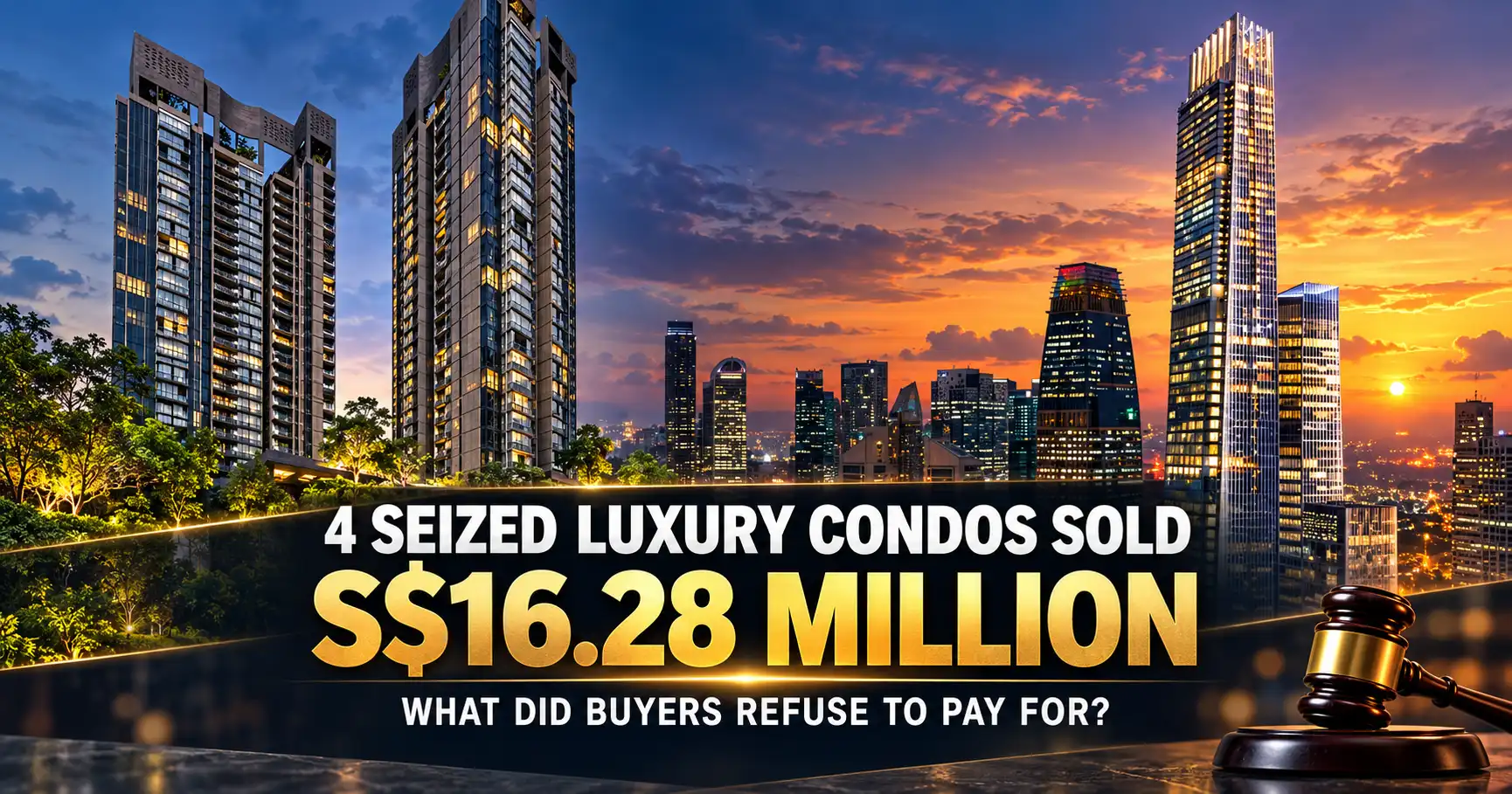
On 23 September 2026, SRI sold four apartments at Martin Modern and Wallich Residence for a combined S$16.28 million. Two 764 sq ft two-bedroom units at Martin Modern fetched S$2.12 million and S$2.08 million, while two four-bedroom apartments at Wallich Residence sold for S$6.6 million and S$5.48 million.
That sounds like a decisive improvement. But six of the ten apartments offered by SRI still went unsold, while the luxury residential units handled by another auction house that day attracted no bids.
The more useful question, then, is not simply why four properties sold.
It is this:
At what prices did buyers start acting—and what were they unwilling to pay for?
The answer provides a useful follow-up to our earlier analysis of the unsuccessful Gramercy Park auction. That auction suggested that some buyers wanted a visible discount before accepting the uncertainty and inconvenience of an auction purchase.
The Martin Modern and Wallich Residence results refine that conclusion. Buyers did not always need a deep discount to transact. But they strongly resisted paying more than recent resale evidence justified.
What Was Sold?
The four successful auction sales were:
| Development and unit | Size | Opening price | Auction result | Approx. auction psf | Reduction from opening price |
|---|---|---|---|---|---|
| Martin Modern #26-xx, 2BR | 764 sq ft | S$2.238m | S$2.12m | S$2,775 psf | S$118,000 / 5.3% |
| Martin Modern #17-xx, 2BR | 764 sq ft | S$2.238m | S$2.08m | S$2,723 psf | S$158,000 / 7.1% |
| Wallich Residence #61-xx, 4BR | 1,991 sq ft | S$6.78m | S$6.60m | S$3,315 psf | S$180,000 / 2.7% |
| Wallich Residence #53-xx, 4BR | 1,658 sq ft | S$5.55m | S$5.48m | S$3,305 psf | S$70,000 / 1.3% |
Sale prices were below their respective opening prices, but discounts varied considerably. The Martin Modern buyers secured reductions of about 5% to 7% from the opening price. The Wallich Residence buyers paid only 1% to 3% below the opening price.
That does not necessarily mean Wallich Residence buyers were less price-sensitive. Its opening prices were already much closer to the level supported by the project’s recent four-bedroom transaction.
Martin Modern: Buyers Rejected S$2.238 Million, Not the Development
Four 764 sq ft two-bedroom apartments at Martin Modern were offered with the same opening price of S$2.238 million, equivalent to approximately S$2,929 psf.
The bidding pattern was revealing.
For #26-10 on the 26th floor, the opening price initially produced silence. Bidding began only after a participant offered S$2.05 million. Three more bids followed, and the apartment eventually sold for S$2.12 million.
The next 764 sq ft apartment, #29-05, attracted a highest offer of S$2.11 million but was withdrawn because the bid did not meet the reserve price.
The final successful Martin Modern unit, #17-06, received a single offer of S$2.08 million and was sold.
This establishes a fairly narrow zone of buyer acceptance:
Approximately S$2.08 million to S$2.12 million, or S$2,723 to S$2,775 psf.
How Does That Compare With Recent Martin Modern Resales?
The two most relevant recent transactions for 764 sq ft two-bedroom apartments were:
| Transaction | Floor range | Price | Approx. psf |
|---|---|---|---|
| September 2026 resale | 10th–20th floor | S$2.145m | S$2,808 psf |
| August 2026 resale | 10th–20th floor | S$2.10m | S$2,749 psf |
*Prices extracted from PropNex Investment Suite. Contact us to understand unit level and facing.
Against these transactions:
- The S$2.12 million sale was only S$25,000, or about 1.2%, below the September transaction. It was S$20,000, or about 1.0%, above the August transaction.
- The S$2.08 million sale was S$65,000, or about 3.0%, below the September transaction and S$20,000, or about 1.0%, below the August transaction.
These are not distressed-sale discounts.
They are broadly market-level transactions.
The real disconnect was between the S$2.238 million opening price and recent resale evidence. The opening price was about S$93,000 above the September transaction and S$138,000 above the August transaction—premiums of approximately 4.3% and 6.6%, respectively.
That is the first important answer to the title question.
Buyers did not refuse to pay for Martin Modern. They refused to pay close to S$2.24 million, while recent buyers paid between S$2.10 million and S$2.145 million for the same unit size.
The Unsold 29th-Floor Unit Reveals a Different Problem
The withdrawn #29-05 apartment may be the most informative Martin Modern result.
Its highest bid was S$2.11 million—almost exactly between the two successful sale prices and within the range of the latest resale transactions. Yet it did not sell because it did not meet the reserve price.
This tells us that buyer demand and a completed sale are not the same thing.
The market produced a bid. The buyer’s price was not obviously unreasonable. The transaction failed because the seller’s minimum acceptable level remained higher.
It also shows why auction clearance rates can understate demand. A withdrawn property may still have attracted a credible market-level offer; the seller and buyer simply did not meet.
Wallich Residence: Two Buyers Independently Arrived at About S$3,310 psf
The Wallich Residence sales produced an even cleaner price signal.
The 1,991 sq ft #61-02 apartment on the 61st floor opened at S$6.78 million. The first offer came in at S$6.4 million, followed by bids of S$6.5 million and S$6.6 million. The unit sold at approximately S$3,315 psf.
The 1,658 sq ft #53-01 apartment opened at S$5.55 million. Bidding began at S$5.3 million before rising through several bids to S$5.48 million, or approximately S$3,305 psf.
Despite a difference of 333 sq ft and S$1.12 million in absolute price, both buyers landed at almost the same rate:
About S$3,310 psf.
That figure becomes more meaningful when compared with the latest relevant four-bedroom resale transaction at Wallich Residence.
In December 2025, a 1,722 sq ft four-bedroom apartment changed hands for S$5.7 million, or approximately S$3,310 psf.
| Wallich Residence comparison | Size | Price | Approx. psf |
|---|---|---|---|
| December 2025 4BR resale | 1,722 sq ft | S$5.70m | S$3,310 psf |
| Auction sale #61-xx | 1,991 sq ft | S$6.60m | S$3,315 psf |
| Auction sale #53-xx | 1,658 sq ft | S$5.48m | S$3,305 psf |
*Prices extracted from PropNex Investment Suite. Contact us to understand unit level and facing.
The three prices are almost perfectly aligned on a per-square-foot basis.
This means the two successful Wallich Residence buyers did not obtain a large discount to the latest four-bedroom resale benchmark. They paid approximately market psf.
They rejected the premium embedded in the opening prices.
For #61-02, the opening price was approximately S$3,405 psf. Bidding became meaningful only after the first offer came in at S$6.4 million, before competition pulled the final price back to S$6.6 million.
For #53-01, the opening price was approximately S$3,347 psf. The first participant offered S$5.3 million, and competitive bidding eventually established S$5.48 million as the clearing price.
The auction did not create an arbitrary bargain. It brought both units back towards a resale benchmark the market already recognised.
Why Did the S$6.6 Million Apartment Sell Despite Its Higher Quantum?
Our previous article argued that luxury demand becomes more discretionary as the purchase quantum rises. That remains true, but #61-02 shows that rarity can offset some of that price resistance.
The apartment occupies the 61st floor, directly below the super penthouse, and offers sea and city views. These are attributes that cannot easily be replicated by buying another unit on a lower floor.
The buyer therefore accepted a S$6.6 million quantum, but did not pay a large psf premium for the rarity. The final S$3,315 psf was still almost identical to the December 2025 four-bedroom resale benchmark.
That balance may explain the result:
- The unit was sufficiently rare to justify committing S$6.6 million.
- The buyer remained disciplined enough to anchor the price close to recent market evidence.
In other words, rarity helped the unit sell. It did not give the seller unlimited pricing power.
What Do the Two Unsold Wallich Residence Units Tell Us?
The two remaining Wallich Residence apartments received no bids.
One was a 1,755 sq ft four-bedroom unit on the 54th floor, offered at S$5.9 million, or approximately S$3,362 psf.
That is only about 1.6% above the S$3,310 psf four-bedroom benchmark. Applied to 1,755 sq ft, S$3,310 psf would yield about S$5.81 million—about S$90,000 below the opening price.
That is not a very large numerical gap. But the lack of a bid suggests buyers did not see enough reason to start at S$5.9 million. The 61st-floor apartment had a clear rarity story. The 54th-floor unit still had to compete against other resale alternatives, and an opening price slightly above the established benchmark offered little visible auction upside.
The other unsold apartment was a 1,313 sq ft three-bedroom unit on the 51st floor, offered at S$4.42 million, or approximately S$3,366 psf.
Recent three-bedroom transactions provide a much lower reference range:
| Recent Wallich Residence 3BR resale | Size | Price | Approx. psf |
|---|---|---|---|
| March 2026 | 1,195 sq ft | S$3.25m | S$2,720 psf |
| March 2025 | 1,679 sq ft | S$4.88m | S$2,906 psf |
*Prices extracted from PropNex Investment Suite. Contact us to understand unit level and facing.
The auction unit’s opening rate was therefore about 15.8% above the S$2,906 psf transaction and about 23.8% above the S$2,720 psf transaction.
These are not exact like-for-like comparisons. Floor level, layout, orientation, view, condition and transaction timing can materially affect value at Wallich Residence. Nevertheless, an opening price of S$3,366 psf required buyers to accept a substantial premium to the available three-bedroom resale evidence.
No one did.
Buyers Did Not Apply One Fixed “Auction Discount”
This is the most important difference from the earlier Gramercy Park auction.
At Gramercy Park, the highest bid for a 2,659 sq ft four-bedroom apartment was S$6.7 million—about 10.7% below two comparable S$7.5 million transactions. That suggested bidders wanted a meaningful margin before taking action.
The latest auction shows that there is no universal 10% rule.
- At Martin Modern, buyers transacted within roughly 1% to 3% of the latest comparable resale prices.
- At Wallich Residence, the two successful purchases matched the latest four-bedroom benchmark almost exactly on a psf basis.
- Where the opening price required a premium without an equally compelling unit-specific advantage, buyers either bid lower or did not bid at all.
The required discount therefore depends on more than the fact that a property is being sold at auction.
It depends on liquidity, purchase quantum, the strength of comparable evidence, the unit’s rarity, its physical condition and the number of realistic alternatives available to the buyer.
What, Exactly, Did Buyers Refuse to Pay For?
The results point to four conclusions.
1. They refused to pay an unsupported premium to recent resale prices
Martin Modern’s S$2.238 million opening price was above the two latest comparable two-bedroom transactions. Buyers only became active after the price moved back towards S$2.1 million.
At Wallich Residence, the two completed sales converged around S$3,310 psf—the same level as the December 2025 four-bedroom resale.
2. They refused to treat an auction guide as proof of value
An opening price starts the conversation. It does not establish market value.
Bidding at Martin Modern began below the opening prices. The same happened for both successful Wallich Residence apartments. Buyers effectively used the auction to negotiate the properties back towards levels they considered fair value.
3. They refused to pay for rarity unless the rarity was obvious
The 61st-floor Wallich Residence apartment had a strong scarcity argument: very high floor, sea and city views, and a position immediately below the super penthouse.
The market rewarded those qualities with a sale, but still kept the price close to the project’s recent four-bedroom psf benchmark.
The unsold 54th-floor four-bedroom apartment did not receive the same response at S$3,362 psf.
4. They refused to confuse interest with urgency
More seized properties are expected to be released progressively through mid-2027. Buyers know that additional opportunities are coming.
Unless a unit is genuinely rare or attractively priced, there is little reason to stretch today. A buyer can bid below the guide, wait for private negotiations, consider another auction or purchase a conventional resale unit instead.
Does the Connection to the Money-Laundering Case Matter?
The four successful sales suggest that the connection itself did not prevent transactions.
When buyers saw a defensible price—and, in the case of #61-02, a rare unit—they acted. The stigma of the seizure was not enough to stop the sale.
But the background didn’t make the properties automatically attractive.
Buyers still evaluated the fundamentals:
- What have comparable units actually sold for?
- Is this particular floor, stack or view worth more?
- What is the apartment’s condition?
- How much renovation or rectification may be required?
- Is there enough upside to justify buying through an auction?
The auction story may bring people into the room. It does not make them abandon their valuation discipline.
Our Assessment
The S$16.28 million of sales should not be read as evidence that buyers suddenly became comfortable paying the auction guides.
They did not.
At Martin Modern, action began only after bids moved from S$2.238 million towards the S$2.1 million level supported by recent resales. The successful prices of S$2.08 million and S$2.12 million were close to normal market evidence, not spectacular bargains.
At Wallich Residence, two different buyers arrived at virtually the same S$3,310 psf level already established by the latest four-bedroom resale transaction. Even the rare 61st-floor unit did not command a major premium on a psf basis.
The properties that failed to sell are equally revealing. Buyers would not automatically pay S$3,362 psf for a 54th-floor four-bedroom unit simply because another apartment on the 61st floor was rare. Nor would they accept S$3,366 psf for a three-bedroom apartment when recent three-bedroom evidence sat materially lower.
The market was not rejecting seized properties.
It was rejecting prices that did not offer enough value relative to ordinary resale alternatives.
That may be the central lesson for the remaining assets still to come. The authorities do not need to create a fire sale. But if the opening prices leave buyers without a clear discount, a strong comparable justification or a genuinely irreplaceable feature, many bidders will simply wait.
And in a luxury market where buyers have no shortage of alternatives, waiting costs them very little.
Disclaimer: This article is provided for general information and commentary only and should not be regarded as financial, investment, legal or property advice. The analysis is based on publicly reported auction results and transaction data available at the time of writing. Comparisons are not necessarily like-for-like, and property values may vary according to floor level, orientation, view, layout, condition, renovation, transaction timing and other factors.
Article contributed by Jerry Wong.
 Jerry Wong is a realtor at Propnex Realty, bringing a rich background in interior and lighting design to his work. He loves exploring diverse spaces and observing the transformative power of real estate. Beyond his professional role, Jerry finds his greatest fulfillment in connecting people with the right properties, gaining immense satisfaction from helping clients achieve their dreams.
Let’s Discuss Your Property Plans
Interested in This Property?
Buying, selling or renting? Get a free consultation with realtors with a background in interior and lighting design. We’ll discuss your goals and help you assess your options—from pricing and timelines to layout practicality and space potential.
Share your contact details below, and we will get in touch to understand your needs and suggest the next steps. No pressure. No obligation to proceed.