
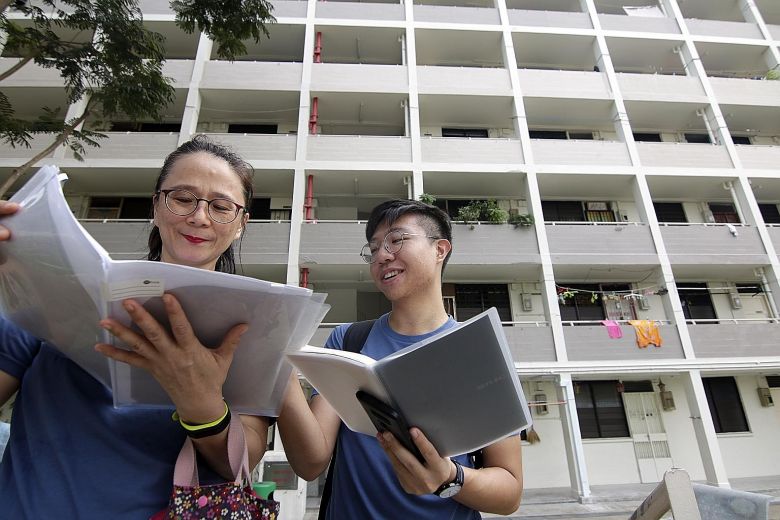
Units in Stirling Road are among the first homes built by HDB
Singapore’s oldest town is undergoing rapid development and redevelopment. By 2027, more than 5,000 new homes could be launched in Queenstown, according to details from an upcoming traffic study of the area.
In the light of the estate’s property resurgence, a group is looking to save the first homes ever constructed by the Housing Board in Stirling Road, as HDB marks its 60th anniversary next year.
Civic group My Community has submitted a 34-page heritage assessment report on rental blocks 45, 48 and 49, and the HDB terrace apartments at 41-44, 46-47, 50, 52-53 and 55-58 Stirling Road, to the Urban Redevelopment Authority (URA).
Its goal: to get these buildings, which were constructed between 1959 and 1963, conserved.
The aim is to also provide thorough information about these buildings to have them factored into the Government’s plans early on.
Responding to queries from The Sunday Times, a URA spokesman said that the agency will consider suggestions from My Community as and when there are future plans for the area.
She said that URA has, over the years, taken into account the heritage significance of several sites in the estate, as well as feedback from My Community. She gave examples of how several places, including the seven-storey Princess House in Alexandra Road, the first dedicated headquarters of HDB, were gazetted for conservation in 2007.
Speaking to The Sunday Times, My Community founder Kwek Li Yong said that Singapore’s first HDB flats and terrace apartments possess exceptional local and national historical significance.
For one thing, they marked the start of the nation’s housing revolution after achieving self-governance in 1959. “They demonstrate the modernisation of Singapore’s housing landscape from kampung to high-rise,” he said.
In its early years, he said that HDB designed shelter for the poor through the construction of low-cost housing units often built close to the city centre, in estates such as Queenstown, to minimise occupants’ transportation costs.
The economic viability and success of the public housing strategies in Queenstown guided the eventual development of public housing in other new towns around Singapore, added Mr Kwek.
According to architecture researcher Jeremy John Kum, 24, who helmed the assessment project, the buildings have exceptional aesthetic merit and are representative of the utilitarian and functional nature of early-1960s HDB flats during Singapore’s nation-building years.
For instance, the design of the homes was economical in nature, with minimal facilities, low ceilings and lifts that did not stop at every floor, so as to reduce construction costs.
The report notes that the terrace apartments can be seen as a transitional housing model from occupants’ kampung and squatter settlements with a front and backyard.
Over the past decade, My Community has been working closely with Queenstown residents, capturing their stories and helping to craft papers and petitions to save key structures there. Its work has contributed to the conservation of three landmarks so far: Alexandra Hospital, Queenstown Public Library and the former Commonwealth Avenue Wet Market.
Dr Yeo Kang Shua, an architectural conservation specialist and president of the International Council on Monuments and Sites, Singapore, said that although the blocks have been left untouched so far because of the demand for rental homes, it might be timely for the authorities to consider conserving the blocks and apartments.
Dr Yeo said: “These flats may be architecturally simple but they have their role in history. It is important to retain a bit of building stock from each era of our past.”
My Community believes that upon conservation, the units can continue to serve as accommodation. When their leases expire, they can be converted into student hostels and a heritage museum.
Mr Kwek said: “Very few physical structures in Singapore interweave national narratives and everyday common man experiences.
“With over 80 per cent of Singaporeans living in public housing apartments, the first HDB flats can be considered a symbol of pride and nationhood, as well as a defining and ubiquitous characteristic of Singaporean society.”
“Source:[Civic group seeks to conserve flats in Queenstown] © Singapore Press Holdings Limited. Permission required for reproduction”
Let’s Discuss Your Property Plans
Interested in This Property?
Buying, selling or renting? Get a free consultation with realtors with a background in interior and lighting design. We’ll discuss your goals and help you assess your options—from pricing and timelines to layout practicality and space potential.
Share your contact details below, and we will get in touch to understand your needs and suggest the next steps. No pressure. No obligation to proceed.