
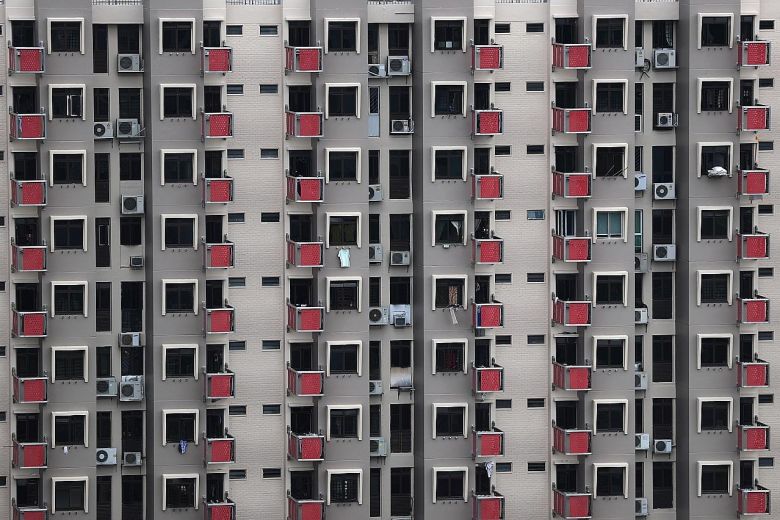
Once seen as luxuries, air-cons, Net access may now be essentials as more have them
The seven wall-mounted fans spread around Madam Haisah Kamarudin’s two-room flat are next to useless on hotter days.
“I want an air-conditioner, but the cheapest I can find is about $1,000,” said the 38-year-old housewife whose husband – a building maintenance officer – is the sole breadwinner for her family of eight. “This is a wish I know I cannot have.”
Madam Haisah’s family is among the 75 per cent of households in one-and two-room flats that do not own air-conditioning systems.
However, according to the latest Household Expenditure Survey carried out in 2017 and last year, and published last Wednesday, this percentage has shrunk from 86 per cent in the 2012/13 survey, as living standards improve.
Retired cleaner Kek Ah Suan, 66, who lives with her husband in their two-room flat, had air-conditioning installed in their bedroom about a decade ago. Without it, she finds it difficult to sleep.
“Even with the fan switched on, it’s very warm. Just walking to the kitchen and back makes me sweaty. I’d have to shower more often without it,” she said in Mandarin.
The couple spend about $100 on electricity a month. The bill drops to about $80 if they turn off the air-conditioning at night, but the extra cost is worth it, Madam Kek said.
Meanwhile, mobile phone ownership is almost universal, with 98 per cent of all households having mobile phones, including more than 90 per cent of those with lower incomes and smaller homes.
Internet subscriptions more than doubled from 22 per cent to 45 per cent for people living in one-room and two-room Housing Board flats.
While this reflects an increased standard of living, it also raises concerns about income inequality and whether or not such things – once considered luxuries – are now basic essentials.
Associate Professor Teo You Yenn, head of sociology at Nanyang Technological University, said ordinary Singaporeans feel basic needs go beyond just staying alive, but also allow people to make choices, feel respected and participate as others do in social activities. “Basic needs – what it takes to belong to society – change over time,” she said.
But Ms Anita Fam, president of the National Council of Social Service, noting finite resources, wondered how social service organisations can best help families in the bottom 20 per cent – the only group for which expenses exceed income.
This is despite the fact that government support, like the Workfare Income Supplement, made up nearly half of the annual household income per member in this group.
“How do you help convince families who are stretched for cash to reprioritise their spending on essentials such as food, transport and education rather than on mobile plans and electricity bill payments for air-conditioners? That is the work at hand,” said Ms Fam.
Singapore will need to review wages and wealth redistribution through taxation and social spending to ensure that everyone has sufficient income to meet his basic needs, Prof Teo said.
MPs in wards with rental blocks, which comprise one- and two-room flats, offered other solutions.
Dr Lily Neo of Jalan Besar GRC said the results may suggest that “government schemes need another tweak”. But she added that the broad areas – such as housing, education and medical care – are covered, and noted that the maximum annual payouts under the Workfare Income Supplement scheme, which helps lower-paid workers, will be increased by up to $400 a year from next year.
Internet access is critical for schoolchildren, Mountbatten MP Lim Biow Chuan believes. He said he will try to help underprivileged families to stay connected.
He said the “only way” to improve their circumstances is to teach them skills relevant for evolving jobs, adding: “I won’t pretend it is easy, and we have to try and help them. But with hard work, you can make a difference in your life.”
“Source:[Higher living standards raise issue of basic needs] © Singapore Press Holdings Limited. Permission required for reproduction”



Let’s Discuss Your Property Plans
Interested in This Property?
Buying, selling or renting? Get a free consultation with realtors with a background in interior and lighting design. We’ll discuss your goals and help you assess your options—from pricing and timelines to layout practicality and space potential.
Share your contact details below, and we will get in touch to understand your needs and suggest the next steps. No pressure. No obligation to proceed.