

Industry-academia collaboration, retaining natural assets are key aspects of future district
John, a student, steps out from his waterfront Punggol North flat and onto his personal mobility device, before zipping along a lush, green trail to his school, the Singapore Institute of Technology (SIT).
Over coffee, he presents a new idea to his project mentor, an innovator at a renowned cyber-security firm. As they brainstorm, the pair get to enjoy views of Coney Island.
John’s experience is a sneak preview of life in the Punggol Digital District (PDD), as envisioned by project manager Chan Ee Mun, 43.
Industry-academia collaboration is a main thrust of the project, said Mr Chan, who is overseeing the development of PDD.
But challenges were unavoidable. One was retaining Punggol’s natural features, an incongruence when one imagines a high-tech digital district. Another was for the many stakeholders to march to the same beat in such a large-scale project.
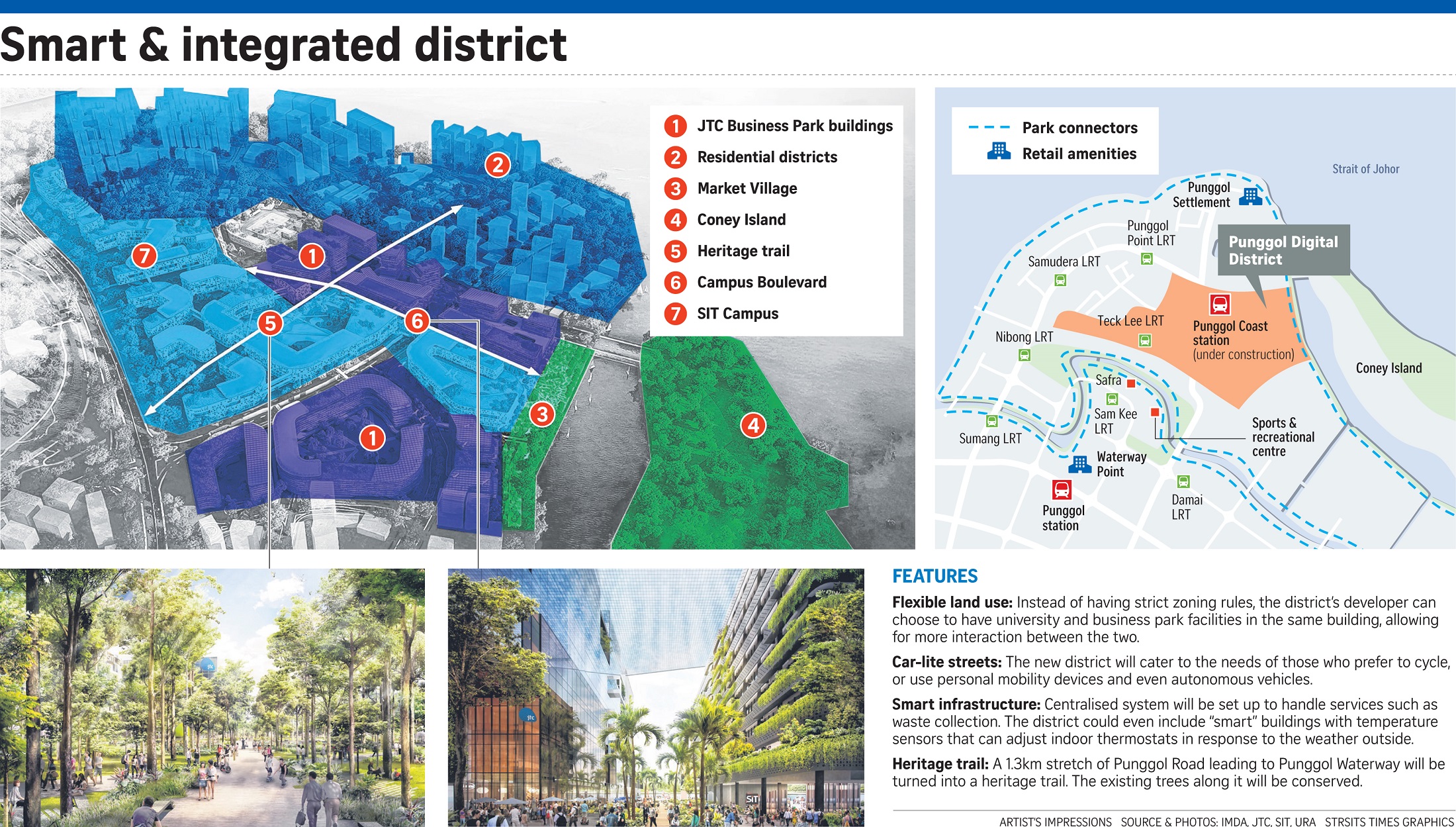
The project, whose masterplan was unveiled last month, will consist of a JTC Corporation business park, SIT and community facilities such as a hawker centre and a community club.
INTERACTION BETWEEN SPACES TO CREATE BUZZ
The benefits of collaboration between industry and academia are clear, said Mr Chan, a director at architecture firm Woha, which was engaged by SIT and master developer JTC for the project’s masterplan.
But to actively foster this relationship from the onset into a district-level project is unprecedented here.
Mr Aaron Tham, JTC’s director of new estates division, called it a “holistic planning approach”, where innovative platforms can be designed and integrated “right from the start”.
Mr Chan’s team of 18 architects is creating spaces to facilitate interaction. “The success of this project is going to be measured by how vibrant all these community spaces are going to be,” he said.
One of the landmark ideas for the project is the “exchange” of spaces.
For example, an SIT class could be on JTC premises, and students can tinker with the latest industry tools and mingle with start-up founders.
There will also be public spaces where entrepreneurs can test or promote their products.
Mr Tham hopes this “conducive test-bed environment” can enable businesses to thrive in a digital economy. He added that enterprises can tap SIT’s strengths in areas such as digital and cyber security, design, engineering and food technology.
Mr Chan said: “We are creating an environment to trigger ideas and creativity by making activities visible.”
He is also cognisant of Punggol’s “important natural assets”. “It will be a shame if we were to develop without retaining and enhancing these assets,” said Mr Chan.
He added the PDD is unique in that nature lovers will not only be surrounded by lush landscaping, but also be able to take a break “every 200m to 300m” to have a drink or meal, which caters for families with young children.
The project’s current 50ha may well be expanded in future and become a place of work and play for hundreds of thousands of people.
Mr Chan said the undertaking is no mean feat, with more than 10 stakeholders on board. “The biggest challenge is to corral the stakeholders so that we can move towards national objectives and aspirations for the district,” he said.
Mr Tham said even as boundaries are being pushed, the needs of the various stakeholders ought to be considered so as to develop an optimal plan.
Mr Chan said: “For this district to be successful, there is a need for community spaces. But what is the right budget? At the end of the day, you are generating intangible benefits.
“We had to find the right balance – what we don’t want is fantastic community amenities but poorly constructed or finished buildings… You want the best of both worlds.”
Despite the difficulties, Mr Chan is pleased at how fast the project is progressing, with the first buildings due to be completed in about five years’ time.
“It is a development that allows you to grow with it. It is the right development – and the right place.”


Let’s Discuss Your Property Plans
Interested in This Property?
Buying, selling or renting? Get a free consultation with realtors with a background in interior and lighting design. We’ll discuss your goals and help you assess your options—from pricing and timelines to layout practicality and space potential.
Share your contact details below, and we will get in touch to understand your needs and suggest the next steps. No pressure. No obligation to proceed.