
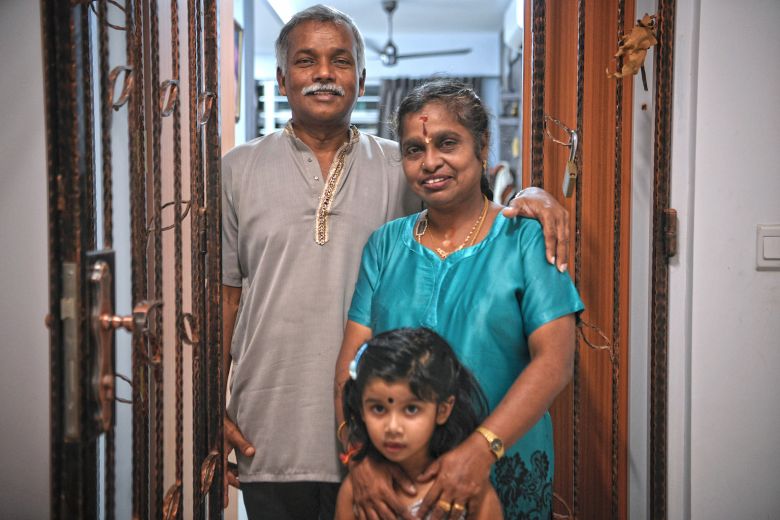
Those from rental flats in Marsiling block largely positive, others have some misgivings
Up till the end of last year, Madam Noma Salam, 51, lived in a densely packed block of rental flats in Champions Way, Woodlands, where she had to put up with problems from her neighbours, such as domestic quarrels and fights in the early hours of the day, on a daily basis.
“It wasn’t peaceful at all, and because there were so many problems, people from purchased flats in the neighbourhood looked at us differently. If I smiled at them, they won’t even smile back. It was as if there was a label on your forehead,” said Madam Noma, a housewife.
Last November, she moved into the only housing block in Singapore that mixes both rental and purchased flats – Build-To-Order (BTO) project Marsiling Greenview in Woodlands Street 13.
It has become much easier to maintain a semblance of normalcy in the mixed block, said Madam Noma, whose husband works as a cleaning supervisor and is the family’s sole breadwinner. Their two children are aged 12 and 18.
The rental and purchased flats in the block are almost indistinguishable from each other, she noted, unlike those in her previous neighbourhood, where the rental block came with more basic fittings for things such as drying racks.
“I’ve come to feel very blessed. There’s ample space along the corridors and most people will return my greetings if I say ‘hi’ to them. Even the gates at my flat are made of wrought iron, just like the purchased flats here. You won’t see this at other rental flats,” she said.
Marsiling Greenview is one of three (BTO) projects that will mix rental and purchased units in the same block.
The other two projects that will feature such blocks – in Bukit Batok and Sengkang – are due to be completed in the next few years.
The initiative was part of a wider move to tackle growing inequality and stratification.
National Development Minister Lawrence Wong, who announced the move in March last year, said more of such integrated blocks will be built if feedback about the lived experiences is positive.
Rental flats typically cater to the lower-income, including those on social assistance. A household’s total gross monthly income must not exceed $1,500 to qualify for the Public Rental Scheme. The HDB ramped up the supply of rental flats from 42,000 units in 2007 to about 60,000 as of August last year.
An Institute of Policy Studies (IPS) study conducted in 2017 found that divisions along school and housing types are stronger than those across race and religion.
Policies that encourage more mixing along class lines can address a potential class divide in Singapore, said the study’s authors, which included IPS deputy director Gillian Koh and National University of Singapore (NUS) sociologist Tan Ern Ser.
About 60 per cent to 70 per cent of residents have moved into the integrated block in Marsiling Greenview, The Straits Times (ST) found on a recent visit, with most moving in about six to seven months ago.
The block consists of 42 one-and two-room rental flats and 241 two-and three-room purchased flats, with all the flats from the 10th level and above being purchased flats.
In a poll of 25 residents conducted by ST, eight said that the move was a positive one, while three others disapproved.
The three who were unhappy about the mix were from purchased flats, while all five rental residents polled were among the eight who applauded the move.
The rest of those polled – or 14 of them – were neutral about the move, with most saying it made little difference to their daily lives.
Driving instructor Rusydi Rostam, 30, who lives in a purchased flat, said he has made friends with a few parents in the block whose children go to the same school as his daughter. He does not pay attention to their housing type.
“It’s good that the housing situation here is diverse. We always talk about being one Singapore, and if we want to achieve that, there shouldn’t be any boundaries (between classes),” he said.
Madam Senthamizhselvi, 55, a temple executive who lives in a two-room purchased flat with her husband and daughter, also said mixing rental and purchased flats is a good move.
“I am friendly with a family in a rental flat, and we often chit-chat when we bump into each other. For instance, we will update each other on new shops that are opening in the neighbourhood. To me, there’s no difference between rental and purchased flats.”
Freelance translator Christopher Chiang, 45, however, said it is a bad idea to include rental flats in the block. “We have different goals in life – because those in rental flats are here only temporarily, they are more likely to dirty the area, while we want to have a clean and comfortable environment to live in,” said Mr Chiang, who bought a two-room flat.
Mr Simon Neo, 32, who works in logistics and lives on a floor that mixes rental and purchased flats, is also worried the presence of rental units may affect the price of his property if he wants to sell it.
Beyond casual interactions, such as exchanging a greeting when they bump into each other, just five of the 25 residents polled said they had forged closer ties with a neighbour from a different housing type.
A resident, who gave her name only as Irene, said she is in a WhatsApp chat group with about 40 residents who are all from purchased flats. They would host regular potluck gatherings during festivals such as Vesak Day and Hari Raya Puasa.
“Sometimes people would complain in the group about shouting and noise coming from the lower mixed levels. But I’m okay with mixing with (rental flat) residents. I’ve just not had a chance to meet or talk to them,” she said.
NUS’ Associate Professor Tan said putting people in close proximity is a necessary condition, but not a sufficient one, for facilitating social mixing.
“Much depends on whether residents across the sold-rental ‘divide’ harbour any negative stereotypes about one another,” he said. “If so, encountering one another may reinforce their stereotypes of one another, since prejudices would be the lens through which they view one another.”
But if they are given opportunities to encounter each other in contexts or activities where their common interests converge, these interactions could also address negative stereotypes and encourage the forging of social ties across classes, Prof Tan added.
For instance, there could be ground-up initiatives such as karaoke singing sessions or brisk-walking interest groups, or block parties, he said.
Residents like housewife Norsidah Ismail, who lived in a rental flat in Boon Lay before buying a unit in Marsiling Greenview, could potentially bridge the two groups together.
The 57-year-old is in the same WhatsApp group chat as Irene, and is also in another group chat with rental flat residents.
“Mixing can allow residents to help each other. Those living in rental flats can also see how it’s like to live in a purchased flat, encouraging them to buy their own flats in future,” she said.
“Source:[Mixed results in HDB block that mixes rental and purchased flats] © Singapore Press Holdings Limited. Permission required for reproduction”
Let’s Discuss Your Property Plans
Interested in This Property?
Buying, selling or renting? Get a free consultation with realtors with a background in interior and lighting design. We’ll discuss your goals and help you assess your options—from pricing and timelines to layout practicality and space potential.
Share your contact details below, and we will get in touch to understand your needs and suggest the next steps. No pressure. No obligation to proceed.