
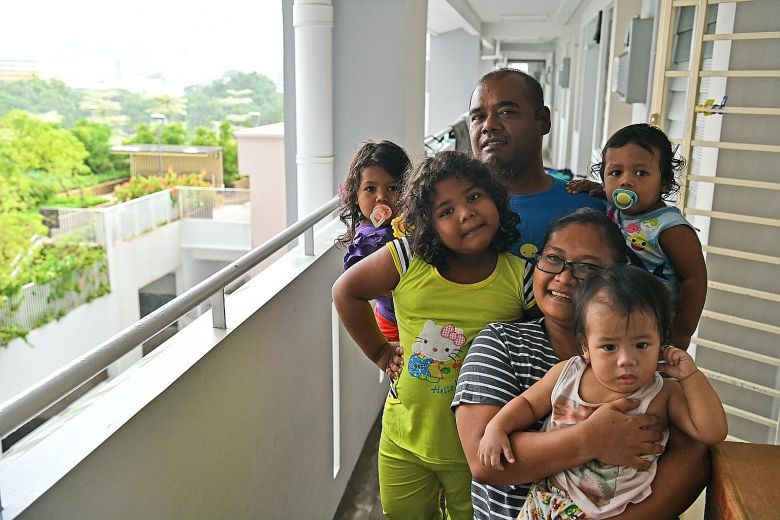
SINGAPORE – When she had to move from a condominium unit to a two-room rental flat after a divorce three years ago, Ms Sophia Hassan, 36, (not her real name) was apprehensive.
She worried about feeling isolated and segregated from the community and feared that the environment would not be good for her children due to negative influences like drugs or crime.
But after moving into Block 299B in Tampines Street 22, Ms Hassan – who works as an employment officer in a charity – realised her fears were unfounded.
People at the nearby market, for instance, treated her no differently from the rest even after finding out that she lives in a rental flat.
Her daughters, aged eight and nine, are also able to mix freely with neighbours when they take part in activities organised by a social service centre at the foot of the block.
The reason for this, believes Ms Hassan, is that hers is the only rental block in the neighbourhood – unlike older estates in Marine Terrace or Circuit Road, which may cluster a few rental blocks together in the same neighbourhood.
She said there is no “us-versus-them kind of mentality” when blocks are integrated into the community. “It’s similar to doing away with streaming in schools, where you have a mixture of students with different abilities in the same class.”
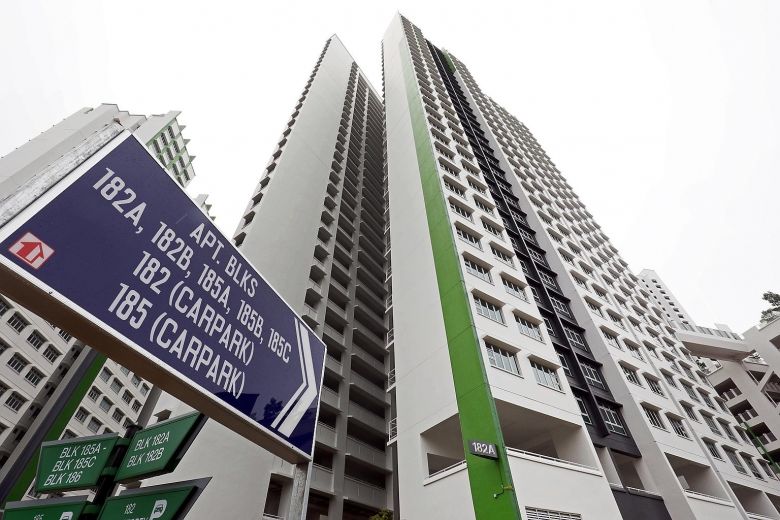
Hundreds of households, including Ms Hassan’s, have benefited from the Housing Board’s move to build blocks of rental flats alongside blocks of purchased units in various HDB towns since 2008. There are now more than a million HDB flats, including rental flats. HDB has ramped up the supply of rental flats from 42,000 units in 2007 to about 60,000 as of August this year.
To qualify for a rental flat under the Public Rental Scheme, a household’s total gross income must not exceed $1,500 a month.
Singapore’s housing and urban plans must continue to push back against the growing pressures of inequality and social stratification, National Development Minister Lawrence Wong said in Parliament in May. “We have been building more rental flats with newer, better designs alongside the sold flats in various HDB towns. This means that families grow up in the same neighbourhood and the residents share the same common areas and facilities,” he added.
The Straits Times understands that at least five rental blocks that are integrated into a neighbourhood have been built since 2008. Two are in Tampines, and the other three in Bishan, Punggol and Pasir Ris.
Family service centres, which provide support for families in need, tend to reap economies of scale when rental blocks are clustered together. But the Ministry of Social and Family Development said that its family service centres will coordinate with other help agencies in these precincts, where rental units may be more dispersed to ensure that support remains accessible.
Opportunities to encourage social mixing across classes, and reduce class stigma, are set to expand with Build-To-Order (BTO) project Marsiling Greenview in Woodlands Street 13, which was completed a few months ago. It is the only public housing project here that integrates rental and sold flat units in the same block, with two other BTO projects – in Bukit Batok and Sengkang – due to be completed in the next few years.
ST interviewed 20 residents of rental blocks that are integrated into the community and found mixed views about such attempts at integration. Nine of them believe that mixing has benefits.
Housewife Nuraini Jamalludin, 34, lives in rental block 410 Sin Ming Avenue with her family of six and is receiving social assistance. She said: “At the playground, we get to meet residents who are not facing the same financial predicament as us. They share with us how they managed to save and buy a house and it serves as a form of encouragement for us.”
The rest of the residents interviewed were either against such integration, or had mixed feelings.
Retiree Chow Yit Keong, 65, who has lived in Block 208A in Tampines Avenue 2 for the past five years, said he prefers living in a block that is filled with only rental flats.
“When you put poor people with poor people, we are more or less equal. But (when) you have money, you will look down on us when you move in with us, and will be more picky about things, like cigarette smoke drifting into flats and so on,” said the resident of a one-room flat.
Retiree Aishah Abdullah, 63, who has lived in a one-room flat in Block 121A Edgedale Plains in Punggol for the past two years, said she rarely has a chance to get to know residents in the same block, much less those from the neighbouring purchased flats. “Singaporeans are usually unfriendly and nobody wants to talk much,” she said.
Ms Aishah’s neighbour in the same block, housewife Dira Sulaiman, 25, feels that her rental block has disamenities despite being located next to purchased flats.
“At the playground, other kids from the rental block tried to take my five-year-old son’s scooter without permission, and we had other strange experiences, such as strangers approaching us for money on the way home.
“But if rental flats are mixed with purchased flats in the same block, maybe the environment will feel more positive and fewer incidents like this will happen,” said the mother of three children aged two months to nine years.
However, some feel uneasy about living close to rental blocks.
Senior therapy assistant Siti Khairunnisa, 33, who lives in a two-room flat at Block 299A Tampines Street 22, next to a rental block, plans to move out next year.
“We hear a lot of shouting at night and there have also been cases of suicide – I’m worried for my children and want to live in a better environment,” said the mother of three children aged four to eight.
But her neighbour in the same block, freelance typesetter Joyce Law, 43, begs to differ. “Problems can crop up whether you are in a rental or purchased flat. I don’t see any issue with being next to a rental block and we haven’t encountered any serious problems.”
Dr Leong Chan-Hoong, head of the Social Lab at the Institute of Policy Studies, said that while such integration of flats may not address the issue of inequality significantly, it can be the first step in reducing the stigma associated with rental flats.
More can be done to bring residents of rental and purchased flats in the same block or neighbourhood together, he said. For instance, ground-up efforts to solve common problems – from dengue fever outbreaks to traffic issues to housing defects – can bring residents together in a more meaningful way and normalise their relationships.
Said Dr Leong: “Rental housing should also be seen as being not just for those who are down and out, or stuck in their life circumstances, but rather thought of as a transient stage that people move in and out of.”
Taxi driver Judy Song, 60, for instance, is matter-of-fact about how she and her husband had to move to a rental flat in 299B Tampines Street 22 three years ago after her motor workshop and spa businesses ran into cash-flow problems.
She said: “I’ve lived in a terraced house, a condominium, and a Housing Board executive maisonette. A house is merely a roof over your head where you can sleep and seek shelter. As long as your home is clean, it doesn’t make a difference where you live.”
“Source:[Mixing rental and purchased flats: Some see mingling as means of bridging social divide, others oppose integration] © Singapore Press Holdings Limited. Permission required for reproduction”
Let’s Discuss Your Property Plans
Interested in This Property?
Buying, selling or renting? Get a free consultation with realtors with a background in interior and lighting design. We’ll discuss your goals and help you assess your options—from pricing and timelines to layout practicality and space potential.
Share your contact details below, and we will get in touch to understand your needs and suggest the next steps. No pressure. No obligation to proceed.