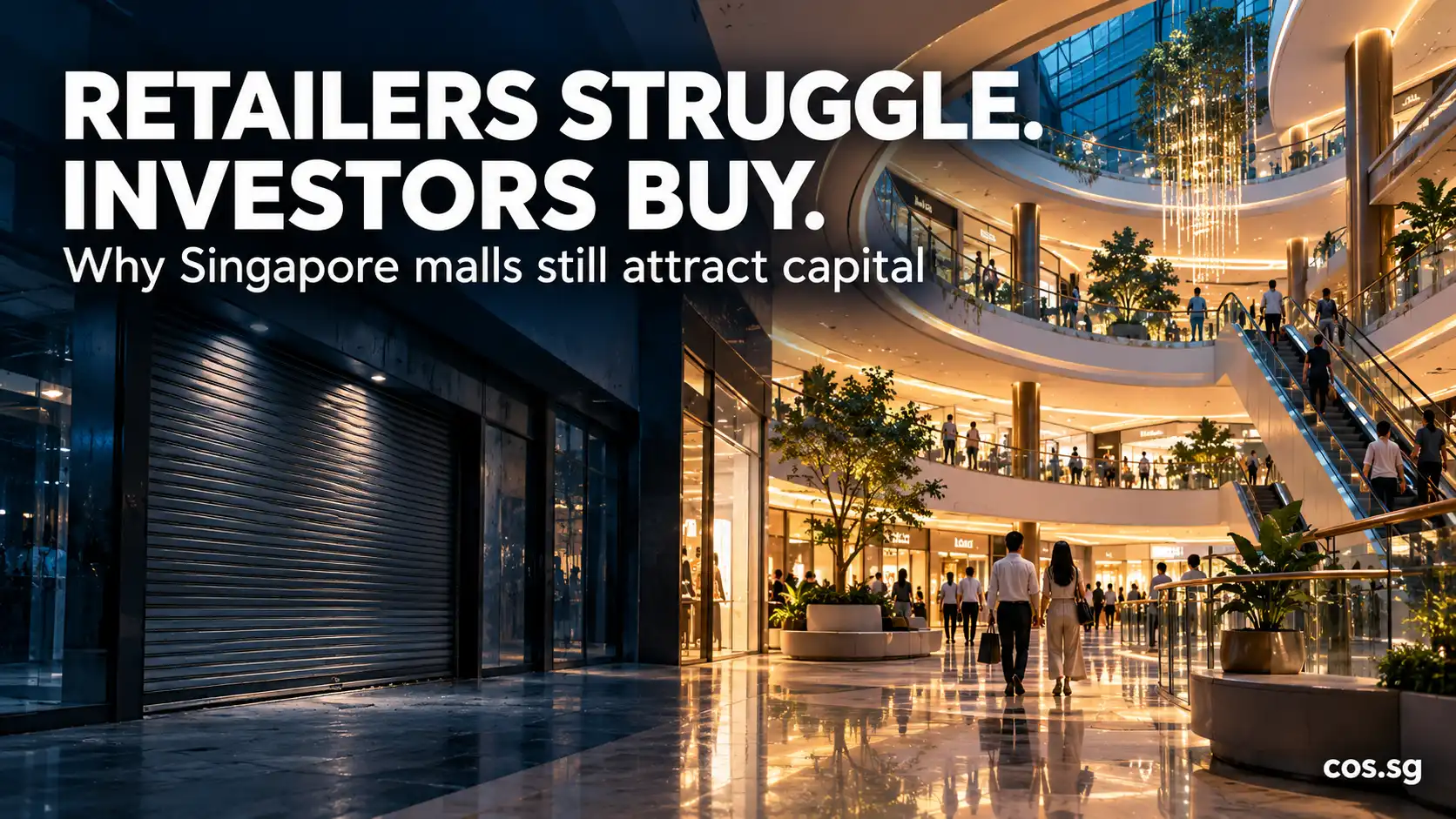
A shop closes, its signage comes down, and another brand prepares to move in. For the outgoing retailer, the closure may represent years of effort and a painful financial loss. For the mall owner, it may be a temporary interruption to rental income.
That difference helps explain an apparent contradiction in Singapore’s property market: retailers face pressure, yet investors continue buying the buildings they occupy.
According to The Business Times on 6 October 2026, property consultancies estimated that up to S$8 billion in Singapore retail assets had changed hands during the year to date. Its transaction list included Paragon at S$3.9 billion, Wheelock Place at S$1.1 billion and Rivervale Mall at S$276 million.
These purchases raise an obvious question. If running a shop is becoming harder, why does owning a mall still appeal?
The answer lies in the durability of rental income, the price investors pay for that income, and their ability to keep a property relevant. However, the investment case ultimately depends on tenants running sustainable businesses.
A retailer and a mall owner face different financial pressures
A retailer pays for rent, staff, inventory, utilities, marketing and other operating expenses. Sales can remain stable while profits decline because costs rise faster than revenue.
A mall owner receives rent from multiple businesses. Its income depends on occupancy, rental rates, collection and property operating costs.
This creates a degree of separation between an individual shop’s performance and the building’s performance.
One struggling tenant does not necessarily undermine an entire mall. If another business wants the space and can support a similar rent, the landlord may preserve much of its income over time.
But replacement comes at a cost. Vacant periods, leasing commissions, rent-free fitting-out periods and works to reconfigure a unit can reduce the financial benefit of signing a new tenant.
The useful distinction is between a mall that can replace tenants on sustainable terms and one that repeatedly fills space through concessions.
Both may appear busy. Their income quality can differ significantly.
Store closures do not describe the whole market
Retail conditions also vary considerably between locations, trades and operators.
Frasers Centrepoint Trust’s results for the six months ended 31 March 2026 illustrate this. Its retail portfolio reported committed occupancy of 99.8%, while shopper traffic increased 1.8% and tenant sales rose 3.2% year on year. Average rental reversion was positive at 6.5% on an average-to-average basis. These are portfolio figures for that reporting period, rather than a measure of every Singapore mall.
The figures show why investors may remain interested even when individual closures attract attention. Some portfolios can sustain leasing demand and growing sales despite difficulties elsewhere.
They do not establish that every tenant is becoming more profitable. Sales growth must still cover changes in wages, rent and other expenses.
Similarly, committed occupancy includes space covered by signed leases; it should not automatically be read as the percentage of shops already open and generating full rental income.
For investors, occupancy is a starting point. The strength of the businesses behind those leases matters too.
The appeal improves when financing becomes cheaper
The report identified the relationship between property yields and borrowing costs as another reason for investor interest. Consultants cited broad net yield estimates of around 4%–5% for retail assets, compared with approximately 3%–4% for Grade A offices.
Those ranges are market observations, not guaranteed returns. Individual properties differ in lease tenure, condition, tenant mix and capital expenditure requirements.
Nevertheless, the financing logic is straightforward. When a property earns more than the cost of its debt, borrowing can increase the income return on the investor’s equity.
Consider a hypothetical S$100 million mall producing S$4.5 million in annual net property income. Assume the purchase is funded with S$50 million of equity and S$50 million of interest-only debt.
| Illustrative scenario | Annual net property income | Interest rate | Annual interest | Income after interest | Return on S$50m equity* |
|---|---|---|---|---|---|
| Base case | S$4.50m | 3.0% | S$1.50m | S$3.00m | 6.0% |
| Property income falls 10% | S$4.05m | 3.0% | S$1.50m | S$2.55m | 5.1% |
| Borrowing rate rises | S$4.50m | 4.0% | S$2.00m | S$2.50m | 5.0% |
Illustrative income return before acquisition costs, tax, fund or corporate expenses, capital expenditure and principal repayments. These assumptions are not financing quotations or forecasts.
The calculation explains both the attraction and the vulnerability. An income-producing mall can offer an appealing return when financing is favourable. Weaker property income or more expensive debt reduces that return.
Actual borrowing costs also differ between buyers. Existing loans, hedging arrangements and refinancing dates determine how quickly lower market rates benefit an owner.
Investors are buying a location they can adapt
A mall’s appeal extends beyond its current list of tenants.
A property serving a substantial residential catchment, with convenient transport access and a useful mix of shops and services, may attract customers even as individual brands change.
That gives an owner options. It can replace an underperforming retailer, divide a large unit, combine smaller units or introduce uses that better match local demand, subject to approvals and physical constraints.
The ability to coordinate these changes across a whole mall is valuable. An owner can assess how a supermarket, clinic, restaurant or enrichment centre contributes to visits and spending elsewhere in the property.
However, adaptation requires investment. New layouts, building services, accessibility improvements and tenant relocation can absorb substantial capital.
A buyer therefore needs to assess the income achievable after these costs and disruptions. A proposed refurbishment only creates value if its eventual benefits justify the money spent.
Higher retail yields come with more operating work
A higher yield can compensate investors for uncertainty and management demands.
Retail landlords must continually assess customer preferences, tenant sales, competing destinations and the balance between different trades. A popular concept today may lose its appeal before the next lease renewal.
Rents can also rise only so far ahead of tenant performance.
Suppose a shop’s sales remain flat while its rent and staffing costs increase. It may initially absorb the pressure through a lower profit margin. Over time, it may reduce its space, seek cheaper premises or close.
The landlord can replace it, but the replacement must eventually make the economics work too.
This is why repeated tenant turnover deserves closer examination. It may reflect healthy renewal of a mall’s offering, or it may indicate that rental expectations exceed what businesses can sustain.
The strongest rental growth is supported by productive trading space and healthy tenant demand.
A whole-mall transaction does not establish the value of every shop
Individual property investors should also be careful about applying institutional mall transactions to small retail units.
A whole-mall owner can coordinate leasing, marketing, circulation and refurbishment. A strata-shop owner usually has much less control over the surrounding tenant mix and common areas.
A vacant unit in an otherwise weak development may remain difficult to lease even when prominent malls attract competitive bids.
Likewise, a national transaction total measures capital changing hands. It does not establish that every retail location is improving or that every acquisition price will deliver an attractive return.
The relevant comparison is with properties sharing similar catchments, ownership structures, lease conditions and operating characteristics.
The investment case depends on what happens after the purchase
Investors can rationally buy malls while some retailers struggle. Diversified rental income, desirable locations, opportunities to improve a property and favourable financing can all support an acquisition.
But landlords and tenants remain financially connected. Persistent pressure on shop profitability eventually affects leasing demand, rent collection or the incentives needed to maintain occupancy.
For buyers, the decisive question is whether the purchase price leaves enough room for tenant turnover, maintenance, refurbishment and changes in financing costs.
A well-bought mall can remain resilient as its shops evolve. A fully occupied mall bought on overly optimistic assumptions can still disappoint.
The most convincing investment case is one in which tenants can trade sustainably, the landlord can maintain the property, and the buyer can earn an acceptable return without depending on uninterrupted rental growth.
Disclaimer: This article is for general information and discussion only and does not constitute financial, investment, legal or tax advice. Market figures and transaction details are based on sources available at the time of writing and may be revised. The financial examples are illustrative, rely on simplified assumptions and do not represent actual financing terms or projected returns. Individual property performance will vary with purchase price, tenancy conditions, operating costs, capital expenditure and financing arrangements. Readers should independently verify relevant information and seek professional advice before making an investment decision.
Article contributed by Jerry Wong.
 Jerry Wong is a realtor at Propnex Realty, bringing a rich background in interior and lighting design to his work. He loves exploring diverse spaces and observing the transformative power of real estate. Beyond his professional role, Jerry finds his greatest fulfillment in connecting people with the right properties, gaining immense satisfaction from helping clients achieve their dreams.