
Tides, storm surges among host of factors that will affect such planning, say experts
Climate change is causing sea levels to rise, and Singapore has already begun to stem the tide.
But it turns out that the seas are rising faster than previously thought.
Scientists have found that if warming continues unabated, sea levels may rise by several metres in the centuries ahead. Earlier estimates had said sea levels could rise by about 1m by 2100.
Severe sea-level events, which could overwhelm low-lying areas here, could also start happening once every year by around 2055 to 2065, instead of once a century.
These were among the grim projections released by the Intergovernmental Panel on Climate Change (IPCC) last month in a special report on the oceans and cryosphere – the frozen parts of the planet.
With the latest science indicating that the seas could be rising faster than expected, are Singapore’s measures enough?
A spokesman for the Ministry of the Environment and Water Resources (MEWR) said sea-level science is a complex and constantly advancing area of study.
“We are cognisant that sea-level projections, including the rate of increase, could change as science progresses,” he said, adding that Singapore’s approach is to keep its adaptation plans flexible and to constantly review them based on the latest science.
Prime Minister Lee Hsien Loong had in his National Day Rally speech in August said Singapore would have to spend $100 billion or more over 100 years to protect itself against rising sea levels.
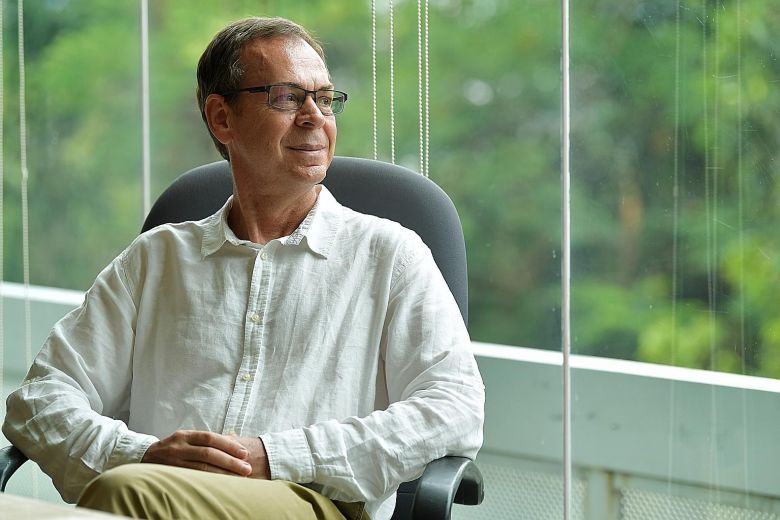
But Professor Benjamin Horton, a sea-level rise expert from Nanyang Technological University’s (NTU) Earth Observatory of Singapore, said the Republic must ensure the latest, most accurate sea-level rise projections are used when planning its coastal defences.
Earlier this year, the Government said it will channel $10 million into studying sea-level rise.
SEA-LEVEL SCIENCE
The need to protect coastlines from rising sea levels is clear. But what is less known is the extent to which they must be protected.
How high would extreme sea-level events go for Singapore? How tall should a seawall be built?
Much of this uncertainty boils down to the fact that how high sea levels will go depends on many different local factors.
The first is climate change. As humans burn fossil fuels and clear forests for development, heat-trapping gases like carbon dioxide are spewed into the atmosphere. The extra heat is stored in the oceans, leading to the thermal expansion of water. And as the oceans expand, sea levels rise, said Prof Horton.
But that is not all. As the world warms, ice on land – including the Antarctic ice sheet, the world’s largest frozen reservoir of water – melts. This raises sea levels the same way the water level in a glass rises when ice is added to it.
A key finding of the latest IPCC report is that if the amount of planet-warming emissions remains high, sea-level rise in the centuries ahead could exceed rates of several centimetres per year, instead of the current increase measured in millimetres per year.
This results in an overall multi-metre rise in sea level, and is more severe than what a 2014 IPCC report projected in a similar emissions scenario – that global mean sea level will rise by about 1m by 2100.
“Projections of global sea-level rise by 2100 are greater than in (the 2014 report) due to a larger contribution from the Antarctic ice sheet,” said the report.
But climate change-induced sea-level rise may impact different regions differently, and studies are needed to contextualise global estimates for local conditions – for example, Singapore’s, said Prof Horton.
Singapore Management University’s Associate Professor Winston Chow, a lead author for another upcoming report by the IPCC due to be released in 2021, said: “Sea-level rise is no longer a long-term threat. The horizon has shifted forward, and there is now greater likelihood of extreme events severely impacting Singapore’s coastline sooner.”
FROM ONCE A CENTURY TO ONCE A YEAR
Sea levels can also be impacted by other factors, such as tides and storm surges.
Extreme sea-level events are water level heights that consist of contributions from rising mean sea level, storm surges and tides.
Even if there is no change to tides and surges, an overall increase in mean sea level could increase the likelihood of flooding.
As a result, extreme sea-level events that were once historically rare, occurring once per century in the recent past, might occur at least once per year at many locations by 2050, warned the IPCC.
For a glimpse into how Singapore might be affected by such events in the future, one could look to its past flooding events, said Dr Wong Poh Poh, visiting associate professor at the University of Adelaide’s School of Social Sciences and Centre for Coastal Research.
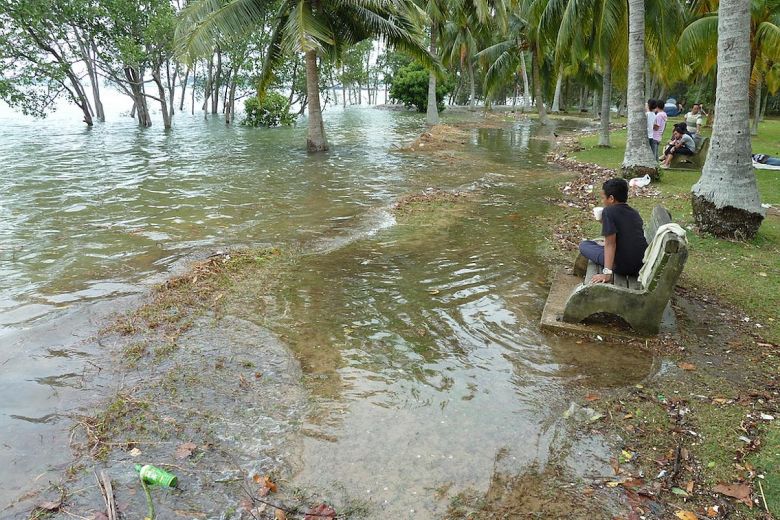
In 1974, 1999 and 2011, extreme high tides, known colloquially as king tides, had caused floods that inundated coastal areas, such as the East Coast and Pasir Ris parks, said Dr Wong, who has been studying the impact of tides on Singapore’s coast since the 1970s.
The 1974 extreme high tide, in particular, was the highest recorded tide at 3.9m. Seawater 1m high covered large tracts of the island. Nicoll Drive, which hugs the Changi Beach coastline, was reportedly under 1.5m of water.
Said Dr Wong: “King tides are useful to show the impact of future sea-level rise. The situation could worsen if these extreme high tides coincide with heavy rainfall or storms.”
Even in the absence of king tide events, there are low-lying parts of Singapore more susceptible to tidal influence than others, he said.
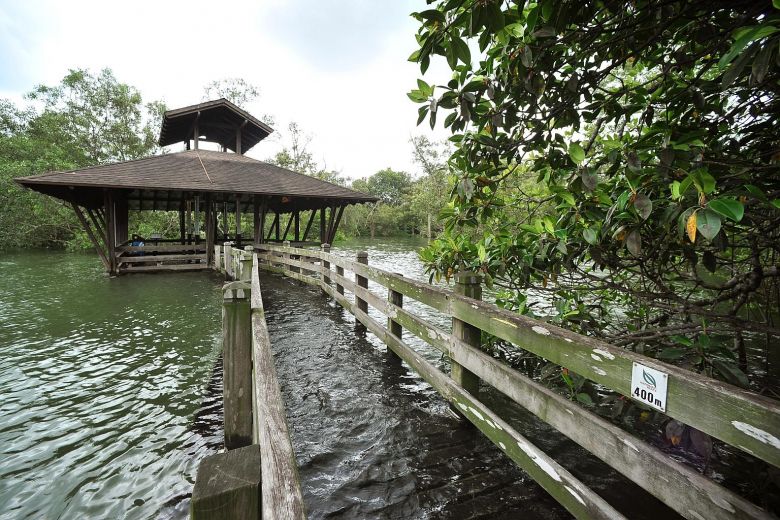
In January 2015, The Straits Times reported that the Sungei Buloh Nature Reserve boardwalk was submerged during a spring tide, which happens when the Earth, Sun and Moon are aligned, and the gravitational pull of the Sun and Moon work together in pulling tides to greater heights.
Dr Wong said tides are higher in the Johor Strait, which is a narrow and semi-enclosed body of water compared with the more exposed Singapore Strait down south.
More research needs to be done to see how other areas of Singapore could be impacted by other aspects of sea-level rise, including tides, he said.
Singapore could look into setting up a national king tide watch, similar to those in the United States and Australia, suggested Dr Wong.
“Concerned citizens and corporations can record and report every king tide event to a central agency. This would provide a more detailed and improved coverage of each king tide event on the coast,” Dr Wong said. A network of tidal gauges could supplement the king tide watch, he added.
Another factor that could influence extreme sea-level events here are storm surges.
Usually, this refers to the rise in water levels along coastlines during storms. This is due to the impact of winds blowing on the water surface, or a reduction in atmospheric pressure that causes water to surge upwards, or both, said Dr Pavel Tkalich, who heads the oceanography laboratory at the National University of Singapore’s Tropical Marine Science Institute.
In Singapore, strong winds that could potentially cause storm surges are often associated with the north-east monsoon season, whereas in nearby regions, typhoons could be the culprit as well.
Such tropical cyclones rarely affect Singapore because the rotational force required for them to form is absent on the Equator. But similar surges can also be experienced here when winds from storms brewing farther away cause water to “pile up” near Singapore’s coasts, said Dr Tkalich.
Such storms usually develop over the South China Sea – a relatively open body of water to Singapore’s north-east – between December and March, when Singapore experiences its north-east monsoon season, he said.
As winds are blowing from the direction of the South China Sea during this season, the force of the winds could cause water to pile up on Singapore’s coast, resulting in sea-level surges above 0.5m, said Dr Tkalich, who has been studying the effects of storm surges for more than 10 years.
This may not seem drastic, but the surges could overwhelm coastlines if they concurrently occur with a high tide. When the Sungei Buloh platform was submerged in January 2015, for example, it was because a spring tide and a storm surge had occurred at the same time, he said.
THE COST OF PREPAREDNESS
With climate change raising mean sea levels, the compounding effect of the other factors could be severe. This could raise the cost of safeguarding Singapore’s coastline.
“The higher the sea level, the greater the costs,” noted NTU’s Prof Horton, citing the Netherlands as an example. “They spend €1 billion (S$1.5 billion) a year – raised through taxation – to protect their cities against events that could happen in just one out of every 10,000 years.”
The global average mean sea-level rise is currently about 3mm a year, and the IPCC expects this rate to accelerate.
Said Prof Horton: “How much will this cost when the rate doubles, triples, or becomes an order of magnitude more? These rates can happen in the next 50 years if we don’t mitigate against climate change.”
The MEWR spokesman said the $100 billion figure was just an estimate, and that more could be required if sea levels rise higher and faster. Smaller-scale infrastructure, such as localised flood-proofing measures, can be funded from the budgets of the ministries, he said.
For larger, long-lived infrastructure, the Government will look at the option of borrowing to “better spread the spending among the generations that will benefit”.
He added: “Based on our existing framework, reclamation costs can be met from the reserves, with the land created being protected as part of past reserves.”
“Source:[Shoring up Singapore’s coastlines as sea levels rise faster than expected] © Singapore Press Holdings Limited. Permission required for reproduction”

Let’s Discuss Your Property Plans
Interested in This Property?
Buying, selling or renting? Get a free consultation with realtors with a background in interior and lighting design. We’ll discuss your goals and help you assess your options—from pricing and timelines to layout practicality and space potential.
Share your contact details below, and we will get in touch to understand your needs and suggest the next steps. No pressure. No obligation to proceed.