Canberra Drive’s record EC land bid raises an uncomfortable question: did expanding the pool of eligible buyers weaken the new cooling measures’ intended effect?
The answer is not yet conclusive. One tender cannot isolate the impact of an income-ceiling increase from location, project size and developers’ differing expectations. But the financing numbers reveal a clearer problem.
Even a household earning S$18,000 a month could need approximately S$833,500 in cash and usable CPF, including Buyer’s Stamp Duty, to purchase a S$1.9 million EC under the assumptions below.
Wider eligibility gives more families permission to buy. It does not necessarily give them sufficient borrowing capacity.

A record bid before the first home is sold
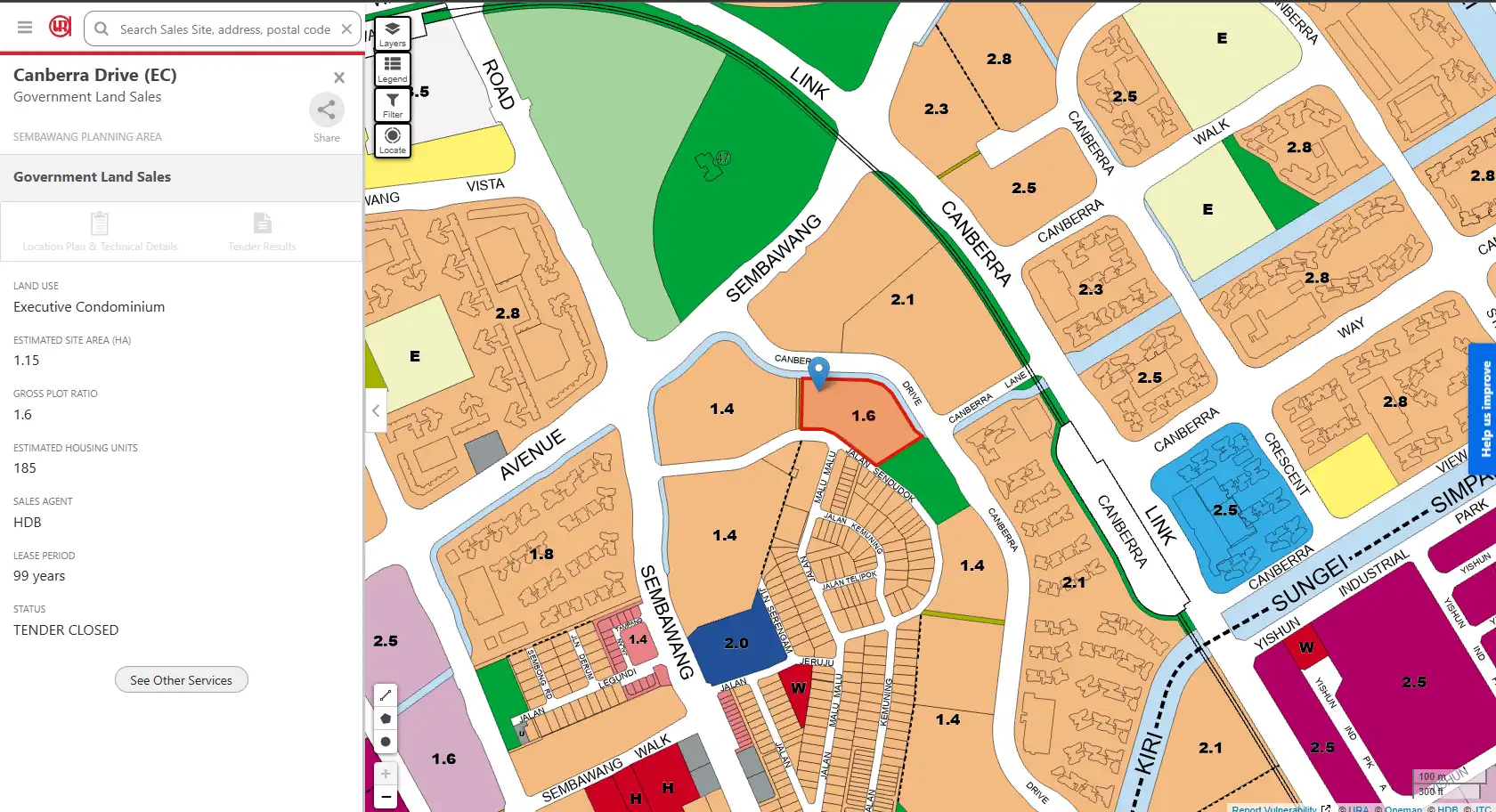
The Canberra Drive tender closed on 1 October 2026 with 13 bids. A consortium comprising Santarli Realty, Heeton Holdings, Kay Lim and Sunray submitted the highest offer of S$163.903 million, or approximately S$825 per square foot per plot ratio.
The 99-year site is expected to yield about 185 homes. The top land rate exceeds the previous EC benchmark of S$794 psf ppr by approximately 3.9%.
These remain provisional tender results. The record refers to the submitted land bid, rather than an awarded project or an achieved home-selling price.
Competition was not confined to one aggressive bidder. The second and third offers were approximately S$803 and S$798 psf ppr, both above the previous benchmark. However, the lowest offer was around S$361 psf ppr, indicating substantial disagreement over the site’s value.
The result shows that several developers were prepared to price the site at a high level. It does not show that all 13 shared the same confidence.
Two policy changes pulling demand in different directions
The May measures increased the minimum occupation period to 10 years, removed the Deferred Payment Scheme and expanded the reservation for first-time buyers to 90% for the first two years of launch. These changes apply to EC sites with tender closing dates on or after 8 May 2026.
The longer holding period reduces flexibility, while progressive payments bring financing commitments forward during construction. Greater first-timer priority also changes the buyer mix developers must serve.
The subsequent income-ceiling increase works in a different direction. HDB raised the ceiling from S$16,000 to S$18,000 for new units on EC sites whose land tenders close on or after 24 August 2026. Canberra Drive therefore falls under both sets of changes.
Households earning above S$16,000 and up to S$18,000 can now enter this segment. Developers may therefore see a larger pool of higher-income buyers.
That is a plausible explanation for stronger bidding. It is not proof that the ceiling increase caused the record, because no equivalent Canberra Drive tender shows what developers would have offered without it.
What the projected launch prices mean for families
The Business Times reported analysts’ selling-price projections of approximately S$1,850–S$1,920 psf, including PropNex’s estimate of around S$1,900 psf. These are forecasts, not announced developer prices.
Applying that range gives the following illustrative purchase prices:
| Illustrative size | At S$1,850 psf | At S$1,900 psf | At S$1,920 psf |
|---|---|---|---|
| 900 sq ft | S$1.665m | S$1.710m | S$1.728m |
| 1,000 sq ft | S$1.850m | S$1.900m | S$1.920m |
| 1,100 sq ft | S$2.035m | S$2.090m | S$2.112m |
| 1,200 sq ft | S$2.220m | S$2.280m | S$2.304m |
Calculations: floor area multiplied by the assumed selling rate. Sizes are scenarios, not confirmed Canberra Drive layouts. Actual prices will vary by unit.
At S$1,900 psf, every additional 100 sq ft costs S$190,000. Moving from 900 to 1,200 sq ft adds S$570,000.
For families needing another bedroom, a helper’s space or room to work from home, the total purchase price matters more than whether the headline psf appears competitive.
The land bid alone cannot establish the eventual launch price. Construction costs, financing, saleable area, specifications, margins and competing supply will also influence pricing.
Can an S$18,000 household obtain a 75% loan?
For new EC purchases, the Mortgage Servicing Ratio limits assessed mortgage repayments to 30% of gross monthly income. The Total Debt Servicing Ratio also applies, with a 55% limit covering total debt obligations.
A 75% loan-to-value limit is a ceiling, subject to qualifying conditions. It does not guarantee the buyer can borrow that much.
The following calculations assume:
- S$18,000 in fully recognised gross monthly borrower income.
- A 30-year bank loan and eligibility for the standard 75% LTV ceiling.
- No other debt constraint, income haircut or valuation shortfall.
- A 4% annual mortgage assessment rate.
- No housing grant included.
MAS requires assessment using the higher of the 4% floor or the applicable thereafter rate. A bank using a higher rate would approve a smaller loan than illustrated.
At S$18,000 a month, the 30% MSR permits an assessed repayment of S$5,400. Using monthly amortisation at 4% over 30 years, that supports a loan of approximately S$1.131 million.
For a S$1.9 million home, a 75% loan would instead be S$1.425 million. Its assessed repayment would be approximately S$6,803 a month, requiring around S$22,677 in recognised monthly income under the 30% MSR.
That exceeds the S$18,000 EC eligibility ceiling in this like-for-like example.
The household can still potentially buy, but it must reduce the borrowing by contributing more equity.
The funding requirement can exceed S$800,000
Using the S$1.131 million loan capacity above:
| Size at S$1,900 psf | Purchase price | Cash and usable CPF towards price | Buyer’s Stamp Duty | Total equity plus BSD |
|---|---|---|---|---|
| 900 sq ft | S$1,710,000 | S$578,900 | S$55,100 | S$634,000 |
| 1,000 sq ft | S$1,900,000 | S$768,900 | S$64,600 | S$833,500 |
| 1,100 sq ft | S$2,090,000 | S$958,900 | S$74,100 | S$1,033,000 |
| 1,200 sq ft | S$2,280,000 | S$1,148,900 | S$83,600 | S$1,232,500 |
Loan-derived amounts are rounded to the nearest S$100. BSD assumes market value does not exceed price and uses current residential rates. Totals exclude legal fees, renovation, financing costs, any applicable resale levy or additional duties, and reserves. These are total funding requirements across the purchase, not amounts all payable on booking.
For the 1,000 sq ft example, the contribution towards the price is approximately 40.5%, rather than 25%.
“Cash and usable CPF” should not be read as an unrestricted interchange between the two. Cash-payment requirements and CPF withdrawal rules still apply.
Age and tenure can widen the gap. At 25 years, the same S$5,400 assessed repayment supports only about S$1.023 million. The equity plus BSD requirement for the S$1.9 million home then rises to approximately S$941,600.
How much does the higher ceiling actually help
Holding the 4% assessment rate and 30-year tenure constant:
| Monthly household income | 30% assessed repayment | Approximate maximum loan | Price supported with exactly 75% financing |
|---|---|---|---|
| S$16,000 | S$4,800 | S$1,005,400 | S$1,340,600 |
| S$18,000 | S$5,400 | S$1,131,100 | S$1,508,100 |
These compare households at the old and new ceilings. Raising the ceiling does not increase the income or borrowing capacity of an existing S$16,000 household.
The higher-income household can borrow approximately S$125,700 more. At exactly 75% financing, that supports about S$167,600 more in purchase price.
Yet the resulting S$1.508 million benchmark remains below even the illustrative 900 sq ft unit at S$1.71 million.
The ceiling change therefore expands access, but accumulated savings remain decisive. If selling prices increase, households already eligible under the old ceiling face higher costs without any automatic increase in their borrowing power.
First-timer priority cannot substitute for accumulated savings
Reserving more units for first-time buyers improves their chances of securing a home. It does not eliminate the equity requirement.
Two families earning S$18,000 may have very different financial positions. One may have substantial CPF balances and cash savings; another may have only recently reached that income.
For a family without substantial accumulated funds, an S$833,500 equity-and-duty requirement is a serious barrier even if monthly repayments are manageable.
Removing deferred payment also makes timing more important. Buyers need funds when progressive payments fall due. Expected future savings or eventual sale proceeds are only useful if they become available in time.
A longer occupation commitment adds another consideration: the home must suit the household through changes in family size, work and finances. Choosing a smaller unit purely to meet today’s budget could create a space problem later.
Why Canberra Drive may be an exceptional tender
The counterargument deserves weight. A S$163.9 million land commitment and an estimated 185 homes offer a smaller absolute exposure than a much larger development. Canberra Drive’s proximity to transport and neighbourhood amenities may also support its appeal.
A developer may believe it can find 185 qualifying buyers at its target prices without believing that the entire EC market can absorb those prices across much larger projects.
The Admiralty Walk tender, scheduled to close on 17 December 2026 and expected to yield about 450 homes, will provide a useful second observation. Its different scale and location mean it will not be a controlled comparison, but it can help show whether strong bidding extends beyond Canberra Drive.
Wider eligibility is only part of affordability
Canberra Drive does not establish that the new EC rules have failed. Longer occupation requirements and first-timer priority can still influence who buys and how homes are used, even if the first land tender produces a record bid.
However, the result does raise a legitimate concern that expanding eligibility may have offset some of the restraint developers were expected to exercise.
The more immediate issue for buyers is measurable. At the illustrative S$1,900 psf price, a household earning S$18,000 could require roughly S$833,500 in equity and BSD for a 1,000 sq ft home, even with a 30-year loan.
The meaningful affordability test is whether eligible families can assemble the required funds, make progressive payments and sustain ownership while retaining adequate reserves.
A higher income ceiling widens the entrance to the EC market. Whether more families can actually buy will depend on how developers set prices and how those prices compare with buyers’ savings and incomes.
Disclaimer: This article provides general market analysis, not personalised financial advice. Selling prices and unit sizes are illustrative; financing calculations are estimates, not loan approvals. Buyers should confirm current eligibility, CPF usage, duties and bank terms for their circumstances.
Article contributed by Jerry Wong.
 Jerry Wong is a realtor at Propnex Realty, bringing a rich background in interior and lighting design to his work. He loves exploring diverse spaces and observing the transformative power of real estate. Beyond his professional role, Jerry finds his greatest fulfillment in connecting people with the right properties, gaining immense satisfaction from helping clients achieve their dreams.