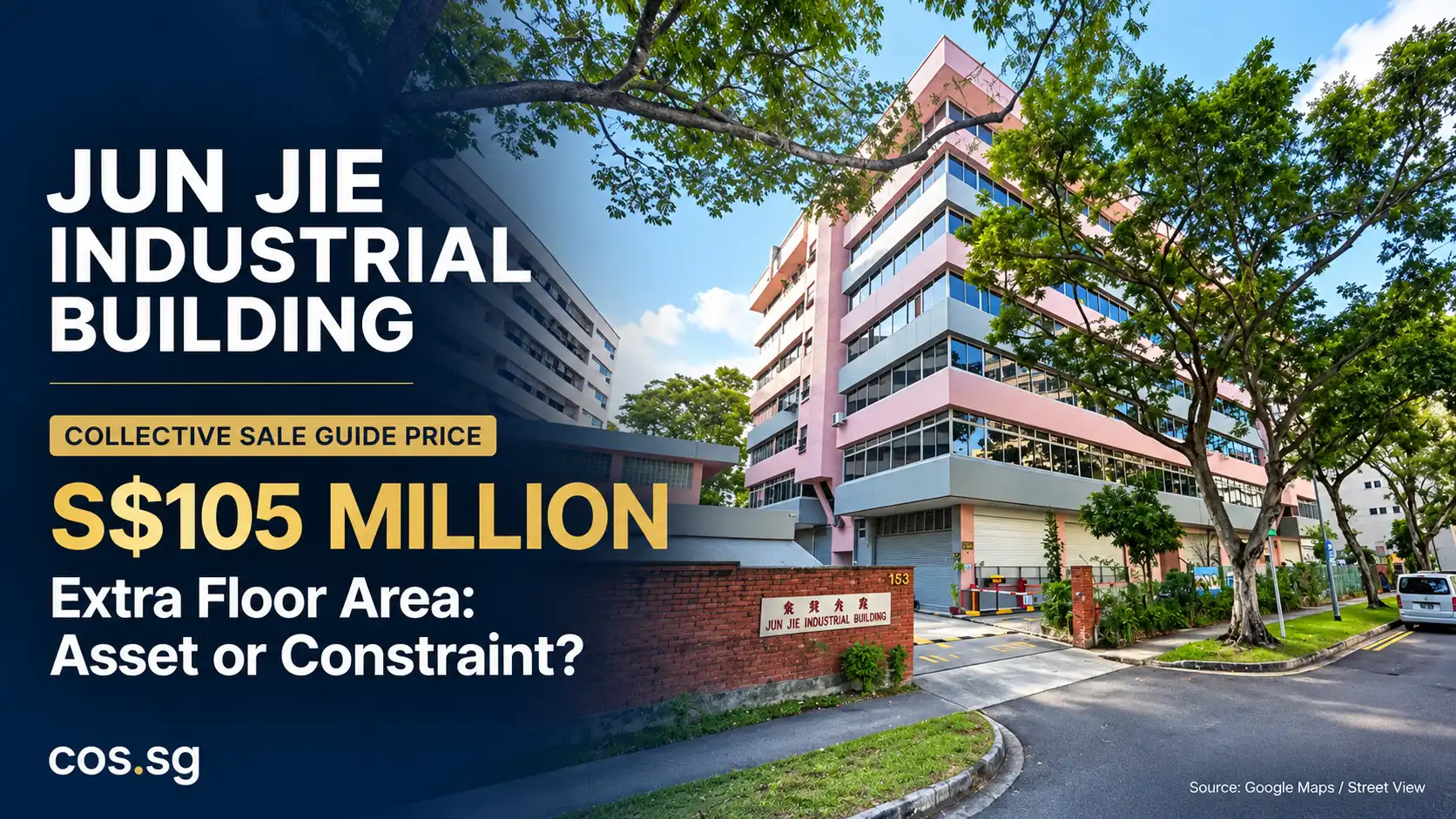
Jun Jie Industrial Building’s S$105 million collective-sale asking price raises an unusual question: could its existing floor area be one of the best reasons to keep the building?
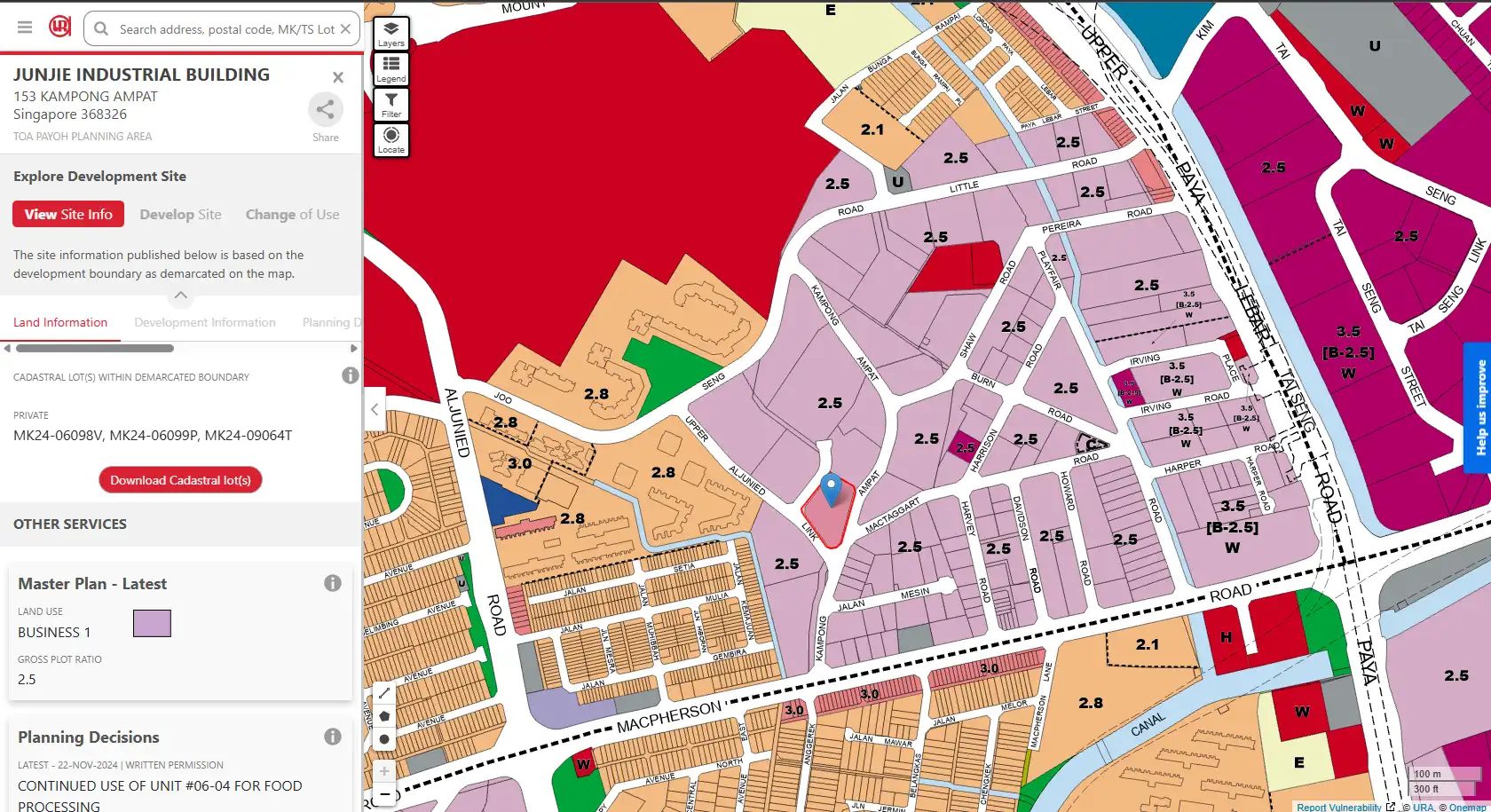
The freehold property at 153 Kampong Ampat has approximately 114,969 sq ft of existing gross floor area (GFA), above the 108,385 sq ft implied by its 43,354 sq ft site and stated Business 1 plot ratio of 2.5. The tender closes at 10 am on 23 October 2026. This is an asking price, not a completed transaction.
The investment question is therefore more specific than whether freehold industrial property is attractive. A buyer needs to establish how much usable space can be retained or rebuilt, what that space can earn, and how much additional capital each option requires.
The S$913 headline already reflects the existing floor area
The reported land rate of approximately S$913 psf per plot ratio can be reproduced by dividing S$105 million by the existing 114,969 sq ft of GFA. It is therefore effectively the purchase price per square foot of existing gross floor area.
Using the stated 2.5 planning plot ratio produces a different denominator.
| Measure | Calculation | Result |
|---|---|---|
| Existing plot ratio | 114,969 ÷ 43,354 | Approximately 2.65 |
| GFA implied by plot ratio 2.5 | 43,354 × 2.5 | 108,385 sq ft |
| Existing GFA above that baseline | 114,969 − 108,385 | 6,584 sq ft |
| Purchase cost per existing GFA | S$105 million ÷ 114,969 | Approximately S$913 psf |
| Purchase cost per baseline GFA | S$105 million ÷ 108,385 | Approximately S$969 psf |
Calculations use the reported approximate areas and exclude acquisition and development costs.
The existing building contains approximately 6.1% more GFA than the 2.5 baseline. If a replacement scheme were limited to that baseline, its acquisition cost per square foot of GFA would also be approximately 6.1% higher than the headline figure.
That difference arises before demolition, construction, professional fees, financing and the period without rental income.
Extra existing space needs planning confirmation
The figures do not establish that 6,584 sq ft must be lost on redevelopment. They also do not establish an automatic right to rebuild all existing space.
URA’s Business 1 guidelines state that allowable gross plot ratio is guided by the Master Plan. They also explain that site constraints and technical requirements can prevent even the stated upper bound from being fully achieved.
A purchaser should obtain site-specific confirmation of the recognised existing GFA and the permissible area under each proposed scheme. Until then, 108,385 sq ft is a useful planning baseline, rather than a confirmed redevelopment approval.
For a retention strategy, the extra floor area could support additional income. Its value still depends on whether it is lawful, usable and economical to maintain. GFA is not the same as net lettable area: common circulation and building services do not necessarily generate rent.
A smaller new building could also provide better usable space through more efficient layouts, loading access or floor specifications. The relevant comparison is the income and utility of the completed space against the full cost of delivering it.
How much income would support S$105 million
A buyer retaining the property for rental income can work backwards from a target net yield.
Here, net property income means rental income after property operating expenses, before financing, income tax and major capital expenditure. The following yields are analytical scenarios, not evidence of current market yields or the building’s actual performance.
| Illustrative net yield on asking price | Annual net property income required | Monthly gross rent required with 20% operating expenses |
|---|---|---|
| 3.0% | S$3.15 million | S$328,125 |
| 3.5% | S$3.675 million | S$382,813 |
| 4.0% | S$4.20 million | S$437,500 |
| 4.5% | S$4.725 million | S$492,188 |
| 5.0% | S$5.25 million | S$546,875 |
Operating expenses are assumed to equal 20% of collected rental revenue. Figures exclude acquisition costs, refurbishment expenditure and debt service.
At a 4% target, the property would need S$4.2 million in annual net property income. Under the expense assumption above, that requires S$5.25 million in annual collected rent.
To translate this into a rent per square foot, suppose 80% of existing GFA is lettable, and 90% of that lettable space is occupied. This gives approximately 82,778 sq ft of occupied space and requires an average monthly rent of about S$5.29 psf.
That is a required rent under stated assumptions, not a claim that Jun Jie currently achieves it. The actual rent roll, leases, lettable area, vacancy and operating expenditure would determine whether the asking price is supported.
Refurbishment and redevelopment raise the income hurdle
The S$105 million purchase price is only the starting point. A buyer should assess income against total invested capital, including acquisition costs, works, professional fees and relevant holding costs.
The table below tests alternative capital budgets at a common 4% stabilised net yield. These are hypothetical sensitivity cases, not quotations or estimates for this building.
| Illustrative strategy | Assumed total invested capital | Annual net income required at 4% |
|---|---|---|
| Retain with limited works | S$115 million | S$4.6 million |
| Undertake more extensive refurbishment or conversion | S$125 million | S$5.0 million |
| Redevelop | S$155 million | S$6.2 million |
Every additional S$10 million invested requires another S$400,000 of annual net income to maintain a 4% yield on cost.
Timing also matters. A redevelopment that eventually earns a 4% stabilised yield may deliver a weaker overall return if approvals and construction tie up capital without income for several years. Comparing investment returns requires both completed income and pre-completion cash flows.
Dormitory potential depends on approved capacity and operating income
Authorities have reportedly indicated support for possible workers’ dormitory use, subject to a detailed proposal and applicable approvals. That creates an option to investigate; it does not establish an approved bed count or a ready-to-operate business.
Consider the hypothetical S$125 million total investment above. At a 4% target, it needs S$5 million in annual net income.
If a dormitory business retained 60% of collected revenue after recurring operating expenses, it would need approximately S$8.33 million of annual revenue, or S$694,444 per month.
At 90% occupancy, the monthly revenue required per occupied bed would be:
| Hypothetical approved capacity | Occupied beds at 90% | Required monthly revenue per occupied bed |
|---|---|---|
| 1,000 beds | 900 | S$772 |
| 1,500 beds | 1,350 | S$514 |
| 2,000 beds | 1,800 | S$386 |
These capacities, occupancy and operating margin are purely illustrative. None is a confirmed proposal, approved capacity or forecast for Jun Jie.
The difference can be substantial. A lower approved capacity would require higher revenue per bed, lower costs or a lower acquisition price to achieve the same return.
The ownership model matters too. A landlord leasing the building to a dormitory operator receives contractual rent; it does not receive the operator’s full bed revenue. In that structure, the landlord must assess lease income after its own expenses, while separately examining the operator’s ability to sustain the rent.
Owner occupation offers a different source of value
An industrial business buying the property for its own use may value control over its premises, operational continuity and the ability to consolidate activities.
Its assessment should compare the full ownership cost with the cost of renting suitable premises, including the opportunity cost of tying up capital in the property. Rental income from surplus space may help, but only where the layout and permitted uses support it.
Freehold tenure provides a long ownership horizon. It does not remove maintenance expenditure, building obsolescence or the need for the premises to suit the business.
The best case may be to preserve useful space
Jun Jie’s existing floor area is potentially an asset because it exceeds the simple 2.5 plot-ratio calculation. Whether that advantage survives a change of use or redevelopment requires confirmation.
At S$105 million, a purchaser needs a credible route from usable space to sustainable income. Retention may work if the existing building can earn enough with manageable expenditure. Redevelopment may work if improved functionality and income justify the extra capital and downtime. Dormitory use depends on approved capacity and operating economics.
The decisive question is how much income each approved option can produce after all the costs required to deliver it. The S$913 headline is a starting point for that assessment, rather than proof that the property is inexpensive.
Disclaimer: This article is for general information and discussion only and does not constitute investment, financial, legal or valuation advice. The S$105 million figure is a collective-sale guide price, not a completed transaction price. Property details and planning parameters are based on publicly available information at the time of writing and remain subject to verification. Existing floor area does not automatically confer a right to retain or reproduce the same area under redevelopment or a change of use. Potential workers’ dormitory use remains subject to detailed approvals and applicable requirements. All income, yield, rental, cost, occupancy and bed-capacity scenarios are illustrative assumptions, not forecasts or confirmed figures for the property. Prospective purchasers should conduct independent due diligence and obtain professional advice on planning approvals, building condition, tenancy income, costs and permitted uses before making any decision.
Article contributed by Jerry Wong.
 Jerry Wong is a realtor at Propnex Realty, bringing a rich background in interior and lighting design to his work. He loves exploring diverse spaces and observing the transformative power of real estate. Beyond his professional role, Jerry finds his greatest fulfillment in connecting people with the right properties, gaining immense satisfaction from helping clients achieve their dreams.