
Singapore’s shophouse market recorded more transactions in the third quarter of 2026, even as the total value of those transactions declined.
According to Huttons’ data reported by EdgeProp, 21 shophouse transactions were caveated in Q3, up from 16 in Q2. Total caveated consideration nevertheless fell 18.6%, from S$193.7 million to S$157.7 million. These figures reflect caveats lodged, rather than necessarily completed conveyances.
At first glance, this suggests buyers are becoming more active while favouring lower-priced properties.
However, a major transaction in the preceding quarter complicates that interpretation. The decline in average quantum does not mean comparable shophouses have become cheaper, or that investors are collectively shifting toward less expensive properties.
The more useful question is whether buyers and sellers are finding common ground on individual assets—and whether the income those assets generate can support their valuations.
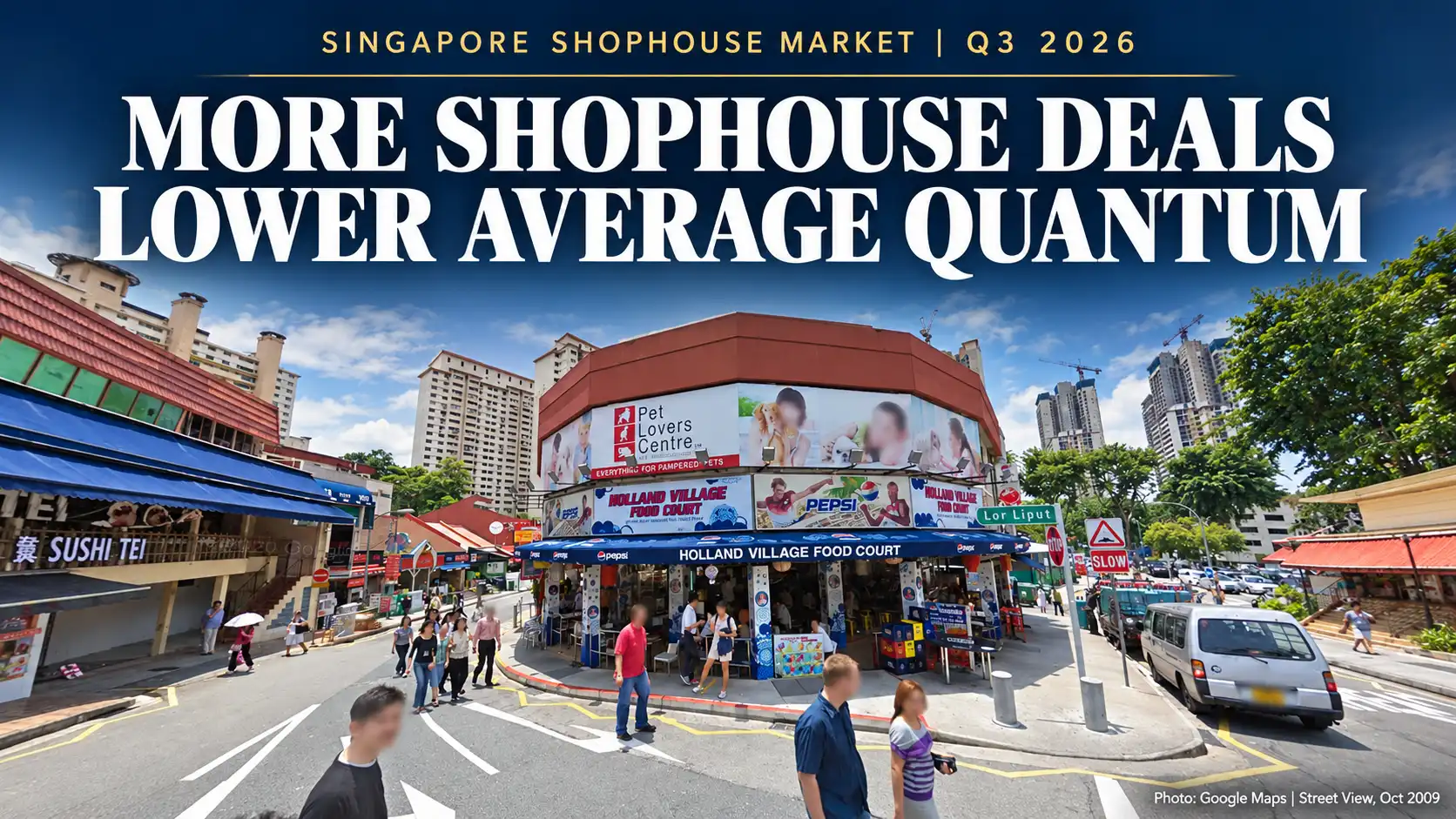
Average transaction quantum fell by about 38%
Dividing total caveated consideration by the reported transaction count shows a substantial decline in average quantum.
| Indicator | Q2 2026 | Q3 2026 | Change |
|---|---|---|---|
| Caveated transactions | 16 | 21 | +31.3% |
| Total caveated consideration | S$193.7 million | S$157.7 million | −18.6% |
| Implied average transaction quantum | S$12.1 million | S$7.5 million | −38.0% |
Average transaction quantum and percentage changes are calculated from the reported figures.
An average quantum of approximately S$7.5 million is significantly below S$12.1 million. But this measures the mix of properties that traded during each quarter.
A quarter with more smaller buildings can record a lower average quantum even if individual property values remain unchanged. Conversely, one large acquisition can raise the average without indicating broader price appreciation.
That distinction is particularly relevant to the latest figures.
The S$70 million Lorong Liput sale changes the comparison
Q2 included the S$70 million sale of three adjoining Lorong Liput shophouses. Huttons identified that transaction as the reason Q3’s total consideration was measured against an elevated base.
Its impact becomes clear when the transaction is removed from Q2’s total.
| Comparison | Caveated consideration |
|---|---|
| Q2 reported total | S$193.7 million |
| Less Lorong Liput transaction | S$70.0 million |
| Q2 total excluding Lorong Liput | S$123.7 million |
| Q3 reported total | S$157.7 million |
Against Q2’s consideration excluding Lorong Liput, Q3’s total was approximately 27.5% higher.
This adjustment is a comparison check. Removing a major transaction from one quarter while retaining every transaction in another does not produce a fully comparable market measure.
Nevertheless, it demonstrates how heavily a single acquisition can influence quarterly statistics in a market with relatively few transactions.
The fall in average quantum therefore provides insufficient evidence that family offices and private investors are broadly moving towards lower-priced shophouses. Part of the change reflects the absence of a similarly large transaction in Q3.
Activity improved, but a broader recovery remains unproven
The quarterly improvement also needs to be viewed against a weaker year-to-date performance.
For the first nine months of 2026, caveated transaction volume was 25% below the corresponding period in 2025, while total consideration was 31.5% lower. Meanwhile, more than 70% of Q3 transactions still exceeded S$5 million.
The market has become more active compared with Q2, but it remains below the previous year’s pace.
A higher caveat count also reveals only part of the picture. It does not show how long properties were marketed, whether sellers reduced their asking prices, or how many properties remained unsold.
A more convincing recovery would involve sustained transaction activity, shorter marketing periods and narrower differences between asking prices and agreed prices.
For now, the figures suggest improving activity within a market where individual property characteristics continue to matter.
Leasing activity rose, while median rents held steady
The leasing market provides another perspective on investment demand.
Rental contracts increased 4.2% quarter-on-quarter to 800, while the median rent remained unchanged at S$6.47 psf per month.
More contracts indicate greater leasing activity, but the count alone cannot show how much additional space was occupied. Renewals, relocations and tenant turnover can also influence the figures.
Similarly, an unchanged median does not mean every landlord experienced the same rental performance. Demand can differ considerably between streets, ground-floor premises and upper-floor spaces.
For investors, the practical implication is that the aggregate figures offer limited support for assuming broad rental growth will quickly justify a higher acquisition price.
Existing income, tenant quality and realistic renewal prospects remain central to assessing value.
A lower purchase quantum does not automatically offer a better yield
Properties at a lower quantum may appeal to a wider pool of buyers, but affordability and investment return are separate considerations.
Consider two hypothetical shophouses:
| Illustrative investment | Property A | Property B |
|---|---|---|
| Purchase price | S$7.5 million | S$12 million |
| Monthly rental income | S$18,750 | S$30,000 |
| Annual rental income | S$225,000 | S$360,000 |
| Gross rental yield | 3.0% | 3.0% |
Illustrative assumptions only. These are not reported transactions or market rental estimates. Gross yields exclude acquisition costs, operating expenses, vacancy and financing.
Property A requires less capital, but both properties generate the same gross yield.
The lower quantum may help a buyer limit exposure to a single asset or preserve funds for other investments. It does not establish that the property offers better value.
The comparison becomes more meaningful after accounting for repairs, insurance, property tax, leasing expenses and vacancy. A building requiring substantial refurbishment may also need additional capital before it can achieve its intended rental income.
A lower-quantum property with weak upper-floor demand or significant maintenance requirements could therefore be less attractive than a more expensive building with dependable income.
Trophy valuations still need a clear investment rationale
Some buyers will accept a lower initial yield for a property with exceptional frontage, a desirable location or the opportunity to acquire adjoining buildings.
Such considerations can support a premium, particularly for investors with a long holding period. However, the financial effect of that premium should remain clear.
Suppose a hypothetical shophouse generates S$300,000 in annual net operating income before financing. At a S$10 million purchase price, its net property yield is 3%. At S$12 million, the same income produces a 2.5% yield.
Paying the higher price means accepting a lower current return unless income subsequently increases.
The buyer therefore needs a credible reason to expect rental growth, improved use of the building, or future capital appreciation. Otherwise, much of the investment case rests on the next buyer accepting an equally ambitious valuation.
This raises a useful question about the latest market figures: are investors becoming more selective about how much they pay relative to sustainable income?
The quarterly totals cannot answer that conclusively. Establishing such a shift would require information on achieved rents, building condition, usable area, buyer profiles and transaction yields.
What the latest figures mean for buyers and sellers
For buyers, the increase in transactions suggests that opportunities are being converted into agreements. Each acquisition still needs to be assessed against properties with comparable tenure, location, floor area, condition and income.
Lease expiries, tenant concentration and refurbishment requirements deserve particular attention. So does the ability of upper floors to attract dependable rental demand.
For sellers, greater activity indicates that transactions remain achievable. However, an exceptional nearby sale may provide limited guidance if it involved adjoining properties, unusual frontage or a buyer with a specific strategic interest.
A well-supported tenancy schedule and a credible account of the building’s income potential can strengthen the case for an asking price.
Singapore’s Q3 shophouse figures show more transactions at a lower average quantum, with the comparison heavily influenced by Q2’s Lorong Liput sale.
The investment question remains property-specific: how much income can the building sustainably generate, what additional capital will it require, and how much future potential has already been priced into the acquisition?
Disclaimer: This article is for general information only and does not constitute investment, financial, tax or legal advice. Transaction figures reflect caveats lodged based on data downloaded on 8 October 2026 and may be revised; they do not necessarily represent completed conveyances or all market transactions. Average transaction quantum is influenced by the mix of properties sold and should not be interpreted as a measure of price movements for comparable assets. Yield examples are hypothetical and do not represent actual properties or guaranteed returns. Readers should independently verify property details, rental income, expenses and applicable requirements, and seek professional advice before making any property decision.
Article contributed by Jerry Wong.
 Jerry Wong is a realtor at Propnex Realty, bringing a rich background in interior and lighting design to his work. He loves exploring diverse spaces and observing the transformative power of real estate. Beyond his professional role, Jerry finds his greatest fulfillment in connecting people with the right properties, gaining immense satisfaction from helping clients achieve their dreams.
Let’s Discuss Your Property Plans
Interested in This Property?
Buying, selling or renting? Get a free consultation with realtors with a background in interior and lighting design. We’ll discuss your goals and help you assess your options—from pricing and timelines to layout practicality and space potential.
Share your contact details below, and we will get in touch to understand your needs and suggest the next steps. No pressure. No obligation to proceed.
Other Topics That May Interest You
Enquire About This Property
Check current availability and rental terms, arrange a viewing, or discuss whether the space could meet your business needs.
Share your requirements and we will get in touch. No obligation to proceed.