
For an HDB owner planning to move into a condominium, the latest property figures raise a practical concern: what happens when the home they want to buy becomes more expensive while the flat they intend to sell loses a little value?
Singapore’s private residential prices rose 1.4% in the third quarter of 2026, while HDB resale prices fell 0.2%, according to the latest URA and HDB flash estimates.
The percentages may look modest. But because a condominium usually costs considerably more than the flat being sold, those movements can translate into tens of thousands of dollars in additional funding.
For households with ample savings, that may be manageable. For an upgrader whose budget is already stretched, it could absorb the money set aside for renovation, increase the mortgage, or put the intended purchase beyond reach.
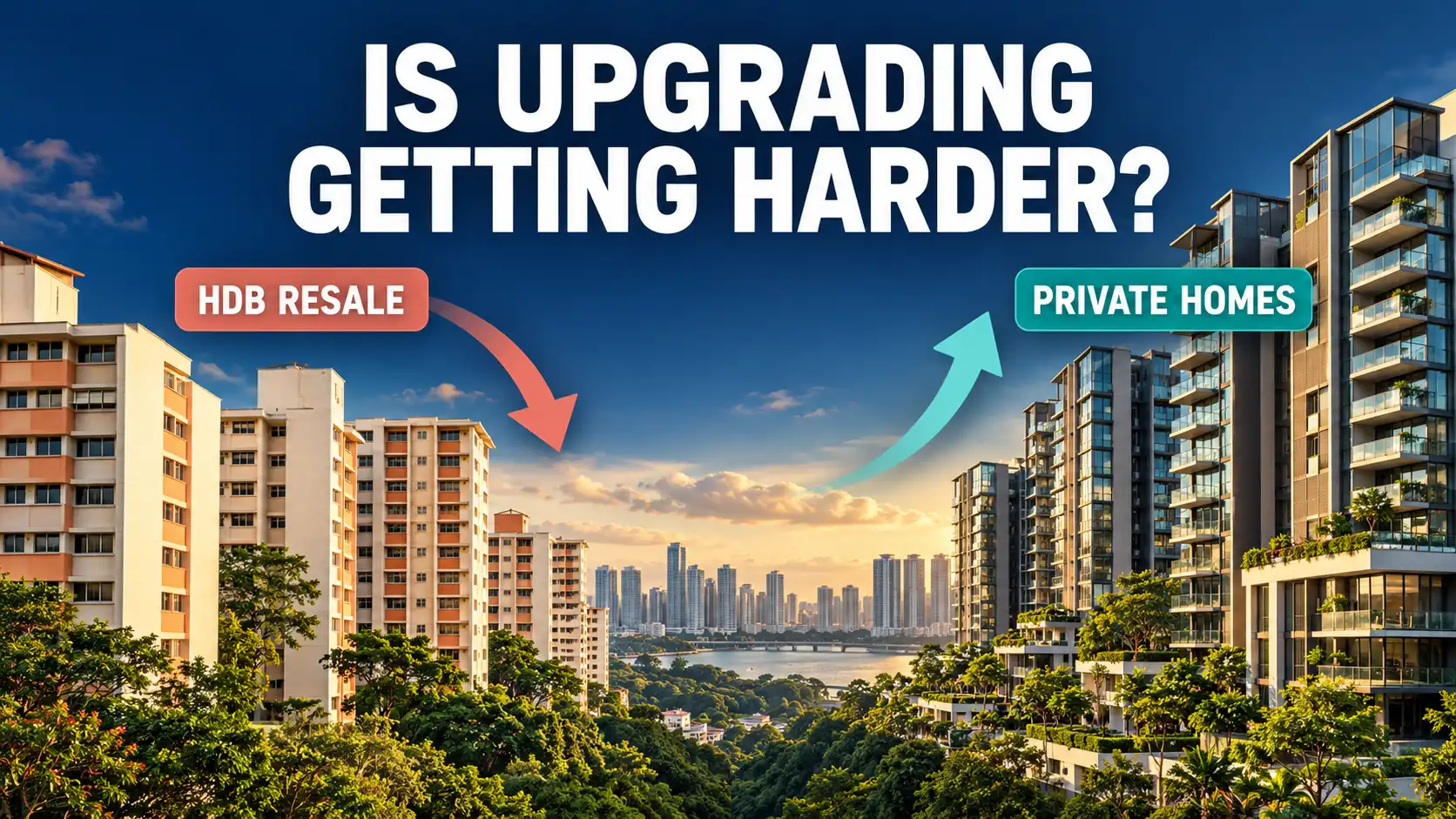
The suburban condo figure deserves closer attention
The headline increase covers several parts of the private market. Their prices did not move together.
| Market segment | Q3 2026 price change |
|---|---|
| All private residential properties | +1.4% |
| Landed private homes | +2.8% |
| Non-landed private homes | +0.9% |
| Non-landed homes in the Outside Central Region | +2.2% |
| Non-landed homes in the Rest of Central Region | +0.2% |
| Non-landed homes in the Core Central Region | −0.1% |
| HDB resale flats | −0.2% |
Sources: URA Q3 flash estimates and HDB Q3 flash estimates. Changes are quarter-on-quarter.
For an owner considering a suburban condominium, the 2.2% increase in non-landed prices in the Outside Central Region is more relevant than the overall private-market figure, which also includes landed homes.
These indices describe broad markets. They do not establish how much a particular flat or condo changed in value. Location, remaining lease, condition and the specific units available still matter.
The estimates are preliminary, and URA’s full Q3 statistics are scheduled for 23 October 2026. Source: URA.
How modest percentages widen the price gap
Consider an illustrative upgrader with a flat worth S$900,000 and a target suburban condo costing S$2 million.
Assume, purely to show the effect, that the flat falls exactly 0.2% and the condo rises exactly 2.2%.
| Illustrative comparison | Before the assumed changes | After the assumed changes |
|---|---|---|
| HDB sale price | S$900,000 | S$898,200 |
| Condo purchase price | S$2,000,000 | S$2,044,000 |
| Difference between the two prices | S$1,100,000 | S$1,145,800 |
The flat’s price falls by S$1,800, while the condo’s price rises by S$44,000. Together, those changes widen the difference by S$45,800.
That is about 4.2% of the original S$1.1 million price gap, even though neither property’s assumed price movement exceeds 2.2%.
The reason is straightforward: the condo’s percentage increase applies to a much larger amount. Each 1% increase on a S$2 million condo adds S$20,000 to its price. Each 1% increase on a S$900,000 flat adds S$9,000 to the selling price.
Even if both properties rose by the same 2.2%, the flat would gain S$19,800 while the condo would gain S$44,000. The price gap would still widen by S$24,200, although the owner would also have more sale proceeds.
For an upgrader, keeping pace in percentage terms does not necessarily mean keeping pace in dollars.
These are sensitivity calculations, not valuations, recorded transactions or predictions that individual properties will follow their market indices.
The increase affects both upfront funding and the mortgage
The wider price gap does not automatically mean the buyer must find another S$45,800 entirely in cash. How it is funded depends on whether the household can support a larger loan.
Assume the buyer can obtain a 75% mortgage on both the original and revised condo prices, and the valuation matches the purchase price. The remaining 25% must come from cash and usable CPF savings.
| Purchase funding calculation | S$2 million condo | S$2.044 million condo | Increase |
|---|---|---|---|
| Mortgage at 75% | S$1,500,000 | S$1,533,000 | S$33,000 |
| Down payment at 25% | S$500,000 | S$511,000 | S$11,000 |
| Buyer’s Stamp Duty | S$69,600 | S$71,800 | S$2,200 |
| Down payment plus BSD | S$569,600 | S$582,800 | S$13,200 |
Author’s calculations using IRAS’s progressive residential Buyer’s Stamp Duty rates. ABSD and other purchase costs are excluded.
The more expensive condo requires an additional S$13,200 in upfront funds. Meanwhile, the assumed HDB price decline reduces the seller’s available proceeds by S$1,800.
With the existing mortgage, CPF refund and selling costs held constant, the household therefore needs S$15,000 more in upfront funding, alongside the S$33,000 larger mortgage.
The distinction matters. A household may be able to raise the extra down payment but find the larger loan uncomfortable. Another may have enough income for the mortgage but insufficient cash and CPF to fund the purchase.
If the household’s maximum approved loan remains fixed at S$1.5 million, the calculation changes sharply. The household must then fund the entire S$44,000 condo price increase from its own resources. Adding the extra S$2,200 of BSD and the S$1,800 loss of sale proceeds brings the additional upfront funding requirement to S$48,000.
The ability to increase the loan determines how much of the price rise the buyer must absorb upfront. A higher property price does not automatically mean a higher mortgage.
A small price move can consume the remaining buffer
The effect becomes clearer when we look at what the household has left after the purchase.
Take the same S$900,000 flat and assume an outstanding mortgage of S$300,000, a CPF principal and accrued-interest refund of S$350,000, and S$22,000 in selling and legal costs.
That leaves S$228,000 in cash proceeds and S$350,000 refunded to CPF. For this example, assume that the refunded CPF is fully usable for the next purchase. Combined cash and CPF from the sale would be S$578,000, excluding other savings.
The CPF refund changes the cash-to-CPF split; it is already included in the combined S$578,000 and should not be added again.
At the original S$2 million condo price, a 25% down payment and BSD total S$569,600. The household would have S$8,400 remaining, before purchase legal fees, renovation, moving and reserves.
After the assumed price movements, its available funds fall to S$576,200, while the down payment and BSD rise to S$582,800.
The S$8,400 remaining balance becomes a S$6,600 shortfall, even with the larger 75% mortgage.
For this household, the practical impact is far greater than the headline percentages suggest. A purchase that narrowly fitted the available funds would now require additional savings before the other costs of moving are considered.
The mortgage also grows:
| Monthly mortgage calculation | S$1.5 million loan | S$1.533 million loan | Approximate increase |
|---|---|---|---|
| Repayment at an assumed 2.6% | S$6,805 | S$6,955 | S$150 |
| Repayment at an assumed 4.0% | S$7,918 | S$8,092 | S$174 |
Calculations based on a 25-year mortgage with monthly principal and interest repayments. Rates are assumed constant and are illustrations, not current bank quotations. Figures are rounded.
The additional monthly payment may be manageable on its own. But it comes alongside the extra upfront funding and a smaller financial buffer. Maintenance fees, household bills and other commitments still have to be paid.
The remaining buffer is the number that matters
The latest figures suggest that the path from HDB to a suburban condo could become more demanding when the target home rises faster than the property being sold. The impact will differ between households and between individual properties.
An owner with a small mortgage and substantial savings may absorb the difference comfortably. An owner relying on nearly all the sale proceeds could find that the same percentage movements change the purchase from affordable to underfunded.
The most revealing comparison is therefore between the household’s position before and after the move: how much additional capital is needed, how much more debt must be carried, and how much money remains after the purchase.
In our illustration, a 2.2% condo price increase and a 0.2% flat price decline mean S$15,000 more in upfront funding and S$33,000 more in borrowing. If the loan cannot increase, the extra upfront requirement becomes S$48,000.
Those differences matter for a household close to its budget limit. They also show why a high HDB selling price, by itself, does not establish that an upgrade is comfortable.
Upgrading gets harder when the next home’s cost grows faster than the resources available to buy it. A sustainable move leaves enough money after the down payment to manage the home and everyday life comfortably. The key number is the remaining buffer.
Disclaimer: This article is for general information and does not constitute financial, legal or property investment advice. Market indices reflect broad trends and may not represent changes in the value of a specific HDB flat or private home. Calculations are illustrative and depend on the stated assumptions; actual sale proceeds, CPF refunds, financing, interest rates, taxes and purchase costs will vary. Flash estimates may be revised, and prevailing rules may change. Obtain personalised advice and confirm your financing and available funds before committing to a property transaction.
Article contributed by Jerry Wong.
 Jerry Wong is a realtor at Propnex Realty, bringing a rich background in interior and lighting design to his work. He loves exploring diverse spaces and observing the transformative power of real estate. Beyond his professional role, Jerry finds his greatest fulfillment in connecting people with the right properties, gaining immense satisfaction from helping clients achieve their dreams.


Let’s Discuss Your Property Plans
Interested in This Property?
Buying, selling or renting? Get a free consultation with realtors with a background in interior and lighting design. We’ll discuss your goals and help you assess your options—from pricing and timelines to layout practicality and space potential.
Share your contact details below, and we will get in touch to understand your needs and suggest the next steps. No pressure. No obligation to proceed.