
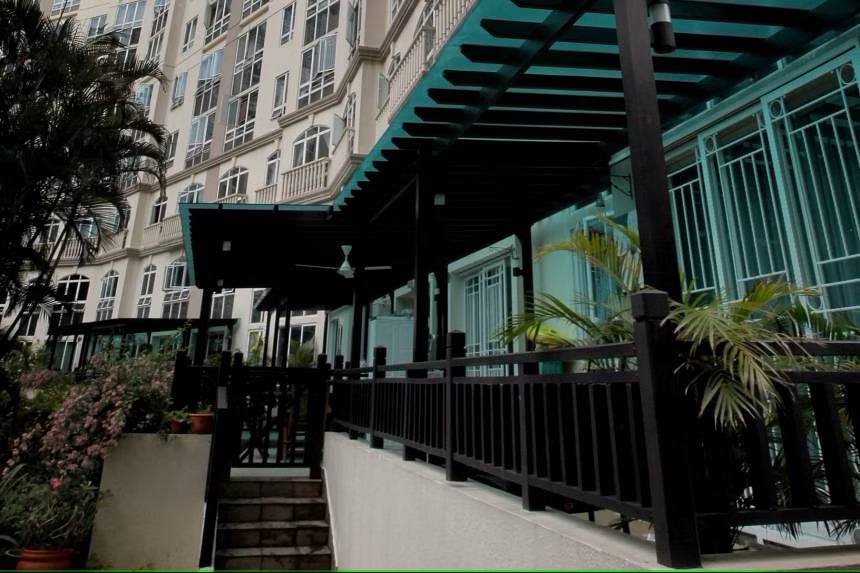
An increasing number of owners of private apartments have been hitting the roof when some neighbours in their condominiums build unwanted structures right under their noses.
One of the most common disputes concerns awnings erected by owners of ground-floor units, who want to shield their small gardens or yards from litter falling from above.
The issue is not as simple as you being the king of your own castle with every right to build an additional roof over your head on your land, because that same structure often makes the owner directly above see red.
Awnings can be intolerable eyesores for second-floor unit owners because these structures sit right outside their windows, create loud noise during heavy downpours, block views and reflect light and heat. If they are not cleaned regularly, they can become a showcase for the rubbish trapped there.
While such disputes often happen between owners of ground-floor and second-floor units, there have been disputes involving owners of higher-floor units as well when some erect awnings to shield their open balconies from the sun and rain, so they can use the space for outdoor activity.
There is nothing stopping owners from putting up beach umbrellas within their own spaces to shield themselves from the sun or litter. But most prefer to install permanent awnings affixed to the walls of their apartment buildings.
Here are four key points condo owners should know.
Use of ‘common property’
Although only the owner of a unit would use those parts of the wall that are next to the unit, such space is deemed “common property” under building rules.
Owners always try to argue that the wall within the balcony or garden enclosure cannot be “common” space, as no one else has access to it.
But this issue has already been settled by the High Court, which found that awnings are fixed to external walls and such fixtures can affect the overall appearance of the building.
As the look and design of a condo is an intangible benefit that can be enjoyed by some or even all owners in the project, it is quite difficult for an individual to argue that external walls do not form part of the common property.
Consent of other owners
Once a space is defined as a common property, the matter is quite literally out of your hands. Under condo rules, an owner who wants to make exclusive use of any “common property” must secure at least 90 per cent of the votes at a residents’ meeting to approve a fixture.
Of course, it is never easy to achieve such near unanimous scores because owners living above are affected by the awnings and are likely to show up to register their protest votes.
If the requisite votes are not obtained, owners cannot fix the awnings to their external walls and those who have already done so without permission would then have to take them down.
That said, the law is not inflexible – owners who fail to garner enough votes can still go ahead and install their awnings if they can prove they are facing a clear and present danger of being hit by litter thrown by residents above them.
To do this, they would probably have to submit photographs or even lodge police reports complaining that residents in higher-floor units are throwing items out of their windows and endangering the safety of others.
Tackling the problem of people throwing rubbish out of their windows or from their balconies is probably the better option than freely allowing owners to build their own shields.
After all, if word gets around that a particular condo has a serious killer litter problem due to “barbarians” living there, the price of all units there would surely plunge because no one would want to move into such a high-risk environment.
No need to sue neighbours
Even if you cannot stand the awnings your neighbours have built illegally, there is no need to exchange blows or lawyers’ letters with them.
The proper procedure is to lodge a complaint with your condo management council, which handles matters involving common property.
As council members are also your fellow residents, they may not be able to resolve all disputes amicably, especially when the owners refuse to remove their structures.
If such an impasse occurs, the council can ask the Strata Titles Board (STB) to compel owners to act. In some cases, aggrieved owners end up suing the council instead, if it fails to act against the errant owners.
The more contentious cases may even find their way to the High Court, as many people here hold property matters close to their hearts. Once the court issues an order for the removal of structures, owners must comply or face grave consequences of being in contempt of court.
No free rein to build
Even if you are allowed to build external structures at your unit, you will have to stick to the approved guidelines for such fixtures.
This was the gist of a recent dispute involving a condo in Toa Payoh where awnings were erected by some owners.
Unlike in other cases, the owners had permission to build these as they won unanimous approval at residents’ meetings, which allowed covers that were no more than 2m from the wall to be installed.
But problems arose after some owners erected awnings that were twice that size so that they could cover their whole yard.
They said they did so because the 2m rule mentioned at the meeting was just a guide, so owners could exceed the limit as long as the authorities approved it.
When STB heard the case recently, it ruled that awnings had to be built within the approved guidelines. It noted that what was discussed in the residents’ meeting may not be referred to because such matters would not be known by other owners who did not attend the meeting.



Let’s Discuss Your Property Plans
Interested in This Property?
Buying, selling or renting? Get a free consultation with realtors with a background in interior and lighting design. We’ll discuss your goals and help you assess your options—from pricing and timelines to layout practicality and space potential.
Share your contact details below, and we will get in touch to understand your needs and suggest the next steps. No pressure. No obligation to proceed.