The S$84.2 million sale of 134 Watten Estate Road is, at first glance, puzzling.
The seller, Far East Organization, is one of Singapore’s largest and most experienced private property developers. It has owned the freehold property since the 1970s, knows the Bukit Timah area intimately, and certainly has the financial and development capability to tear down the ageing apartments and build something new itself. Yet instead of redeveloping the site, Far East sold it to the much smaller Aurum Land, the development arm of construction group Woh Hup.
That raises two obvious questions: Why would Far East leave the redevelopment profit to someone else? And why is Aurum prepared to pay S$84.2 million for something Far East apparently decided was better sold than developed?
The answer is not that Far East cannot redevelop the property. The evidence points in almost exactly the opposite direction. This appears to be a case of two developers assigning very different values to the same piece of land because they have different portfolios, capital-allocation priorities, product strategies and opportunity costs.
There is another intriguing layer. Far East and Aurum are not related companies, but their wider corporate groups are not strangers to each other: a Far East Organization member company has previously entered property-development joint ventures with Woh Hup’s Aurum investment arm in the United Kingdom. That does not make the Watten transaction a related-party deal, but it does establish a degree of institutional familiarity between the two groups.
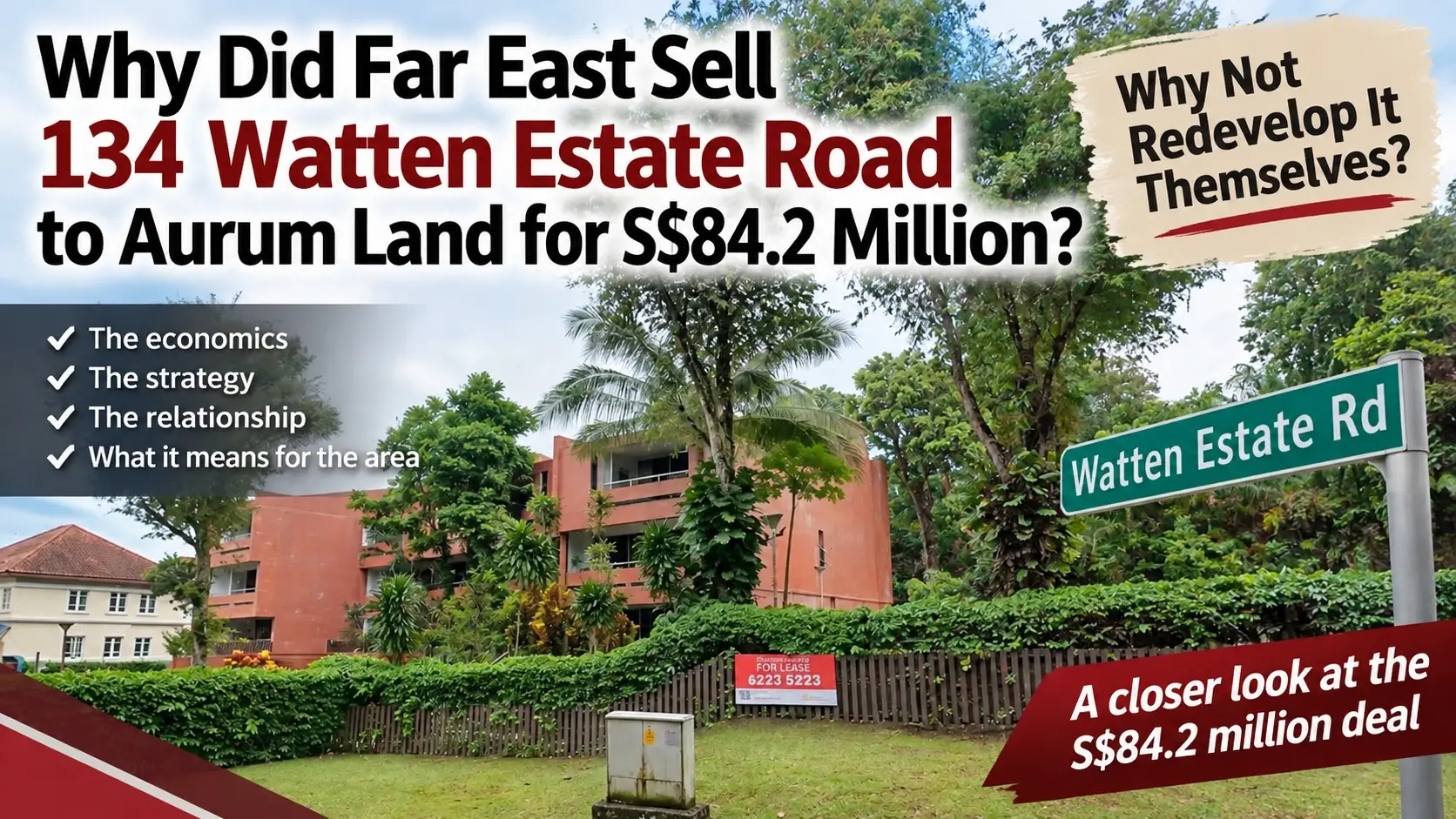
What exactly changed hands at Watten Estate
The property is a freehold 37,155 sq ft site at 134 Watten Estate Road, comprising a larger plot of about 32,953 sq ft and an adjoining 4,202 sq ft parcel. Far East sold it to Aurum Land for S$84.2 million, equivalent to approximately S$2,266 psf of land. A caveat was lodged on 31 August 2026.
The property is unusual because of its age and history. It currently contains a three-storey walk-up apartment complex developed in the 1970s by Lucky Realty Company, a Far East Organization subsidiary. Far East has retained it ever since as a rental property rather than selling individual apartments.
This was therefore not Far East selling a recently acquired development site. It was the monetisation of a roughly half-century-old legacy investment asset.
The historical context matters even more. Far East founder Ng Teng Fong assembled and developed Watten Estate from the 1960s. The wider estate covers more than two million sq ft, is predominantly landed housing, and includes the Ng family’s own Ng’s Mansion near its entrance. Far East still owns other properties in the Watten and Shelford area after this sale.
So the transaction should not be read as Far East abandoning Watten Estate. It is more accurately viewed as a selective disposal of one legacy parcel within an area where the group continues to have substantial historical exposure.
The property was also not quietly transferred to a pre-selected buyer. According to The Business Times, Realstar Premier Group marketed it for at least six months; it received several offers, and Aurum ultimately emerged as the buyer. Lianhe Zaobao reported that Realstar represented both sides and that the site was put up for sale in the second quarter of 2026.
That competitive process is an important clue to Far East’s motivation: someone else was willing to attach a sufficiently attractive redevelopment value to the land for Far East to prefer an immediate S$84.2 million realisation over undertaking that redevelopment itself.
Why Far East probably chose to sell rather than redevelop it
There is an important caveat here: Far East has not publicly disclosed its internal investment committee reasoning for the disposal, and the reports on the transaction do not quote the group explaining why it sold. What follows is therefore an analysis based on the property’s history, planning restrictions, transaction process, Far East’s wider portfolio and the economics of redevelopment.
This was an asset-management decision, not a question of development capability
The least convincing explanation is that Far East lacked either the expertise or resources to redevelop 134 Watten Estate Road.
Far East continues to market its own landed developments. Its current property portfolio includes projects such as Cashew Green, described as a collection of new 999-year landed homes, alongside other low-density residential products. The group has decades of experience across landed, condominium, mixed-use and investment property.
Therefore, asking “Why couldn’t Far East redevelop it?” frames the decision incorrectly.
The more relevant question is:
Was redeveloping this particular 37,155 sq ft parcel the best use of Far East’s capital, management attention and development capacity compared with simply accepting S$84.2 million today?
For a company with a very large portfolio, the answer can quite rationally be no.
A smaller boutique developer may consider a S$100 million-plus development one of its core projects. For Far East, the same project can be relatively small compared with other opportunities available across its portfolio. That difference in opportunity cost can produce a transaction even when both parties are perfectly rational.
The existing apartment block has become a land-value story primarily
Far East had already extracted rental income from the property for decades. The Business Times says the apartments were built in the 1970s and have been leased by the group ever since.
After roughly half a century, a freehold property’s economics increasingly separate into two components:
the value of the ageing building as a rental asset, and the value of the underlying land to a developer willing to replace it.
The buyer is paying S$84.2 million mainly for the latter.
That makes a sale especially logical when a prospective buyer assigns a larger redevelopment premium to the land than the incumbent owner does. Far East can capture much of that expected future value upfront, without demolition, approvals, construction, sales, or financing risk.
In other words, selling does not necessarily mean Far East thought redevelopment would be unprofitable. It may simply mean:
S$84.2 million today was more attractive, on a risk-adjusted basis, than the incremental return Far East expected from spending several more years and tens of millions more turning the site into finished houses.
The zoning limits the type of upside Far East can extract
This is probably one of the most important features of the transaction.
Despite the existing walk-up apartment block, the site is currently zoned for mixed-landed housing, and Aurum is understood to be planning landed homes. Zaobao reported that the intended mix could include detached, semi-detached and terrace houses.
That is very different from owning a 37,155 sq ft site that could simply be intensified into a sizeable condominium.
URA’s current controls impose minimum landed-plot parameters. For example, prevailing rules specify a minimum 400 sq m plot for a detached house, 200 sq m for a semi-detached or certain corner terraces, and 150 sq m for a conventional intermediate Terrace-I house, in addition to width, setback and other requirements.
So the redevelopment opportunity is fundamentally a small-volume, high-ticket landed-housing exercise, not a high-unit-count condominium play.
For Far East, that changes the capital-allocation equation. The group can develop landed homes, but a relatively small boutique development may not offer the same scale advantages a large integrated developer can gain from major residential or mixed-use projects. Far East’s current portfolio spans integrated developments, condominiums, landed housing, investment property, and commercial assets.
For Aurum, by contrast, small-volume luxury landed development has become a core product.
That asymmetry is the heart of the deal.
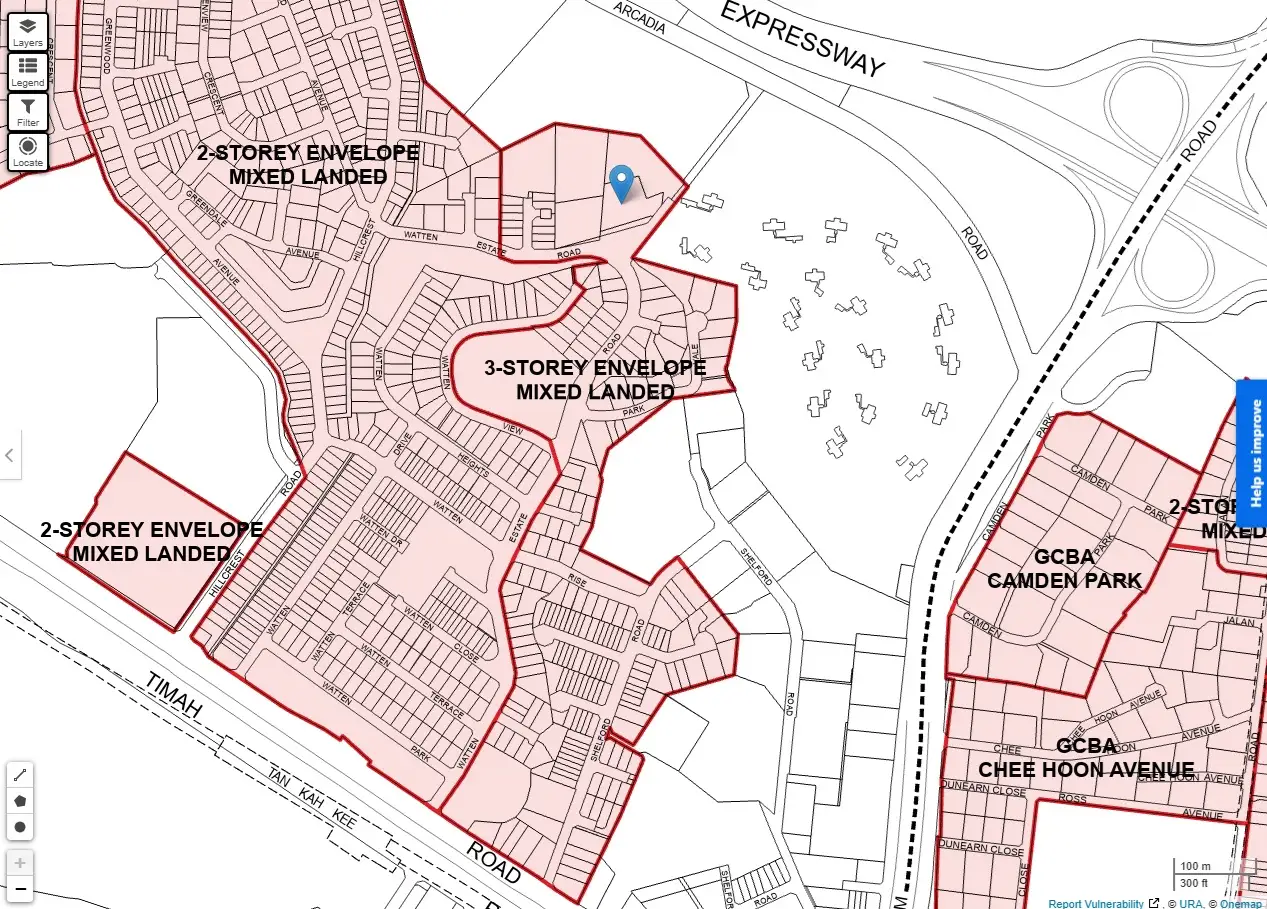
It was also an unusually good time to test the market
The sale occurred against a stronger landed-property backdrop.
URA’s final second-quarter 2026 statistics show that landed residential prices rose 2.5% quarter-on-quarter, after falling 0.4% in the preceding quarter. That significantly outpaced the overall private residential market’s 0.5% quarterly increase. Landed rents were also up 2.7% in the quarter.
In the Watten area specifically, The Business Times counted 11 freehold landed transactions from January through August 2026. Reported transactions ranged considerably in land rate, illustrating both active demand and the importance of each property’s individual characteristics.
Zaobao quoted the buyer’s property adviser as saying redevelopment land was scarce, developer demand was strong, and new-build landed homes were commanding approximately S$4,000-S$5,500 psf in the market. The same report said the transaction was completed in roughly one quarter after the property was launched for sale in the second quarter.
That combination gave Far East an opportunity to sell into strength rather than undertake another development cycle itself.
Far East has already shown that it will monetise mature Watten assets
There is also a useful precedent nearby.
Far East developed the original 104-unit Watten Estate Condominium on Shelford Road. That property was eventually sold en bloc to UOL Group for S$550.8 million in 2021. UOL and Singapore Land subsequently redeveloped it into the 180-unit Watten House, which achieved an average price of roughly S$3,230 psf at launch in November 2023.
That history makes an important point: Far East does not need to capture every subsequent redevelopment cycle of land originally associated with the Ng family.
An asset can deliver value to one owner for decades and then become worth more to a different developer with a different redevelopment thesis.
There is nothing anomalous about that. It is precisely how mature real-estate portfolios are recycled.
Why Aurum Land is almost the perfect buyer
Look at the transaction from Aurum’s perspective, and the mystery largely disappears.
The Watten property bears an extraordinary resemblance to a development strategy Aurum has already executed successfully just a few streets away.
In 2023, Aurum purchased Kew Lodge at 34 and 36 Kheam Hock Road for S$66.8 million. That was another freehold, low-density development site in District 11, measuring 34,433 sq ft and zoned for mixed landed housing. At the acquisition price, Aurum paid approximately S$1,940 psf for the land.
It then redeveloped Kew Lodge into Anagram Homes, a collection of eight landed houses—detached, semi-detached, and terrace homes — which were subsequently sold in full.
Aurum therefore does not have to invent a development model for Watten Estate. It has essentially spent the past three years proving the model on another approximately 35,000 sq ft freehold mixed-landed site in the same broad Bukit Timah market.
The comparison is striking:
| Kew Lodge | 134 Watten Estate Road | |
| Site area | 34,433 sq ft | 37,155 sq ft |
| Acquisition price | S$66.8m | S$84.2m |
| Land rate | ~S$1,940 psf | ~S$2,266 psf |
| Intended product | Landed homes | Landed homes |
| Buyer | Aurum Land | Aurum Land |
Watten is only about 7.9% larger in land area, but Aurum is paying about 26% more in total consideration and roughly 16.8% more per sq ft of land than it did for Kew Lodge three years earlier.
That looks aggressive until one examines what has happened at Anagram Homes.
When Aurum bought Kew Lodge in 2023, CEO Michelle Yong explicitly described the acquisition as an expansion into the landed sector and said the company intended to produce a bespoke collection of luxury houses.
By September 2026, Zaobao reported that the Kheam Hock Road Anagram development had sold out and specifically said Aurum needed to replenish its land bank.
That is perhaps the single clearest explanation for why Aurum bought Watten.
Watten is not a speculative departure from Aurum’s strategy. It is a land-bank replacement for a product line that has just demonstrated market acceptance.
Aurum describes Anagram Homes as a limited collection of luxury landed residences, while its website says it is building on the success of the Kheam Hock Road project with another landed offering at Tan Boon Chong Avenue.
Aurum also has an unusual construction advantage
Aurum Land is wholly owned by Woh Hup, one of Singapore’s largest privately owned construction and civil-engineering businesses. Aurum explicitly markets itself as Woh Hup’s property-development arm and emphasises that its developments can draw on the parent’s construction expertise.
Its latest landed homes are advertised as being built by Woh Hup itself.
That creates an especially compelling structure for boutique landed development.
For a traditional developer, an eight- or ten-home project can be operationally awkward: it brings all the complexity of architecture, tendering, procurement, construction, quality control, and sales, but only a handful of units to spread those costs across.
Aurum belongs to a group whose primary competence is precisely building.
That does not make construction free, nor does it guarantee higher margins. But it likely gives the group tighter integration between developer, product designer and contractor, while giving Woh Hup a way to capture value not only from construction but from the development margin on the completed property. This is an analytical inference from the group’s ownership and operating structure, not a disclosed financial target.
That structure helps explain why a parcel that may look too small to be strategically significant to Far East can be right in Aurum’s sweet spot.
The relationship between Far East and Aurum
Far East Organization and Aurum Land are not part of the same corporate group.
The Watten seller belongs to the Ng family’s Far East Organization. Aurum Land belongs to Woh Hup, the construction group associated with the Yong family, and is led by Michelle Yong.
So this should not be characterised as Far East transferring property to an affiliate.
However, Far East and Woh Hup have an established group-level commercial relationship.
In 2022, Far East Orchard, an SGX-listed company that explicitly describes itself as “a member of Far East Organization,” formed a joint venture involving Woh Hup and its wholly owned Aurum Investments vehicle to develop purpose-built student accommodation in Bristol, United Kingdom. Far East Orchard had an effective 42.5% interest in that development.
The underlying SGX announcement shows that the Singapore joint-venture vehicle was owned 50% by Far East Orchard Investments, 37.5% by Aurum Investments and 12.5% by Way Assets. It also confirms that Woh Hup Holdings wholly owned Aurum Investments.
The relationship continued. In March 2024, Far East Orchard announced another UK student-accommodation acquisition in Glasgow under the headline that Far East Orchard and Woh Hup “continue partnership.” That project again involved Far East Orchard and Aurum Investments, Woh Hup’s investment subsidiary.
The distinction is important:
- Aurum Land, the buyer of Watten Estate, is Woh Hup’s property developer.
- Aurum Investments, the entity that has partnered Far East Orchard overseas, is Woh Hup’s investment/family-office vehicle.
- Both sit within the broader Woh Hup/Aurum ecosystem, but they are not interchangeable legal entities.
Therefore, the strongest conclusion supported by public evidence is:
Far East Organization and Woh Hup/Aurum are independent groups, but they have prior institutional familiarity and have been willing to partner on real-estate investments.
That may reduce transaction friction or counterparty uncertainty, but we found no public evidence that the Watten sale was a related-party transaction, a special off-market arrangement, or part of their overseas joint ventures.
The available evidence points the other way: 134 Watten Estate Road was marketed for months, attracted several offers, and Aurum emerged as the buyer through that marketing exercise.
So the prior relationship is interesting context — but it should not be turned into a conspiracy theory.
The economics reveal why the two sides can both be right
The most revealing way to understand the transaction is to build a simplified development equation.
Aurum paid S$84.2 million, or S$2,266 psf of site area. But S$84.2 million is nowhere near its actual cost base.
At current Singapore stamp-duty rates, residential property attracts Buyer’s Stamp Duty with a top marginal rate of 6%; based purely on an S$84.2 million purchase price and assuming that is also the relevant dutiable value, the BSD works out to approximately S$4.99 million. IRAS states that BSD is calculated on the higher of the purchase price or market value.
For a housing developer buying residential land to develop at least five homes, IRAS currently imposes 40% developer ABSD, of which 35 percentage points may be remitted upfront subject to the relevant conditions, while 5% is non-remittable. That 5% alone would equal about S$4.21 million on S$84.2 million. The remission regime generally requires development to commence within two years and the development to be completed and all units sold within five years, subject to applicable extensions and rules.
On that simplified assumption:
- Land price: S$84.20m
- Estimated BSD: S$4.99m
- 5% non-remittable developer ABSD: S$4.21m
- Subtotal before demolition, construction, consultants, finance and marketing: ~S$93.40m
That is equivalent to approximately S$2,514 per sq ft of site area before Aurum has built a single house.
And that still excludes a long list of substantial expenditure: demolition, site preparation, architects and engineers, authority fees, construction, landscaping, financing costs, sales expenses, contingencies and the developer’s required return.
This is why comparing Aurum’s S$2,266 psf land price directly with S$4,000-plus psf prices for completed new landed homes and calling the difference “profit” would be badly misleading.
The project needs a significant finished-product premium just to cover development costs and generate an acceptable return.
The unit count will be crucial
Aurum has not publicly disclosed the final number or configuration of houses at Watten.
That variable may ultimately determine whether S$84.2 million proves to be an excellent purchase or merely an expensive one.
For perspective, if Aurum hypothetically recreated Kew Lodge’s eight-home format, the simplified S$93.4 million land-plus-BSD-plus-non-remittable-ABSD basis alone would average about S$11.7 million per eventual home, before allocating one dollar of construction or finance.
That does not mean Aurum will build eight houses at Watten. The site is somewhat larger, and the planning envelope could permit a different mix of terraces, semi-detached homes and detached houses subject to URA requirements. Zaobao specifically reports that multiple landed types are being contemplated.
But the illustration demonstrates why site planning is economically critical.
Each additional legally and commercially viable house spreads the S$84.2 million land cost over another saleable unit. Conversely, creating fewer, very large detached houses raises the land allocation per unit and requires much higher absolute selling prices.
Aurum’s task will therefore be to optimise scarcity, plot size, architecture and absolute price, not simply maximise the number of units.
That is exactly the type of boutique product positioning it has already tested at Anagram Homes.
What the deal really says about Far East, Aurum and Singapore’s landed market
The most tempting interpretation of the sale is also probably the wrong one:
“Far East must know something Aurum doesn’t. Why else would an experienced developer sell developable land?”
Real-estate transactions do not work that way. The seller and buyer do not need opposing views about whether a site is “good.” They can simply have different required returns and different strategic uses for the same capital.
For Far East, 134 Watten Estate Road had already performed for decades as a rental asset. A competitive buyer was prepared to pay S$84.2 million for the redevelopment opportunity. Far East could crystallise that value immediately, avoid another multi-year development cycle and still retain other properties in the neighbourhood.
For Aurum, however, the land solves a very specific strategic problem. Its first sizeable landed redevelopment at Kheam Hock Road has sold out; it needs new inventory; it has developed a brand around limited-edition luxury landed houses; its parent is one of Singapore’s major builders; and it has now found another roughly 37,000 sq ft freehold mixed-landed site in prime Bukit Timah.
Aurum can therefore plausibly value the site more highly than Far East without either side making a mistake.
The timing also coincides with strength in landed housing. URA recorded a 2.5% quarterly rise in landed prices in Q2 2026, while the agent involved in the Watten transaction reported strong demand for redevelopment sites and new landed pricing substantially above raw land values.
Another scarcity element is easy to overlook. Government land supply can add thousands of new private apartments, but prime freehold landed redevelopment parcels in established Bukit Timah neighbourhoods cannot be manufactured in the same way. The existing planning controls preserve the low-density nature of such locations, making assembled parcels of this scale relatively unusual.
That scarcity is precisely what boutique developers such as Aurum are trying to monetise.
The deeper conclusion: Far East sold the land, but Aurum bought a business model
Ultimately, S$84.2 million is not the interesting part of this transaction. The difference is in how the two companies see the asset.
Far East inherited something economically unusual: a freehold rental property that it had controlled since the 1970s in an estate developed by its founder. Holding property for that long can create emotional and historical significance, but institutional owners eventually have to ask a colder question: what return can the next dollar invested in this site produce compared with every other use of that dollar? The transaction suggests that at S$84.2 million, Far East found selling sufficiently attractive.
That should not be confused with Far East believing the property has no further upside. In fact, competitive bidding and redevelopment plans show it does.
Far East has simply sold that future upside — together with its construction cost, financing requirements, development risk and sales risk — to Aurum at today’s price.
Aurum is taking the opposite side because it appears to possess three advantages specific to this opportunity.
First, it has product-market proof. Kew Lodge was a similarly sized freehold mixed-landed site; Aurum turned it into Anagram Homes, and that development has reportedly sold out.
Second, Aurum has organisational fit. A boutique collection of perhaps a relatively small number of expensive houses is significant enough to matter to Aurum, while its Woh Hup parent gives it deep construction expertise.
Third, it has an immediate land-bank requirement. The buyer-side adviser explicitly linked the acquisition to the need to replenish Aurum’s land inventory after Anagram Homes at Kheam Hock Road sold out.
That makes 134 Watten Estate Road much more than another piece of prime District 11 real estate.
For Far East, it is capital recycled out of a mature legacy holding.
For Aurum, it is the next iteration of an already validated luxury-landed strategy.
And the prior collaborations between Far East Orchard and the Woh Hup/Aurum investment ecosystem add an interesting final nuance: these are not related companies, and the Watten transaction appears to have been competitively marketed, but the two groups already know how to do business with each other. [26]
That is why the best interpretation of the transaction is not, “Why didn’t Far East see the opportunity?”
Far East almost certainly did.
The better question is:
“Why was the opportunity worth more to Aurum than it was to Far East?”
On the available evidence, Aurum is buying exactly the kind of scarce, boutique, prime landed redevelopment site around which it is now building its identity, while Far East is monetising a 50-year-old rental asset at a moment when another developer is prepared to pay handsomely for that specialisation.
Both sides can therefore emerge from the same S$84.2 million transaction having made a rational decision — and that, rather than any hidden relationship between them, is probably the most important insight from the sale.
Disclaimer: This article is provided for general information, commentary and educational purposes only and does not constitute investment, financial, legal, tax or property advice, nor an offer or recommendation to buy or sell any property or investment. Information has been compiled from publicly available sources believed to be reliable at the time of writing, but its accuracy, completeness and continued relevance are not guaranteed.
Any discussion of the motivations, strategies, capital-allocation decisions or expected returns of Far East Organization, Aurum Land, Woh Hup or their related entities represents analysis and interpretation based on publicly available information unless expressly attributed to the relevant company or source. The internal considerations of the parties have not been publicly disclosed, and readers should not interpret such analysis as statements of fact regarding their intentions.
Development-cost, stamp-duty, land-rate, unit-count and profitability illustrations are simplified estimates based on stated assumptions and are intended only to explain the potential economics of the transaction. Actual development costs, planning approvals, taxes, financing costs, unit configurations, selling prices and eventual returns may differ materially. No final redevelopment scheme for the site should be assumed unless and until it is confirmed by the developer and relevant authorities.
References to previous business dealings or partnerships involving entities associated with Far East Organization and the Woh Hup/Aurum group are included for contextual purposes only and should not be interpreted as evidence that the sale of 134 Watten Estate Road was a related-party transaction or that any undisclosed arrangement existed between the parties.
Readers should conduct their own due diligence and, where appropriate, seek advice from qualified professionals before making any property, investment or financial decision.
Article contributed by Jerry Wong.

Jerry Wong is a realtor at Propnex Realty, bringing a rich background in interior and lighting design to his work. He loves exploring diverse spaces and observing the transformative power of real estate. Beyond his professional role, Jerry finds his greatest fulfillment in connecting people with the right properties, gaining immense satisfaction from helping clients achieve their dreams.