What this analysis covers and why it matters
In this analysis, we examine Elta, a 501-unit 99-year leasehold condominium along Clementi Avenue 1, to assess whether it represents a compelling purchase for buyers or investors. The focus is specifically on the projected rental price and potential rental yield of the 4-Bedroom Type D1 units, with the development expected to obtain TOP around March 2028.
Because Elta is a post–floor-area-harmonisation project (so its marketed strata sizes can look smaller than older projects even when the “liveable feel” is comparable), the analysis normalises the Type D1 size to enable a fairer comparison against older surrounding projects along the same road—especially Clavon and The Clement Canopy, which are both on Clementi Avenue 1 and have broadly comparable development type and tenant pool dynamics.
The hard question for a rental-focused buyer is not “Can Elta rent out?” but rather: At Elta’s current asking quantum, what rent level is realistically achievable in 2028, and what gross yield does that translate to versus nearby alternatives?

Why floor area harmonisation changes the “psf” conversation
Singapore agencies introduced a harmonised set of floor area definitions (URA/SLA/BCA/SCDF), effective 1 June 2023, to reduce inconsistencies and confusion across agencies and to streamline submissions; key changes include measuring to the middle of walls, including all strata areas as GFA, and excluding voids from strata area.
In market terms, this can make new-launch unit sizes appear smaller on paper, and therefore, headline $psf can look higher, even when functional space planning remains competitive. Media coverage of the harmonisation also highlighted implications, including reduced “saleable area” for developers and the knock-on impact on margins and unit metrics.
The normalisation used in this report
We estimated the aircon ledge area and applied it as a best-fit adjustment for the Elta Type D1 unit.
- Published (harmonised) size: 1,184 sqft (Type D1)
- Estimated aircon ledge area not counted:28 sqft (estimated)
- Comparison size (non-harmonised equivalent): 1,237.28 sqft (used in analysis)
This is a modelling assumption (because the exact “excluded area” can vary by project and definition), but it is a practical method to compare price and rent against older surrounding units that were marketed under different measurement conventions.

The Clement Canopy and Clavon as anchor comparables along Clementi Avenue One
The Clement Canopy baseline
The Clement Canopy is a 505‑unit condominium in District 5 with a 99‑year tenure, developed by SingLand/UOL entities. Its completion/vacant possession is 2019, making it a “young-mature” project rather than a brand-new one.
Its 4-bedroom configuration differs from Elta/Clavon’s D1-style layout: The Clement Canopy’s 4-bedroom type has a junior master suite and dry + wet kitchens, among other family-oriented features.
Clavon baseline
Clavon is a 640-unit, 99-year leasehold condominium located along Clementi Avenue 1, which obtained vacant possession in 2024. Its relatively recent completion is important, as newer developments typically command a rental premium.
Clavon’s 4 Bedroom Type D1 is a 1281 sqft unit with dry and wet kitchens, a WC, and a store room—a close functional analogue to the way Elta Type D1 is positioned.

Elta snapshot relevant to this analysis
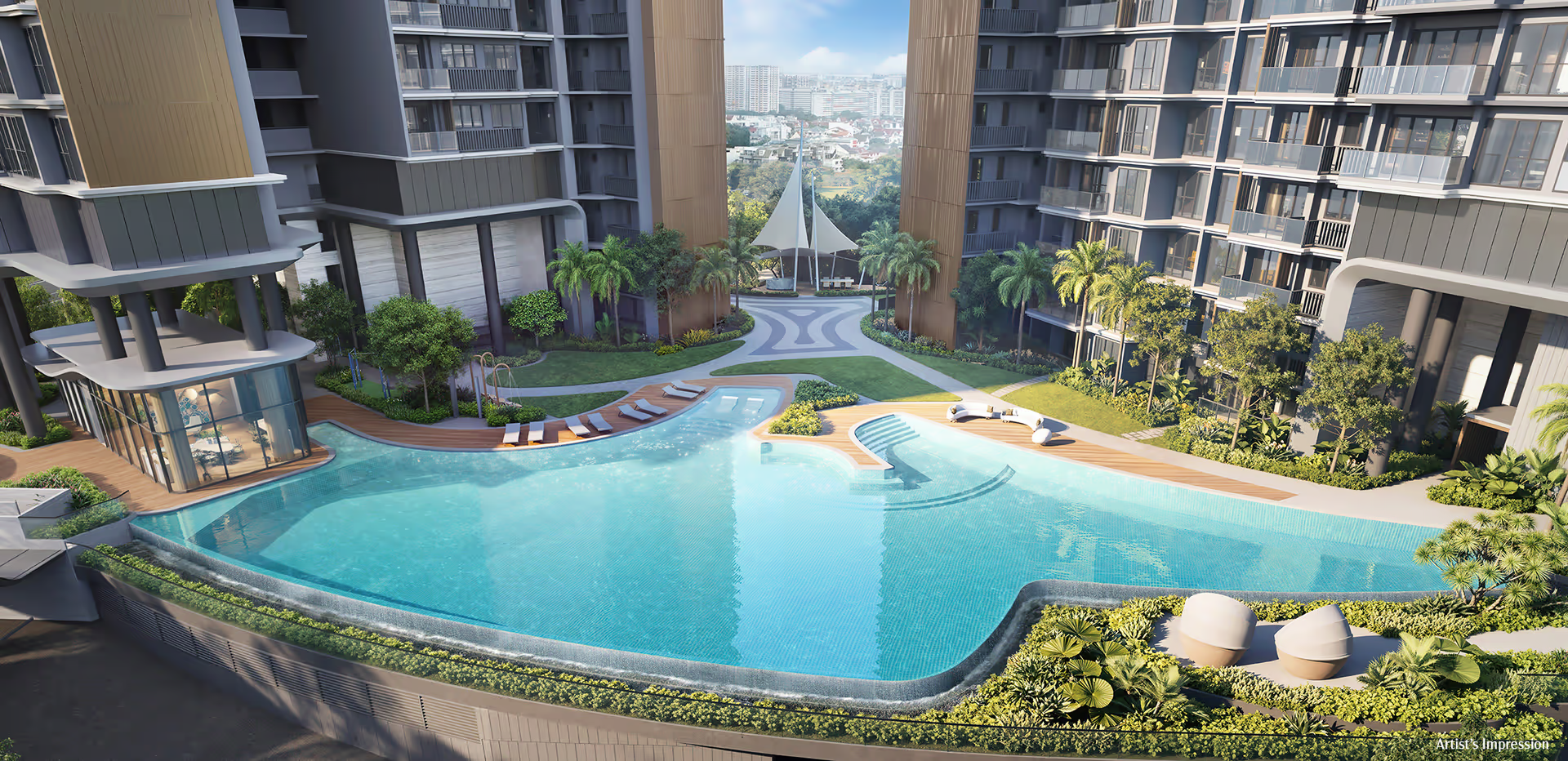
Elta is a 501-unit, 99-year leasehold development comprising two 39-storey residential towers located at 10 and 12 Clementi Avenue 1. The project is expected to obtain vacant possession around March 2028.
The 4-bedroom Type D1 units have a harmonised size of 1,184 sqft, with currently available units starting from $3,156,000 (as of 7 March 2026). The layout is designed as a practical family configuration, featuring a master bedroom with an ensuite bathroom, three additional bedrooms, a balcony, a dry and wet kitchen, a yard area, a store room, and a household shelter.
What the nearby resale and rental graphs imply for Elta’s 2028 rent potential
The following two charts show the ProTrend resale and rental trends (PropNex Investment Suite, generated on 7 March 2026). These charts provide the empirical basis for analysing the neighbourhood’s price movements and the rental premium typically commanded by newer developments compared to older projects.
What stands out from the resale trend
From the charted yearly averages (2017–2025): – The Clement Canopy’s average transacted psf rises from about $1,273 psf (2017) to about $1,998 psf (2025) (strong long-run appreciation trend). – Clavon tracks higher in recent years, reaching about $2,138 psf (2025).
Interpreting the shape (not just the endpoints), both projects show a clear upward slope into 2024–2025, which aligns with the broader narrative that Singapore private home prices continued rising but with moderating annual growth by 2025.

What stands out from the rental trend
From the charted yearly averages (2019–2026): – The Clement Canopy’s rental average climbs from about $3.68 psf/month (2019) to about $5.26 psf/month (2026), with a surge from 2021–2024 and a mild plateau thereafter. – Clavon prints higher rents in its limited data window: about $5.88 psf/month (2024) and $5.81 psf/month (2025), implying a “newer stock” premium.
This local picture aligns with the macro environment, where Singapore private rents surged sharply in 2022, grew more slowly in 2023, and then showed easing momentum as supply completions increased. For example, URA-referenced reporting noted that rentals rose 8.7% for full-year 2023 versus 29.7% in 2022, and fell 2.1% q-o-q in Q4 2023, largely due to increased completion supply and tenant resistance.
That matters for 2028 investors: Elta’s vacant possession will land in a market with potentially more supply, so projecting 2028 rents should use scenarios rather than a single straight-line CAGR.

Elta Type D1 pricing today on an apples-to-apples basis
For this analysis, we use two available Type D1 price points as reference:
• $3,156,000 (24th floor)
• $3,396,000 (39th floor)
Using the non-harmonised comparison size 1,237.28 sqft, the implied entry psf is:
- Low case: $3,156,000 ÷ 1,237.28 ≈ $2,551 psf
- High case: $3,396,000 ÷ 1,237.28 ≈ $2,745 psf
For context only, if a buyer compares using the published harmonised 1,184 sqft figure, the headline psf looks higher (≈$2,666–$2,868 psf). This is exactly why normalisation is useful when lining up against older projects marketed under earlier conventions.
Projected 2028 rental and gross yield for Elta D1
The projection logic
Instead of assuming one “correct” growth rate, the most defensible approach is to anchor to what tenants are already paying nearby, then apply conservative-to-upside adjustments:
- Nearby “newer” benchmark: Clavon ~ $5.81 psf/mo (2025) based on the provided chart.
- Nearby “young-mature” benchmark: Clement Canopy ~ $5.26 psf/mo (2026) based on the provided chart.
Then, consider what macro sources say about rent momentum: rents can surge in tight supply periods but can also soften when completions rise.
Three 2028 rent scenarios
All scenarios below convert rent using 1,237.28 sqft.
| Scenario | Assumed 2028 Rent (S$/psf/month) | Est. Monthly Rent (S$) | Gross Yield @ $3.156M | Gross Yield @ $3.396M |
| Conservative (roughly flat vs current Clavon rent) | 5.80 | 7,176 | 2.73% | 2.54% |
| Base (moderate growth: ~2% p.a. from 2025 to 2028) | 6.17 | 7,629 | 2.90% | 2.70% |
| Upside (stronger growth: ~4% p.a. + “brand-new” premium) | 6.73 | 8,329 | 3.17% | 2.94% |
These are gross yields (rent ÷ price). Real-world net yield will be lower after factoring in vacancy downtime, maintenance fees, property tax, insurance, agent fees, and financing costs.
A quick “reality check” using existing 4-bedroom yield patterns nearby
A common trend with larger units is that gross rental yields tend to be slightly lower, as the overall purchase quantum typically increases faster than achievable rents. At The Clement Canopy, 4-bedroom units currently rent at around $5.27–$5.28 psf, translating to gross yields of approximately 3.25%–3.38%, depending on the time period analysed.
Comparing that neighborhood yield band (~low 3%s) with Elta’s projected ~2.5%–3.2% suggests a simple takeaway:
Elta Type D1 can be a rentable family product in 2028, but its entry price means yield is likely “mid‑2s to low‑3s,” not high‑3s, unless 2028 rents surprise strongly to the upside.
What rent is needed to “feel like” a 3%+ yield deal?
Using the same 1,237.28 sqft:
- To hit 3.0% gross yield
- at $3.156M, rent needs to be about $7,890/mo (~$6.38 psf)
- at $3.396M, rent needs to be about $8,490/mo (~$6.86 psf)
Those rents are not impossible for a brand-new 4-bedroom in a strong cycle—especially if expat family budgets remain resilient—but they are meaningfully above today’s nearby benchmarks shown in your chart, so they should be treated as upside, not base case.
Is Elta Type D1 a good buy?
If your primary goal is rental yield
On the numbers, Elta Type D1 does not screen as a high-yield purchase at this pricing. Even with the size normalisation, the entry quantum of ~$3.16M–$3.40M implies that a very realistic 2028 rent outcome produces gross yields that are more commonly mid‑2% to around ~3%, with >3% requiring either (a) a meaningfully stronger rent market in 2028, or (b) Elta achieving a sustained premium above nearby “newer” stock.
This does not mean it is a bad investment—only that it is not a pure yield play at the current price band.
If your goal is a “new-family-home that can also rent well later”
Elta Type D1 looks stronger. The case here is less about squeezing yield and more about buying a brand-new, efficient family layout that aligns with proven demand patterns (Clavon D1-style) in an area with persistent tenant demand drivers tied to employment and education nodes.
For example, the broader one-north concept is a long-running work-live-play-learn district planned by JTC, anchored by precincts such as Biopolis/Fusionopolis/Mediapolis and supported by nearby education/research institutions—factors that tend to underpin medium-term rental demand across the Clementi/Queenstown city-fringe.
Key risks to acknowledge plainly
The most material risk is rent cycle timing. The same URA-linked reporting that documented the huge 2022 rent spike also points out rent easing when supply completions rise. If 2027–2029 completions are heavy, Elta’s initial leasing years could face more tenant choice and more landlord competition.
A second risk is large-unit liquidity: 4-bedroom units have a smaller buyer pool than 2-bedders, so resale demand and pricing can be more sensitive to macro conditions, interest rates, and family upgrader sentiment (even if the underlying product is good).
Bottom line
Elta Type D1 can be justified as a “good buy” if you value (a) a brand-new family layout, (b) future-proofed measurement transparency in a harmonised era, and (c) are comfortable with mid‑2% to low‑3% gross yield expectations at today’s price range.
If your priority is maximising rental yield, the same Clementi Avenue 1 micro-market evidence used here suggests you will likely find better yield efficiency in nearby resale options—unless you have a strong conviction that 2028 rents will re-accelerate materially beyond the range implied by Clavon/Clement Canopy’s latest observed rental benchmarks.
Disclosure: This post is educational and analytical. It is not financial advice. Projections are scenarios based on the provided ProTrend 4BR graph values, our 1237 sqft comparability assumption, and an indicative price of $3,156,000 to $3,396,000 (as of this article). Actual rents, yields, and timelines may differ.
Article contributed by Jerry Wong.

Jerry Wong is a realtor at Propnex Realty, bringing a rich background in interior and lighting design to his work. He loves exploring diverse spaces and observing the transformative power of real estate. Beyond his professional role, Jerry finds his greatest fulfillment in connecting people with the right properties, gaining immense satisfaction from helping clients achieve their dreams.