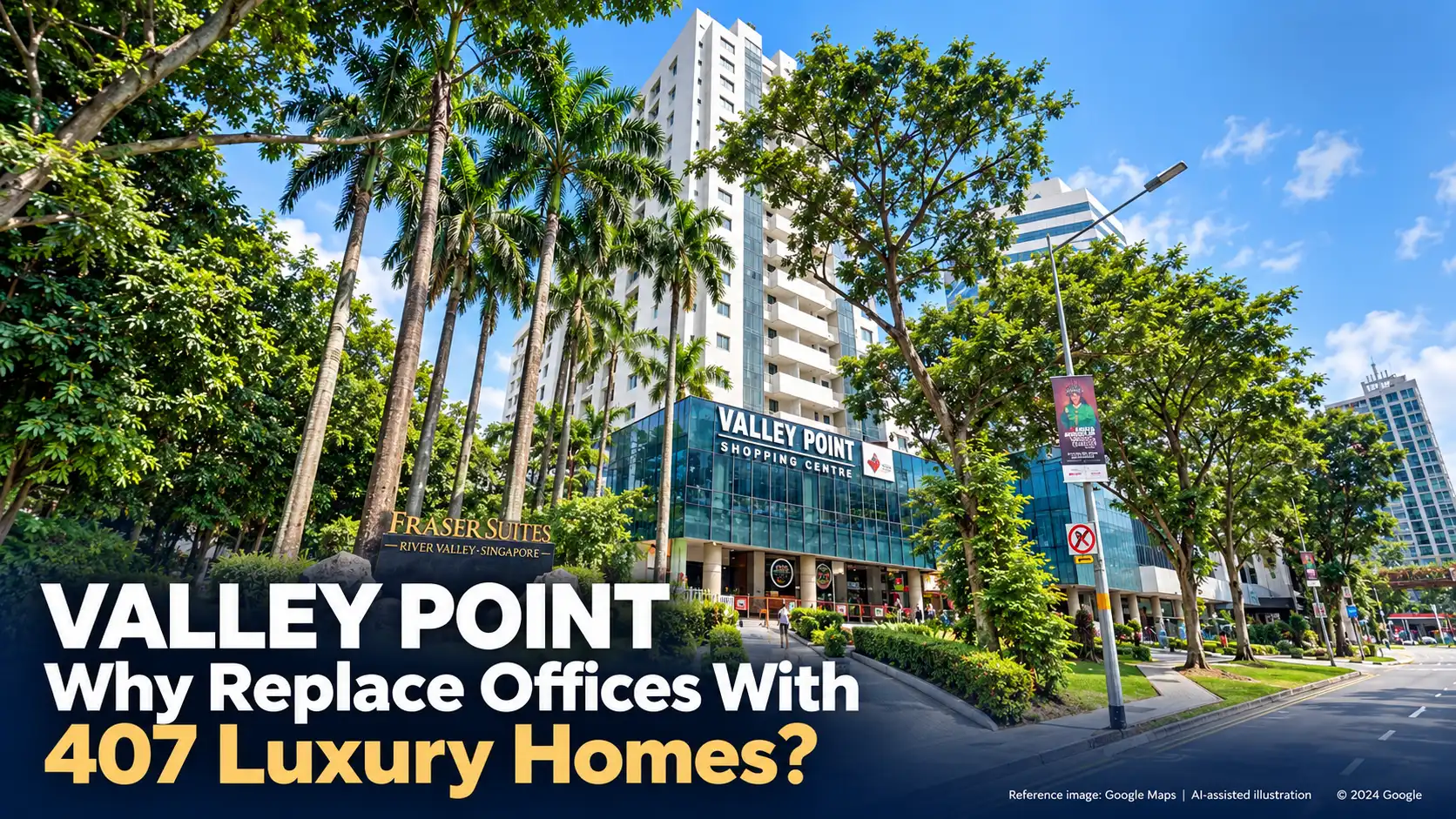
Valley Point already earns income from offices, shops and serviced apartments. Redeveloping it means giving up those earnings, committing fresh capital and waiting several years for a replacement to be completed.
Why would Frasers Property make that trade?
The proposed redevelopment points to a different way of earning returns from the land: sell private homes to realise part of the site’s value, while keeping a hospitality and commercial presence that can generate income after completion.
The overall plan is to generate greater value from the site through a new mix of uses. Whether the redevelopment succeeds will depend on whether those returns outweigh the rebuilding costs and the income forgone during construction.
What Frasers plans to build
Frasers Property and Mitsubishi Estate announced a 51:49 joint venture on 30 September 2026 to redevelop Valley Point and Fraser Suites Singapore.
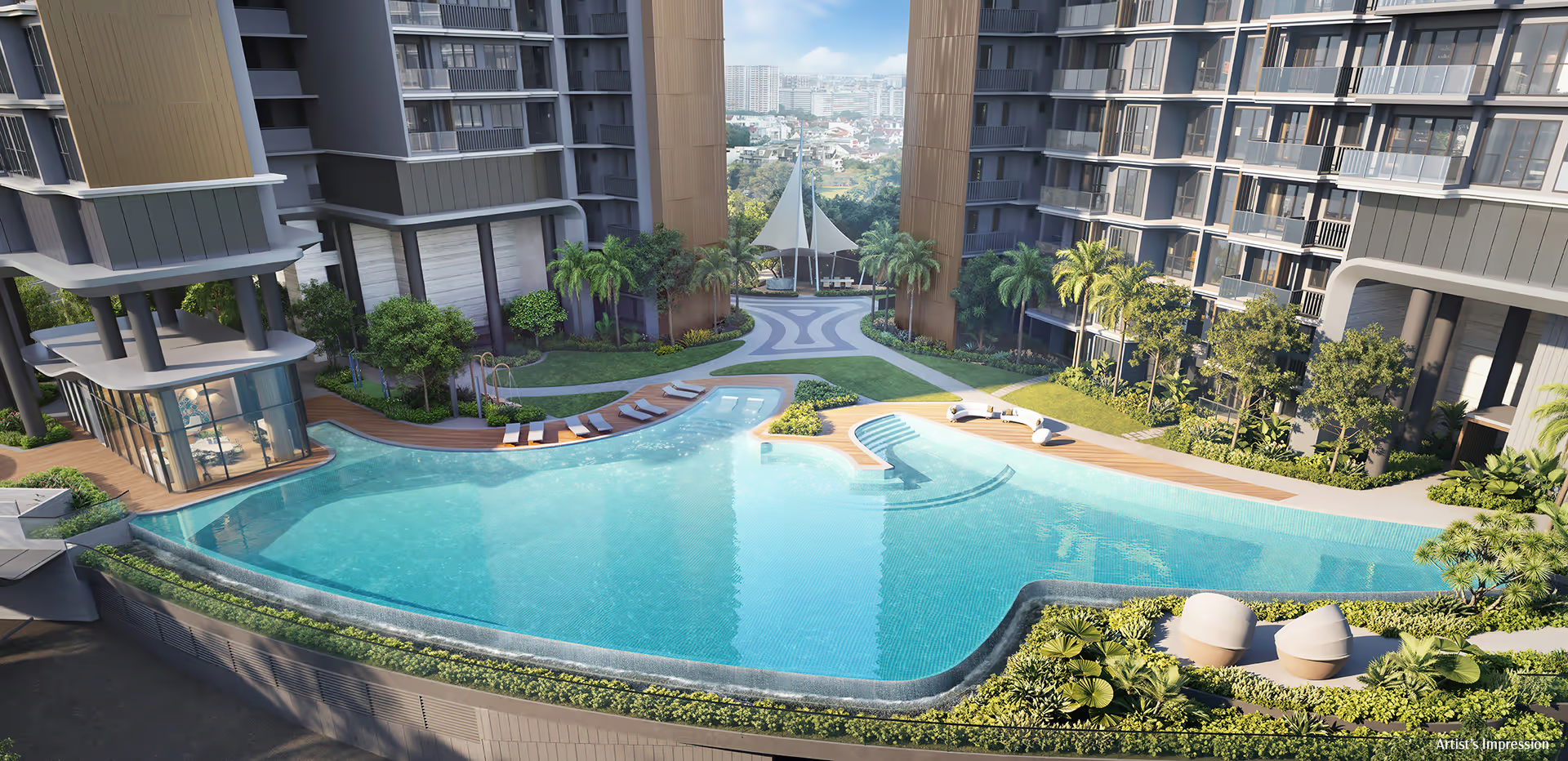
The proposed project will comprise approximately 407 luxury residences and sky villas, a 184-unit Fraser Suites, and retail, dining and lifestyle space. The launch is targeted for 2027, with completion in 2031. Existing operations are expected to cease on 31 March 2027.
The site has a 999-year lease commencing on 21 June 1877. Residential pricing has not been announced.
The notable change is the introduction of homes for sale. The announced mix does not include a replacement office component.
| Component | Existing development | Proposed redevelopment |
|---|---|---|
| Offices | Valley Point office tower | No replacement office component identified |
| Serviced residences | 255 units | 184 units |
| Private homes for sale | Not part of the existing announced operating mix | Approximately 407 residences and sky villas |
| Retail and dining | Valley Point shopping centre | Renewed retail, dining and lifestyle offerings |
An income-producing property can still be worth replacing
Redevelopment does not necessarily mean that the existing buildings have stopped being useful.
Reporting based on Frasers Property’s FY2025 annual report puts Valley Point’s combined office and retail occupancy at 79.2%, and Fraser Suites Singapore’s occupancy at 74.7%. These are historical figures, but they show the properties operated with substantial occupancy.
The decision is therefore more demanding than finding a use for an empty site. Frasers must weigh the earnings it could continue collecting against the returns it expects from redevelopment.
An older office tower may remain lettable while another use offers greater value for its location. Similarly, an established serviced residence may generate income while tying up capital that could be partly realised through selling homes.
This assesses the land’s best commercial use over time. Current occupancy alone cannot settle it: a busy building can still have redevelopment potential, just as a new building can struggle to earn an adequate return on its construction cost.
Home sales change the timing of returns
The existing development largely earns its returns through occupation: tenants rent offices and shops, while guests pay for serviced accommodation.
The proposed private homes introduce a different revenue source. Selling them provides a route to realising development value through individual purchases, instead of relying entirely on future rental and hospitality earnings.
That distinction matters for capital allocation. A developer can realise part of a property’s value through residential sales while maintaining exposure to income-producing uses elsewhere in the same development.
However, sales bookings are not the same as immediately receiving the full sales proceeds or recovering the investment. Cash collection, construction spending and financing obligations unfold over time. The benefit depends on both the prices achieved and the pace at which homes sell.
The 407 residences therefore become central to the redevelopment’s economics. Buyers must be willing to pay enough for the location, tenure, layouts and finished product to support the cost of replacing the existing buildings.
Keeping Fraser Suites preserves a future income stream
The proposal retains the Fraser Suites brand on the site, although the serviced-residence count falls from 255 to 184 units.
That is a reduction of 71 units, or approximately 27.8%. It signals a smaller hospitality operation by unit count, alongside a substantial new private-housing component.
It does not establish an equivalent fall in hospitality floor area or future earnings. Unit sizes, room rates, occupancy, operating costs and the standard of the replacement property will all matter.
Commercially, the combination offers two potential sources of return: development proceeds from home sales and recurring income from the completed serviced residences and commercial space.
The mix could also support the retail component. Permanent residents and serviced-apartment guests may provide regular customers for food, convenience and lifestyle businesses. Whether that translates into stronger rents will depend on the tenant mix, accessibility and appeal to the wider neighbourhood.
The cost of stopping operations is part of the bet
The expected March 2027 closure and targeted 2031 completion imply several years without the existing on-site operations. Reopening and achieving stable occupancy could take additional time.
That interruption is an economic cost. A comparison with retaining the current buildings must consider the net income forgone during redevelopment, alongside demolition, construction, professional fees, financing and applicable taxes and charges.
There is also execution risk. Higher building costs or delays can consume value even if the homes eventually sell well. Slower sales can tie up more capital for longer.
Partnering with Mitsubishi Estate brings another investor into the project. The 51:49 equity split shows how ownership is divided, but does not disclose all funding obligations or distribution arrangements.
Development costs and the joint venture consideration were not disclosed in the announcement coverage. It is therefore too early to calculate a credible project margin or break-even selling price.
Additional GFA supports the scheme but does not explain the whole decision
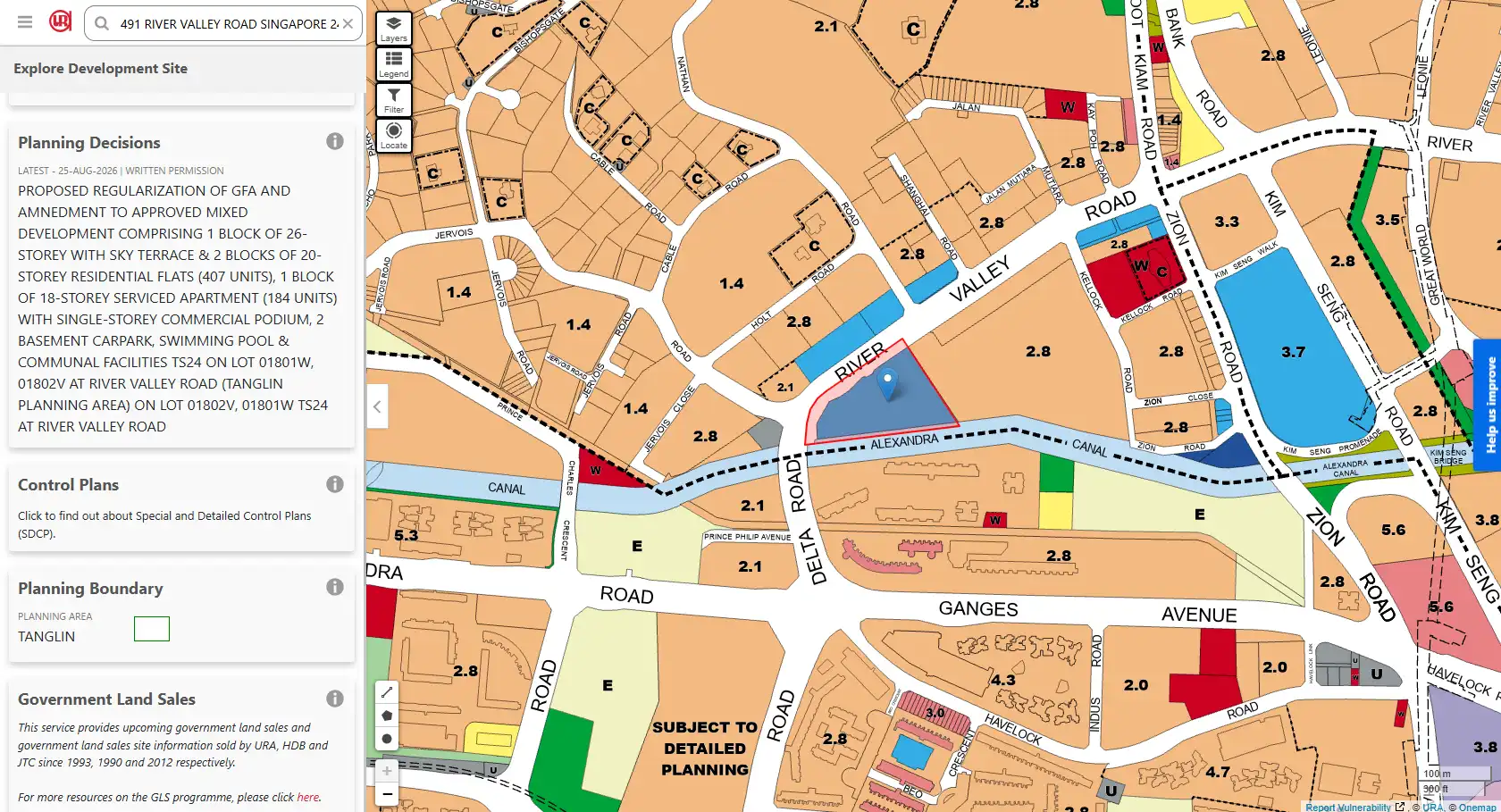
URA’s Written Permission dated 25 August 2026 approves 58,055.78 sq m of total GFA, with a stated overall gross plot ratio of 4.31.
The total comprises 54,309 sq m of commercial and residential GFA plus 3,746.78 sq m under the indoor recreation and balcony incentive schemes. The latter represents approximately 6.9% above that subtotal.
This confirms incentive GFA within the approved redevelopment. It does not establish the increase over the existing buildings: their combined approved GFA has not been verified on a comparable basis. The notice’s reference to GFA regularisation also does not quantify the change from the previously approved scheme.
The redevelopment should therefore not be presented as a proven case of a substantially underbuilt site. Changing the allocation of space from offices and serviced accommodation towards saleable homes can affect value even without a large increase in total floor area.
What would make the redevelopment worthwhile?
The decisive test is whether the residential proceeds and the value of the completed hospitality and commercial assets justify the property committed to redevelopment, the rebuilding expenditure and the risks taken.
Long ownership does not make the land economically free. Frasers could otherwise continue operating the properties, invest in improvements or consider selling them. Redevelopment must be assessed against those alternatives.
A large residential sales total does not automatically demonstrate success. Gross revenue must cover the costs of delivering the homes and the rest of the mixed development.
For buyers, the same distinction applies. A developer’s ability to unlock value from its land does not automatically make every new unit an attractive purchase. That assessment must wait for prices, layouts, specifications and the relationship between the residential and public-facing parts of the project.
Frasers is making a significant trade: several years of disruption and new investment in exchange for a different combination of sales proceeds and future operating income. The redevelopment will succeed commercially if that new combination delivers a better return than continuing with Valley Point as it stands.
Disclaimer: This article is for general information and discussion only and does not constitute investment, financial, legal or property advice. Project details, planning approvals and timelines are based on information available at the time of writing and may change. Interpretations of the redevelopment’s commercial rationale are the author’s analysis and should not be taken as statements of the developers’ intentions or expected returns. Approved GFA and incentive allocations do not, by themselves, establish an increase over the existing development’s floor area. Readers should verify current details with the developers and relevant authorities and seek independent professional advice before making any property or investment decision.
Article contributed by Jerry Wong.

Jerry Wong is a realtor at Propnex Realty, bringing a rich background in interior and lighting design to his work. He loves exploring diverse spaces and observing the transformative power of real estate. Beyond his professional role, Jerry finds his greatest fulfillment in connecting people with the right properties, gaining immense satisfaction from helping clients achieve their dreams.