When newer office buildings can command premium rents, why would major investors pursue an established development such as One Raffles Place?
The answer lies in the difference between a building’s rental rate and an investor’s return. A property with the highest rent does not automatically offer the best investment opportunity. What matters is the price paid, the income it can sustain and the cost of improving it.
That makes IOI Properties Group and CapitaLand Investment’s proposed acquisition of One Raffles Place worth a closer look. The opportunity could depend on how much more an established Raffles Place address can earn under a different investment and operating strategy.
According to The Business Times, the partners have entered exclusive due diligence after submitting a 50–50 joint bid to OUE REIT and UOB. Earlier reports placed indicative pricing at S$2.3 billion to S$2.4 billion. The transaction remains under negotiation; that range should not be treated as a confirmed purchase price.
An established landmark with different components
Describing One Raffles Place simply as an old office building misses an important distinction.
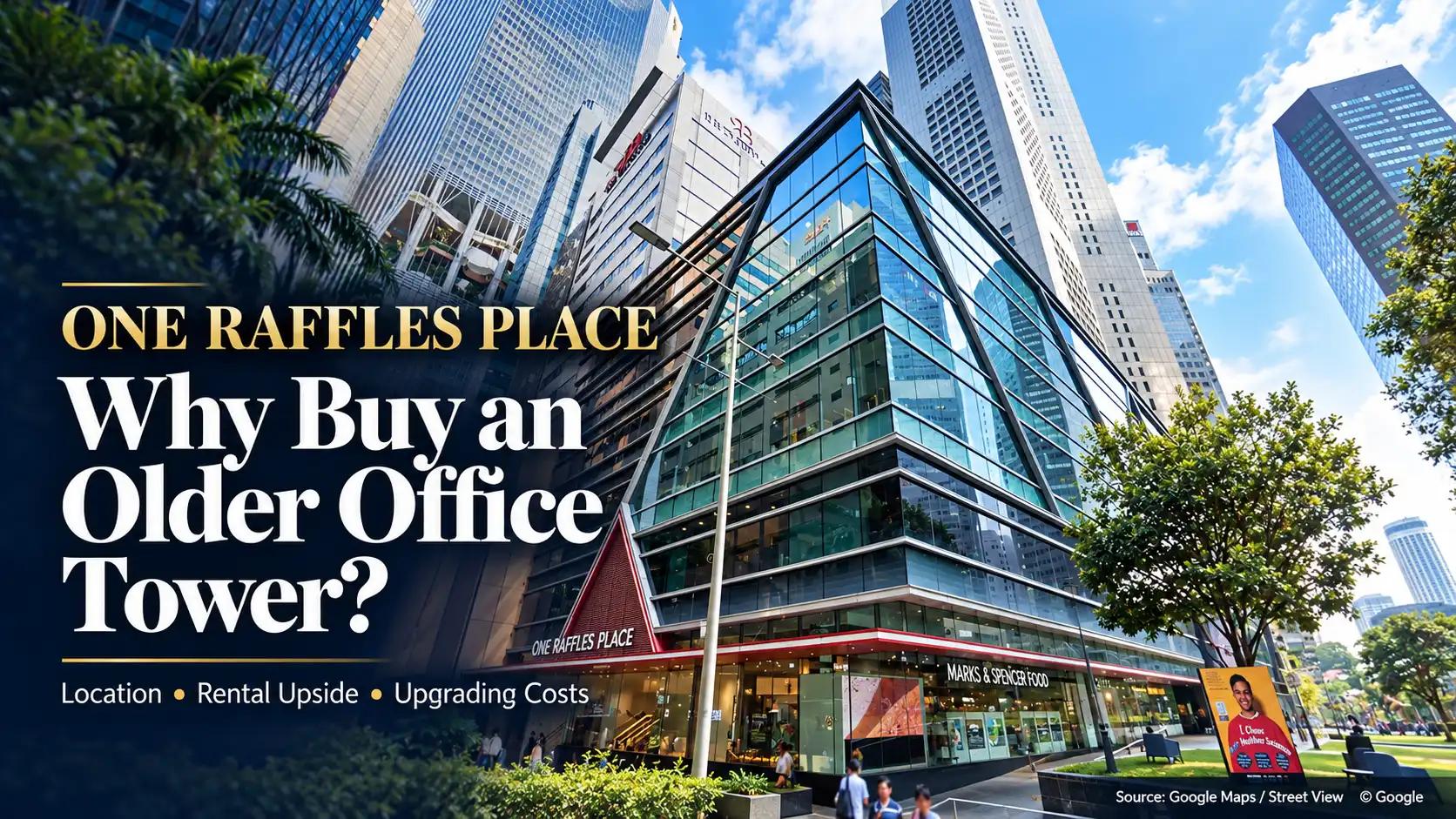
The development comprises two Grade A office towers and a six-storey retail podium. Tower 1 is the familiar 62-storey landmark, while the 38-storey Tower 2 was completed in 2012. The property also has a direct underground connection to Raffles Place MRT interchange.
These components need separate assessments. Their physical condition, tenant requirements, remaining useful life and potential upgrading costs will differ.
For a buyer, that creates the possibility of a targeted strategy: improve the areas where expenditure can produce a meaningful return, while continuing to collect income from functioning parts of the development.
Whether that approach works depends on detailed building surveys and leasing analysis. But it explains why the choice between “old” and “new” is too simplistic.
A premium building can already have its upside priced in
Newer offices can offer features that tenants value: efficient floor plates, modern building systems, attractive common areas and amenities that support recruitment and staff retention.
However, buyers of such properties also pay for those advantages.
If strong occupancy and premium rents are already reflected in the acquisition price, further income growth may be harder to achieve. An established building could offer a different proposition if it can be bought at a price that leaves sufficient room for improvements.
There is no basis yet to conclude that One Raffles Place is a bargain. Its final transaction terms, required capital expenditure and sustainable earnings would need to be assessed first.
The relevant comparison is therefore the income achievable relative to the total cost of ownership, including acquisition expenses, refurbishment and disruption during works.
A lower purchase price offers little advantage if the building subsequently requires disproportionate spending to remain competitive.
Location can support demand even when the building is older
An office serves a business purpose. Tenants weigh rent against commuting convenience, proximity to clients, operational needs and the cost of moving.
One Raffles Place’s position in an established commercial district and its MRT connection give it attributes that a refurbishment programme does not need to create from scratch.
The analytical question is whether those strengths allow it to retain tenants at rents that remain attractive to both occupiers and owners.
Consider a hypothetical company occupying 20,000 sq ft. A rental difference of S$2 per sq ft per month amounts to S$480,000 a year, before other occupancy costs.
That saving could influence a tenant’s decision if an established building still meets its operational requirements. Conversely, a company that needs particular technical specifications or a flagship corporate environment may consider a newer building worth the premium.
This suggests a potential market position for an upgraded established office: a convenient business address with suitable specifications at a competitive total occupancy cost.
It does not need to command the highest rent in Singapore to be financially successful.
The retail podium could improve the office proposition
One of the more concrete priorities identified by IOI is improving the retail tenancy mix.
In the report, IOI Properties chief executive Lee Yeow Seng highlighted demand from the surrounding office population and opportunities to improve dining choices. He also said there was no fixed redevelopment plan for the podium and Tower 1.
This matters because retail can contribute in two ways.
First, a better tenant mix could improve the podium’s own income. Second, useful dining and service options could make the office towers more convenient places to work.
The opportunity would depend on selecting businesses that match actual spending patterns. Quick lunches, coffee, everyday services and venues for informal meetings serve different needs and price points.
Office footfall alone does not guarantee profitable retail. A busy lunch period can coexist with quiet evenings, and higher shop rents are sustainable only if tenants can generate sufficient sales.
The objective should therefore be a healthier retail ecosystem that supports repeat visits and sustainable rents. Simply replacing existing tenants with more expensive concepts would not necessarily achieve that.
Upgrading must produce more income than it costs
The case for buying an established building often rests on the ability to improve its earnings. That requires discipline.
Some expenditure creates visible benefits that tenants may pay for. Other spending merely preserves the building’s ability to operate.
Replacing ageing equipment, for example, may be essential without producing an equivalent rent increase. Renovating common areas may improve competitiveness, but the owner still needs to establish whether it increases occupancy, supports higher rents or reduces tenant turnover.
A simplified hypothetical illustrates the distinction:
| Illustrative refurbishment outcome | Amount |
|---|---|
| Capital expenditure | S$50 million |
| Additional annual net property income after stabilisation | S$3 million |
| Incremental annual income divided by expenditure | 6.0% |
The 6% figure is an illustrative incremental yield on the refurbishment cost, not the return on the whole property or a forecast for One Raffles Place.
The actual outcome would also depend on how long the improvements take, income lost during construction, leasing incentives and financing costs.
An attractive proposal on completion can become less attractive if the owner must wait several years for the additional income.
Long tenure helps—but it is not uniform across the property
Tenure is another reason to avoid treating One Raffles Place as a single, uniform asset.
OUE REIT identifies Tower 1 as having an 841-year lease commencing in November 1985. Tower 2 has a 99-year lease commencing in May 1983. Approximately 75% of the retail podium’s net lettable area sits on a 99-year lease commencing in November 1985, with the remainder on the longer lease.
Tower 1’s long tenure provides a different investment horizon than the shorter-lease components.
However, a long land lease does not prevent building systems from ageing. Investors still need to fund maintenance and improvements, while assessing each component’s remaining income-producing life.
Calling the entire development “almost freehold” would therefore obscure a material valuation consideration.
The investment case does not require matching the newest towers
The most plausible investment thesis is that One Raffles Place could strengthen its position within the office market through selective improvements, better retail offerings and disciplined leasing.
This is an analytical interpretation, not a confirmed business plan from the prospective buyers.
Its success would depend on several questions: How competitive are existing rents? Which leases offer scope for increases? How much expenditure is needed? Can works be phased without excessive disruption? And does the acquisition price leave a sufficient margin for those risks?
Those questions matter more than whether the building can eventually match the rents of the newest premium towers.
An established office can be a good investment while still charging less than a newer competitor. It needs to provide tenants with a compelling reason to stay and generate sufficient income relative to the capital committed.
For One Raffles Place, the attraction may lie in improving an already valuable location. Whether that translates into an attractive return will ultimately depend on the purchase terms, the cost of execution and how much additional income the property can sustainably produce.
Disclaimer: This article provides general information and independent analysis, and does not constitute investment, financial, legal or valuation advice. Transaction details and indicative pricing reflect information available at the time of writing. The proposed acquisition of One Raffles Place remains subject to due diligence, final agreement and any applicable approvals. Illustrative calculations are hypothetical and are not forecasts of the property’s income, expenditure or investment returns. Views on rental upside, upgrading opportunities and tenant demand are analytical interpretations rather than confirmed plans of the prospective buyers. Readers should verify current information and seek professional advice before making investment decisions.
Article contributed by Jerry Wong.

Jerry Wong is a realtor at Propnex Realty, bringing a rich background in interior and lighting design to his work. He loves exploring diverse spaces and observing the transformative power of real estate. Beyond his professional role, Jerry finds his greatest fulfillment in connecting people with the right properties, gaining immense satisfaction from helping clients achieve their dreams.