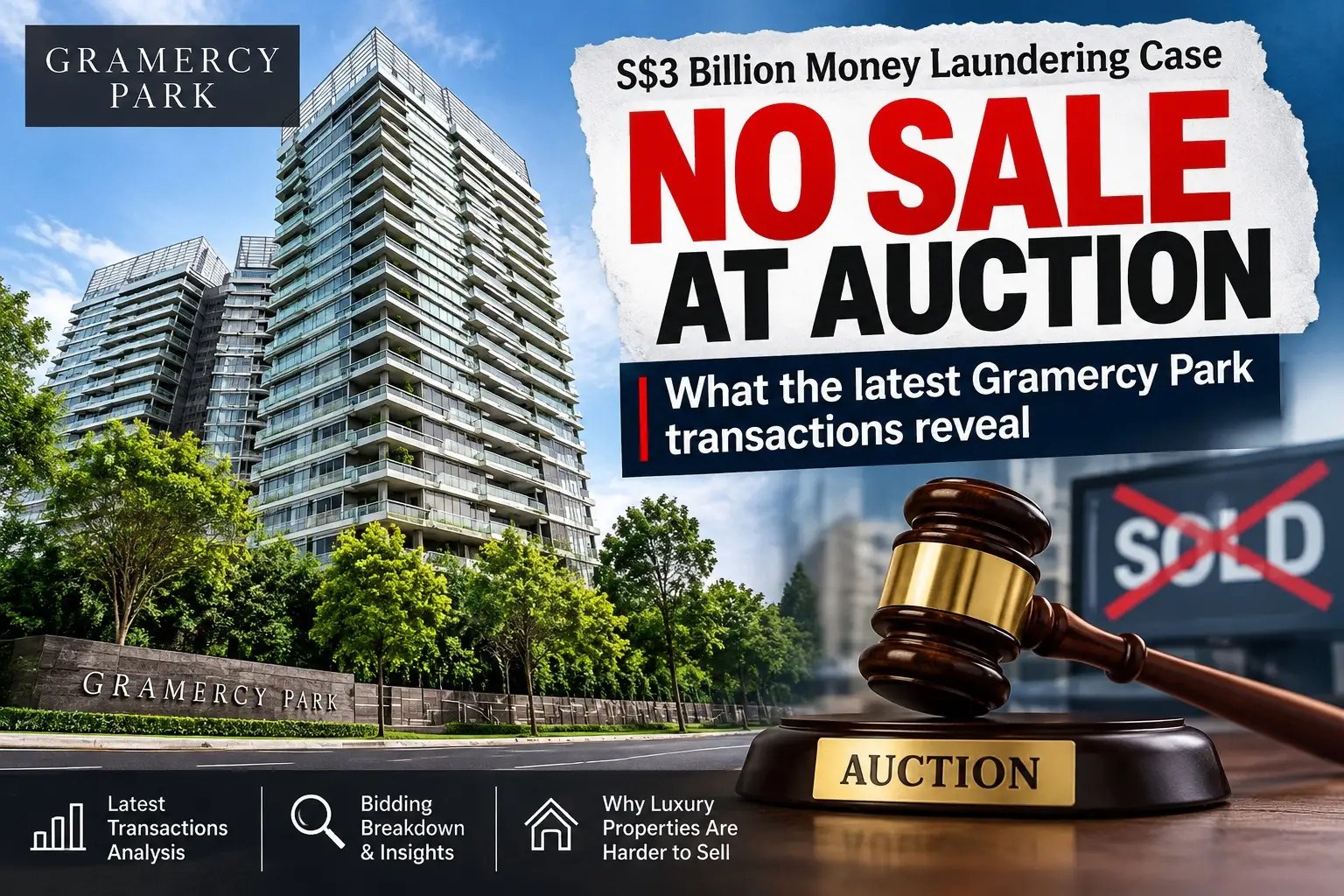
The first auction of properties seized in Singapore’s S$3 billion money-laundering case ended without a single sale.
On Sept 17, 2026, four apartments at Gramercy Park, two units at Sloane Residences and an office at Suntec Tower One were put up for auction by Knight Frank. All seven were eventually withdrawn after the bids failed to meet their respective reserve prices.
At first glance, that might suggest weak demand.
But the actual bidding — particularly at Gramercy Park — tells a more complicated story.
There were buyers.
Recent transactions at Gramercy Park also let us compare auction prices with actual resale evidence. And when we put those numbers together, a different picture emerges.
The problem may not be that buyers are unwilling to buy these properties.
They may simply be unwilling to buy them unless the auction provides a sufficiently attractive discount.
That distinction is particularly important in the luxury residential market, where demand tends to be much more discretionary — and therefore more price-sensitive — than in the mass-market condominium segment.
What Actually Happened at the Auction?
The Knight Frank auction attracted considerable attention.
There were 65 attendees, including 30 registered bidders, although Knight Frank noted that some attendees may have been curious observers.
The strongest bidding centred on two apartments at Gramercy Park.
The first was a 1,292 sq ft two-bedroom-plus-study unit at #21-07. It opened at S$3.82 million, or approximately S$2,957 psf.
Initial offers of S$3.2 million and S$3.3 million were rejected. Bidding then became more competitive, starting at S$3.5 million, with three interested parties eventually pushing the price to S$3.75 million, or approximately S$2,902 psf.
The unit was nevertheless withdrawn because the highest bid failed to reach its reserve price.
The second was considerably more revealing.
A renovated 2,659 sq ft four-bedroom apartment at #17-01 opened at S$7.55 million, or about S$2,839 psf.
Initial bids of S$4 million and S$4.5 million went nowhere.
But bidding subsequently restarted at S$6 million, and two bidders competed until the price reached S$6.7 million, or approximately S$2,520 psf.
Again, the property was withdrawn.
The question is therefore:
Were buyers offering unrealistically low prices, or were they pricing in the discount they expected from an auction?
Gramercy Park’s recent transactions give us some clues.
What Have Buyers Actually Been Paying at Gramercy Park?
The latest caveats show that Gramercy Park is not a development without transactions.
These are the seven latest transactions extracted from the PropNex Investment Suite App:
| Contract date | Size | Type | Price | PSF |
|---|---|---|---|---|
| 27 Aug 2026 | 1,948 sq ft | 3BR | S$5.60m | S$2,874 |
| 6 Jan 2026 | 2,153 sq ft | 3BR | S$5.20m | S$2,415 |
| 1 Aug 2025 | 1,948 sq ft | 3BR | S$5.70m | S$2,926 |
| 13 Jun 2025 | 2,680 sq ft | 4BR | S$7.50m | S$2,798 |
| 9 Apr 2025 | 1,981 sq ft | 3BR | S$5.65m | S$2,853 |
| 7 Mar 2025 | 2,691 sq ft | 4BR | S$7.50m | S$2,787 |
| 26 Nov 2024 | 1,270 sq ft | 2BR | S$3.63m | S$2,858 |
This gives us a much clearer basis for evaluating the auction results.
And the comparison is revealing.
The S$3.75 Million Bid Was Actually Quite Strong
Consider the smaller auction unit first.
The 1,292 sq ft #21-07 apartment received a highest bid of:
S$3.75 million / S$2,902 psf.
No recent transaction matches this exact unit configuration, so we should be careful about a direct like-for-like comparison.
But the closest recent smaller-unit transaction was a 1,270 sq ft two-bedroom apartment sold for S$3.63 million, or S$2,858 psf, in November 2024.
That makes the auction result interesting. The unsuccessful bid of S$2,902 psf was actually about 1.5% higher on a psf basis than that 2024 transaction.
It was also very close to the S$2,926 psf achieved by a 1,948 sq ft three-bedroom apartment in August 2025, although the different unit sizes and configurations mean that comparison should not be treated as directly equivalent.
More importantly, the S$3.75 million bid was only S$70,000 below the S$3.82 million opening price.
That’s less than a 2% difference. So calling the result a lack of demand would be misleading.
Three bidders competed for the property. Someone was prepared to pay S$3.75 million.
The issue was the reserve price, not the absence of buyers.
The Four-Bedroom Auction Tells a Very Different Story
The 2,659 sq ft #17-01 four-bedroom apartment offers a much better comparison because Gramercy Park has two very recent transactions involving almost identical four-bedroom apartments.
A 2,680 sq ft four-bedroom unit sold for S$7.5 million, or S$2,798 psf, in June 2025.
Another 2,691 sq ft four-bedroom unit sold for S$7.5 million, or S$2,787 psf, in March 2025.
The auction unit was 2,659 sq ft.
Its opening price of S$7.55 million — about S$2,839 psf — was therefore not obviously unreasonable compared with these transactions.
In fact, the guide was only around S$50,000 above the S$7.5 million achieved by each of those two comparable four-bedroom units.
But buyers at the auction weren’t prepared to pay that.
The bidding stopped at:
S$6.7 million, or approximately S$2,520 psf.
That is where the story becomes much more interesting.
Buyers Wanted Roughly an 11% Discount
Compare the S$6.7 million auction bid against those two S$7.5 million transactions.
The difference is:
S$800,000.
That represents a discount of approximately 10.7% to the S$7.5 million transaction price.
On a psf basis, the difference is similar.
- Against S$2,798 psf, the S$2,520 psf auction bid represents a discount of approximately 9.9%.
- Against S$2,787 psf, that’s about 9.6%.
That tells us something important about how bidders may be approaching these properties.
They don’t necessarily appear to be asking:
“What is Gramercy Park worth?”
The recent transactions already provide some evidence of that.
Instead, they may be asking:
“How far below normal market value do I need to buy before this auction becomes worthwhile?”
That is an entirely different mindset.
This Doesn’t Look Like a Fire Sale
This distinction is crucial.
Before the auction, one might have assumed that properties seized in the money laundering case would eventually be sold at deeply discounted prices.
But the reserve prices appear to have prevented that from happening — at least during this first auction.
The authorities are not simply accepting whatever the highest bidder offers.
This aligns with earlier analysis of the auction portfolio, which suggested that many guide prices were relatively close to prevailing transaction or asking prices rather than priced as distressed sales.
Gramercy Park illustrates this particularly well.
- A 2,680 sq ft apartment sold for S$7.5 million.
- A 2,691 sq ft apartment sold for S$7.5 million.
- The 2,659 sq ft auction apartment opened at S$7.55 million.
Where, then, was the bargain?
From an auction buyer’s perspective, arguably there wasn’t much of one at the opening price.
And that may explain why bidders tried to manufacture their own discount.
Why Auction Buyers May Demand a Discount
This brings us to auction psychology.
A normal resale buyer may enter negotiations because they specifically want a particular development.
An auction buyer may enter for a different reason:
They are looking for an opportunity.
That distinction matters.
Someone attending an auction of seized assets may expect compensation for accepting the uncertainties and inconvenience associated with the purchase.
That does not mean every bidder expects a distressed-sale price.
But if the property is offered at essentially the same price that comparable units have achieved through ordinary resale transactions, some buyers may reasonably ask:
Why buy through the auction at all?
If an ordinary resale unit can be negotiated at a similar price — potentially with a motivated seller, better presentation and more conventional transaction dynamics — the auction needs another attraction.
Usually, that attraction is price.
Condition Becomes Particularly Important at This Level
There is another complication.
Not every seized apartment is necessarily being presented in the condition normally associated with a multimillion-dollar luxury home.
This was particularly apparent at Sloane Residences.
CNA reported that one prospective buyer who inspected a unit estimated that she would need to spend at least S$200,000 on renovations. She observed missing light fittings and appliances, while The Straits Times also reported concerns about the property’s condition.
This matters because luxury property isn’t purchased purely by multiplying square footage by a market psf.
- Presentation matters.
- Finishes matter.
- Condition matters.
- And, perhaps most importantly, emotion matters.
Luxury Property Is Not the Same as Mass-Market Housing
This is where we think the difference between the luxury and mass-market condominium segments becomes particularly important.
Economists describe demand as more elastic when buyers respond strongly to price changes.
Demand is more inelastic when price changes have a smaller effect on the quantity demanded.
We shouldn’t interpret that to mean that every mass-market condominium has inelastic demand or every luxury condominium has elastic demand.
Property markets aren’t that simple.
But luxury housing generally has an important characteristic:
The purchase is more discretionary.
Imagine a family buying a S$1.5 million to S$2 million home.
- They may need three bedrooms.
- Their children may attend a nearby school.
- Their parents may live nearby.
- They may need to be close to an MRT station.
- They may already have sold their existing property.
They may have practical reasons to transact.
A buyer considering a S$7 million luxury condominium is in a very different position.
- They can buy another luxury development.
- They can choose another district.
- They can buy freehold instead of leasehold.
- They can invest the S$7 million elsewhere.
- They can continue living in their existing property.
- Or they can simply do nothing.
That creates a much larger universe of substitutes.
And when buyers have substitutes, they can walk away much more easily.
Gramercy Park’s Transaction History Demonstrates This
The transaction history itself illustrates the luxury market’s price variability.
Recent Gramercy Park transactions range from S$2,415 psf to S$2,926 psf.
Go further back, and the variation becomes even greater.
A 2,680 sq ft four-bedroom apartment that changed hands at approximately S$3,377 psf in April 2022 was subsequently resold at around S$2,798 psf in June 2025.
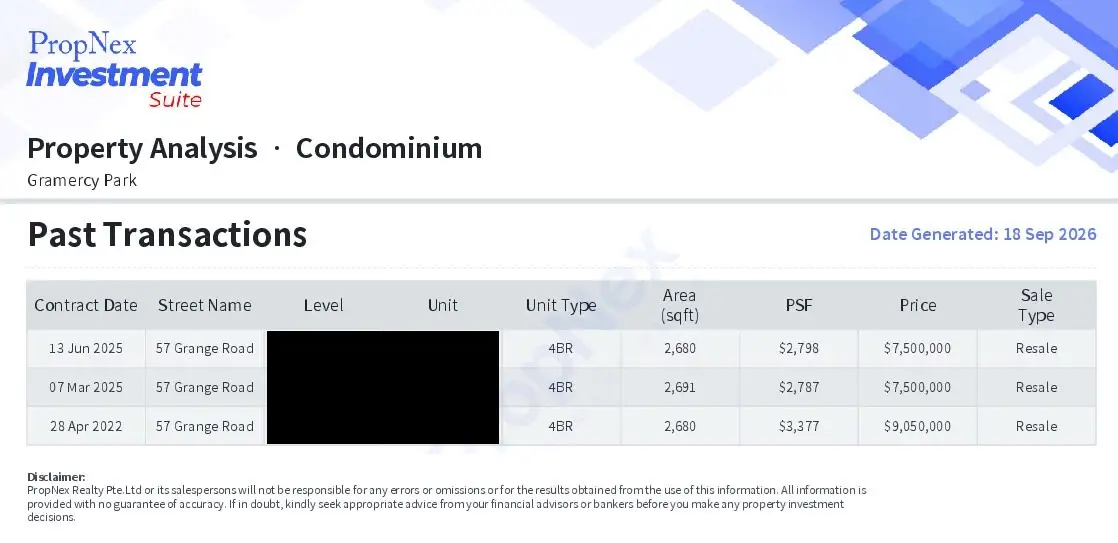
That is a substantial difference for apartments within the same development. It reinforces why applying a single “market psf” to a luxury development can be misleading.
Views, floor level, renovation, layout, buyer motivation and the small number of transactions can have an outsized impact.
Liquidity is also thinner. That means price discovery can be messy.
And That Makes Presentation Even More Important
This is why we believe the physical presentation of these seized properties shouldn’t be dismissed as cosmetic.
Imagine two identical S$7 million apartments.
- One is professionally staged.
- The curtains are open.
- The lighting is carefully designed.
- The marble has been polished.
- The furniture is contemporary.
- Everything is functioning.
The buyer walks inside and immediately imagines living there.
Now imagine the same apartment with damaged finishes, missing appliances, deteriorated fittings and obvious refurbishment work ahead.
The buyer starts calculating.
- S$100,000 for this.
- S$50,000 for that.
- Perhaps S$200,000 or S$300,000 for renovation.
Then another margin for unexpected problems.
And finally:
“Since I’m buying this at auction, what discount am I actually getting?”
The psychology has completely changed.
Instead of adding an emotional premium, the buyer starts subtracting a risk discount.
The S$6.7 Million Bid May Therefore Be More Rational Than It First Appears
Look at the four-bedroom Gramercy Park apartment through this lens.
Recent comparable transactions:
S$7.5 million.
Auction opening price:
S$7.55 million.
Highest auction bid:
S$6.7 million.
At first glance, the S$6.7 million offer looks low.
But from the bidder’s perspective, paying S$7.5 million would effectively mean paying approximately what previous buyers paid through the normal resale market.
Where is the auction upside?
At S$6.7 million, however, the buyer would be entering around S$800,000 below those recent comparable transactions.
Now there is an identifiable margin.
That margin compensates for uncertainty, transaction circumstances and potentially renovation or holding costs.
Whether S$6.7 million represents fair value is ultimately subjective.
But the bid makes considerably more economic sense when we examine it against Gramercy Park’s actual transaction history.
The Smaller Unit Tells Us Something Different
Interestingly, #21-07 tells almost the opposite story.
At S$3.75 million or S$2,902 psf, the highest bid was already within the range of recent Gramercy Park resale transactions.
And three bidders competed for it.
- That suggests smaller luxury units may behave differently.
- The absolute quantum was only S$3.75 million rather than S$6 million to S$8 million.
- That dramatically expands the potential buyer pool.
- It also reduces the absolute financial consequences of paying slightly more per square foot.
This could explain why competition was much stronger for the smaller unit.
Price elasticity may therefore increase not merely because a property is “luxury”, but as the absolute quantum becomes progressively larger.
That is an important distinction.
The First Auction Has Actually Given Us Valuable Price Discovery
So I wouldn’t describe the Sept 17 auction as a failure.
No properties were sold.
But the auction gave us information.
For the 1,292 sq ft Gramercy Park unit, competitive bidding established that at least one buyer was prepared to pay:
S$3.75 million / S$2,902 psf.
For the 2,659 sq ft four-bedroom unit:
S$6.7 million / S$2,520 psf.
These aren’t transactions because the hammer never fell.
But they are real bids from buyers prepared to put money on the table.
That is useful price discovery.
And now everyone knows those numbers.
That Could Make the Next Stage More Interesting
Knight Frank has said that the relevant authorities will decide whether to put the unsold properties through another auction or enter into private negotiations with interested bidders.
This changes the negotiating dynamics.
- The seller now knows someone was prepared to pay S$3.75 million for #21-07.
- The highest bidder knows the property failed to sell.
- Other potential buyers know where the bidding stopped.
- And everybody knows the recent Gramercy Park transactions.
The question is therefore no longer simply:
“What is this apartment worth?”
It becomes:
“How far apart are the seller and the highest bidder?”
For #21-07, that gap may be relatively narrow. For #17-01, it could be substantially wider.
More Seized Properties Are Coming
The Sept 17 auction is also only the beginning.
More than 80 properties connected with the case are expected to be progressively realised, and Deloitte has previously said that assets may be sold not only through auctions but also through methods including limited tender, expressions of interest and direct sales.
That creates another interesting dynamic.
Buyers know more inventory is coming.
For a buyer seeking a luxury property rather than one specific apartment, there may therefore be little urgency.
Why chase a property aggressively today when another seized luxury unit may appear shortly afterwards?
Again, this is where the elasticity of luxury demand matters.
The buyer has alternatives.
Our Take
The first auction of properties seized in the S$3 billion money laundering case does not show that Singapore’s luxury property market has suddenly lost its buyers.
The Gramercy Park numbers actually suggest something more nuanced.
- There was genuine demand.
- There were multiple bidders.
- And one buyer was prepared to offer S$3.75 million for the smaller Gramercy Park apartment, only S$70,000 below its S$3.82 million opening price.
But the four-bedroom apartment tells a different story.
Two similar-sized four-bedroom units had recently sold for S$7.5 million, yet auction bidders stopped at S$6.7 million.
That approximately S$800,000 gap may be the most important number from the auction.
It suggests that some buyers aren’t merely looking for a luxury home.
They are looking for an auction opportunity.
And if the price approaches ordinary resale value, much of the attraction disappears.
That is especially important in the luxury market because demand is highly discretionary. A buyer considering a S$7 million apartment can choose another development, another district, another investment — or simply wait.
Add the condition of some of these seized properties, the potential renovation expenditure and the knowledge that more properties are coming to market, and buyers have several reasons to remain disciplined.
So the difficulty in selling these properties may not necessarily be because their guide prices are fundamentally unreasonable.
Gramercy Park’s transaction evidence suggests that at least some of the guide prices are defensible against recent resale transactions.
The problem is that a defensible market price and an attractive auction price are not necessarily the same thing.
And that could ultimately determine how quickly the remaining properties from Singapore’s S$3 billion money laundering case are sold.
Disclaimer: This article is provided for general information and commentary only and should not be regarded as financial, investment, legal or property advice. The analysis is based on publicly available information, reported auction results and property transaction data available at the time of writing. Auction bids that did not result in completed sales should not be treated as confirmed market transactions or definitive indications of market value. References to price elasticity, buyer behaviour, renovation costs and possible motivations of bidders represent general market analysis and should not be interpreted as statements about any specific individual. Property values can vary significantly depending on factors including unit condition, floor level, orientation, views, layout, renovation, market conditions and transaction circumstances. Readers should conduct their own due diligence and seek appropriate professional advice before making any property or investment decision.
Article contributed by Jerry Wong.

Jerry Wong is a realtor at Propnex Realty, bringing a rich background in interior and lighting design to his work. He loves exploring diverse spaces and observing the transformative power of real estate. Beyond his professional role, Jerry finds his greatest fulfillment in connecting people with the right properties, gaining immense satisfaction from helping clients achieve their dreams.