
Singapore’s HDB resale market became considerably busier in the third quarter of 2026, yet the increase in transactions did not translate into higher overall prices.
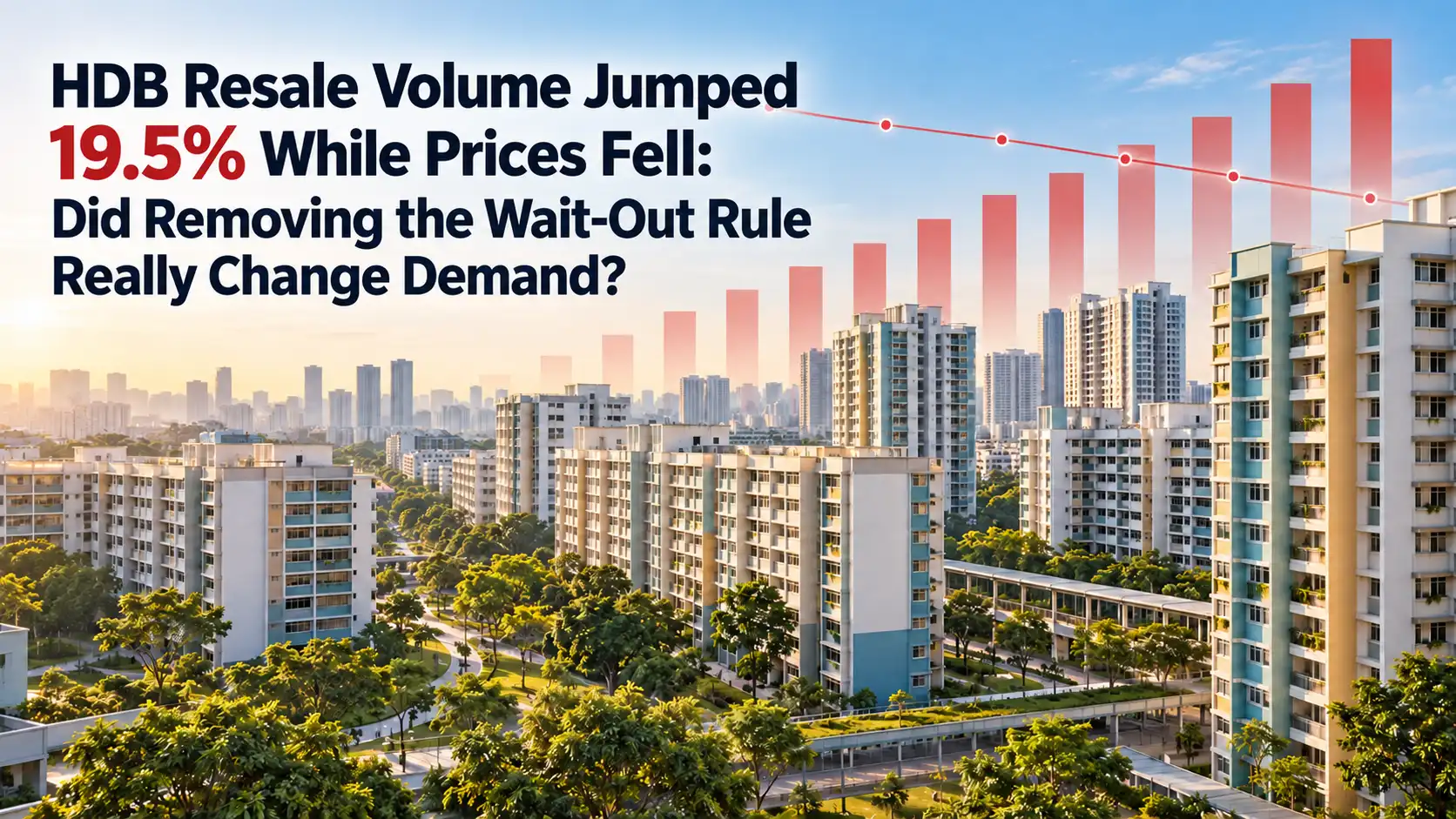
HDB’s final figures, released on 23 October, recorded 7,645 resale transactions, up 19.5% from 6,396 in Q2 and 5.9% from the previous year. Meanwhile, the Resale Price Index slipped 0.1%, marking its third consecutive quarterly decline.
For homebuyers, this is an encouraging combination: more transactions taking place without an accompanying rise in the overall price index. For sellers, it suggests there are buyers willing to commit, although a busier market does not automatically justify a higher asking price.
The figures also raise a question: how much of the increase came from removing the 15-month wait-out period for private-property owners?
The headline numbers alone cannot answer that.
More Transactions Do Not Automatically Mean Stronger Pricing Power
Transaction volume and prices measure different aspects of the market.
Higher volume tells us that more buyers and sellers reached an agreement. It does not tell us whether buyers stretched their budgets or sellers accepted more realistic offers.
One possible explanation for Q3’s combination of rising activity and slightly falling prices is that expectations became better aligned. Buyers may have felt more comfortable committing, while sellers may have become more willing to negotiate.
That is an interpretation, rather than a finding established by the quarterly figures. Nevertheless, it explains why stronger sales activity can coexist with softer prices.
A 0.1% quarterly decline is also modest. It points to broadly steady prices with a slight downward movement, rather than widespread bargains across every town and flat type.
Did Removing the 15-Month Wait-Out Period Drive the Increase?
The rule’s removal naturally attracted attention because it eased the path for eligible private-property owners and former owners to purchase non-subsidised HDB resale flats.
HDB said it had not observed a significant increase in either the prices or the number of resale flats purchased by these buyers since the wait-out period was removed on 28 July 2026.
That observation weakens the claim that the policy change immediately unleashed a wave of private-property wealth that pushed HDB resale prices higher.
However, it does not establish that the change had no effect. To understand what drove the increase in transactions, we need to examine several influences separately.
1. Seasonality and the comparison quarter
While the 19.5% quarter-on-quarter surge was surprising, the year-on-year increase was only a modest 5.9%.
Comparing Q3 with the same quarter a year earlier helps put the rebound in perspective, although it does not fully isolate seasonal effects. A stronger assessment would examine several years of quarterly patterns and account for changes in supply and policy.
It would therefore be premature to attribute the entire Q2 increase to the removal of the wait-out rule.
2. Delayed purchases coming through
Some households may have postponed their purchases while considering their options, arranging their finances or coordinating a move.
The rule change could also have brought forward purchases by households that had already intended to buy an HDB flat. That would affect the timing of demand, without necessarily representing an equivalent increase in long-term demand.
These are plausible explanations to investigate. The aggregate quarterly totals do not show how many transactions fall into each category.
3. The mix of flats and buyers
An additional transaction involving a smaller, older flat tells a different story from an additional transaction involving a large flat in a highly sought-after location.
To assess the policy’s impact, it would help to know which flat types and towns drove the increase, along with the purchasing patterns of private-property owners and former owners.
HDB’s town-level median prices can provide useful context, but a median describes the flats sold during that period. It should not be treated as the price change of an otherwise identical flat.
Without a more detailed breakdown, neither the overall transaction increase nor individual high-priced sales can establish a policy-driven surge.
Why One Quarter Is Too Early for a Final Verdict
However, an important caveat is that the policy had been in effect for only about two months by the end of Q3.
Households need time to assess their eligibility, search for a suitable home, negotiate and progress through the purchase process. Any change in behaviour may therefore appear gradually.
There is also a difference between observing falling prices and proving that a policy had no upward influence. Prices could, in principle, have fallen further without the rule change. Conversely, the increase in transactions could largely reflect unrelated factors.
The available figures do not establish either scenario.
A more convincing assessment would track subsequent quarters, including the number and share of purchases by affected buyers, the flats they purchased and price movements among comparable properties.
What Buyers and Sellers Should Take From This
For buyers, the figures offer little support for rushing into a purchase simply because private-property owners can return to the market more easily. Recent transactions involving comparable flats remain more useful than a broad claim that prices are about to surge.
For sellers, higher activity is encouraging, but pricing still needs to reflect the competition. A busier market can improve the chance of finding a buyer without increasing what that buyer is prepared to pay.
Q3’s clearest message is that more HDB resale transactions took place while overall prices edged down. That is consistent with a market where households can complete their moves without renewed broad-based price escalation.
Whether removing the wait-out period changes that balance will require more time—and more detailed evidence—than a single quarter can provide.
Disclaimer: This article is for general information only and does not constitute financial, investment or property advice. It is based on HDB’s Q3 2026 statistics and information available as at 28 October 2026. Views on market trends and the effects of the removal of the 15-month wait-out period are interpretations, not confirmed causal findings or predictions. Overall market movements may not reflect the value or performance of individual flats. Readers should verify current policies and eligibility requirements with HDB and seek professional advice before making property decisions.
Article contributed by Jerry Wong.

Jerry Wong is a realtor at Propnex Realty, bringing a rich background in interior and lighting design to his work. He loves exploring diverse spaces and observing the transformative power of real estate. Beyond his professional role, Jerry finds his greatest fulfillment in connecting people with the right properties, gaining immense satisfaction from helping clients achieve their dreams.


Let’s Discuss Your Property Plans
Interested in This Property?
Buying, selling or renting? Get a free consultation with realtors with a background in interior and lighting design. We’ll discuss your goals and help you assess your options—from pricing and timelines to layout practicality and space potential.
Share your contact details below, and we will get in touch to understand your needs and suggest the next steps. No pressure. No obligation to proceed.