
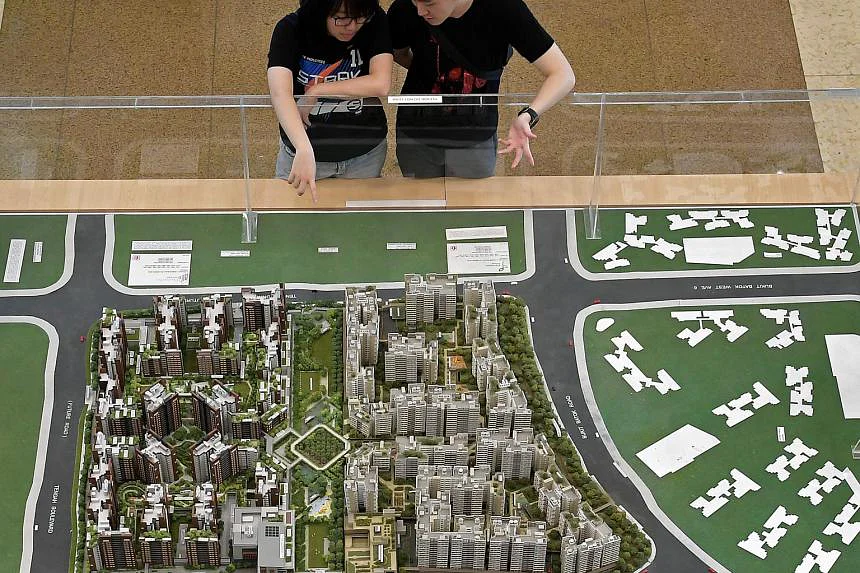

SINGAPORE – The United States central bank has raised benchmark interest rates by 0.75 percentage point – the biggest increase since 1994.
The decision to hike by what Federal Reserve chair Jerome Powell called an “unusually large” amount came as inflation in the US hit 8.6 per cent in May, a level not seen in more than 40 years.
The rise brought benchmark rates to between 1.5 per cent and 1.75 per cent, with the Fed signalling that another 0.75 percentage-point lift is possible at its July meeting.
Central banks around the world have been on a tightening path to fight inflation, including here, where the Monetary Authority of Singapore (MAS) has adjusted monetary policy three times since last October.
Unlike most central banks that fight inflation through interest rates, Singapore does so by letting the Singdollar rise or fall against a basket of currencies of its main trading partners. The Singdollar has been allowed to appreciate in a bid to curb imported inflation.
Because monetary policy is centred on the exchange rate and Singapore’s capital markets are open, interest rates here are largely influenced by global market movements, especially US rates.
ST Explains looks at how rising US rates will affect mortgages and other loans in Singapore.
1. There have been three rate hikes in the US this year. But Sora, the new interest rate benchmark for floating loans in Singapore, has not moved that much. Why?
Mr Ernest Tay, a real estate consultant at Huttons Asia, says banks can still borrow at low rates in the interbank lending market. This is because they are flush with cash in the form of savings and fixed deposits that pay interest much lower than the now-climbing official rate.
Sora is based on the average rate of all interbank lending transactions and the low interbank rate means Sora has not moved that much higher, Mr Tay says.
Floating home loans are also usually priced using the one-month compounded Sora rate or the three-month compounded Sora rate.
Mr Eugene Leow, rates strategist at DBS Bank, says these are both backward-looking rates. For example, the three-month compounded Sora takes into account the Sora rates of the past three months, while the one-month compounded Sora cites rates of the past month.
Mr Leow notes that there is a lag, but the rates will usually catch up in about one to three months.
He adds that the strong Singdollar puts downward pressure on domestic interest rates so they will not go up as much as US rates. For example, if US rates go up by 1 percentage point, Singapore rates might go up by only 0.7 percentage point.
While floating rates have not moved much so far, fixed-rate home loans have priced in the US hikes since the fourth quarter of last year.
The Straits Times has been tracking these. As an example, three-year fixed rates were around 1.15 per cent in the fourth quarter of last year, but have since risen by about 1.45 percentage points to 2.6 per cent now.
2. What should borrowers do?
Hutton’s Mr Tay advises going for Sora floating-rate packages because fixed-rate packages have priced in too much of the rate hikes already.
“The gap is very big between the effective Sora rate versus the fixed-rate packages that you are getting,” he adds.
DBS’ Mr Leow says that if the US does hike rates to 3.5 per cent by the end of the year, consumers could reasonably expect Singapore Sora rates to be close to 2.5 per cent, already higher than the one-month or three-month compounded Sora now.
One-month compounded Sora has reached only as high as 0.9531 per cent, while three-month compounded Sora has hit 0.6 per cent so far, based on MAS data. Therefore, “we’ve got to brace ourselves for this jump in borrowing costs”, notes Mr Leow.
3. As rates move higher, will property prices take a hit?
Singapore’s property market defied expectations during the Covid-19 pandemic and continued to move higher. Property agency SRX said resale prices rose for the 22nd straight month in May.
Ms Selena Ling, chief economist and head of treasury research and strategy at OCBC Bank, says demand in the private residential property market remains healthy.
She expects price increases to slow, but does not think higher interest rates will derail the market completely at this juncture.
Ms Ling adds that the situation could evolve as interest rates go higher and growth prospects sour.
Even if there is a correction, the property market should be able to weather the downturn because the Government has been very prudent and pre-emptive, says Hutton’s Mr Tay, noting that the total debt servicing ratio (TDSR) framework introduced in 2013 had a stress-test interest rate of 3.5 per cent.
So if rates do go up to 3.5 per cent, an individual can borrow only up to the limit where his monthly debt repayments account for less than 55 per cent of total income.
Mr Tay notes that “3.5 per cent is a very conservative and safe percentage. Singapore already catered in the buffer”.
“Source: [How will rising rates in the US affect housing loans and property prices in Singapore?] © Singapore Press Holdings Limited. Permission required for reproduction”

Let’s Discuss Your Property Plans
Interested in This Property?
Buying, selling or renting? Get a free consultation with realtors with a background in interior and lighting design. We’ll discuss your goals and help you assess your options—from pricing and timelines to layout practicality and space potential.
Share your contact details below, and we will get in touch to understand your needs and suggest the next steps. No pressure. No obligation to proceed.