When “99-to-1” Is Not Just Paperwork: Lessons from a Landmark Condo Ownership Dispute
The recent Business Times article on the Court of Appeal’s decision in the 99-to-1 condominium dispute is not just a story about a failed relationship or a fight over who owns more of a property. It is a warning about how dangerous property arrangements can become when buyers treat ownership structures as mere “paperwork” rather than legally and financially binding decisions.
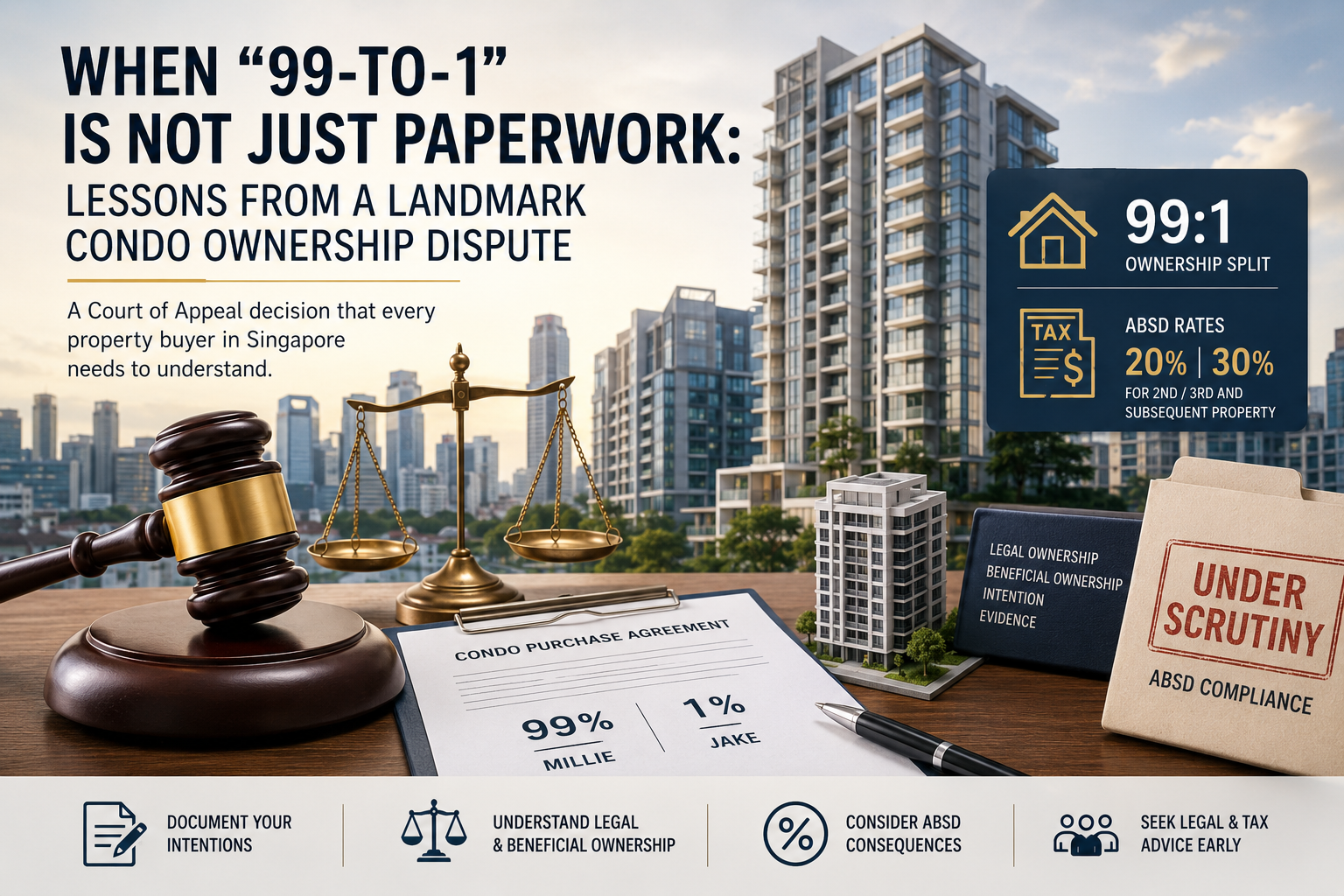
In Wong Mei Lee Millie v Ngor Shing Rong Jake [2026] SGCA 27, the parties bought a Hillcrest Arcadia condominium while they were in a romantic relationship. Although Jake contributed more money towards the purchase, the property was registered in Millie’s favour at a 99:1 ratio. After the relationship ended, Jake claimed that he was entitled to a much larger beneficial interest in the property. The High Court initially found that part of Millie’s share was held on a resulting trust for Jake, but the Court of Appeal allowed Millie’s appeal and found that the 99:1 split reflected the parties’ legal and beneficial ownership.
The Key Issue: Ownership Is Not Always As Simple As “Who Paid More”
Many people assume that if they contributed more to a property, they must own more of it. This case shows why that assumption can be wrong.
A resulting trust claim is, in simple terms, an argument that the registered ownership does not reflect the true beneficial ownership. The person making the claim is saying: “Even though the title shows something else, I paid for more of the property and did not intend to give that benefit away.”
But the Court of Appeal made an important point: the court must first look at the actual evidence of intention. Presumptions about resulting trusts are a last resort, not the starting point. In this case, the evidence showed that the parties intended the 99:1 ratio to reflect both legal and beneficial ownership. The court also noted that neither party understood the distinction between legal and beneficial ownership at the time, which supported the conclusion that they meant the registered ownership to be the real ownership.
That is a crucial lesson. If you sign documents stating that one person owns 99% and the other owns 1%, you should not assume that a court will later rewrite the arrangement simply because one party paid more.
Why 99-to-1 Arrangements Are So Sensitive
The 99-to-1 structure has become controversial because it can be used in property “decoupling” strategies. The usual idea is that two people buy a first property together in a 99:1 ratio, use both names for financing and CPF, then have the 1% owner transfer that small share to the 99% owner. After that, the former 1% owner may try to buy another property in his or her sole name without paying Additional Buyer’s Stamp Duty, or ABSD. The Court of Appeal described this basic mechanism and explained how it can minimise stamp duty across two property purchases.
The danger is that two different stories may be told. One story is told to the authorities and appears on the title: “I only own 1%.” Another private story may be: “Actually, I still own much more, but we are registering it this way to save ABSD.”
That mismatch is where the risk becomes serious.
The ABSD Problem: This Is Not Just A Private Dispute
ABSD is not a small administrative charge. For Singapore citizens, the current ABSD rate is 20% for a second residential property and 30% for a third and subsequent residential property, calculated on the higher of the purchase price or market value.
On a property worth S$1.865 million, a 20% ABSD exposure would be S$373,000. That explains why buyers may be tempted to structure transactions creatively. But it also explains why the authorities and courts take these arrangements seriously.
IRAS states that ABSD liability depends on the buyer’s profile and the number of residential properties owned, including those beneficially owned and those held in trust. IRAS also makes clear that partial ownership counts and that property held on trust for an identifiable beneficial owner may be included in that beneficial owner’s property count.
That means beneficial ownership cannot be treated as invisible. A person who says privately, “I still beneficially own the first property,” may create exactly the tax problem the structure was meant to avoid.
The Court of Appeal’s Warning on Illegality
Although the Court of Appeal did not need to decide the illegality issue after finding that no resulting trust arose, it gave important observations. It said that if a resulting trust had existed in favour of Jake, recognising it would likely have endorsed an illegal intention to evade ABSD. The court described the asserted resulting trust as the precise legal arrangement that would have allowed Jake to retain a beneficial interest in the first property while buying a second property without incurring ABSD.
This is one of the most important parts of the decision. The court was not merely concerned with who paid what. It was concerned with whether the legal arrangement would undermine the ABSD regime.
IRAS also takes a stern view of contrived or artificial arrangements used to reduce or avoid stamp duty. In tax avoidance cases, the Commissioner of Stamp Duties may disregard or vary the arrangement, claw back the rightful stamp duty and impose a 50% surcharge on the additional duty payable. Further penalties of up to four times the outstanding amount may also be imposed if the duty and surcharge are not paid by the deadline.
So the consequences are not limited to the loss of a civil claim. They may include tax clawbacks, surcharges, penalties, legal costs, and reputational damage.
The Practical Lesson: Do Not Use Ownership Percentages Casually
The biggest mistake in arrangements like this is thinking that the ownership ratio is just a temporary tool.
It is not.
A 99:1 split can affect who receives the sale proceeds, who bears the loss, who controls decisions, what happens after a breakup, what happens on death, what happens if one party refuses to sell, and whether a future purchase attracts ABSD. It can also determine whether a court sees one party’s larger financial contribution as a gift, a loan, a trust arrangement, or simply part of the agreed ownership structure.
Before entering any co-ownership arrangement, buyers should ask direct questions:
What are the legal shares? What are the beneficial shares? Are they the same? Who is paying the cash, CPF and loan instalments? Who receives rental income? What happens if the relationship ends? What happens if one party wants to sell and the other does not? Is there any intention to transfer shares later? Will the arrangement affect ABSD? Has this been properly disclosed and documented?
These are not afterthoughts. They are the core terms of the deal.
The Real Danger Is Not Just Tax — It Is Uncertainty
The 99-to-1 dispute shows how uncertainty can destroy the value of a property plan. The parties ended up in litigation because their intentions, contributions, relationship expectations and tax planning were not aligned in a clean, documented and legally robust way.
For buyers, the lesson is simple: never enter a property arrangement because “everyone does it” or because it seems like a clever way to save tax. A structure that looks efficient at the start can become disastrous if it is challenged later.
A genuine 99:1 ownership split is very different from an artificial arrangement in which the registered ownership reflects one thing, but the private understanding reflects another. The first may be defensible. The second may expose the parties to litigation and tax consequences.
Conclusion
This Apex court case is important because it highlights a hard truth about property ownership: what you sign, what you intend, what you pay, and what you tell the authorities must be consistent.
Property is usually one of the largest financial commitments a person will make. A poorly understood ownership arrangement can affect not only the property itself, but also future purchases, ABSD liability, relationships, estate planning and litigation risk.
The message from this case is clear: before signing any 99-to-1, decoupling or co-ownership arrangement, get proper legal and tax advice. Do not assume that a private understanding will save you later. And do not assume that a court will help enforce an arrangement if doing so would undermine Singapore’s stamp duty regime.
Disclaimer: This article is general commentary and should not be treated as legal or tax advice.
Article contributed by Jerry Wong.
 Jerry Wong is a realtor at Propnex Realty, bringing a rich background in interior and lighting design to his work. He loves exploring diverse spaces and observing the transformative power of real estate. Beyond his professional role, Jerry finds his greatest fulfillment in connecting people with the right properties, gaining immense satisfaction from helping clients achieve their dreams.