Singapore’s prime office market is tightening. Quality space is becoming harder to secure, rents are rising, and limited new supply is strengthening landlords’ negotiating position.
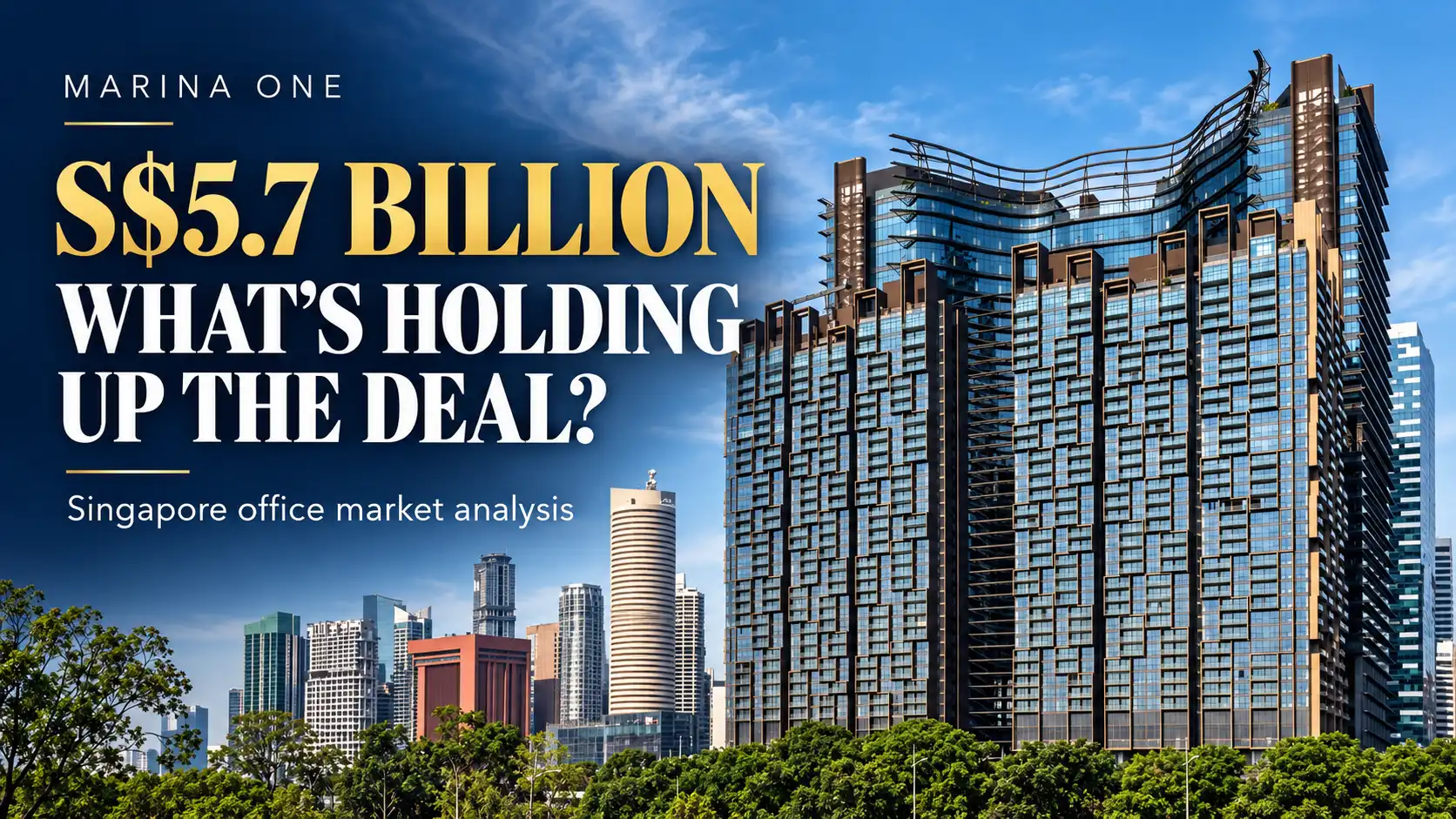
Yet the prospective sale of Marina One’s commercial component, carrying a reported asking price of about S$5.7 billion, has remained unresolved for months.
At first glance, that seems contradictory. If prime offices are scarce and rental conditions are improving, why has a major investor not completed the acquisition?
The explanation lies in the difference between securing tenants and securing investment capital. A building can be attractive to occupiers while remaining difficult to transact at the seller’s expected price—particularly when the purchase requires billions of dollars in equity and debt.
Marina One illustrates how property quality, investment returns and transaction structure must come together before a large acquisition can proceed.
The leasing market supports the investment case, but only up to a point.
JLL reported that Singapore’s CBD Grade A office rents rose about 1% in the third quarter of 2026, bringing year-to-date growth to 2.8%. It also highlighted vacancy at its lowest level in 10 quarters and limited new supply until 2028. These conditions strengthen the case for owning well-positioned office assets.
For landlords, fewer available alternatives can improve tenant retention and support higher rents when leases expire. For companies needing substantial contiguous space, the shortage can encourage earlier renewal discussions.
However, investors must establish how much of that benefit will reach a particular building’s income, and when.
Existing leases do not automatically reset whenever market rents rise. Some tenants may already be paying rents close to current market levels. Others may have several years remaining before renewal. Higher operating expenses, leasing incentives and refurbishment spending can also absorb part of the increase.
A buyer therefore needs to examine the rent roll, lease expiries and capital expenditure requirements. A favourable market outlook provides support, but the acquisition price determines how much future growth is needed to earn an acceptable return.
The S$5.7 billion figure remains an asking price.
The Business Times commentary dated 8 October describes a prospective acquisition that had yet to be announced. Its reported S$5.7 billion asking price relates to Marina One’s commercial component, comprising approximately 1.88 million sq ft of offices and 140,000 sq ft of retail space.
The residential apartments are outside the commercial package under discussion.
The distinction between an asking price and an agreed transaction price matters. Until binding terms are disclosed, the headline figure cannot be treated as evidence that the market has accepted that valuation.
Nor does an extended negotiation prove that the property is unattractive. It could reflect differences over price, financing, contractual conditions, ownership structure or the form of payment. The precise reason for the delay has not been publicly established.
Even a well-funded buyer faces a substantial equity requirement.
Hongkong Land launched the Singapore Central Private Real Estate Fund, or SCPREF, in February 2026 with S$8.2 billion of assets under management. The fund provides a platform for investing in premium Singapore commercial properties.
That provides a clear strategic context for its reported interest in Marina One. But assets under management represent an existing investment portfolio; they do not indicate an equivalent amount of cash available for acquisitions.
At an illustrative S$5.7 billion purchase price, the financing requirement would look like this:
| Assumed borrowing as a share of purchase price | Debt required | Equity required |
|---|---|---|
| 50% | S$2.85 billion | S$2.85 billion |
| 55% | S$3.135 billion | S$2.565 billion |
| 60% | S$3.42 billion | S$2.28 billion |
These are illustrative calculations and exclude transaction costs, reserves, and other funding requirements. They do not represent disclosed financing terms.
Even with borrowing covering 60% of the price, investors would need to commit S$2.28 billion of equity before additional costs.
Raising that capital can involve several institutions, each with its own approval process, return expectations and limits on exposure to Singapore offices. An investor may support the property’s long-term prospects while being unwilling to allocate such a large amount to one acquisition.
The size of the transaction consequently narrows the pool of buyers who can proceed.
A narrow gap between property yield and borrowing cost can constrain returns.
The income required to support the asking price is another important consideration.
At S$5.7 billion, the following annual net property income would be needed to achieve different acquisition yields:
| Illustrative net property yield | Annual net property income required |
|---|---|
| 3.0% | S$171 million |
| 3.5% | S$199.5 million |
| 4.0% | S$228 million |
These figures are calculated income requirements, not Marina One’s reported income or actual yield. Net property income is measured before financing costs.
The effect of borrowing depends on the relationship between that property yield and the cost of debt.
Consider a hypothetical purchase generating a 3.2% net property yield, funded with 60% debt. Annual net property income would be S$182.4 million, against debt of S$3.42 billion and equity of S$2.28 billion.
At an assumed borrowing cost of 3%, annual interest would be S$102.6 million. Income remaining after interest would be S$79.8 million, equivalent to about 3.5% of the equity invested.
At a borrowing cost of 4%, annual interest would rise to S$136.8 million. Income remaining after interest would fall to S$45.6 million, or approximately 2% of equity.
These simplified figures exclude principal repayments, fund fees, taxes, capital expenditure and transaction costs. They are not forecasts of the deal’s returns. They show why relatively small financing changes matter when the debt runs into billions.
In this example, a one-percentage-point increase in borrowing cost reduces annual income by S$34.2 million.
Rising rents may also be offset by a change in investors’ required yields.
Rental growth does not guarantee an equivalent increase in capital value.
Under a simplified income-capitalisation approach, a property producing S$190 million of annual net income would be worth about S$5.43 billion at a 3.5% capitalisation rate.
If income rose by 5% to S$199.5 million, but investors required a higher rate of 3.75%, the implied value would be approximately S$5.32 billion.
Income would have increased while the calculated value declined.
This is an illustration rather than a Marina One valuation. It demonstrates why buyers must consider both rental prospects and the return they require for committing capital. Stronger leasing conditions can coexist with cautious pricing.
The sale structure may be as important as the offer.
Marina One is owned by M+S, the joint venture held 60% by Khazanah Nasional and 40% by Temasek.
The Business Times commentary raises possible complexities around selling shares in the property-holding vehicle and whether part of the consideration could take the form of units in SCPREF. These are suggested explanations, rather than confirmed transaction terms.
Receiving cash would allow a seller to exit its investment directly. Receiving fund units would preserve exposure to a wider property portfolio and introduce considerations such as fund governance, fees, distributions and redemption arrangements.
A higher headline offer with more conditions may therefore be less attractive than a lower offer providing greater certainty.
Shareholders may also have different preferences about how much exposure to retain. Resolving those preferences can take time even where the parties broadly agree on the quality of the asset.
A large acquisition also creates a concentration decision.
For a property fund, buying Marina One could expand its portfolio quickly and deepen its presence in an established commercial district.
The same acquisition would commit substantial capital to one development. Two office towers and a retail component still share a location, infrastructure and exposure to the same surrounding market.
Investors must assess major tenants, lease-expiry concentrations, future capital expenditure and the options for selling the investment later.
Several smaller acquisitions could offer more flexibility and diversification, although assembling them would take longer and create additional transaction work. The appropriate route depends on the fund’s mandate and its investors’ priorities.
A fund’s growth target can explain its interest in a property. It cannot, by itself, justify the price.
The unresolved Marina One sale should therefore be read with care. It does not establish that Singapore’s office recovery is weakening, and it does not confirm that financing or fundraising has failed.
It shows the gap between a compelling property story and an executable investment.
The next meaningful development would be disclosure of the agreed consideration, buyer, ownership structure, conditions and completion timetable. Those details would reveal much more than another report of interest from a potential bidder.
Singapore’s tight office market helps explain why investors want Marina One. Completing a S$5.7 billion acquisition requires those investors to agree on how much income it can generate, how that income will be financed, and whether the resulting return justifies the capital committed.
Disclaimer: This article is for general information and commentary and does not constitute investment, financial, legal or valuation advice. The reported S$5.7 billion figure is an indicative asking price, not a confirmed transaction value. Potential reasons for the sale’s delay are analytical interpretations and have not been confirmed by the parties involved. Financing, income, yield and valuation calculations are illustrative and do not represent Marina One’s actual financial performance or agreed transaction terms. Information reflects sources available at the time of writing and may change. Readers should independently verify material details and seek qualified professional advice before making investment decisions.
Article contributed by Jerry Wong.
 Jerry Wong is a realtor at Propnex Realty, bringing a rich background in interior and lighting design to his work. He loves exploring diverse spaces and observing the transformative power of real estate. Beyond his professional role, Jerry finds his greatest fulfillment in connecting people with the right properties, gaining immense satisfaction from helping clients achieve their dreams.