Singapore’s office investment market appears to be entering another significant capital-recycling cycle. Reports that Marina One may soon change hands have been followed by a growing list of major office assets being offered for sale, including Frasers Property’s 50% stake in Frasers Tower, Lazada One, 30 Raffles Place, Income Centre and selected office floors within One Raffles Place.
At first glance, the simultaneous sale of so many prominent properties could be interpreted as a sign that owners are becoming cautious about Singapore’s office market. However, the motivations behind these transactions appear to be more complex. Many of the sellers are institutional investors, developers, insurers, sovereign-linked entities and private investment groups. Their decisions are likely driven by portfolio management, capital recycling and the opportunity to crystallise gains, rather than a broad loss of confidence in Singapore office fundamentals.

Singapore’s Office Investment Market Has Regained Momentum
According to this Business Times article, approximately S$10.8 billion of Singapore office assets changed hands during the first half of 2026. This already exceeded the roughly S$4 billion transacted during the whole of 2025.
The historical peak was recorded in 2007, when about S$13.3 billion of office transactions were completed. If the proposed Marina One transaction proceeds at a price close to the reported S$5.7 billion, 2026 could become one of the strongest years on record for Singapore office investment sales.
This level of activity does not resemble a distressed market. Instead, it indicates that buyers remain prepared to deploy substantial capital into Singapore commercial property. The number of buildings being placed on the market may therefore reflect a period of strong liquidity, when sellers believe there is sufficient demand to achieve attractive valuations.
Why Owners Are Choosing to Sell Now
One of the most important reasons behind the current wave of sales is capital recycling. Institutional owners generally do not retain every property indefinitely. Once an asset has been completed, refurbished, leased and stabilised, its future returns may become more predictable but also less substantial.
Selling a mature office property allows the owner to recover the capital tied up in the building and redeploy it into new developments, redevelopment opportunities or faster-growing sectors. The proceeds may also be used to reduce debt, strengthen the balance sheet, fund overseas expansion or invest in sectors such as logistics, data centres, hospitality and mixed-use projects.
The timing may also be attractive because Singapore office values and rental conditions have recovered from the uncertainty experienced during the pandemic. Owners who have held their properties through that period may now see an opportunity to sell into a stronger market rather than waiting for the next cycle.
Higher financing costs have added another layer of pressure. Even when a property is fully occupied, its income return must be assessed against the cost of debt and the returns available from alternative investments. For some owners, a sale at today’s valuation may generate a better overall return than continuing to hold the building.
Marina One Could Become the Defining Transaction
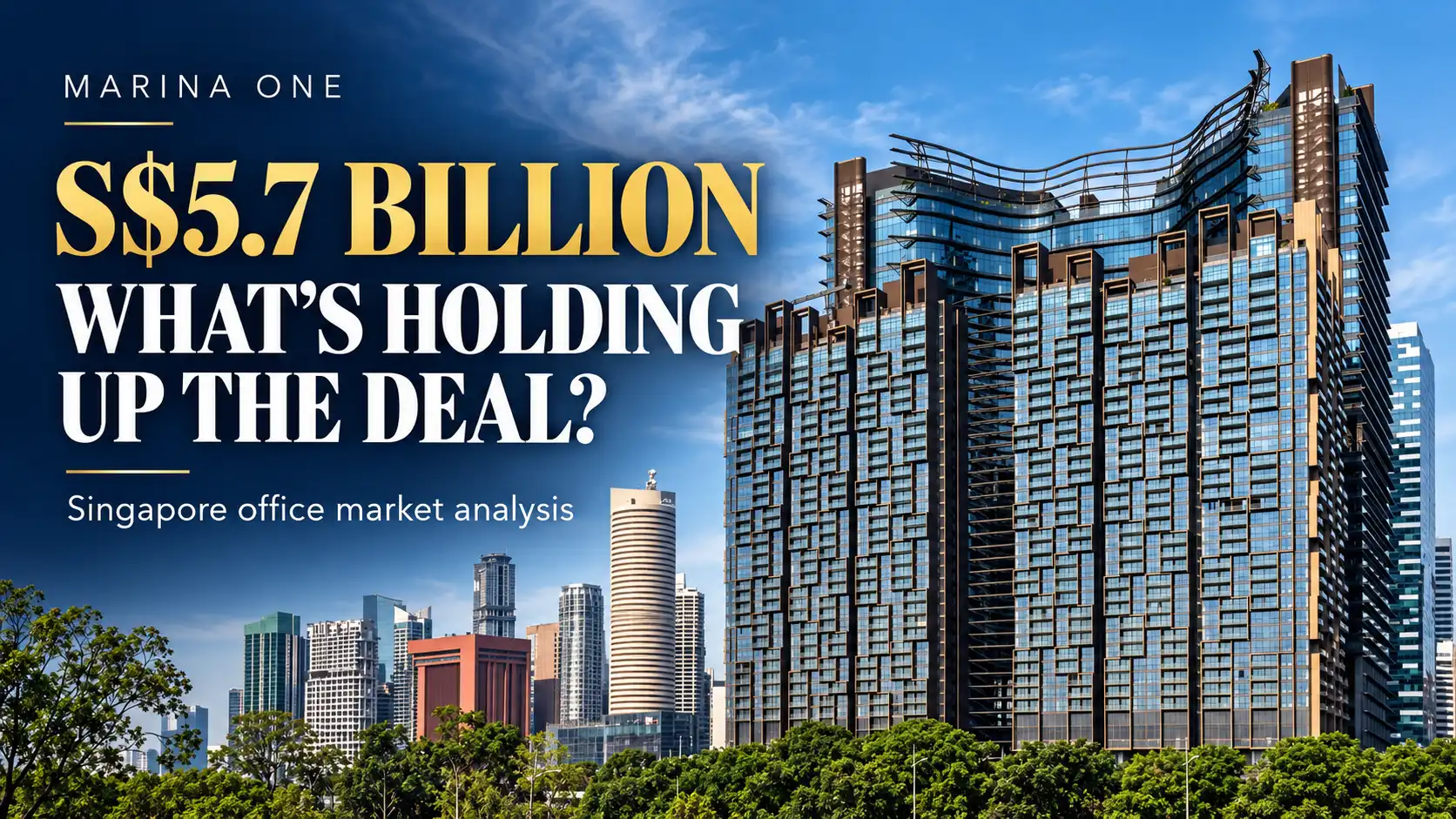
Marina One is expected to be the largest and most closely watched office transaction in the current cycle. The development comprises approximately 1.88 million sq ft of premium Grade A office space and around 140,000 sq ft of retail accommodation.
The asset was developed by M+S, a joint venture between Malaysia’s Khazanah Nasional and Singapore’s Temasek. The joint venture is reportedly seeking around S$5.7 billion for the office and retail components.
Marina One is a stabilised landmark asset in the Marina Bay financial district. Its scale, location and tenant profile make it suitable for sovereign wealth funds, large real estate investment managers and international institutional investors.

Why M+S May Be Selling Marina One
The potential sale of Marina One does not necessarily suggest that Khazanah or Temasek have become negative on Singapore real estate. M+S was originally established to develop major projects, including Marina One and DUO, following the resolution of land matters between Singapore and Malaysia.
With Marina One completed and established as an income-producing development, the joint venture may have reached the monetisation stage of its investment cycle. The development risk has already been absorbed, the buildings are operational, and the asset can now be marketed as a completed institutional investment.
A sale at around S$5.7 billion would release a significant amount of capital. Khazanah and Temasek could redeploy the proceeds into infrastructure, technology, private markets, overseas investments or new real estate opportunities. For large sovereign-linked investors, the decision is therefore likely to be based on portfolio optimisation rather than the performance of one building.
Why Hongkong Land May Be Interested in Marina One
Hongkong Land’s Singapore Central Private Real Estate Fund is reportedly the leading bidder for Marina One. The acquisition would be consistent with its long-term strategy of owning and managing premium commercial assets in major Asian financial centres.
Marina One would substantially enlarge Hongkong Land’s Singapore office portfolio and strengthen its position in the Marina Bay and Raffles Place districts. The company could benefit from a larger leasing platform, deeper relationships with multinational tenants and improved operational scale.
A major landlord with several Grade A buildings can offer tenants more flexibility when expanding, relocating or renewing leases. It may also be able to coordinate property management, leasing and asset enhancement more efficiently across its portfolio.
The reported interest therefore appears to be strategic rather than purely financial. Marina One would give Hongkong Land a rare opportunity to acquire a large, modern and already established office complex in a location where comparable assets seldom become available.
Lazada One Appears to Be a Value-Add Exit
Lazada One at 51 Bras Basah Road has reportedly been put on the market at around S$755 million. The building contains approximately 259,666 sq ft of net lettable area and was extensively refurbished before reopening in 2022.
Its committed occupancy was reported to be around 99.5%, with tenants including Alibaba Group, Lazada, Uniqlo and Singapore Management University.
The sale appears to fit the profile of a completed value-add strategy. The owners have upgraded the property, improved its positioning and secured a strong tenant base. Once these objectives have been achieved, selling the asset allows the investors to realise the uplift in value.
This is particularly common for fund-managed properties. Investment funds normally operate within defined holding periods and return targets. Even when a building is performing well, the fund may sell because the asset has reached the point where most of the intended value creation has already been captured.
The sale of Lazada One should therefore not automatically be interpreted as a concern over its future occupancy. Its high commitment rate may actually make this an attractive time to market the asset to income-focused buyers.
Why Frasers Property Is Selling Half of Frasers Tower
Frasers Property has appointed agents to market its 50% stake in Frasers Tower, with the interest reportedly valued at slightly above S$1 billion. The remaining 50% is held by South Korea’s National Pension Service and is not currently being offered for sale.
Frasers Tower is a 38-storey Grade A office building near Tanjong Pagar MRT station. Its tenants include Microsoft, TotalEnergies and several other large corporations.
Frasers Property’s decision to sell only its half stake suggests that the transaction may be primarily about capital recycling and balance-sheet management. The building remains a high-quality asset, but it also represents a substantial amount of capital tied up in a completed development.
By selling its interest, Frasers Property can realise part of the value created through the development and redirect the proceeds into other business priorities. These may include logistics and industrial properties, new development projects or debt reduction.
The transaction also illustrates how listed developers often differ from long-term institutional landlords. A developer may create the property, stabilise its income and then sell the mature asset to an investor seeking steady long-term returns.
Income Centre Offers Redevelopment and Strata Potential
Income Centre at Bras Basah Road has reportedly attracted strong interest, with around a dozen bids received. The highest offers were said to be in the S$240 million to S$250 million range.
The property is currently occupied by Income Insurance and is expected to be sold with a leaseback arrangement. This would give the buyer an immediate income stream while allowing Income Insurance to continue occupying the building for an agreed period.
One of the main attractions of Income Centre is its longer-term redevelopment potential. The building may not be subject to the same strata subdivision restrictions that apply to some other commercial properties.
This could potentially allow a future owner to subdivide and sell individual strata office units, subject to the relevant planning and regulatory requirements. The building may also offer opportunities for asset enhancement, conversion to alternative uses or eventual redevelopment.
Buyers are therefore not evaluating Income Centre solely on its current rental income. They are also placing a value on the flexibility embedded in the site and building. Such optionality can be especially valuable in central locations where land is scarce and redevelopment opportunities are limited.
Why Income Insurance May Be Selling
For Income Insurance, the sale may allow the company to monetise a valuable property while continuing to use the premises through a leaseback arrangement. This converts an illiquid real estate asset into deployable capital without requiring an immediate relocation.
The proceeds could be used for insurance operations, investments, business expansion or balance-sheet management. A sale-and-leaseback structure may also provide greater financial flexibility, especially when property ownership is not central to the company’s core business.
The strategy is common among corporations that occupy buildings they also own. Rather than retaining capital in real estate, the company sells the property to an investor and becomes a tenant.
Why 30 Raffles Place Is Being Offered Again
30 Raffles Place is reportedly being marketed at a guide price of at least S$1.1 billion. The property was previously offered in separate ownership components, but the current sale is understood to involve the entire building.
This is important because buyers generally place a premium on full control. Ownership of an entire building allows the investor to make leasing, refurbishment and redevelopment decisions without coordinating with another co-owner.
Complete ownership also improves future exit flexibility. The buyer can sell the whole asset, recapitalise it, undertake major enhancement works or introduce a new investment partner at a later stage.
The decision to offer the entire building may therefore be intended to attract a broader pool of institutional buyers and achieve a stronger valuation than would be possible through the sale of a partial interest.
Why One Raffles Place May Be Restructured
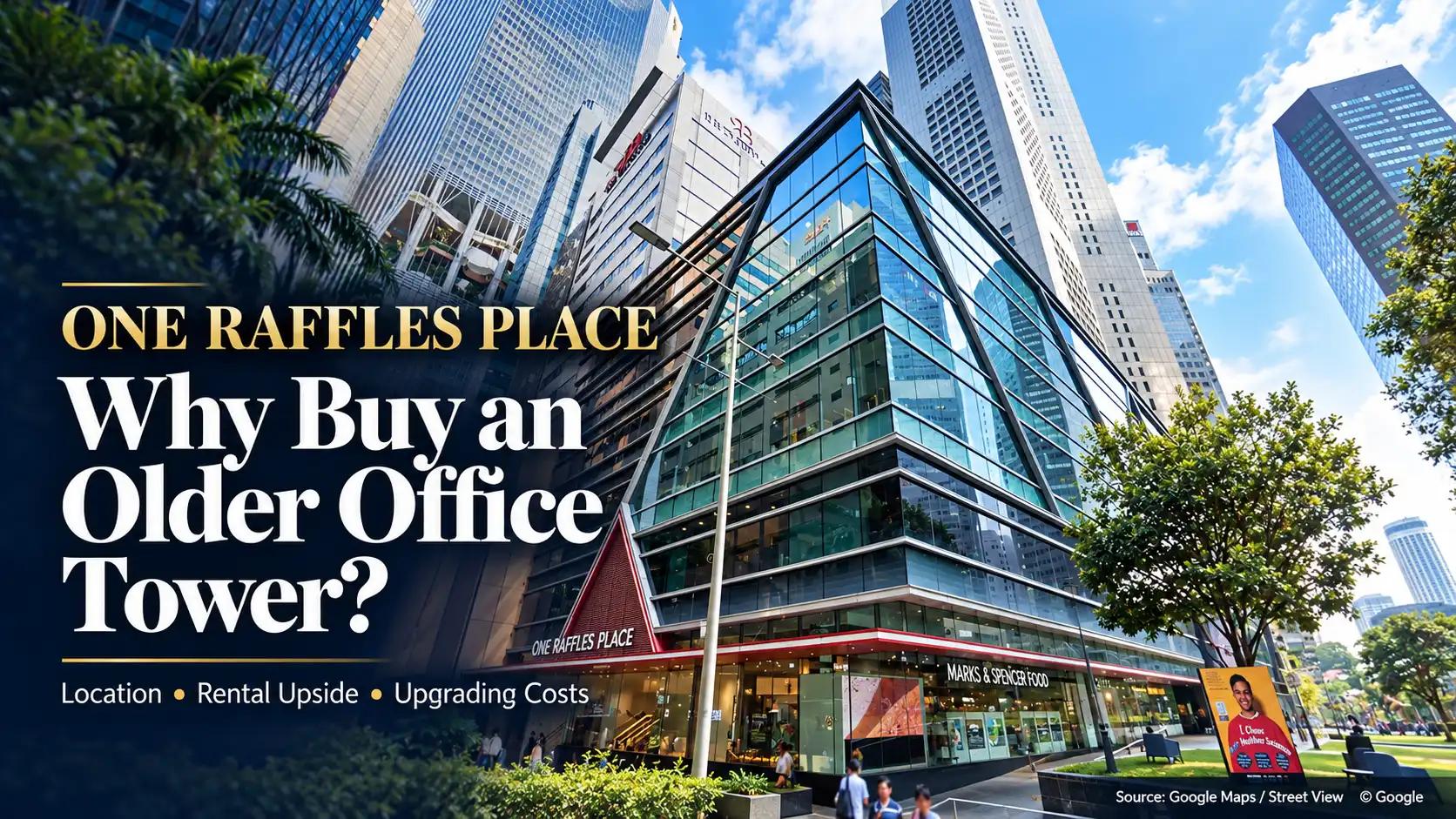
The article also discusses the ownership of One Raffles Place. OUE Real Estate Investment Trust holds an effective interest of 67.95%, while OUB holds 26.61%. The property comprises two office towers and a six-level retail podium.
One possible scenario is for a buyer to acquire a limited stake while working with an existing owner. Another is for related parties to restructure their interests in the property.
Large mixed-use assets with multiple shareholders can sometimes be difficult to sell as a single transaction. A strategic investor may therefore enter through a minority or partnership stake before pursuing a broader consolidation later.
The appeal of One Raffles Place is its location, scale and established position within Singapore’s financial district. Any ownership restructuring would likely be aimed at unlocking value, simplifying control or creating a clearer path for future asset enhancement.
Why Olayan Is Selling Its Office Floors
The Olayan Group owns three lower office floors within One Raffles Place, covering approximately 109,500 sq ft of net lettable area. These floors have reportedly been marketed at around S$400 million.
The asset differs from the other buildings because it represents strata office ownership rather than an entire building. A sale would allow Olayan to monetise a discrete portion of its Singapore real estate portfolio without affecting the ownership of the wider complex.
The reported asking price reflects the scarcity of large contiguous strata office space in a prime Raffles Place location. Potential buyers could include family offices, corporations seeking premises for their own use or investors looking for long-term rental income.
For Olayan, the sale may be part of a broader global capital-allocation strategy. The group has extensive investments across multiple sectors and countries, and the decision to sell may simply reflect a preference to redeploy capital elsewhere.
Why Buyers Remain Interested in Singapore Offices
The strong buying interest across these properties reflects Singapore’s position as one of Asia’s most defensive office markets. The country offers political stability, a transparent legal system, strong property rights and a deep base of multinational occupiers.
These factors are particularly attractive to sovereign wealth funds, pension funds, insurance companies and long-term investment managers. Such buyers are often willing to accept relatively moderate initial yields in exchange for income stability and capital preservation.
Singapore also has limited availability of large prime office assets. Investors seeking to deploy hundreds of millions or several billion dollars cannot easily assemble a comparable portfolio through smaller individual acquisitions.
When a building such as Marina One, Frasers Tower or 30 Raffles Place becomes available, institutional investors may compete aggressively because the next comparable opportunity may not emerge for several years.
Rental Reversion Is Another Important Motivation
Several of the buildings mentioned in the article reportedly contain leases signed at rental rates below prevailing market levels. This creates the potential for positive rental reversion when leases expire or are renewed.
A buyer may be willing to accept a relatively low initial yield if there is a credible path to higher rental income. As older leases are renewed at market rates, the building’s net property income and valuation may increase.
This appears particularly relevant for Lazada One and Frasers Tower, where the initial acquisition yield may not look especially high, but future income growth could improve the total return.
The buyer’s motivation is therefore based not only on current rent but also on the expected rental trajectory over the coming years.
Buyers Are Seeking Different Types of Returns
Not every buyer is pursuing the same strategy. Some investors are looking for long-term core income from stabilised Grade A offices. Others are attracted by redevelopment potential, rental reversions or the opportunity to improve an older building.
Marina One is likely to appeal to investors seeking scale, prestige and long-duration income. Frasers Tower offers a modern Grade A asset with strong corporate tenants. Lazada One may attract buyers seeking rental growth following refurbishment. Income Centre offers more speculative redevelopment and strata potential.
This diversity of opportunities is helping to draw a wide range of investors into the market. It also explains why multiple buildings can be marketed simultaneously without necessarily competing for exactly the same buyers.
A Sign of Liquidity Rather Than Weakness
The growing number of office assets being offered for sale should not automatically be read as a negative signal. In many cases, the buildings are being sold precisely because they are mature, highly occupied and capable of attracting strong institutional demand.
The sellers are attempting to monetise assets at a time when capital is available, and transaction volumes are recovering. The buyers are seeking exposure to stable rental income, future rental growth and scarce central business district properties.
This is characteristic of an active and liquid investment market. Owners are willing to sell because they believe pricing is attractive, while buyers are willing to commit large sums because they remain confident in Singapore’s long-term office fundamentals.
Conclusion
The current wave of Singapore office transactions is best understood as a transfer of assets between investors with different objectives.
Developers, funds, insurers and sovereign-linked owners are selling to recycle capital, realise development gains, reduce concentration and fund other priorities. Long-term landlords, private investment groups and institutional buyers are acquiring because they value Singapore’s stability, scarce prime supply, established tenant base and prospects for rental growth.
The proposed Marina One deal may become the centrepiece of this cycle, but the wider trend is equally important. Lazada One, Frasers Tower, Income Centre, 30 Raffles Place and One Raffles Place each represent a different stage of the real estate investment cycle.
Taken together, these transactions suggest that Singapore’s office market is not experiencing an exodus of capital. Instead, capital is changing hands as mature owners exit and new investors enter with longer holding periods, different return targets and fresh plans for the assets.
Disclaimer: This article is provided for general information and commentary only. It is based on publicly available reports, market information and the author’s interpretation of the possible motivations behind the transactions discussed. Certain statements concerning the intentions, strategies or future plans of buyers, sellers and other parties are analytical opinions or reasonable inferences and have not necessarily been confirmed by the organisations involved.
The information should not be regarded as financial, investment, legal, tax or property advice, nor as an offer, recommendation or solicitation to buy, sell or invest in any property, company, security or financial product. Transaction values, yields, occupancy levels, lease terms, planning potential and other market details may change, while proposed sales may be revised, delayed or not completed.
Readers should conduct their own due diligence and consult appropriately qualified professional advisers before making any investment or property-related decision. While reasonable care has been taken in preparing this article, no representation or warranty is made regarding the completeness, accuracy or timeliness of the information, and no liability is accepted for any loss arising from reliance on it.
Article contributed by Jerry Wong.
 Jerry Wong is a realtor at Propnex Realty, bringing a rich background in interior and lighting design to his work. He loves exploring diverse spaces and observing the transformative power of real estate. Beyond his professional role, Jerry finds his greatest fulfillment in connecting people with the right properties, gaining immense satisfaction from helping clients achieve their dreams.