
Pine Grove’s S$1.78 billion collective-sale attempt appeared to be running out of road, with 67.5% of owners reportedly having signed. Parliament’s decision to lower the consent threshold for developments aged 40 to 59 years could transform the arithmetic—but it does not remove the need for a realistic price or a willing developer.
In our earlier analysis of Pine Grove’s S$1.78 billion en bloc attempt, we argued that securing the 80% owners’ mandate could prove harder than making a case for the site’s redevelopment potential.
That conclusion was not based on the view that Pine Grove lacks redevelopment value. The opposite is true. The 660-unit former HUDC estate occupies a substantial 893,219 sq ft site off Ulu Pandan Road, and marketing agent ERA estimates it could yield about 2,050 new homes, subject to approval from the relevant authorities.
The difficulty was always the gap between recognising the site’s potential and persuading a sufficiently large and diverse group of owners to accept the same sale terms at the same time.
The latest figures reinforce that point. About 62% had reportedly signed the collective sale agreement by late July 2026. By late August, support had risen to approximately 67.5%. This represented progress, but it still left Pine Grove 12.5 percentage points short of the existing 80% requirement, with the agreement due to lapse on 20 September.
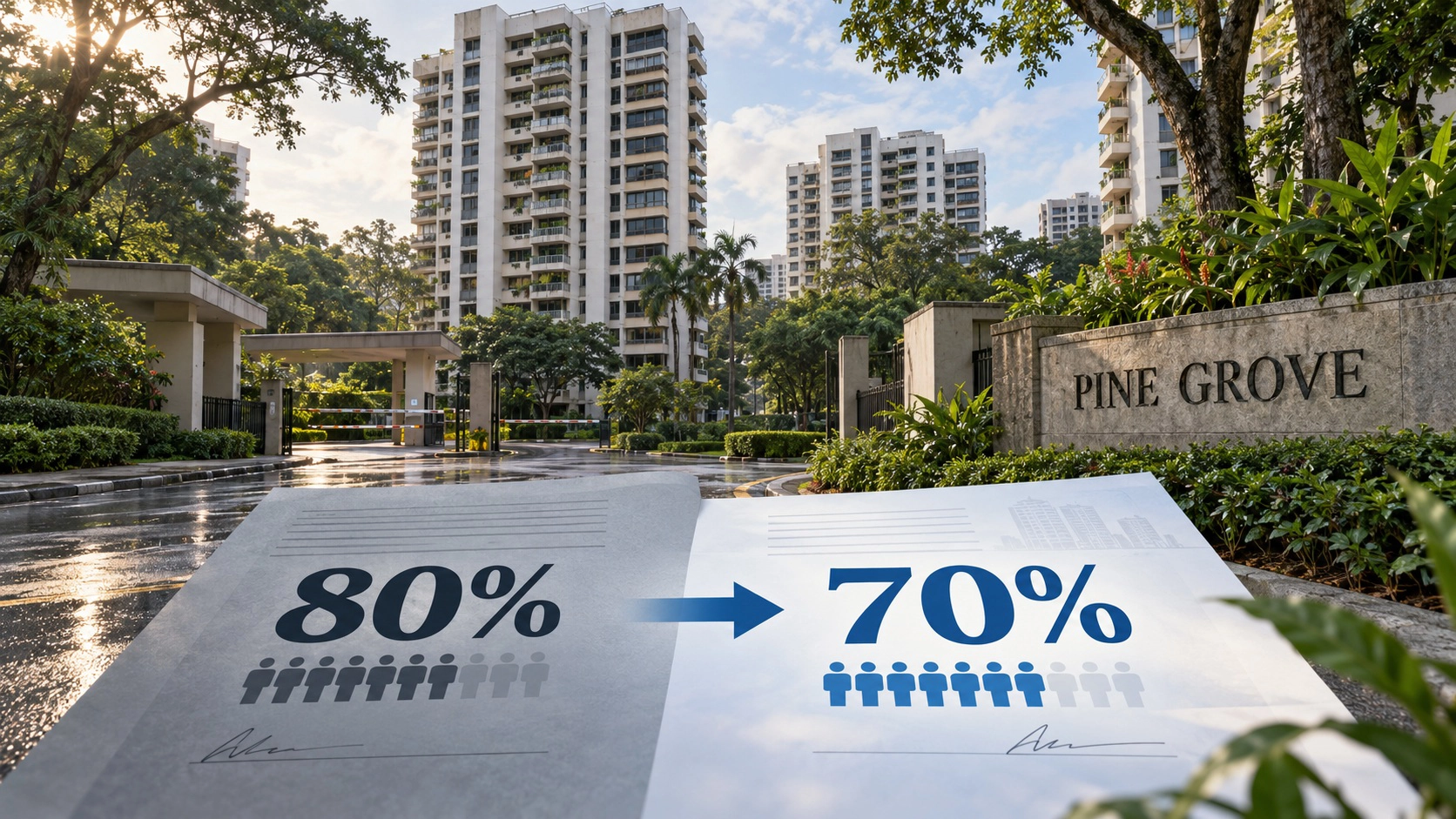
The rules Parliament passed on 8 September 2026 could significantly change that position. Once the relevant amendments commence, a development aged between 40 and 59 years will require 70% consent instead of 80%. As Pine Grove is about 42 years old, it falls directly within this new band.
At the reported 67.5% level, the remaining gap would therefore fall from 12.5 percentage points to just 2.5 percentage points. That is an 80% reduction in the final gap.
However, this does not mean Pine Grove has automatically secured an en bloc mandate. The new law has not simply converted every existing signature into approval under a 70% exercise. The collective sale committee may have to choose between continuing under the current agreement or terminating it and beginning afresh under the transitional arrangement.
Why the final stretch to 80% was always likely to be difficult
An en bloc mandate is not a normal majority vote. For an older development under the existing framework, the supporting owners must reach at least 80% by both share value and total strata area. Therefore, it is not enough to count only the number of households that appear supportive.
More importantly, the final few percentage points are rarely as easy to obtain as the first 60% or 70%. Owners who are enthusiastic about a collective sale tend to sign earlier. Those who remain may have stronger objections, more complicated personal circumstances, or expectations further from the proposed terms.
Pine Grove illustrates several reasons why this last group can be particularly difficult to persuade.
1. Owners can disagree with the same reserve price for opposite reasons
Pine Grove’s S$1.78 billion reserve price has created a difficult balancing act. Some owners may worry that the price is too ambitious to attract a developer, while others may believe that it is not high enough to justify giving up a large home in an established location.
These views pull the collective sale committee in opposite directions. Reducing the reserve price may make the project more attractive to developers but weaken support among owners seeking a larger payout. Raising it may win over some owners while making a successful tender less likely.
This tension is not theoretical. During Pine Grove’s 2018 attempt, owners representing about 78% reportedly supported a reserve price of S$1.72 billion, while a group held out for S$1.86 billion. The attempt did not reach the required mandate. The episode showed how the final few percentage points can become decisive even when a substantial majority already supports a sale in principle.
2. A collective-sale payout must be considered against replacement cost
Pine Grove’s apartments are unusually large by current new-launch standards. For owners who want to remain in the private residential market and preserve a similar amount of living space, the central question is not simply whether the en bloc proceeds exceed their unit’s current resale value.
They must consider what those proceeds can buy after legal costs, stamp duty, renovations, moving expenses, and financing constraints. A replacement home of comparable size in or near the same neighbourhood may be difficult to find without a significant top-up.
This affects households differently. An owner planning to right-size may view the sale proceeds as attractive. A multigenerational family that needs the existing floor area may reach the opposite conclusion. Retirees may also be reluctant to take on a new mortgage merely to reproduce the space they already have.
The result is a fragmented ownership base with no single definition of an acceptable payout.
3. A 660-unit estate is a major coordination exercise
Pine Grove not only has a large site; it also has a large number of owners. Some units may be rented out, some owners may live overseas, and elderly owners may need more time or assistance to understand the documents and complete the signing process.
This helps explain why support can rise rapidly at first and then slow. Every unresolved case near the end may require more individual engagement, legal clarification or family discussion. The numerical gap may look small, but the remaining owners are often the least accessible or least convinced.
The reported movement from 62% in late July to 67.5% in late August is instructive. Pine Grove added about 5.5 percentage points over that period, yet still needed another 12.5 points under the old framework before 20 September. It would have had to gain more than twice its preceding month’s progress within a much shorter period.
4. Attachment to the estate cannot be solved by valuation alone
Many residents have lived at Pine Grove for decades. Their resistance may stem from community ties, familiarity with the neighbourhood, established routines, or a desire to remain in a home that holds personal meaning.
These concerns cannot always be resolved by presenting a higher projected payout. Even owners who accept the logic of lease decay and rising maintenance costs may still be unwilling to leave now.
This is especially relevant in an ageing development, where long-term residents may value continuity and certainty more than a potential windfall.
5. The existing 80% rule increased the influence of the final holdouts
When support approaches but does not reach 80%, a relatively small group can determine whether an entire exercise proceeds. Some owners may then delay their decision in hopes of revised terms, a higher reserve price, or a different method of apportionment.
This does not mean that every non-signing owner is behaving strategically. Many will have genuine concerns. However, the old threshold structure gives the final group disproportionate influence once the wider estate has already shown strong support.
That is precisely where the new 70% threshold could change the dynamics at Pine Grove.
What Parliament changed
Parliament passed amendments to the Land Titles (Strata) Act on 8 September 2026. The revised consent thresholds are based on the age of the development:
| Age of development | Consent threshold under the revised framework |
|---|---|
| Less than 10 years | 90% |
| 10 to 39 years | 80% |
| 40 to 59 years | 70% |
| 60 years and older | 65% |
The Ministry of Law explained that the lower thresholds are intended to give ageing developments a more practical route to renewal where broad support already exists. At the same time, the reforms introduce stronger safeguards for owners who do not wish to sell.
These include raising the level of support needed to initiate a collective-sale exercise, reducing the normal signature-collection period from 12 months to six months, and extending the restriction period following a failed attempt from two years to three years.
The six-month collection window may itself be challenging for very large estates. In Pine Grove’s case, however, the transitional arrangement is more immediately important than the general six-month rule.
Pine Grove may have an opt-in route—but it is a restart, not a shortcut
For an older development already gathering signatures when the amendments commence, the Land Titles (Strata) (Amendment) Bill provides an opt-in mechanism.
Subject to the commencement timetable and the statutory conditions, the collective sale committee may convene a general meeting for owners to decide whether to terminate the existing collective sale agreement and approve the terms of a new agreement under the revised framework. The new agreement would then have to obtain the applicable mandate within seven months from the commencement of the relevant amendments.
This leaves Pine Grove with two conceptually different routes:
| Route | Required mandate | Main advantage | Main difficulty |
|---|---|---|---|
| Continue with the existing CSA | 80% | Existing signatures and agreed terms are retained | The reported support remained 12.5 percentage points short, with the CSA due to lapse on 20 September 2026 |
| Opt in to the revised framework | 70% | The target is much closer to the reported 67.5% support | Owners must approve a new CSA and signatures must be obtained afresh within the transitional period |
The opt-in route is therefore not a matter of simply adding another 2.5 percentage points to the existing total. Existing signatories would need to support and sign the new agreement. The reserve price, apportionment method and other terms would also have to remain acceptable to enough owners when the process restarts.
Nevertheless, Pine Grove would start from a much stronger political position than a development attempting to build support from scratch. A reported 67.5% has already shown that a broad majority is prepared to consider a sale on the present terms. The challenge under a new exercise would be to preserve most of this support and persuade only a relatively small additional group to join it.
Rising repair costs may strengthen the case for renewal
The debate is also shifting as the cost of keeping Pine Grove in its present form becomes more visible.
According to the collective sale committee’s estimates reported by The Business Times, major repairs and replacements could cost between S$15 million and S$21 million if the collective sale fails. This is equivalent to about S$22,000 to S$32,000 per unit if spread evenly, although the actual funding method would depend on the management corporation’s decisions.
The estimates include work involving roads, pipes, water tanks, handrails, wiring, walkways, lobbies, fire doors and other ageing facilities and building systems. Monthly maintenance fees have already risen from S$318.28 to S$479.60 from August, and further increases have reportedly been projected.
These figures do not mean redevelopment is the only responsible outcome. A building can keep functioning beyond 40 years if owners are prepared to fund its upkeep. However, the trade-off is becoming sharper: owners are no longer comparing an en bloc payout with the cost of doing nothing. They are comparing it with higher recurring contributions and potentially substantial capital expenditure to maintain an ageing property with a shortening lease.
This supports the policy rationale behind the new age-based thresholds. Once an estate reaches the stage where renewal enjoys clear majority support, requiring the final 20% to agree may prevent the majority from addressing rising costs and long-term lease decay.
The lower threshold does not solve the developer side of the equation
Reaching the required mandate would only allow Pine Grove to proceed to market. It would not guarantee that a developer will accept the S$1.78 billion reserve price. Nevertheless, recent government land-sale results suggest that the site may be more competitively priced than its headline quantum initially implies.
Based on current estimates, Pine Grove’s reserve price, together with the relevant lease top-up and redevelopment charges, translates into an effective land rate of approximately S$1,355 psf ppr. By comparison, the New Upper Changi Road site was awarded to a UOL Group and CapitaLand-led consortium for S$1,537 psf ppr.
Pine Grove is therefore priced about S$182 psf ppr, or nearly 12%, below the New Upper Changi Road benchmark. This is a meaningful difference, particularly since developers have already shown a willingness to pay more than S$1,500 psf ppr for a large suburban residential site. The comparison suggests Pine Grove’s land rate may provide more room to absorb construction and financing costs while allowing the eventual project to launch at a competitive price.
The plot also offers qualities that are difficult to replicate through the regular Government Land Sales programme. Its approximately 893,219 sq ft land area could accommodate around 2,050 new homes, subject to approval, giving a developer considerable flexibility in planning the unit mix, facilities and development positioning. Its established Ulu Pandan location, proximity to the Bukit Timah and Clementi housing markets, and surrounding schools and employment centres could support demand from families, HDB upgraders and buyers seeking larger homes in the western region.
The main drawback is the investment scale. Pine Grove’s estimated effective acquisition cost is approximately S$2.75 billion, substantially higher than the S$1.4 billion paid for the New Upper Changi Road site. The redevelopment would therefore probably appeal most to a well-capitalised developer or consortium capable of managing the financing, construction and sales risk associated with more than 2,000 units.
The revised Additional Buyer’s Stamp Duty remission timeline should make this scale more manageable. An en bloc redevelopment yielding at least 1,400 homes may receive up to seven years to complete and sell the project, subject to the applicable conditions. As Pine Grove could potentially produce about 2,050 units, the longer runway reduces the pressure to sell such a large development within the previous timeframe.
A lower consent threshold cannot guarantee a successful tender, but the comparison with New Upper Changi Road strengthens Pine Grove’s investment case. Its absolute acquisition cost remains formidable, yet its estimated S$1,355 psf ppr land rate represents a sizeable discount to the latest S$1,537 psf ppr suburban benchmark. For developers confident in long-term private housing demand, that pricing gap—combined with the site’s scale, established location and extended development timeline—could make Pine Grove an increasingly attractive redevelopment opportunity.
Does the new law change our earlier conclusion?
It changes the possible outcome, but it does not invalidate the reasoning.
Our earlier article argued that the 80% mandate was the immediate obstacle because Pine Grove had already spent years confronting the same mix of replacement-cost concerns, differing price expectations, emotional attachment and coordination difficulties. The latest reported support of 67.5% supports that assessment: a clear majority favoured it, but the final step to 80% remained substantial.
Parliament has now recalibrated the law around precisely this problem. For developments aged 40 to 59 years, 70% will be treated as sufficient evidence of broad support, while new safeguards aim to prevent weak or repetitive sale attempts from placing prolonged pressure on the minority.
For Pine Grove, this could be decisive. The development may no longer need to persuade nearly every remaining fence-sitter. It may instead need to retain the support already demonstrated and close a much smaller gap under a new agreement.
Final verdict: a lower mandate and more competitive land rate improve Pine Grove’s prospects
Pine Grove’s fifth collective-sale attempt demonstrates why owner consent and developer demand must be assessed separately. Under the previous framework, the development had attracted wide support but remained materially short of the statutory requirement. At 67.5%, it was still 12.5 percentage points from 80%, with the remaining owners likely the hardest to persuade.
The new 70% threshold could substantially reduce this last-mile obstacle. If Pine Grove qualifies for the transitional arrangement, approves a new collective sale agreement and retains the support of its existing signatories, it would need to close a much smaller gap. Securing the mandate would therefore become considerably more achievable, although the existing signatures would not automatically carry over to the new agreement.
The developer side of the equation may also be more encouraging than the S$1.78 billion headline price suggests. After accounting for the estimated lease top-up and redevelopment charges, Pine Grove’s effective land rate is approximately S$1,355 psf ppr. This is S$182 psf ppr, or nearly 12%, below the S$1,537 psf ppr paid by the UOL Group and CapitaLand-led consortium for the New Upper Changi Road site.
That discount could give a developer more room to manage construction, financing and marketing costs while keeping the eventual launch competitively priced. Pine Grove also offers an established Ulu Pandan location, an extensive 893,219 sq ft site and the potential to produce approximately 2,050 new homes. The extended seven-year ABSD remission timeline for qualifying mega developments further reduces sales pressure for a project of this scale.
The principal challenge is its estimated effective acquisition cost of approximately S$2.75 billion. This is a substantial commitment that may limit the field to major developers or well-capitalised consortiums. The collective-sale process also carries legal, execution and timing risks that are generally less pronounced when acquiring a Government Land Sales site.
Pine Grove’s en bloc sale has therefore not become easy, but both sides of the transaction now look more workable. The 70% threshold could make securing the owners’ mandate more realistic, while the estimated S$1,355 psf ppr land rate provides a meaningful discount to the latest suburban benchmark. If the existing support can be preserved and developers remain confident about long-term demand, Pine Grove may have a stronger chance of securing both the mandate and a buyer than it did under the previous framework.
Disclaimer: This article is intended for general information and discussion only. It does not constitute legal, financial, investment or property advice, nor should it be regarded as a recommendation to support or oppose any collective sale. Consent levels, reserve prices, land rates, redevelopment costs, potential unit yields, maintenance estimates and timelines are based on publicly available information and media reports at the time of publication and may change. The revised collective-sale provisions remain subject to their commencement date, transitional requirements and interpretation under the applicable legislation. Any redevelopment proposal is also subject to regulatory approval, market conditions and a developer’s assessment. Owners and prospective buyers should independently verify all information and obtain professional legal, financial and property advice before making any decision.
Article contributed by Jerry Wong.

Jerry Wong is a realtor at Propnex Realty, bringing a rich background in interior and lighting design to his work. He loves exploring diverse spaces and observing the transformative power of real estate. Beyond his professional role, Jerry finds his greatest fulfillment in connecting people with the right properties, gaining immense satisfaction from helping clients achieve their dreams.


Let’s Discuss Your Property Plans
Interested in This Property?
Buying, selling or renting? Get a free consultation with realtors with a background in interior and lighting design. We’ll discuss your goals and help you assess your options—from pricing and timelines to layout practicality and space potential.
Share your contact details below, and we will get in touch to understand your needs and suggest the next steps. No pressure. No obligation to proceed.