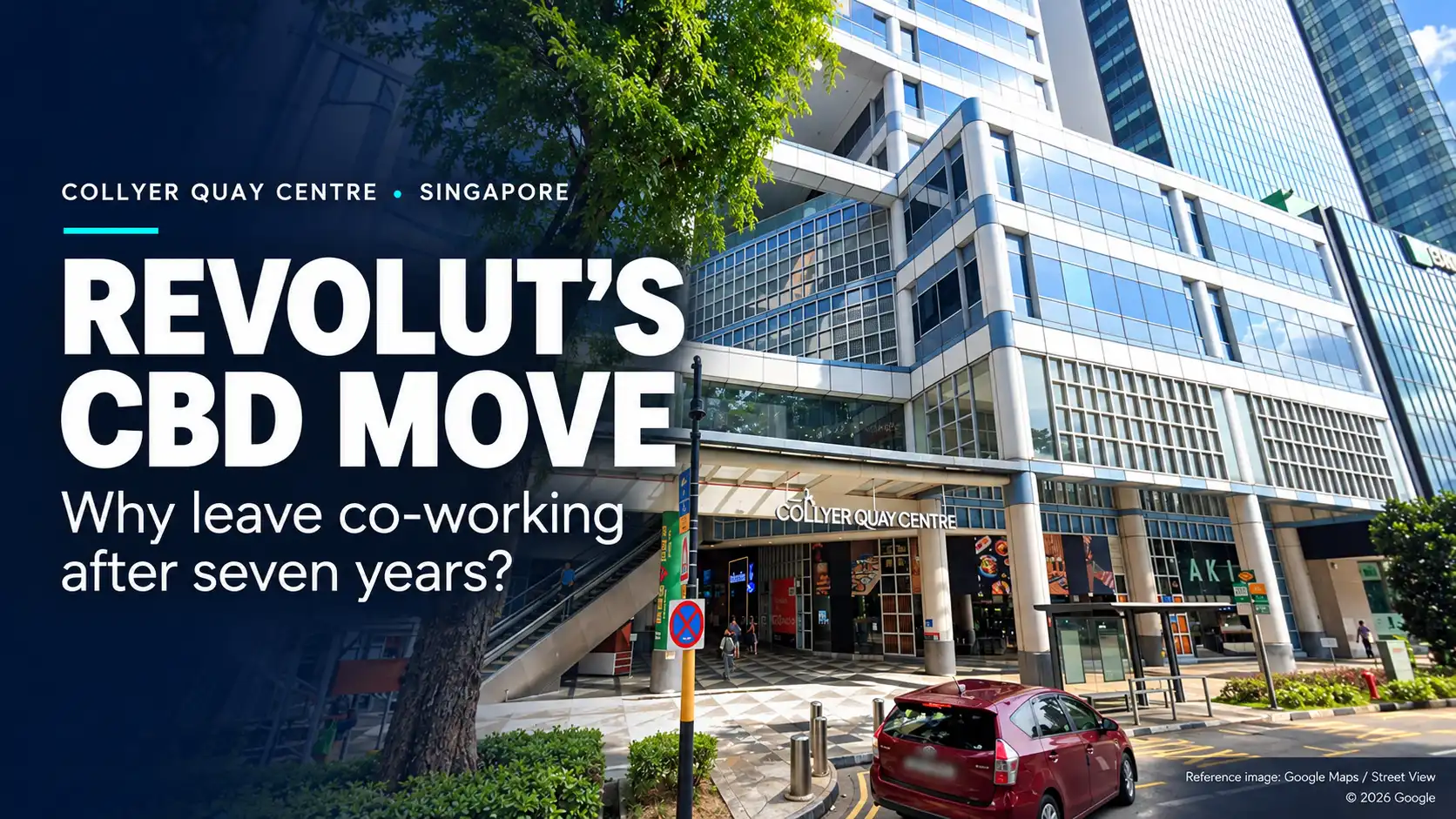
For a company that delivers services through an app, a physical office might seem like a secondary consideration. Yet Revolut’s decision to establish a dedicated office at Collyer Quay Centre suggests that physical presence becomes more valuable as a digital business grows.
After seven years operating from co-working spaces in Singapore, the fintech company is taking approximately 8,880 sq ft under a five-year lease, with the new office expected to open in early 2027. The move accompanies a commitment to invest nearly S$350 million in Singapore over five years, supporting product development, business expansion and workforce growth.
For Singapore’s property market, the interesting question is what has changed in Revolut’s requirements. Why does a company that has operated successfully from shared premises now see value in having its own office?
The answer points to the different roles an office can play as a business matures: accommodating employees, establishing a recognisable identity and giving practical expression to a longer-term commitment.
A dedicated office makes the commitment more visible
In a Business Times report dated 8th October 2026, Revolut’s Singapore and South-east Asia chief executive Raymond Ng linked the move to the company’s intention to deepen its local roots. Having its own office and logo would help communicate that commitment to local authorities and users.
That gives the property decision a purpose beyond providing desks.
A dedicated workplace lets a company control how it presents itself to employees, visitors, and business partners. Meeting rooms, reception areas and the working environment can all reinforce a consistent identity.
For a financial-services business seeking a larger role in customers’ daily lives, this visibility can support its message of permanence. An office does not establish financial strength or service quality by itself, but it gives people a tangible place to associate with an otherwise largely digital business.
The word “permanent” also needs context. Revolut is leasing the premises. Here, permanence refers to establishing a dedicated base, not owning the building or committing to that location indefinitely.
The workplace requirements change as the team grows
Revolut currently employs about 170 people in Singapore and plans to expand its local workforce to more than 300 over the next three years, according to the supplied report. Hiring is expected to focus on engineering, product management, data science and artificial intelligence.
As teams grow, companies may need greater control over the balance between individual workstations, collaboration areas, meeting rooms and private spaces.
Co-working premises can provide convenience and flexibility, particularly when a company is still testing a market or its hiring needs are uncertain. A dedicated office brings more responsibility, including fit-out decisions and ongoing workplace management, but it also lets the space be organised around a company’s own working practices.
That trade-off becomes more attractive when management has greater confidence in the business’s scale and direction.
Revolut’s move can therefore be read as a change in its priorities: the benefits of control and identity appear to have become valuable enough to justify a dedicated lease. That is an interpretation of the decision, rather than evidence that shared offices have become unsuitable for every growing fintech.
Why a CBD address may matter
The company’s choice of Collyer Quay places its new office within Singapore’s established financial district.
For a fintech business, this environment offers plausible advantages. A central location can support meetings with business partners and service providers, while a recognisable address can contribute to how the company presents itself to prospective employees and clients.
These are potential benefits rather than confirmed explanations for Revolut’s selection of this particular building. The available information does not disclose its comparison of alternative locations, negotiated rent or fit-out costs.
Nevertheless, the decision illustrates how companies may assess an office on more than rental cost per square foot. Accessibility, identity and suitability for the team can all affect the value a business receives from its premises.
A relatively compact office in a preferred location may meet those objectives without requiring a very large footprint.
An 8,880 sq ft lease carries a larger business message
The scale of the investment announcement should be kept separate from the size of the property commitment.
The nearly S$350 million is a business expansion programme, rather than the cost of the office. It covers activities such as product innovation, growth and hiring. The office supports that activity.
This distinction matters because a substantial corporate investment does not translate directly into an equally substantial amount of office demand. Spending on technology and employees can rise considerably while the physical workplace remains relatively modest.
The workforce target also should not be used to infer the office’s seating capacity. The available information does not establish how many employees will attend simultaneously, how desks will be allocated or whether other premises will eventually be needed.
For property analysis, the useful observation is that business growth and occupied floor area do not necessarily increase at the same rate.
What does the move mean for office landlords?
Revolut offers a case study of a company moving from shared accommodation into a dedicated office as its local operations develop.
For landlords, that suggests a potential source of demand among businesses established in Singapore and ready to take greater control of their workplaces. Attracting these tenants may depend on offering appropriately sized spaces, workable layouts and options that accommodate future growth.
However, a move out of co-working space does not automatically create an equivalent amount of net new demand across the market.
The company was already occupying workspace somewhere in Singapore. Its departure may free capacity at its previous location, while its new lease fills space elsewhere. The overall effect depends on the difference between the old and new footprints and whether the vacated capacity is subsequently taken up.
This is why an individual lease should not be treated as proof of a broad office-market upswing. It provides evidence of one occupier’s commitment and preferences; wider conclusions require leasing, vacancy and absorption data.
Revolut’s decision is most revealing as a statement about the company’s next stage in Singapore. After years of using flexible premises, it is committing to a workplace that can carry its own identity and support its expanding operations.
For the office market, the opportunity lies in understanding that transition. Growing businesses may still value flexibility while also being willing to pay for greater control, a recognisable address, and a place their employees can identify as their own.
Disclaimer: This article is for general information and commentary only and does not constitute financial, investment or property advice. It draws on publicly reported information available at the time of writing. Revolut’s expansion plans, investment commitment and office opening timeline may change. Views on its location choice and implications for Singapore’s office market are the author’s analysis unless expressly attributed. The S$350 million commitment relates to broader business expansion, rather than the cost of the office. A single leasing transaction does not establish a market-wide trend. Readers should independently verify relevant information and seek professional advice before making business or property decisions.
Article contributed by Jerry Wong.
 Jerry Wong is a realtor at Propnex Realty, bringing a rich background in interior and lighting design to his work. He loves exploring diverse spaces and observing the transformative power of real estate. Beyond his professional role, Jerry finds his greatest fulfillment in connecting people with the right properties, gaining immense satisfaction from helping clients achieve their dreams.