Belgravia Ace’s final release has now produced its first real test of demand.
When the 23 completed semi-detached homes were launched for sale on 17 September 2026, buyers selected nine units. That represents a take-up rate of approximately 39.1% for the final release.
On the surface, selling nine homes priced above S$5 million in a single release is a respectable result. These are large, specialised strata-landed properties in a car-dependent location, so the buyer pool is naturally narrower than that of a conventional condominium launch.
However, the more useful story is not simply how many homes sold. It is which configurations buyers chose.
Six of the nine selected homes were Type B units, three were Type A, and none were Type C. This is especially noteworthy because the remaining Type C homes are priced below the Type B units, yet buyers still clearly preferred Type B’s larger, more complete family layout.
The result suggests that buyers were not merely looking for the cheapest way into Belgravia Ace. Many appear to have been willing to pay more for the configuration they considered better suited to long-term family occupation.
The latest availability chart adds another layer to the analysis. It shows that price differences within the same house type are not arbitrary. The remaining homes occupy very different positions within the development, with some beside the main arrival area and others enjoying more internal or peripheral locations.
This follow-up analysis examines what the 17 September selection pattern may tell us, how it compares with our earlier Belgravia Ace relaunch review, and whether the 14 remaining homes now offer better opportunities.
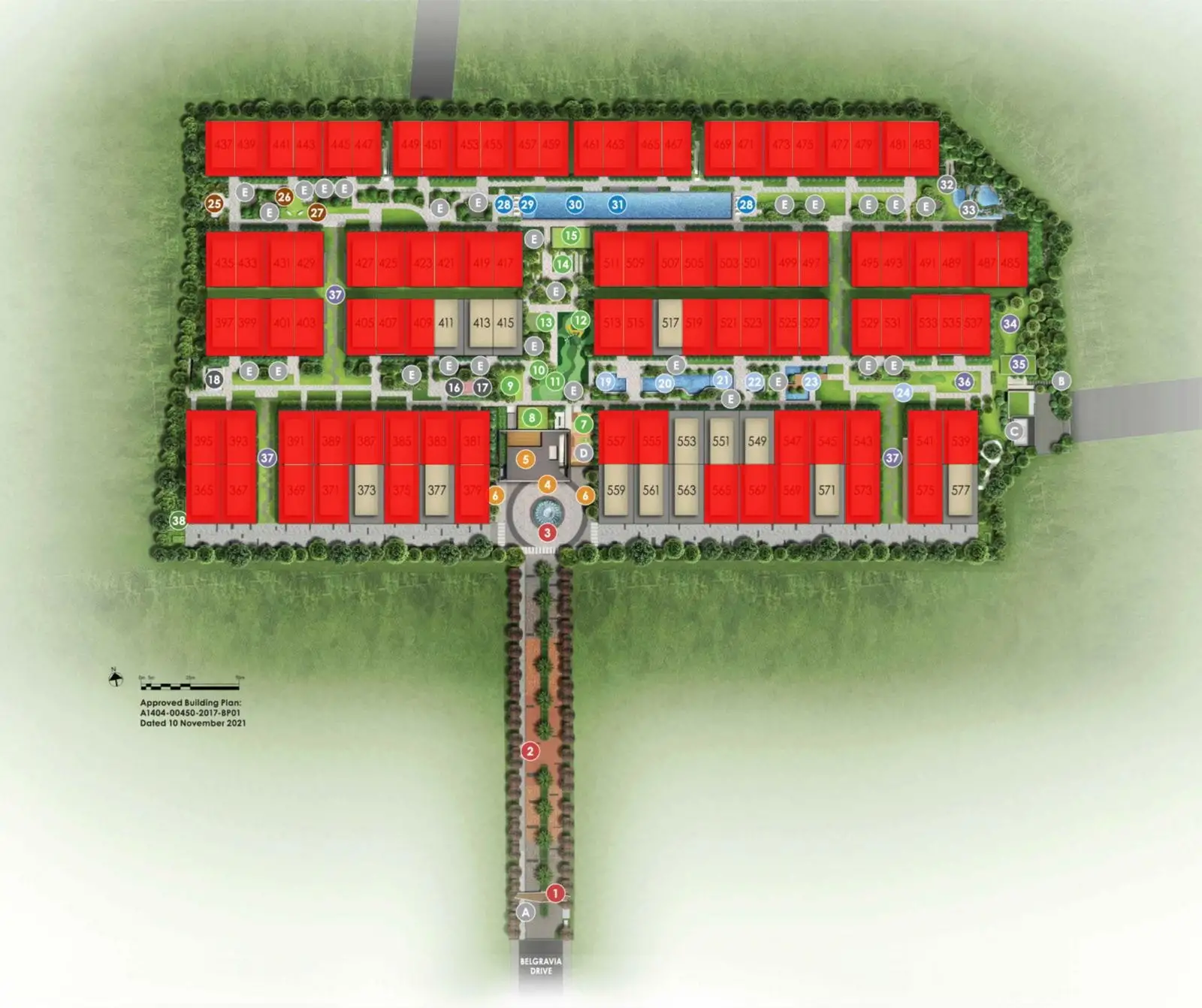
What Sold on 17 September?
The following nine units were selected:
| Unit | Configuration |
|---|---|
| 383 | Type B |
| 545 | Type B |
| 379 | Type A |
| 565 | Type A |
| 557 | Type B |
| 375 | Type A |
| 541 | Type B |
| 547 | Type B |
| 381 | Type B |
The sales can therefore be broken down as follows:
| Configuration | Released | Sold | Remaining | Sell-through rate |
|---|---|---|---|---|
| Type A | 10 | 3 | 7 | 30.0% |
| Type B | 9 | 6 | 3 | 66.7% |
| Type C | 4 | 0 | 4 | 0% |
| Total | 23 | 9 | 14 | 39.1% |
Type B represented only 39.1% of the homes offered but accounted for 66.7% of the units sold. Put differently, two out of every three buyers chose Type B.
That is a meaningful preference signal, even though the sample remains relatively small.
What the Latest Availability Chart Reveals
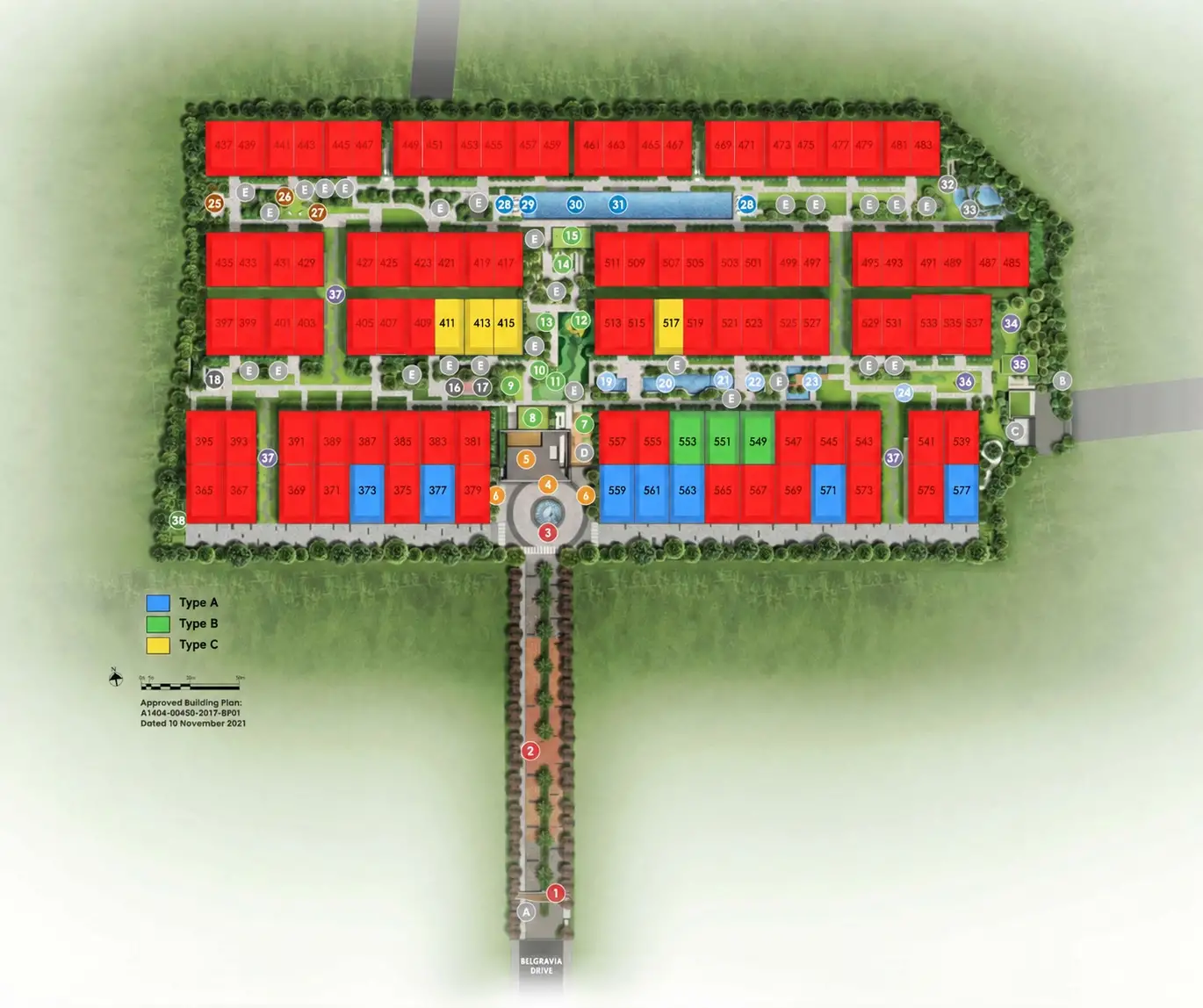
The updated chart marks the 14 remaining houses against the wider Belgravia Ace site plan. This makes it possible to look beyond configuration and consider how position may have affected pricing and demand.
The main entrance is at the southern end of the development. Vehicles travel along the entrance boulevard before reaching the circular arrival and drop-off area near the clubhouse and central facilities.
The remaining units are distributed as follows:
- Type A: Units 373, 377, 559, 561, 563, 571 and 577;
- Type B: Units 549, 551 and 553; and
- Type C: Units 411, 413, 415 and 517.
The chart immediately explains why buyers should not compare prices by layout alone. Two houses may share the same internal configuration and strata area but differ in their exposure to arriving vehicles, visitor activity, headlights, communal facilities, internal traffic and the development boundary.
It also helps explain one of the most noticeable prices in the remaining inventory: Unit 559 at S$5.19 million.
Unit 559 is not only the lowest-priced remaining Type A. At S$5.19 million, it is also the cheapest home across the entire remaining selection. All four Type C homes, including Unit 413, are priced at S$5.30 million.
The most likely explanation for its discount is its position immediately beside the principal arrival area. It is the first remaining Type A encountered on the eastern side of the central roundabout and sits closer to the main entrance than the other unsold Type A homes.
That position offers convenience. Residents have a shorter route to the entrance, clubhouse and central facilities. However, it may also involve greater exposure to vehicles entering and leaving the estate, visitors using the arrival area, car headlights and general movement around the development’s main circulation node.
The S$5.19 million price therefore appears to compensate buyers for accepting a busier and more exposed position. By comparison, the other remaining Type A homes are priced from S$5.50 million to S$5.665 million.
This does not automatically make Unit 559 undesirable. Some households may value accessibility more than privacy, particularly if elderly family members frequently use the clubhouse or if the owners expect regular visitors. But its S$310,000 to S$475,000 discount against the other remaining Type A homes should be understood as a location trade-off rather than a straightforward bargain.
Buyers Appeared to Prioritise Functionality Over the Lowest Quantum
Before the release, Type C appeared capable of attracting buyers seeking a lower purchase quantum without giving up the conventional basement-to-living arrangement.
It provides 4,058 sq ft of strata area, basement parking, first-storey living and dining spaces, five bedrooms, separate deluxe and oriental kitchens, a private lift and a roof terrace. Its layout retains much of the conventional landed-house circulation offered by Type B.
All four remaining Type C homes are asking S$5.30 million. That places them S$300,000 below the remaining Type B homes at S$5.60 million, although they are S$110,000 above Type A Unit 559—the lowest-priced remaining house at S$5.19 million.
Yet none of the four Type C homes was selected on 17 September.
That weakens the argument that buyers were primarily driven by price alone. Type C provided a S$300,000 saving against Type B while retaining basement parking, first-storey living and five bedrooms, yet buyers still concentrated on the larger configuration.
Instead, buyers strongly favoured Type B, the largest configuration at 4,370 sq ft.
This does not necessarily mean buyers were chasing square footage blindly. As explained in our earlier review, some of Type B’s additional strata area comes from its larger private car porch, private enclosed spaces and roof-terrace allocation. Its lower price per square foot therefore cannot be interpreted in the same way as a conventional condominium’s internal floor area.
Nevertheless, Type B also contains a dedicated family room on the roof-terrace level. For a household spending more than S$5 million on a five-bedroom home, that additional enclosed communal space may have been easier to appreciate than a saving of a few hundred thousand dollars.
The launch results suggest buyers saw genuine utility in the extra space.
Why Type B Was the Clear Winner
Type B’s success probably came from a combination of three factors.
1. It offers the most complete large-family layout
Type B follows a conventional progression from basement parking to the main living and entertaining floor, followed by the bedroom levels and a separate rooftop family zone.
This allows different members of a large or multigenerational household to use the home simultaneously without concentrating every activity in the principal living room.
The family room could function as a children’s playroom, television room, games room, informal lounge or space for teenagers and adult children. In a house intended for long-term owner occupation, that flexibility may matter more than achieving the lowest initial purchase price.
2. Its price per square foot remained comparatively attractive
The three remaining Type B homes are each asking S$5.60 million. Based on a strata area of 4,370 sq ft, this works out to approximately S$1,282 psf.
That is still below the remaining Type A homes, which range from approximately S$1,321 psf to S$1,442 psf, and broadly competitive with the Type C units at approximately S$1,306 psf.
Buyers therefore did not have to choose between functionality and headline value. Type B offered the largest overall area, the additional family room and one of the lowest price-per-square-foot positions in the release.
3. Buyers could inspect the completed space
Belgravia Ace was completed in 2025, so buyers could assess actual houses rather than purchase from plans and visualisations. The final release comprised 23 completed semi-detached homes, with the preview commencing on 5 September and sales bookings opening on 17 September.
That matters particularly for Type B. The value of a rooftop family room, the circulation between levels and the relationship between indoor and outdoor areas can be difficult to judge on paper. Once buyers walked through the houses, the additional space may have felt more useful than the strata-area breakdown initially suggested.

Type A Found a Smaller but Identifiable Buyer Group
Three of the ten Type A homes were selected, producing a 30% sell-through rate.
That is substantially weaker than Type B but still demonstrates demand for Type A’s more specialised arrangement.
Unlike Types B and C, Type A has no basement. Its car porch and fifth bedroom sit at entrance level, while the principal living and dining areas are on the second storey.
This arrangement may appeal to households wanting a more separated bedroom for an elderly parent, adult child, long-term guest or live-in family member. It is therefore not surprising that Type A found buyers despite having the smallest strata area and generally the highest price per square foot.
However, seven Type A homes remain, making it the largest component of the unsold inventory. This reinforces our earlier conclusion: Type A is not necessarily an inferior house, but it requires a more specific buyer.
Households that prefer to enter directly into their main living and dining level may find its vertical arrangement less intuitive. Buyers also need to decide whether the privacy created by the entrance-level fifth bedroom is worth paying a higher effective rate for a smaller overall strata area.

Why Did Type C Fail to Sell?
Type C’s zero take-up is the most surprising part of the release.
Before launch, it seemed like the balanced option. It offers most of Type B’s core organisation, including basement parking and first-storey living spaces, but at a lower overall quantum.
There are several possible explanations.
First, the price gap may not have been large enough. All four remaining Type C homes are asking S$5.30 million. Against the remaining Type B price of S$5.60 million, the saving is S$300,000.
For a buyer already committing more than S$5 million, paying about 5.7% more for the larger Type B and its additional family room may have seemed reasonable.
Second, Type C may occupy an awkward middle position. Type A offers a genuinely different entrance-level bedroom arrangement, while Type B offers the most complete family configuration. Type C is more efficient, but efficiency alone may not be the strongest motivation for buyers in this price segment.
Third, buyers of large landed-style homes may place a premium on optionality. Even if they do not immediately need a second family room, they may prefer to own it for future children, ageing parents, guests, entertainment or work-from-home use.
These are plausible interpretations, not proof of every purchaser’s motivation. The availability chart confirms that unit position was another important variable: orientation, frontage, privacy, sunlight, proximity to the entrance and relationship to the communal facilities could all have influenced individual decisions.

What Remains Available?
Following the nine sales, 14 homes remain:
| Unit | Type | Strata area | Asking price | Approx. asking psf |
|---|---|---|---|---|
| 559 | A | 3,929 sq ft | S$5.19M | S$1,321 psf |
| 413 | C | 4,058 sq ft | S$5.30M | S$1,306 psf |
| 415 | C | 4,058 sq ft | S$5.30M | S$1,306 psf |
| 517 | C | 4,058 sq ft | S$5.30M | S$1,306 psf |
| 411 | C | 4,058 sq ft | S$5.30M | S$1,306 psf |
| 561 | A | 3,929 sq ft | S$5.50M | S$1,400 psf |
| 563 | A | 3,929 sq ft | S$5.50M | S$1,400 psf |
| 373 | A | 3,929 sq ft | S$5.50M | S$1,400 psf |
| 571 | A | 3,929 sq ft | S$5.50M | S$1,400 psf |
| 549 | B | 4,370 sq ft | S$5.60M | S$1,282 psf |
| 551 | B | 4,370 sq ft | S$5.60M | S$1,282 psf |
| 553 | B | 4,370 sq ft | S$5.60M | S$1,282 psf |
| 377 | A | 3,929 sq ft | S$5.60M | S$1,425 psf |
| 577 | A | 3,929 sq ft | S$5.665M | S$1,442 psf |
Prices and availability can change. The table reflects the supplied post-launch availability and is accurate as of 20th September 2026.
The Three Remaining Type B Homes May Now Attract the Most Attention
Only Units 549, 551 and 553 remain for Type B, all at S$5.60 million.
The chart shows that these three houses form a contiguous central cluster. They sit along the inner row east of the arrival area, with Unit 549 furthest from the roundabout and Units 551 and 553 progressively closer.
Interestingly, the adjoining Type B Unit 557, closest to the main arrival area, sold on 17 September. This reinforces the view that buyers were strongly attracted to the Type B configuration even when a unit occupied a busier central position.
Because the remaining Type B homes carry the same asking price, buyers should compare their precise outlooks and immediate surroundings rather than relying on psf. Unit 549 may offer slightly more separation from the arrival area, while Units 551 and 553 sit closer to the central facilities. The final preference will depend on whether the household values convenience or a little more distance from internal activity.
The price is S$150,000 above the earlier Type B starting indication of S$5.45 million. Even so, the implied rate of approximately S$1,282 psf remains compelling relative to the remaining Type A inventory.
For example, a Type B at S$5.60 million costs the same as Type A Unit 377 but provides 441 sq ft more strata area, a basement-to-living circulation pattern and the rooftop family room. The buyer should still examine how much of the extra area is enclosed and usable, but the side-by-side value proposition is difficult to ignore.
The stronger first-day take-up also introduces an element of scarcity. Two-thirds of the released Type B homes have already been selected, leaving only one-third available.
This does not guarantee future resale outperformance, but it shows Type B currently has the widest buyer acceptance among the three layouts.
Type C Is Consistently Priced
At S$5.30 million, Type C Units work out to approximately S$1,306 psf. That is S$200,000 above the S$5.10 million paid for another 4,058 sq ft Type C in July 2026, a same-development transaction highlighted in our earlier review. The difference is approximately 3.9% before accounting for the individual units’ positions and attributes.
The chart shows that Units 411, 413 and 415 form a group along an internal row west of the central facilities, while Unit 517 sits in a separate row to the east. Unit 413 is therefore not beside the main entrance in the same way as Unit 559.
Because all four Type C homes carry the same asking price, buyers should carefully compare their orientation, exposure, privacy, relationship to nearby facilities, and physical condition.
Type C can still suit a household that wants Type B’s conventional basement-to-living organisation but does not need the additional family room.
Why Unit 559 Is the Lowest-Priced Type A
Unit 559 is asking S$5.19 million, substantially below the other remaining Type A homes, which are priced at S$5.50 million to S$5.665 million.
Its approximate rate of S$1,321 psf is also noticeably lower than the S$1,400 to S$1,442 psf range of the remaining Type A inventory.
The availability chart makes the likely reason much clearer.
Unit 559 is positioned immediately beside the main circular arrival area and is the closest remaining Type A to the estate entrance. Residents will benefit from convenient access to the entrance and communal facilities, but the house will also likely experience more passing vehicles, visitor activity, and exposure to headlights than Type A homes positioned further into the development.
Its lower price should therefore be viewed as compensation for location, not evidence that the developer has undervalued an otherwise identical unit.
The comparison with nearby Type A homes illustrates the size of that adjustment:
| Type A unit | Asking price | Premium over Unit 559 |
|---|---|---|
| 559 | S$5.19M | — |
| 373 | S$5.50M | S$310,000 |
| 561 | S$5.50M | S$310,000 |
| 563 | S$5.50M | S$310,000 |
| 571 | S$5.50M | S$310,000 |
| 377 | S$5.60M | S$410,000 |
| 577 | S$5.665M | S$475,000 |
Unit 577 commands the highest Type A price and occupies an end position on the estate’s eastern side. Unit 377 also carries a higher price of S$5.60 million and sits on the western side of the central arrival zone. These prices indicate that the developer applies meaningful premiums and discounts for position, even when the house type and strata area remain the same.
For a multigenerational household that values the entrance-level fifth bedroom, Unit 559 may deserve an inspection—but the visit should take place during a busy period rather than only when the estate is quiet.
Buyers should observe the route taken by arriving vehicles, how headlights interact with the house after dark, the level of activity around the roundabout and whether the landscaping provides sufficient visual screening. If those factors are acceptable, the S$310,000 or greater saving against the other Type A homes could represent a reasonable trade-off.
The key qualification remains the same: buyers should choose Type A because its layout meets a genuine family requirement, not simply because one unit costs less.
What the Sales Result Says About the S$5 Million-Plus Buyer
The 17 September outcome points towards a buyer who is highly owner-occupier driven.
This is unlikely to be an investor-led market. Belgravia Ace is not within walking distance of an operational MRT station, its large floor areas limit rental efficiency, and neighbouring strata-landed homes can be purchased for less. Its appeal rests instead on freehold tenure, five-bedroom accommodation, private parking, a private lift, completed-product certainty and condominium-style facilities.
Within that context, buyers appear willing to pay for spaces that make family life easier.
The stronger demand for Type B suggests the typical purchaser may be:
- a large family needing more than one communal area;
- a multigenerational household wanting separation between living zones;
- a private-property upgrader accustomed to generous shared spaces;
- an owner-occupier intending to remain for many years; or
- a buyer who values flexibility more than the lowest initial price.
Has the Ranking Changed After Launch Day?
The sales result strengthens the ranking in our original review, but it also adds an important qualification.
Type B: strongest overall—and now validated by demand
Type B remains the most attractive configuration for buyers who can use the rooftop family room and additional ancillary areas. Its 66.7% sell-through rate provides the clearest evidence of market acceptance.
At S$5.60 million, the remaining homes are no longer at the initial S$5.45 million indication, but their approximate S$1,282 psf rate remains competitive.
Type C: potentially the best numerical value, but not the market favourite
Type C still makes sense for a family seeking conventional landed-house organisation at a lower quantum than Type B. However, all four remaining Type C homes are priced at S$5.30 million—approximately 3.9% above the S$5.10 million July 2026 same-size transaction—so Unit 413 no longer stands out as a special value opportunity.
However, buyers should recognise that none of the four Type C homes sold on the first release day. That does not make Type C a poor purchase, but it suggests its future buyer pool may be more price-sensitive or less enthusiastic than Type B’s.
Type A: useful for a specific household, but increasingly price-sensitive
The three Type A sales confirm demand for its distinctive arrangement. Nevertheless, seven units remain, including several at approximately S$1,400 psf or more.
The higher-priced Type A homes may appeal to buyers who strongly value the entrance-level fifth bedroom or prefer a particular unit position. The chart indicates that the price spread within Type A is closely connected to location: Unit 559 receives the largest discount because it is nearest the main arrival area, while more internal or end-position homes command higher prices. Otherwise, the comparison with the remaining Type B homes becomes challenging.
Our Assessment: Buyers Paid for the Layout They Wanted
Belgravia Ace’s 17 September result was neither a sell-out nor a weak launch.
Selling nine of 23 completed houses represents a 39.1% take-up rate at purchase prices above S$5 million. More importantly, the distribution of those sales clearly indicates what buyers valued.
They did not simply select the cheapest configuration.
Type B dominated because it combined the largest strata area, the lowest or near-lowest price per square foot, conventional basement parking and an additional family room that can support long-term family living. Type A attracted a smaller group of buyers who presumably saw value in its more separated entrance-level bedroom arrangement. Type C, despite offering the lowest entry price, did not sell.
For buyers considering the remaining homes, we would prioritise the following units for review:
- Units 549, 551 and 553 for buyers wanting the strongest all-round layout. Type B has already demonstrated the best demand, although the S$5.60 million price should still be compared with recent resale evidence.
- Unit 559 is for buyers seeking the lowest remaining quantum and who specifically value Type A’s entrance-level fifth bedroom. At S$5.19 million, it is now the least expensive remaining home, but its discount reflects its position beside the entrance and main arrival area.
- Units 411, 413, 415 and 517 are for buyers who prefer Type C’s more efficient layout. All four are priced at S$5.30 million, so the decision should be based on position, outlook and privacy rather than an assumed discount.
The main lesson is that at this price level, buyers do not appear to be purchasing square feet or entry quantum alone. They are purchasing a long-term family arrangement.
The best Belgravia Ace unit is therefore not automatically the cheapest one. Buyers are choosing both a floor plan and a position within the estate. The 17 September sales suggest that Type B provided the most convincing overall layout, while the updated chart shows why individual units within the same type can still deserve very different prices.
Disclaimer: This article is for general information and discussion only and does not constitute financial, investment, legal or property advice. Sales, availability and asking prices are based on information supplied following the 17 September 2026 release and may change without notice. A selected unit is not necessarily a completed transaction, and prices should not be treated as lodged URA caveats unless independently confirmed. Approximate price-per-square-foot figures are calculated using the stated strata areas and rounded. Buyers should verify current availability, final pricing, unit attributes, financing, taxes and all relevant documents before making a purchase decision.
Article contributed by Jerry Wong.

Jerry Wong is a realtor at Propnex Realty, bringing a rich background in interior and lighting design to his work. He loves exploring diverse spaces and observing the transformative power of real estate. Beyond his professional role, Jerry finds his greatest fulfillment in connecting people with the right properties, gaining immense satisfaction from helping clients achieve their dreams.