Executive summary
The Dover Drive Government Land Sale (GLS) that closed on 26 March 2026 produced a top bid of S$951.0 million (S$1,556 psf ppr) from a consortium comprising Qingjian Realty / Forsea Holdings / Jianan Capital, with six bids in total and a relatively tight spread between the top and mid-pack bidders. This result matters because it is the first private residential GLS parcel released in the emerging Dover–Medway neighbourhood under URA’s Greater One-North growth story, anchoring expectations for future private-home pricing in a location that is effectively “next-door” to One-North’s employment ecosystem.
Using (i) market-based benchmarks from major brokerage/consultancy commentaries and (ii) a cost-and-margin calibration derived from comparable nearby launches (Bloomsbury Residences, Blossoms by the Park, and LyndenWoods), the most defensible expectation is that Dover Drive’s eventual new launch will need to cluster around ~S$2,800–S$2,950 psf on average, with S$2,900 psf a plausible psychological “headline” level if market conditions are firm at launch. This aligns closely with CBRE’s S$2,800–S$2,900 psf expectation and with PropNex-guided views that pricing could exceed S$2,900 psf.
Implications for the four nearby developments we listed are asymmetric: Bloomsbury Residences (closest “like-for-like” One-North/Media Circle product) and Blossoms by the Park (Slim Barracks Rise) are most likely to experience a positive “benchmark uplift” effect on both remaining developer inventory and near-term resale expectations; LyndenWoods (Science Park) could benefit through a relative-value re-rating (especially for the future subsale units), while The Hillshore (Pasir Panjang, freehold boutique) is less a direct competitor and more likely to see indirect support via District 5 pricing optics and scarcity value, rather than demand diversion.

What actually happened at the Dover Drive GLS tender
Site positioning and planning parameters
The Dover Drive parcel (formerly referred to as “Dover Road”) is a 99-year leasehold site zoned Residential with Commercial at the 1st storey, within the new Dover–Medway residential area that URA has positioned as part of the Greater One-North regional plan. Commentary around the tender consistently highlights three demand-supportive attributes:

Connectivity and employment adjacency. The site is a short walk from One-North MRT (Circle Line) and is embedded within the One-North/Science Park/Kent Ridge knowledge corridor.School and “family” draw. The land parcel is also directly opposite Fairfield Methodist (within 1km), as well as nearby tertiary institutions such as NUS and Singapore Polytechnic.Future transformation catalysts. Demand narratives increasingly link Greater one-north housing to the innovation ecosystem, including JTC’s announced Kampong AI concept at LaunchPad @ one-north (slated for completion in 2028), alongside URA’s broader plan for new housing and amenities in Dover–Medway.

Tender outcome and bid stack
The tender drew six bids, with the top bid setting a new high-water mark for recent One-North–adjacent residential land.
Dover Drive GLS tender results (26 Mar 2026)
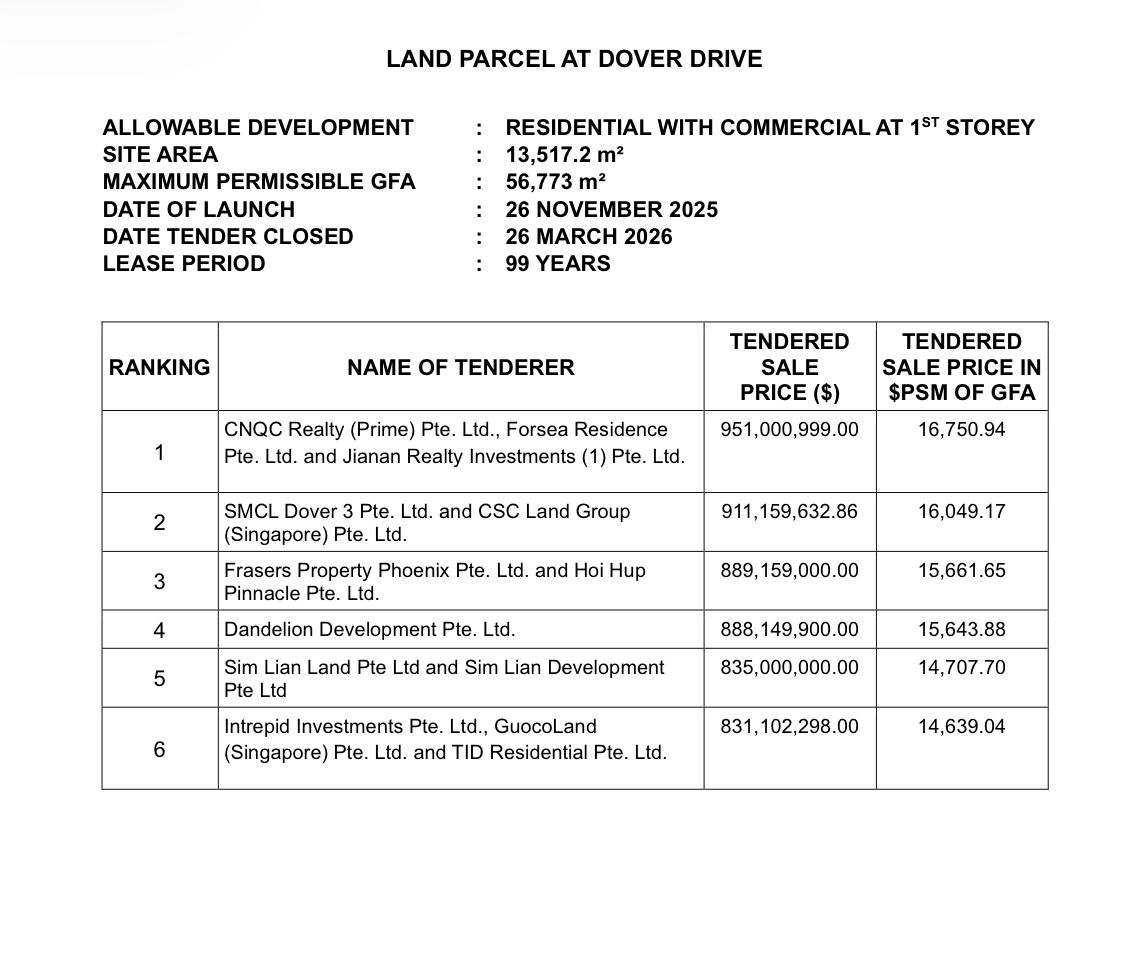
Two structural takeaways from the bid stack:
First, the gap between rank 1 and rank 2 is modest (~4.4%), which is usually interpreted as “broad consensus” among bidders on the site’s valuation (as opposed to a single outlier bidder).
Second, the winning consortium’s repeat exposure to nearby Media Circle sites suggests they are effectively underwriting a “Greater One-North residential cluster strategy,” which can matter for product design and pricing confidence (they have a current/near-term pipeline in Bloomsbury Residences and Hudson Place Residences).
Comparative land-cost and pricing benchmarks for the four nearby developments
To analyse spillover effects credibly, it helps to “normalise” each comparable by looking at:
Land rate (psf ppr) → current transacted pricing (psf) → implied cost buffer/pricing power …and then compare those relationships against Dover’s S$1,556 psf ppr land rate.
Land psf ppr reference set
Blossoms by the Park (Slim Barracks Rise Parcel A, One-North) at S$1,246 psf ppr.
Bloomsbury Residences (Media Circle, Mediapolis). Awarded land rate S$1,191 psf ppr (Qingjian/Forsea JV).
The Hillshore (Former Gloria Mansion, Pasir Panjang). Gloria Mansion was sold en bloc for S$70.3 million; with a site area of 45,742 sq ft and plot ratio 1.4 (implying 64,039 sq ft of baseline GFA).
From these inputs, the implied land rate is:
S$70.3m ÷ 64,039 sq ft ≈ S$1,098 psf ppr (rounded).
LyndenWoods (Singapore Science Park). Unlike standard GLS/en-bloc acquisitions, public reporting on LyndenWoods focuses on sales performance and positioning as Science Park’s first private residential project; a clearly disclosed “land psf ppr” acquisition number is not consistently published in mainstream coverage.
For comparability, this report therefore treats LyndenWoods as a pricing benchmark (what buyers paid) rather than an acquisition-land benchmark, and uses a calibrated back-solve in the Dover pricing model section (clearly labelled as an estimate, not a known land rate).
“Current selling prices” benchmark used in this analysis
Because “selling price” can mean either (a) current developer price list or (b) realised caveat prices, we anchor on recent caveat-based medians/averages where possible, and supplement with developer-list guidance only when needed.
LyndenWoods: Median prices of S$2,462 psf in 2025.
Bloomsbury Residences: Median prices of S$2,506 psf in 2025;
Blossoms by the Park: Median prices of S$2,387 psf in 2025.
The Hillshore: Recent transactions averaged approximately S$2,387 psf in 2025, with peak deals achieving higher levels. Notably, an earlier placement exercise recorded an average of ~S$2,592 psf for a limited tranche of units. This divergence highlights that achievable pricing can exceed the trailing average, particularly depending on unit mix, positioning, and timing. However, given the small sample size of units transacted, the data exhibits higher volatility, which contributes to the observed fluctuations in psf benchmarks.

Comparative matrix
| Development | Tenure | Land rate (S$ psf ppr) | Current transacted benchmark (S$ psf) | Notes on comparability |
| The Hillshore | Freehold | ~1,098 (implied from en-bloc price ÷ GFA) | ~2,387 avg (last 12m), with evidence of ~2,592 achieved on select sales | Boutique, low-rise, different buyer pool vs Dover |
| LyndenWoods | 99-year | Not consistently disclosed in public sources | ~2,462 median 2025 | Strong “live-work” adjacency; closest proxy is price performance |
| Bloomsbury Residences | 99-year | 1,191 | ~2,506 median 2025 | Most direct “like-for-like” in Mediapolis/One-North orbit |
| Blossoms by the Park | 99-year | 1,246 | ~2,384 median 2025 | One-North product; different micro-location (Slim Barracks Rise) |
A key observation is that Dover’s land rate (S$1,556) is ~25–31% higher than the 2021–2024 One-North GLS comparables (S$1,191–S$1,246). However, market expectations for Dover’s eventual launch pricing are not “25–31% higher” than current One-North new-launch benchmarks—because a large part of a condo’s all-in cost is non-land (construction + preliminaries + professional fees + finance + sales/marketing), which does not scale 1:1 with land.
Pricing the future Dover Drive project
Market-anchored expectation
Two highly cited, near-term reference points after the tender close are:
CBRE’s view that Dover Drive (at this land rate) is likely to launch around S$2,800–S$2,900 psf.
PropNex / media commentary suggesting the eventual project could exceed S$2,900 psf on average (often framed as “crossing 2,900”).
This bracket is also directionally consistent with the idea that Dover becomes a new price “step-up” for the immediate Greater One-North micro-market, given its first-mover status in Dover–Medway and adjacency to One-North MRT and Fairfield Methodist. [12]
Cost-based sanity check using Singapore construction cost benchmarks
RLB’s Rider’s Digest (Singapore, costs as at 1Q2025) provides indicative condominium construction cost ranges per Construction Floor Area (CFA), inclusive of general allowances for foundation, car parks, and external works, while explicitly excluding land cost and many development soft costs (fees, financing, DC, etc.).
For condominiums, total construction (building works + building services) is shown as:
Medium quality: S$2,900–S$3,570 per m² CFA, which is ~S$269–S$332 psf
Good quality: S$3,590–S$4,520 per m² CFA, which is ~S$333–S$420 psf
Given Dover’s positioning next to One-North MRT, with a commercial podium component, a reasonable underwriting assumption is that the eventual development would lean toward at least a “medium–good” specification, especially for façade, M&E, and common-area specifications.
Calibrating “non-land cost” using known One-North comparables
Instead of guessing soft-cost percentages, you can back-solve an implied “non-land cost buffer” from comparable projects that have both:
A known land rate (psf ppr) and observed transacted pricing (psf).
Using PropNex’s Protrend 2025 median benchmarks for Bloomsbury Residences and Blossoms by the Park, and their known land rates, Dover’s expected pricing starts to converge on the S$2,800–S$2,950 range if non-land costs are treated as the dominant “fixed” component and land as the variable.
Protrend’s reported medians:
Bloomsbury: land 1,191, price 2,506
Blossoms: land 1,246, price 2,384
If we assume a developer targets (roughly) mid-teen gross margin on all-in cost (a commonly used feasibility heuristic in market commentary), then these comparables imply non-land costs in the high hundreds psf. When that same magnitude is applied to Dover’s higher land basis, the resulting feasible launch range is broadly consistent with CBRE/PropNex’s published expectations.
Base-case and sensitivity range for Dover Drive
Pulling the above together, a practical pricing band for the future Dover Drive new launch can be framed as:
Base case (most likely): ~S$2,800–S$2,950 psf average
Upside case (strong market & premium product execution): ~S$2,950–S$3,100 psf average
Downside case (macro softness/rate shock/demand resistance): ~S$2,650–S$2,800 psf average
The base case directly matches the most credible post-tender consultant guidance.
Impact analysis for the four nearby developments
Bloomsbury Residences
Where it stands now. Bloomsbury’s land basis is S$1,191 psf ppr and recent reporting puts its achieved prices around ~S$2,562 psf.
Why Dover matters most to Bloomsbury. Dover Drive is effectively the next major private supply node closest to One-North MRT and Fairfield Methodist, and the winning developer group overlaps with Bloomsbury’s sponsor group—meaning buyer targeting, product language, and pricing strategy are likely informed by Bloomsbury’s absorption experience.
Expected pricing effect. If Dover launches around S$2,800–S$2,950 psf, Bloomsbury’s current caveat band at ~S$2,5xx becomes “value” on a relative basis (a ~10–17% discount). This typically allows:
A firmer negotiating stance for remaining developer inventory (if any meaningful stock remains), and
A higher probability that resale/subsale sellers will anchor asking prices upward once Dover sets the new “reference price” for the precinct.
This direction is explicitly echoed by market commentary that a new Dover launch could lift prices in the One-North neighbourhood / wider Queenstown planning area.
Risks to the uplift thesis. The main risk is competitive substitution: some buyers may defer a Bloomsbury purchase to wait for Dover’s product (especially if Dover offers stronger retail integration and a “first-in-Dover–Medway” narrative). A second risk is macro—if financing conditions tighten, the market may resist the higher “2.9k handle” even if feasibility supports it.
Blossoms by the Park
Where it stands now. Blossoms by the Park sits on a higher land basis than Bloomsbury (S$1,246 psf ppr), but the reported 2025 median transacted price is S$2,384 psf—meaning current price discovery is still below Bloomsbury on a psf basis.
Why Dover helps. Dover’s top land rate is a step change above the 2021 Slim Barracks Rise sites, and there is already limited unsold inventory across the One-North launch set (Blossoms, The Hill @ One-North, Bloomsbury, LyndenWoods), providing a rationale for bidders’ confidence. In a tight-supply micro-market, a higher-priced new entrant often does two things:
It pulls forward buyers who decide to “buy the discount” in existing projects before the new benchmark is established, and it provides resale/subsale sellers a stronger anchor for future pricing, especially for projects with unique attributes (views, stack facing, proximity to One-North Park/Rail Corridor, etc.).
Expected pricing effect. Under a Dover base case ~S$2,800–S$2,950, Blossoms at ~S$2,415 median (2025) looks meaningfully cheaper (mid-to-high teens discount).
A reasonable market expectation is that Blossoms’ resale/subsale “centre of gravity” could migrate upward into the mid-S$2,5xx range over time if Dover successfully transacts at ~S$2.9k—subject to broader RCR market conditions.
Competitive nuance. Blossoms and Dover do not compete on identical buyer psyche: Dover is closer to Fairfield Methodist and positioned as the “first private” within Dover–Medway; Blossoms is a pure One-North housing product with its own amenity story. This reduces “winner takes all” cannibalisation and increases the probability of a spillover uplift rather than a displacement effect.
LyndenWoods
Where it stands now. LyndenWoods was the most successful recent nearby launch by absorption rate, selling ~94% quickly and achieving around S$2,462 psf in 2025.
What Dover changes. LyndenWoods is not inside One-North proper, but it is within the same “innovation belt” catchment (Science Park / Kent Ridge / One-North), and the same consultants connect Dover’s appeal to the large nearby professional tenant and owner-occupier base.
If Dover prints at ~S$2,8xx–S$2,9xx, LyndenWoods’ pricing becomes a strong relative-value reference (roughly mid-teens cheaper), which can:
Support subsale pricing for early buyers aiming to exit at/near TOP, and increase the probability that remaining developer units (if any) can be repriced upward without impairing take-up, because buyers benchmark against the “next available” new supply.
Key limitation. Unlike Bloomsbury and Blossoms, LyndenWoods does not have a publicly consistent land-rate disclosure to tie “land psf ppr → selling psf” directly. The impact analysis, therefore, rests on market anchoring and substitution logic, not land-feasibility comparisons.
The Hillshore
Where it stands now. The Hillshore is a 59-unit freehold boutique redevelopment of the former Gloria Mansion site.
Its implied land basis is about S$1,098 psf ppr (calculated by dividing the S$70.3m en-bloc price by the cited GFA).
On realised pricing, the PropTrend data shows an average of approximately S$2,387 psf over the past 12 months. A recent limited placement exercise achieved around S$2,626 psf, suggesting seller expectations may be higher for selected unit types or higher floors, particularly given the development’s constrained supply.
Degree of exposure to Dover pricing. Hillshore is the least directly comparable to Dover because:
Freehold vs 99-year leasehold,
Low-rise boutique vs high-density, MRT-adjacent mixed-use,
Different micro-catchments (Haw Par Villa/Pasir Panjang lifestyle vs One-North MRT doorstep living).
So why should it still be impacted at all? Dover’s pricing is likely to affect buyer psychology in District 5. If a new, 99-year project near One-North prints at ~S$2,800–S$2,950, then Hillshore’s marketing and resale narrative can lean harder on “freehold scarcity at a discount to the new benchmark,” especially for owner-occupiers who are tenure-sensitive.
This is an indirect uplift channel (a repricing of willingness-to-pay for D5 convenience and scarcity), rather than a direct “same-buyer-pool” competition effect.
Expected pricing effect. Hillshore is more likely to experience a narrowing of its discount to the D5 benchmark (i.e., firmer pricing power), rather than a sharp step-jump. The magnitude will depend heavily on how quickly Dover becomes a real transacted benchmark (i.e., whether Dover can actually clear units at ~S$2.9k, not just list them).
Outlook and key risks to monitor
The Dover Drive land result is a clear “developer confidence vote” on the Greater One-North residential story, with URA explicitly planning new homes and amenities in Dover–Medway and JTC positioning LaunchPad/AI initiatives as part of the innovation corridor’s evolution. That said, the spillover effects to nearby projects will be moderated by three practical constraints:
The new benchmark only matters if Dover clears meaningful volume near the S$2.8k–S$2.95k band; otherwise, the market will treat it as an aspirational list price.
Construction costs and delivery risk remain real for high-density and mixed-use builds; even RLB’s “medium vs good quality” construction cost bands show wide ranges, and Dover’s mixed program could skew costs upward compared with simpler pure-residential projects.
Pipeline competition remains present: there is residual and near-term supply within the broader one-north catchment—including the upcoming Media Circle Parcel A—despite currently limited unsold inventory.
Disclosure: This post is for educational and analytical purposes. It is not financial advice. Projections are based on the provided ProTrend graph values, our inferred prices and comparability assumption, and indicative prices (accurate as of 30th March 2026). Actual construction costs, timelines, and market conditions may vary.
Article contributed by Jerry Wong.

Jerry Wong is a realtor at Propnex Realty, bringing a rich background in interior and lighting design to his work. He loves exploring diverse spaces and observing the transformative power of real estate. Beyond his professional role, Jerry finds his greatest fulfillment in connecting people with the right properties, gaining immense satisfaction from helping clients achieve their dreams.