Dunearn House GLS: Land Cost, Tender Results and Its Role as Turf City’s First Private Price Benchmark
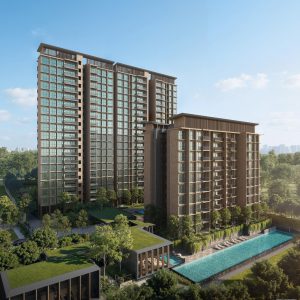
The Dunearn Road parcel, now marketed as Dunearn House, is the first private residential GLS site in the new Bukit Timah Turf City estate. It was awarded on 3 July 2025 to CSC Land Group (Singapore) Pte. Ltd., Sekisui House, Ltd. and Frasers Property Phoenix II Pte. Ltd. for S$491,454,208, based on a site area of 13,491.9 sq m and a maximum permissible GFA of 32,381 sq m. That works out to S$15,177.24 per sq m of GFA, or S$1,410.01 psf ppr. The tender was notably strong: nine bids were received, and the top five were tightly clustered, signalling broad developer conviction in the precinct rather than a single aggressive outlier.

For pricing, the most credible post-tender estimates for the first Dunearn site clustered around an average launch price of S$2,900-S$3,100 psf, with CBRE at S$2,900–S$ 3,000 psf and SRI at S$2,910–S$ 3,100 psf. As of 12 May 2026, our base-case read is that Dunearn House should be considered a low-S$3,000 psf project, not a sub-S$2,800 psf one. The second adjacent Dunearn parcel, awarded on 4 May 2026 to Winrich Investment Pte. Ltd. and Metrobilt Construction Pte Ltd at S$1,625 psf ppr, now strengthens the upper end of that pricing band for the precinct, even if it does not automatically reset the first site to the second site’s future price level.

Tender Facts and Benchmark Significance
After the first Dunearn Road GLS parcel was awarded, the adjacent second plot was subsequently released and sold. With both tender outcomes now available, the two parcels can be compared more directly. The table below draws on URA SPACE and URA’s Annex A for the first Dunearn Road site, the Wing Tai award announcement for the second site, and our own calculations based on the official site area, maximum GFA and tender price inputs.
| Parcel | Use | Award date | Winning party | Site area | Max GFA | Est. homes | Tender price | Land rate |
| First Dunearn Road parcel | Residential | 3 Jul 2025 | CSC Land / Sekisui House / Frasers Property Phoenix II | 13,491.9 sq m | 32,381 sq m | 380 | S$491,454,208 | S$15,177.24 psm GFA / S$1,410.01 psf ppr |
| Second Dunearn Road parcel | Residential with commercial at 1st storey | 4 May 2026 | Winrich Investment / Metrobilt Construction | 19,045.9 sq m | 30,474 sq m | about 330 | S$532,999,999 | S$17,490.32 psm GFA / S$1,624.90 psf ppr |
Two things stand out. First, the first site’s nine-bid turnout made it one of the most competitive prime private GLS tenders in years, which is rare for an inaugural precinct parcel. Second, while the first site’s S$1,410 psf ppr was strong, it still sat below the S$1,540 psf ppr paid in 2017 for the nearby Fourth Avenue Residences site. The lower headline land rate should be viewed against today’s more challenging development economics, including higher construction costs and reduced saleable-area efficiency under GFA harmonisation.
That comparison matters because Dunearn House is not merely “another Bukit Timah GLS site.” It is the opening price-discovery point for the private residential side of Turf City. The URA’s annex A shows that the winning bid was only 3.7% above CDL’s second-place offer, while the top five bids spanned a 10% spread. In practice, that is a sign the market had already formed a fairly coherent view of end-pricing and residual land value for the parcel.
Land Cost Translated Into Likely Launch Price
In Singapore land tenders, psf ppr is the most common shorthand because it prices land against the site’s maximum permissible GFA. For Dunearn House, the math is straightforward: S$491,454,208 ÷ 348,546 sq ft of max GFA = S$1,410.01 psf ppr. On a crude “cost-to-price” basis, that land rate is already substantial: at a future launch average of S$2,900 psf, the raw land rate alone is about 48.6% of launch psf; at S$3,100 psf, it is still about 45.5%. Because sale prices are quoted on sellable strata area rather than GFA, that ratio is only directional, but it still shows why this was never going to be a low-S$2,000 psf project.
Published consultant estimates, issued shortly after the tender closed, were tightly grouped. CBRE expected the winning developer to look at an average launch price of S$2,900–3,000 psf. SRI put the likely range at S$2,910–3,100 psf. Those estimates were anchored against nearby resale comparables such as Fourth Avenue Residences and several freehold Bukit Timah condos, rather than being pure “rule-of-thumb” guesses.
Those estimates also make sense in light of actual construction economics. RLB’s Riders Digest 2025 puts total condominium construction cost ranges at about S$3,590–4,520 per sq m CFA for good-quality projects and S$4,540–6,210 per sq m CFA for luxury-quality projects, while explicitly excluding land cost, professional fees, finance cost, showflats, cost escalation and GST. In other words, once you layer a prime Bukit Timah product spec on top of a S$1,410 psf ppr land rate, a low-S$3,000 psf launch average is economically coherent. That is why the published CBRE/SRI bands are the most sensible current benchmark for Dunearn House.
A useful mental model is this: the Dunearn House consortium paid a raw average land cost of about S$1.29 million per intended unit if the project yields 380 homes. That figure is before physical construction, statutory costs, consultant fees, financing, marketing, contingency and developer profit. Put differently, the land is expensive enough that the project needs premium own-stay/better-off family demand, not mass-market investor pricing, to work.
Our own working conclusion, therefore, is:
| Expected pricing view for Dunearn House | Reading |
| Most defensible current average launch band | S$2,900–3,100 psf |
| Best single base-case shorthand | Around S$3,000 psf average |
| Why not much lower | Land is already S$1,410 psf ppr, with prime-area build and soft costs still to come |
| Why not automatically S$3,200+ average | The second site supports the upper bound, but the first site has a meaningfully lower land basis |
That final row is important. The first site almost certainly has room to launch at a price below the future price level implied by the second parcel and still make its numbers. That relative-value flexibility is one of the Frasers-led consortium’s biggest advantages today. This is an inference from the published land rates and analyst launch ranges, not a confirmed developer pricing decision.
How The Site Fits The New Turf City Plan
Bukit Timah Turf City is being recast as a new housing estate with strong public transport, future amenities and substantial nature-and-heritage retention. URA says residents can expect amenities near the future Turf City MRT Station and other community nodes, including retail, food and beverage options, green spaces and neighbourhood parks, sports facilities, a school, healthcare and senior-friendly amenities, and a bus interchange. URA also says the estate is intended to be walkable and cycle-friendly, with road improvements under study for Eng Neo Avenue, Dunearn Road and Bukit Timah Road.

The estate’s planning narrative is not only about connectivity and convenience, but also about preservation. URA has highlighted plans to retain substantial green spaces and ecological links within the precinct, while 22 heritage buildings, including the two grandstands, are proposed for conservation and adaptive reuse as community nodes. With Turf City eventually expected to accommodate around 15,000 to 20,000 public and private homes amid lush greenery and shared community spaces, the first Dunearn Road site enjoys a meaningful first-mover advantage in a precinct whose identity will continue to mature over time.
Transport is a genuine plus here. Sixth Avenue MRT on the Downtown Line is already nearby, and Turf City will also be served by the Cross Island Line Phase 2, which LTA says includes Turf City station and is expected to open by 2032. LTA separately awarded the CR14 Turf City station and tunnels civil contract in 2024, confirming that the rail infrastructure is not just conceptual but physically underway.

The above plot-ratio image is valuable because it shows the first Dunearn parcel as a 2.4 plot-ratio site sitting at the southern edge of the much larger master-planned Turf City estate. In practical terms, that gives Dunearn House a gateway position: close to current Bukit Timah amenities and Sixth Avenue MRT, but still plugged into the future precinct’s greener, more expansive planning story. The same image also visually reinforces URA’s emphasis on green buffers and a broader nature-and-heritage framework around the estate.
What the Preliminary Unit Mix Suggests
The preliminary unit-mix points to a 380-unit scheme with the following split:

This is clearly an own-stay and family-oriented unit mix. With no 1-bedroom units and more than half the development comprising 3-bedroom and 4-bedroom layouts, the likely buyer pool will be families, right-sizers from nearby landed estates, and purchasers attracted by the area’s school cluster and long-term precinct transformation, rather than investors focused purely on rental yield.
The project’s yield also supports this analysis. Using the official maximum GFA and the 380-home indication, the site allows roughly 917 sq ft of GFA per intended unit on average, before accounting for efficiency and common-area effects. That is consistent with a development that can carry a proper family-weighted mix rather than one dominated by compact investor stock.
If we apply the published S$2,900–3,100 psf launch band to the attached preliminary size ranges, the indicative entry-to-upper quantum picture looks like this. These are not official prices; they are just arithmetic illustrations built from the preliminary unit sizes and our launch estimates.
| Unit type | Indicative quantum at published launch band |
| 2 Bedroom / 2 Bedroom + Study | ~S$1.54M to S$2.11M |
| 3 Bedroom / 3 Bedroom + Study | ~S$2.52M to S$3.13M |
| 4 Bedroom / 4 Bedroom + Study | ~S$3.42M to S$4.28M |
The practical implication is that Dunearn House is likely to straddle two buyer pools: relatively affluent upgraders entering through the 2-bedroom line, and genuine family owner-occupiers focusing on the 3- and 4-bedroom stock. That is one reason we would not treat it as a pure “headline psf” project. The unit mix suggests that quantum discipline on the 2-bedrooms and lifestyle/space premiums on the larger units will matter at least as much as the average psf headline.
Why The Second Dunearn Parcel Matters
The adjacent second Dunearn Road GLS site was awarded on 4 May 2026 to Winrich Investment Pte. Ltd. and Metrobilt Construction Pte Ltd for S$532,999,999. Wing Tai’s announcement gives the official site area as 19,045.9 sq m, while market reporting and CBRE’s commentary indicate a maximum permissible GFA of 30,474 sq m, about 330 homes, and ground-floor commercial space. That converts to roughly S$17,490 per sq m GFA or S$1,624.9 psf ppr.
That second-site price is a big deal because it is 15.2% higher than the first site’s S$1,410 psf ppr. It was also 3.1% above the second-highest bid—which, tellingly, came from the same Frasers / CSC / Sekisui consortium that won the first Dunearn parcel. In other words, the first-site winner was prepared to bid aggressively for the neighbouring plot too, which is a strong vote of confidence in the precinct.
CBRE’s explanation for the premium is persuasive. It pointed to the second site’s long frontage along a future park, its unblocked landed view, and the scarcity value of a modest 1,400 sq m commercial component that can seed immediate retail convenience without the development risk of a large mall. CBRE’s estimate for the second site’s future launch was S$3,200–3,300 psf average.
For Dunearn House, the second-site award has two opposite effects at once.
The supportive effect is that it raises the benchmark psychology for the whole precinct. If the market now accepts that the more park-fronted second plot can justify low-S$3,200S to low-S$3,300S psf, then a Dunearn House launch around S$2,900–3,100 psf looks much more defensible. That is especially true because the first site’s land basis is still materially lower.
The cautionary effect is competition. The second site will eventually bring another roughly 330 homes into the same micro-market, and it will almost certainly be marketed as the more exclusive, park-fronted, lower-density alternative. That means Dunearn House should be seen as the gateway/first-mover / convenience-led product, while the second site is likely to position itself as the park-edge / exclusivity / prestige-lifestyle product.
Dunearn House Pricing Outlook: First-Mover Advantage With Relative Value in Turf City’s New Growth Precinct
The most credible initial selling price expectation today is around S$2,900 to S$3,100 psf on average, with approximately S$3,000 psf serving as a practical base-case estimate. This is supported by published post-tender estimates from CBRE and SRI, and remains consistent with the cost economics of delivering a prime Bukit Timah development.
The second Dunearn parcel does not automatically push Dunearn House to the second site’s projected S$3,200 to S$3,300 psf launch range. However, it does make the upper end of Dunearn House’s expected launch band more defensible, while giving the first project a strong “relative value within the same emerging precinct” positioning.
Strategically, this is what makes Dunearn House compelling. It will set the first private residential price benchmark in a new rail-served, green and heritage-sensitive Turf City estate. The subsequent Winrich / Metrobilt award has further validated the precinct’s premium direction. For buyers, this means Dunearn House is unlikely to be priced cheaply; for the developer, it means the project has scope to be positioned as premium, without carrying the burden of being the highest land-cost site in the precinct.
Disclaimer: This article is for general information and market commentary only. It does not constitute financial, investment, property, legal or tax advice, nor should it be relied upon as a recommendation to buy, sell or invest in any property. All figures, projections and expected selling prices are based on publicly available information, tender results, market estimates and assumptions available at the time of writing. Actual launch prices, unit prices, project details, planning parameters and market conditions may differ. Readers should conduct their own due diligence and consult qualified professional advisers before making any property purchase or investment decision.
Article contributed by Jerry Wong.

Jerry Wong is a realtor at Propnex Realty, bringing a rich background in interior and lighting design to his work. He loves exploring diverse spaces and observing the transformative power of real estate. Beyond his professional role, Jerry finds his greatest fulfillment in connecting people with the right properties, gaining immense satisfaction from helping clients achieve their dreams.