
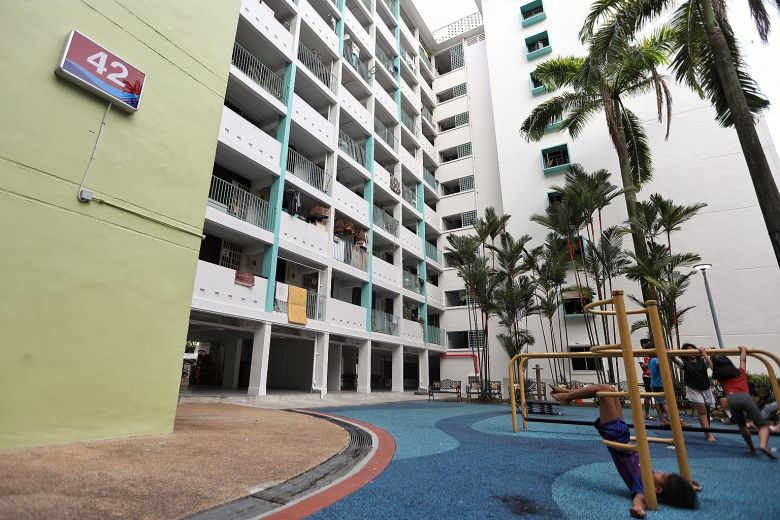
Price and location are top of the list when potential home owners decide to buy Housing Board flats.
No. 3 on the list is to be far away from HDB public rental blocks, a study has found.
Owing to the deeply entrenched national aspiration surrounding home ownership, HDB public rental flat dwellers are stigmatised and held as unfamiliar, poor and even undesirable. The proximity of rental flats is perceived as possibly reducing the value of one’s own home.
The study, based on focus group discussions with 27 HDB real estate agents in the second half of 2018, found that home owners regarded their neighbours’ socio-economic status (SES) as a more important consideration than even race and nationality when deciding where they want to live.
Only price and location, such as being close to relatives and good schools, ranked higher in importance than neighbours’ SES.
“After price and location, proximity to public rental flats would be the variable that discourages a person from buying a unit,” said the lead researcher, Associate Professor Leong Chan-Hoong of the Singapore University of Social Sciences.
The paper, published last September in the journal Equality, Diversity And Inclusion, said: “Buyers take into account the SES of their immediate neighbours and the neighbourhood in proximity in anticipation of behaviours and experiences linked to people from varying income groups.
“In general, prospective home buyers prefer to stay away from rental apartments and small dwelling types (example, one-to three-room types) as they are usually built for lower-income families and a sign of lower SES.”
HOME OWNERSHIP A KEY NARRATIVE
Owing to the heavy emphasis on home ownership and thanks to grants that have facilitated nationwide home ownership of around 90 per cent, there was a corresponding 25-year gap in the building of public rental flats from 1982 to 2007, said Prof Leong, a psychologist trained in statistics and geographic information systems.
This explains why many public rental blocks are located in central, older districts, with fewer in new towns.
The pervasive narrative in Singapore is home ownership.
“If you don’t live in an owner-occupied apartment, it’s not normal,” Prof Leong said, adding that public rental flats are held at arm’s length by home owners, who make up the majority of the population.
“Public rental units are a signpost of instability because they are associated with lower income, transition and economic limitations. It’s a different profile of neighbours. It doesn’t help encourage prospective buyers to consider a location that is next to rental flats.”
Home owners in Singapore also tend to see their homes as investments and would be wary of having neighbours perceived as undesirable, he added.
DRIVING OUT STIGMA
However, during an interview with The Sunday Times last week, Prof Leong warned that it is precisely such stigmatising, classist attitudes that Singaporeans need to examine – and purge.
While it is generally true that public rental flat tenants face economic challenges, it would be a stretch to suggest that such neighbourhoods are less worthy, he said.
“Now, the idea of a rental unit is either you are poor or you have problems,” he said.
“These are exactly the types of attitudes, values that won’t make us cohesive and which will erode the unity we have built.”
To de-stigmatise and normalise the concept of public rental flats, Prof Leong suggested loosening their criteria so that more Singaporeans can qualify for and access them.
These can include opening up applications to people who are in transition, such as Singaporean families who have just returned from overseas, and young adults who have just moved out of their parents’ homes and need a place to stay, he said.
Presently, requirements to qualify for a public rental flat are stringent. Among other things, households in general must not have a total gross income of more than $1,500. Under the Joint Singles Scheme, both occupiers must be at least 35 years old.
“Source:[HDB home buyers don’t want public rental blocks in vicinity: Study] © Singapore Press Holdings Limited. Permission required for reproduction”

Let’s Discuss Your Property Plans
Interested in This Property?
Buying, selling or renting? Get a free consultation with realtors with a background in interior and lighting design. We’ll discuss your goals and help you assess your options—from pricing and timelines to layout practicality and space potential.
Share your contact details below, and we will get in touch to understand your needs and suggest the next steps. No pressure. No obligation to proceed.