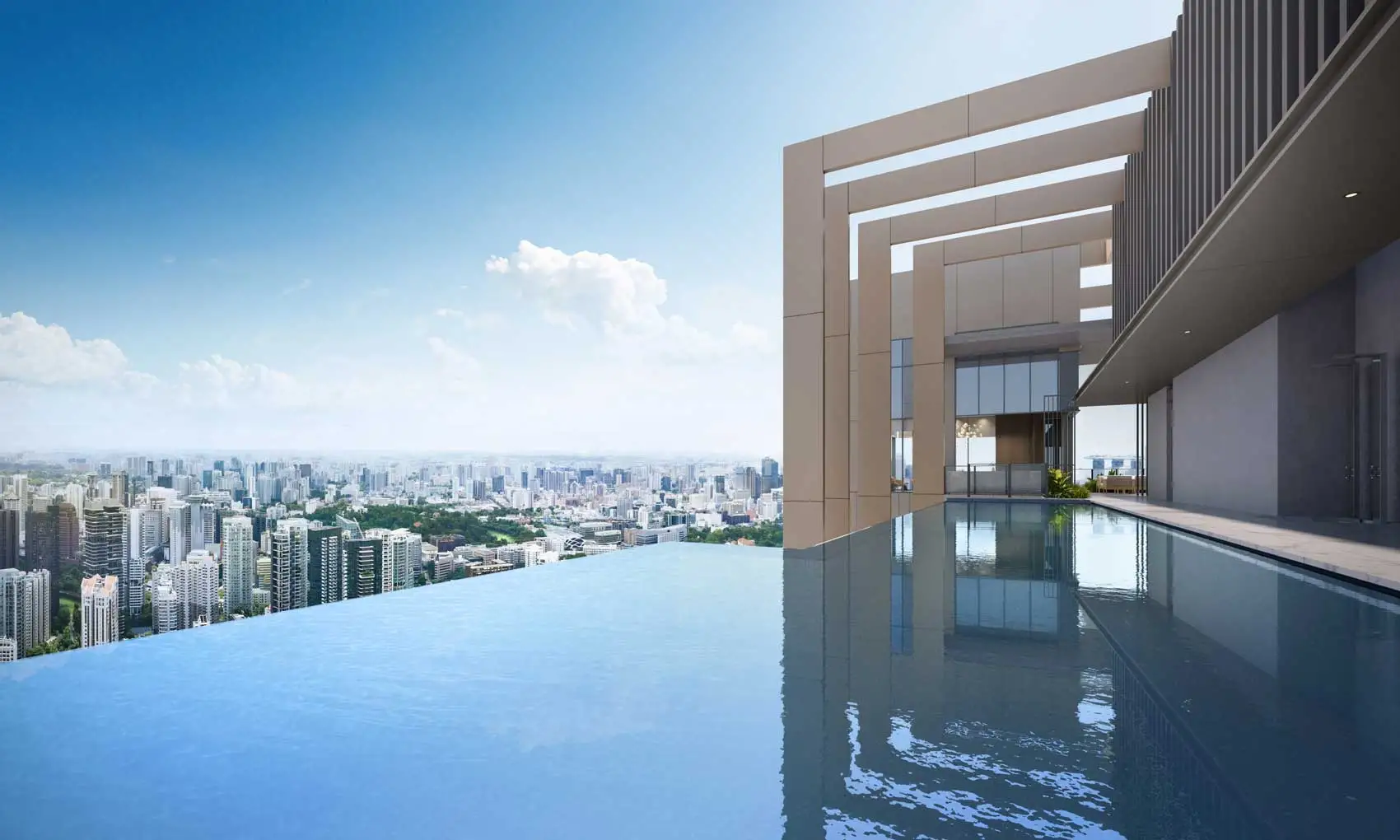
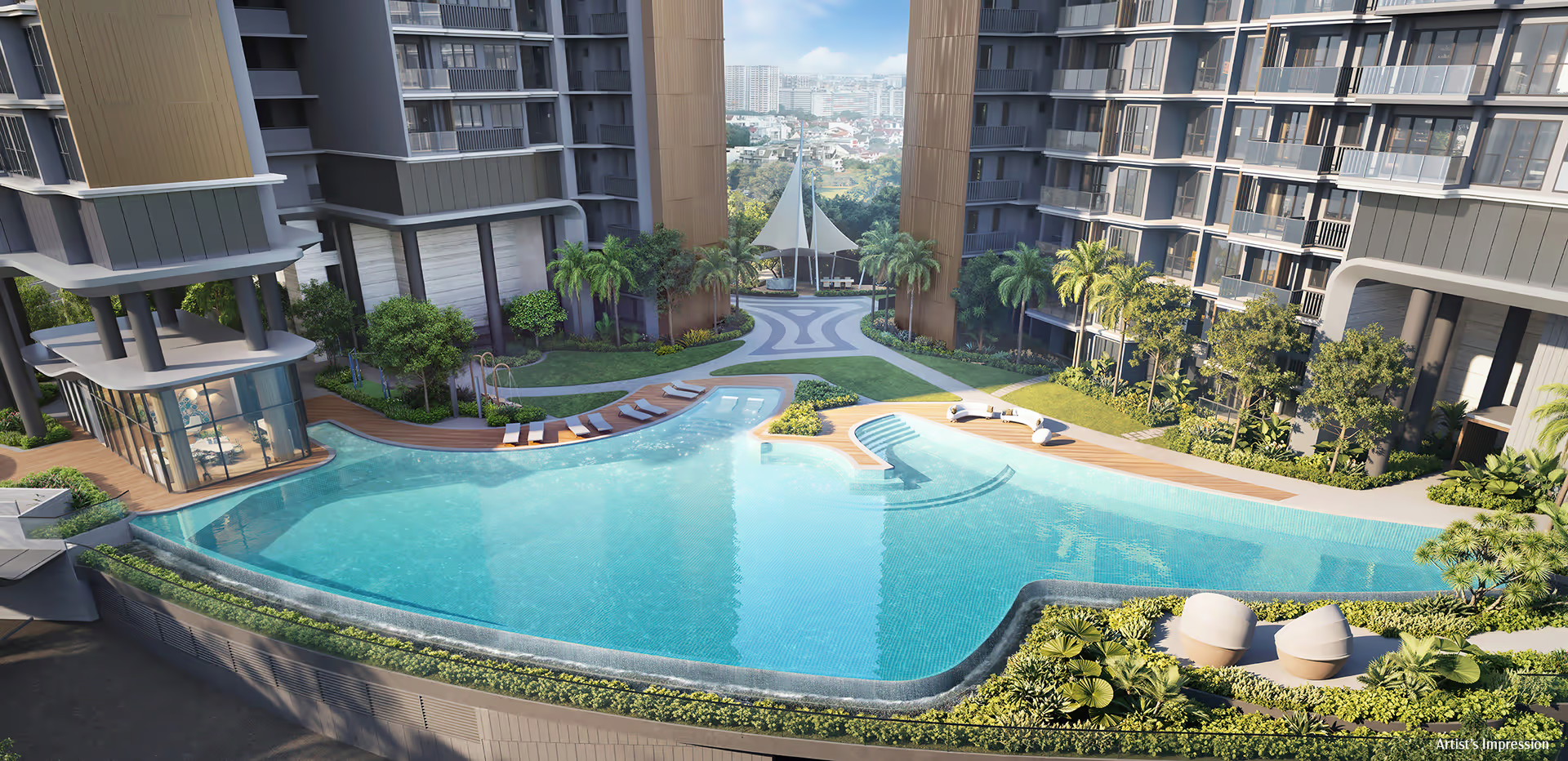
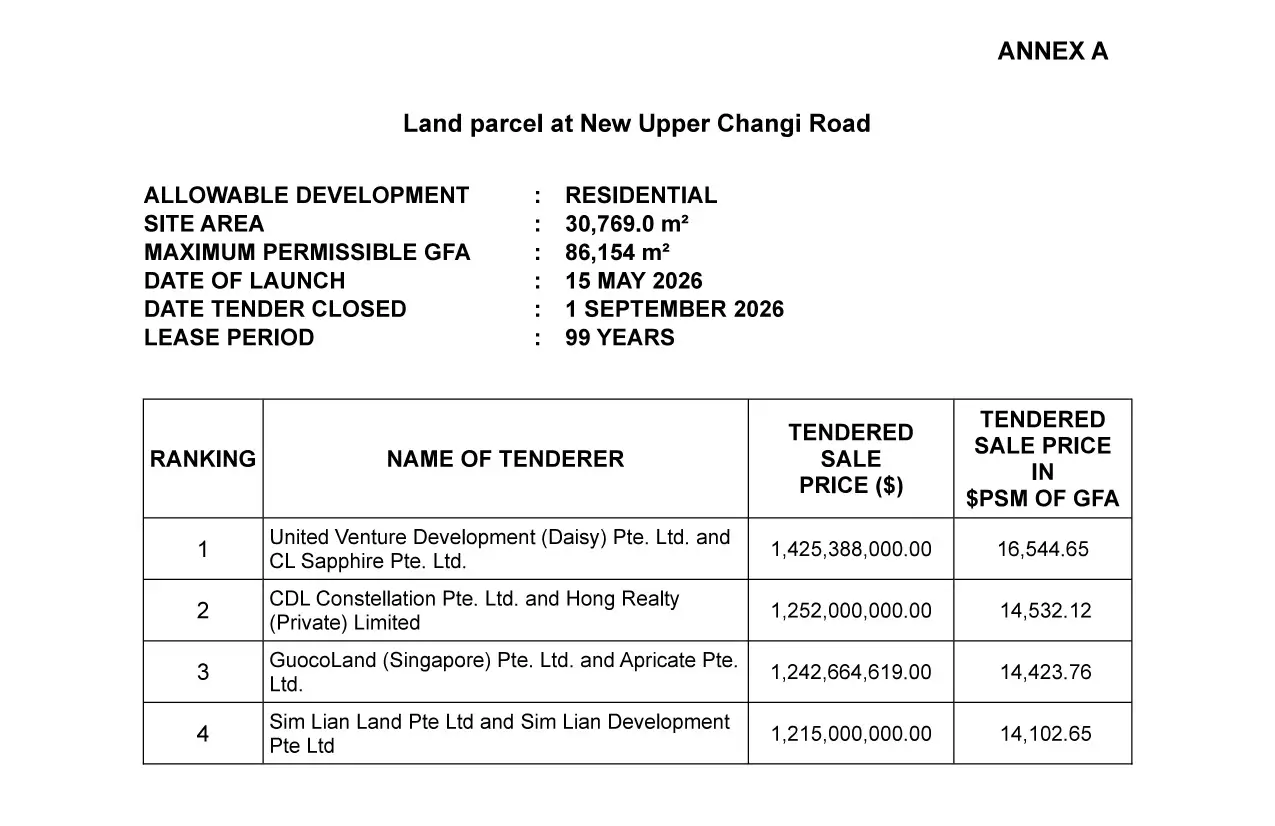
The New Upper Changi Road Government Land Sales (GLS) site has been awarded for S$1.425 billion, but the more telling figure is its land rate of about S$1,537 per sq ft per plot ratio (psf ppr).
That is a record for a purely residential GLS site in the Outside Central Region (OCR). It is also about 15.6% above the S$1,330 psf ppr paid for the nearby Bedok Rise site in December 2025.
The winning bid came from a consortium involving UOL Group, Singapore Land Group and CapitaLand Development. The joint venture did not merely edge out its competitors. Its bid was approximately 13.8% above the second-highest offer—a gap large enough to suggest that the consortium placed a distinctly higher value on the site than the rest of the field.
Why were three experienced developers prepared to pay such a premium for a large 99-year leasehold site in Bedok? And, more importantly for buyers, how might that land price influence the future project’s selling price?
The answer goes beyond proximity to Bedok MRT. This is a rare opportunity to create a large private residential project beside one of the East’s most established town centres, with potential demand from HDB upgraders, landed-home right-sizers and families already rooted in Bedok. However, the scale of the bid also creates a demanding cost base, while the site’s planning constraints will influence which units eventually command the strongest premiums.
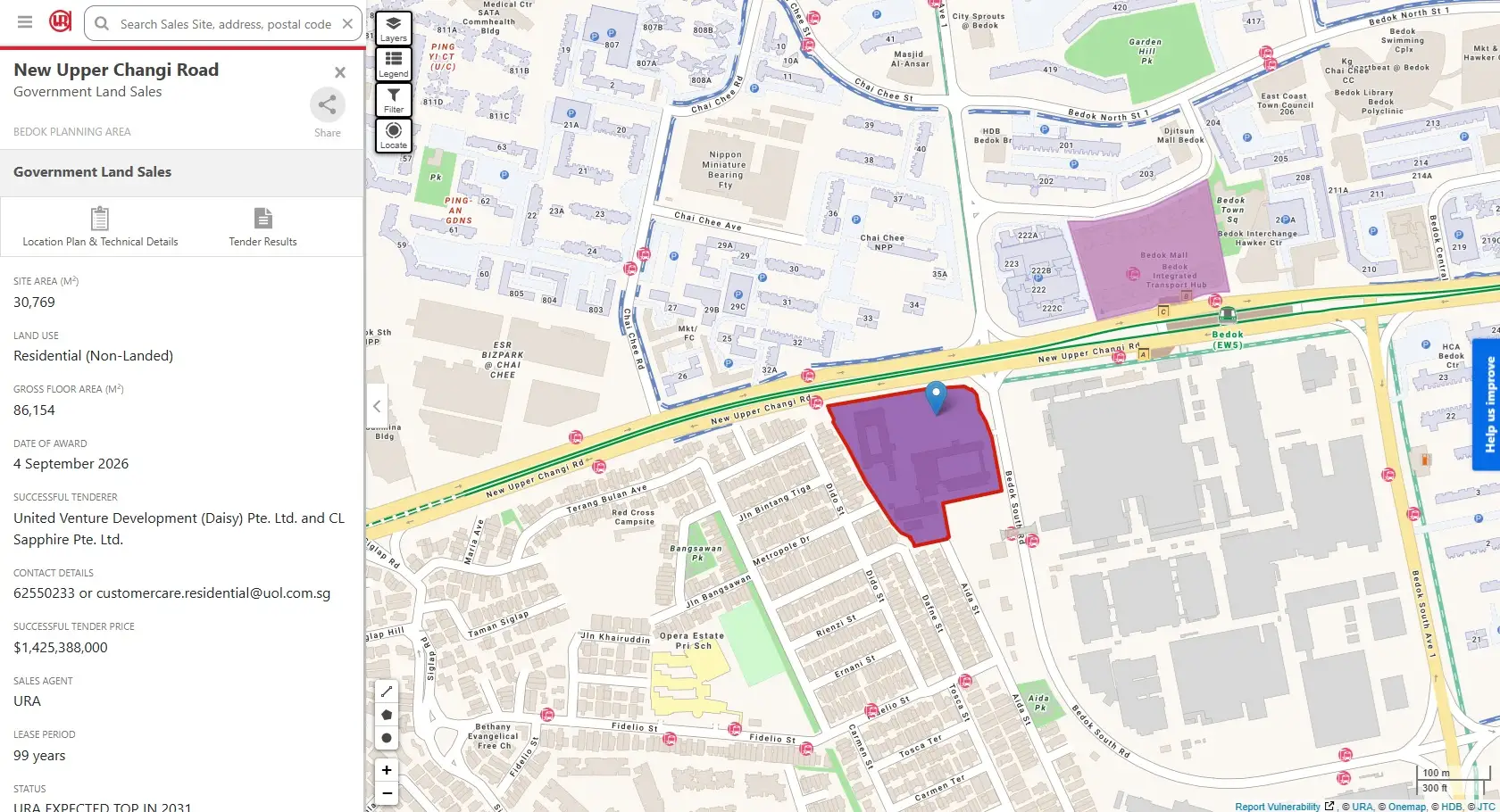
The Tender Result at a Glance
| Item | Details |
|---|---|
| Site | New Upper Changi Road / Bedok South Road |
| Tenure | 99 years |
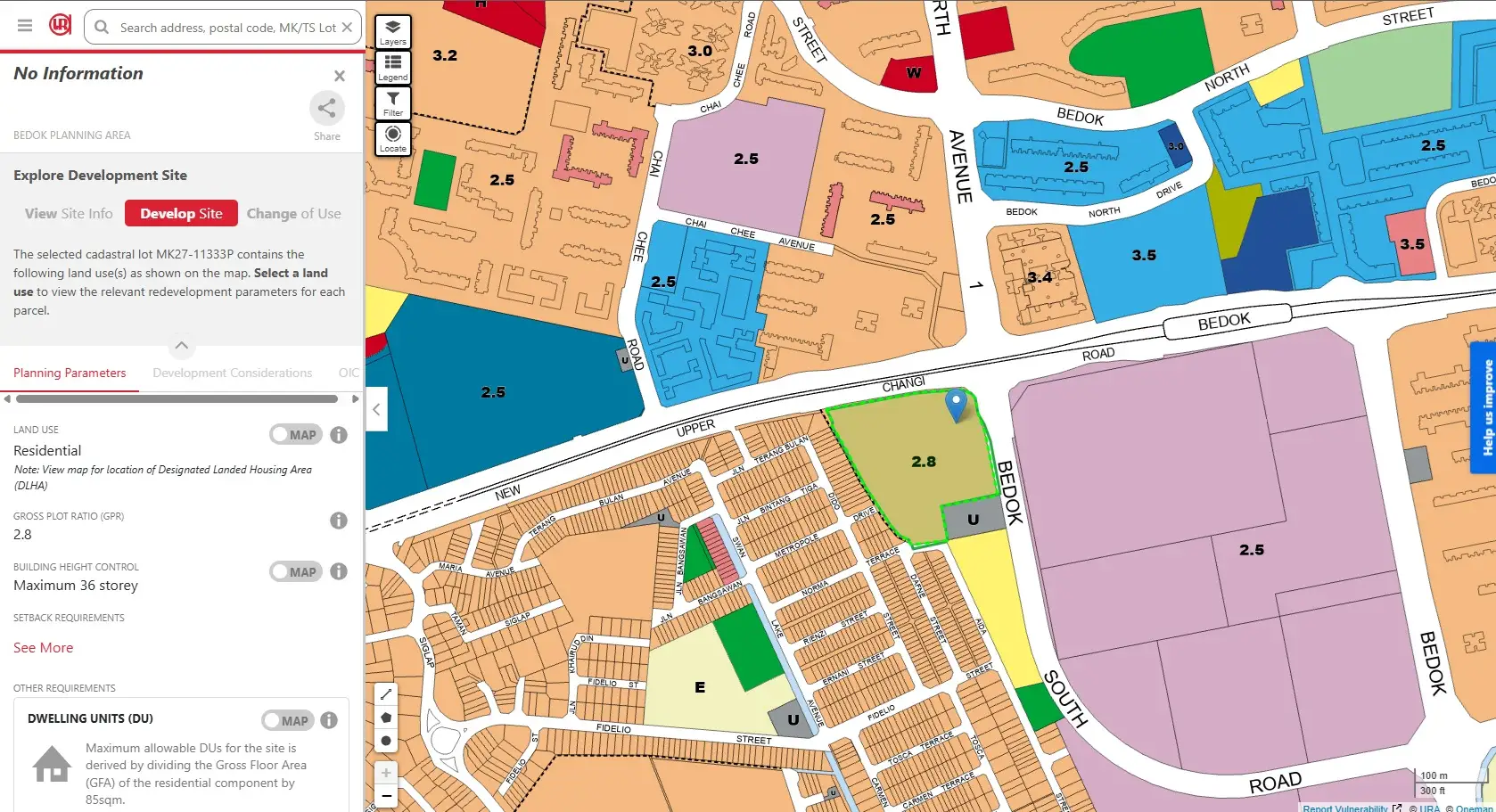
| Site area | 30,769 sq m |
| Maximum permissible GFA | 86,154 sq m |
| Gross plot ratio | 2.8 |
| Estimated housing yield | About 1,010 units |
| Winning tender price | S$1.425388 billion |
| Winning land rate | About S$1,537 psf ppr |
| Second-highest bid | S$1.252 billion, or about S$1,350 psf ppr |
| Number of bids | Four |
A CDL–Hong Leong consortium submitted the second-highest bid. Frasers Property and Apricot Capital placed the third bid, while Sim Lian submitted the fourth.
The four land rates ranged from approximately S$1,310 to S$1,537 psf ppr. The three unsuccessful bids were comparatively close, at roughly S$1,310 to S$1,350 psf ppr. The winning consortium therefore appears to be the outlier—not the market as a whole.
That distinction matters. The result shows strong confidence in Bedok, but it also suggests UOL, SingLand and CapitaLand may see strategic value in this site that conventional land pricing does not fully capture.
The Site Is Not Merely Near an MRT Station
The site sits across New Upper Changi Road from Bedok MRT station, Bedok Mall, the integrated transport hub and the town centre. Residents can reasonably expect to reach this cluster of amenities in several minutes on foot, although the actual walking experience will depend on the project’s gate locations and pedestrian crossings.
This combination is difficult to replicate. Many suburban sites offer rail connectivity, but fewer combine MRT access with an established mall, bus interchange, hawker centre, wet market, healthcare services and everyday retail within the same mature town centre.
For future buyers, that reduces dependence on the condominium’s own retail component—there is none required under the tender—and makes the location workable for households that do not want to drive for daily needs.
The land parcel’s scale is equally important. With an estimated 1,010 homes, the developer should have room to provide a broader range of facilities and unit types than a boutique project. A large development can also spread the cost of pools, clubhouses, landscaping and estate operations across more households.
The trade-off is that the project will need to sell a substantial amount of inventory. Location quality reduces that risk, but does not eliminate it.
Why Bedok Offers More Than One Buyer Pool
The consortium is unlikely to be underwriting the project around a single type of purchaser.
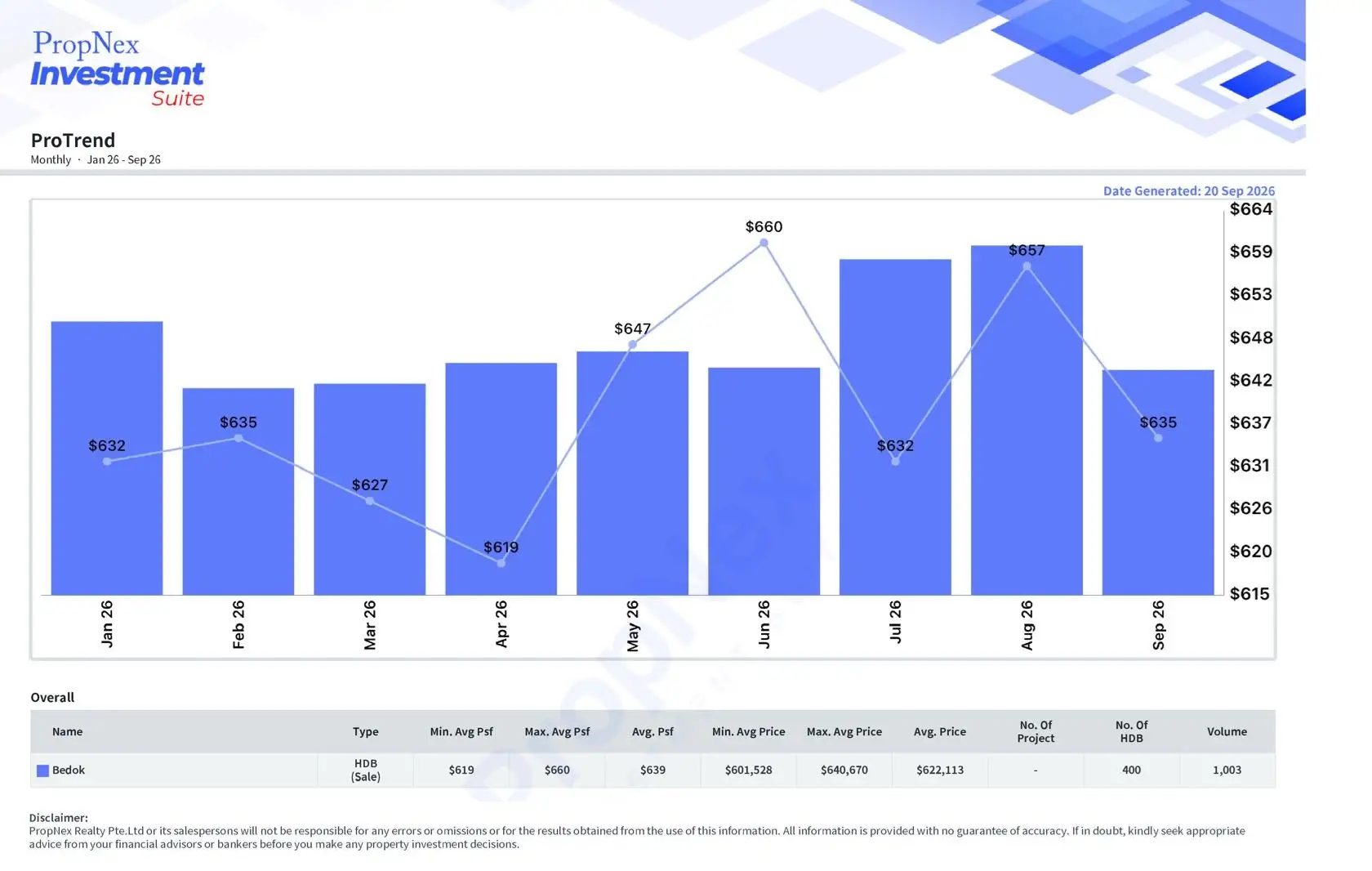
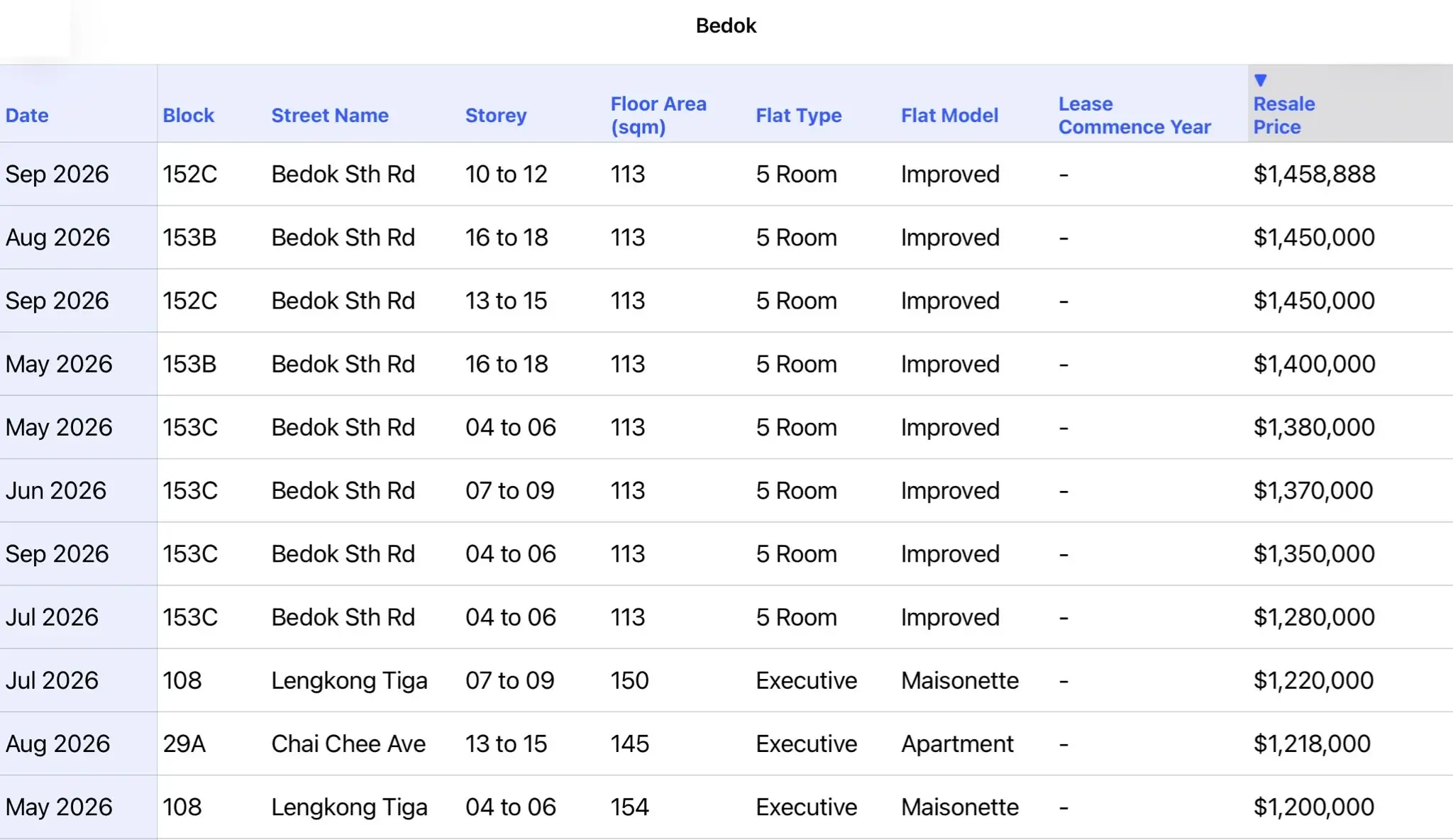
The first and most obvious group is the Bedok HDB upgrader. According to data extracted from PropNex’s Investment Suite, Bedok recorded 1,003 HDB resale transactions from 1st Jan to 20th Sept in 2026, including 70 million-dollar deals. The highest-priced transaction was a five-room flat sold for S$1,458,888 in September. These figures do not mean that every seller will upgrade to a new condominium, but they indicate a sizeable pool of owners with accumulated housing equity.
The second group comprises owners from nearby landed enclaves such as Opera Estate. Some may eventually prefer a newer apartment with lift access, security and lower maintenance demands while remaining within the same part of the East.
The third group comprises families attracted by Bedok’s schools, transport links and established amenities. This group may not already live in Bedok, but may see the project as a comparatively central OCR option with direct access to the East-West Line.
The ability to draw from several buyer pools helps explain why the winning consortium may have been willing to accept a higher land cost. A large project is less risky when demand does not rely on one narrow catchment.
Why a Three-Developer Consortium Makes Sense
The ownership structure is revealing. CapitaLand Development holds 50% of the project joint venture. The other 50% is held through United Venture Development (Daisy), which is itself owned 80% by UOL and 20% by SingLand.
The effective interests are therefore approximately:
- CapitaLand Development: 50%
- UOL Group: 40%
- Singapore Land Group: 10%
This is a very large land commitment even for a major developer. Sharing the site allows the partners to reduce their individual capital exposure while combining development, procurement, marketing and project-delivery capabilities.
It also makes an aggressive bid easier to understand. A developer acting alone would carry the full S$1.425 billion land bill, construction cost, financing exposure and sales risk. The consortium structure spreads those risks without sacrificing the opportunity to control one of the most prominent residential sites released in Bedok in recent years.
This does not make the land cheaper. It makes the risk more manageable.
The 13.8% Bid Gap Is the Most Important Signal
When several bids cluster closely together, the result provides a reasonably clear indication of market value. Here, the second, third and fourth bids sat within a relatively narrow band, while the winning bid was materially higher.
There are several possible explanations.
First, the winning consortium may have used more optimistic selling-price assumptions. Second, its scale and procurement capabilities may allow it to underwrite construction or marketing costs differently. Third, the partners may place strategic value on replenishing their residential land banks with a large, highly visible project.
The gap could also reflect different assumptions about unit mix and saleable efficiency. On a project of roughly 1,010 units, modest differences in average unit size, layout efficiency and achieved price can materially change total revenue.
However, buyers should not interpret the record land rate as proof that surrounding property values have already risen by the same percentage. It represents what one consortium was prepared to pay for one site, based on its own cost structure and expectations.
The Site Has Planning Constraints That Will Shape the Product
The parcel looks generous on a map, but not every part can be developed the same way.
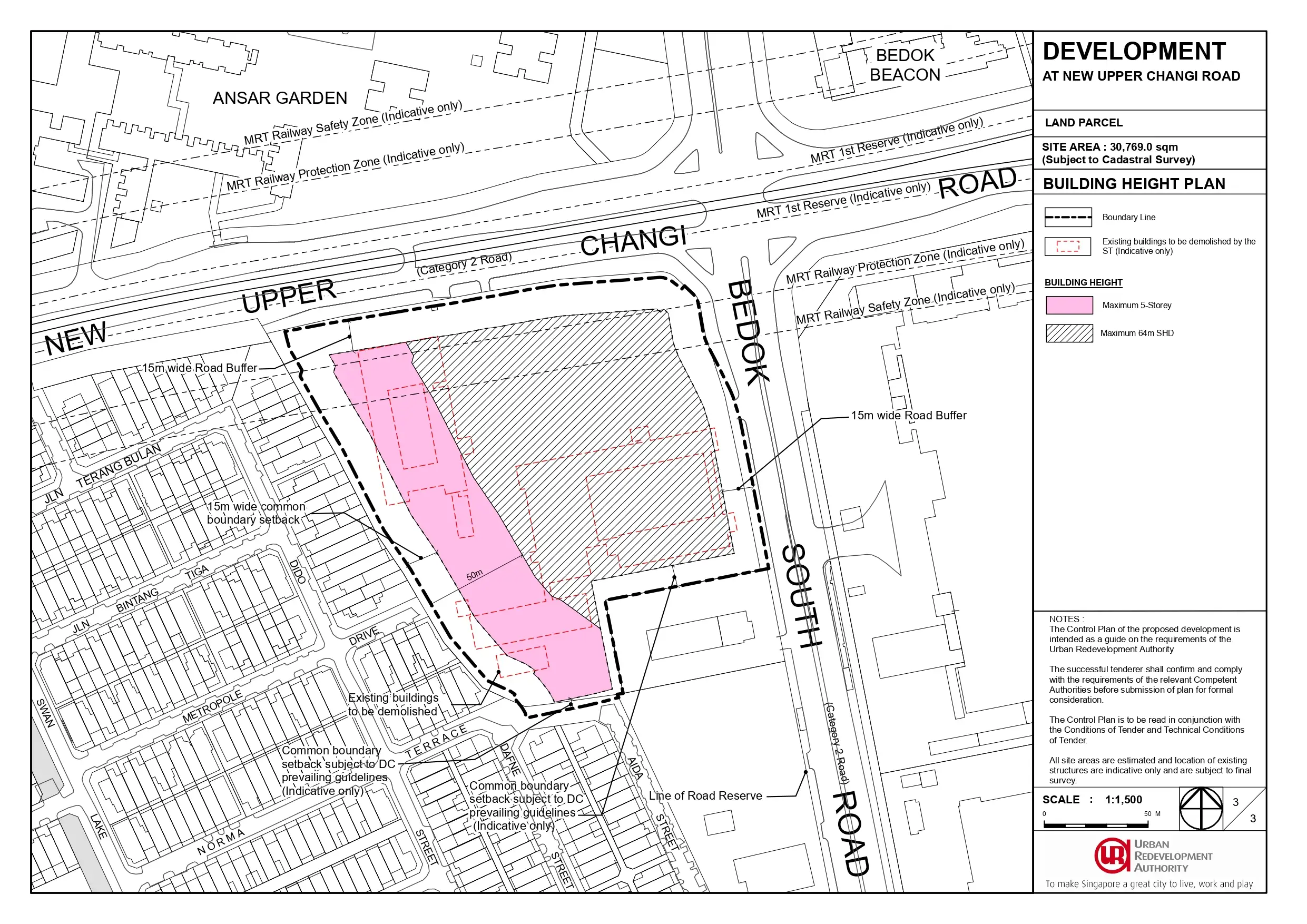
The tender conditions impose a 50 m-wide low-rise zone along the western side facing Opera Estate. Buildings within this zone are limited to five storeys. A minimum 15 m building setback also applies along the western boundary, and the tender encourages windows and balconies in the low-rise zone to face away from the existing landed homes where feasible.
Across the remainder of the site, the maximum technical height is 64 m Singapore Height Datum. The developer must also avoid a wall-like building form and preserve visual porosity.
These controls are sensible for the surrounding context, but they affect design efficiency. The future development may have a noticeably stepped profile: lower blocks beside Opera Estate and taller residential blocks toward the north and east.
This could create meaningful price differences within the project.
Homes facing the landed estate may offer a lower-density outlook, but the strict height and orientation controls could limit the number and configuration of such units. Apartments nearer New Upper Changi Road may enjoy the shortest route to Bedok MRT, but could experience more road and rail noise. Units facing Bedok South Road or the neighbouring institutional land may have different exposure and views again.
Buyers should therefore compare stack position, height, facing and walking route—not simply distance to the MRT measured from the centre of the site.
Connectivity Is Strong, but Gate Placement Still Matters
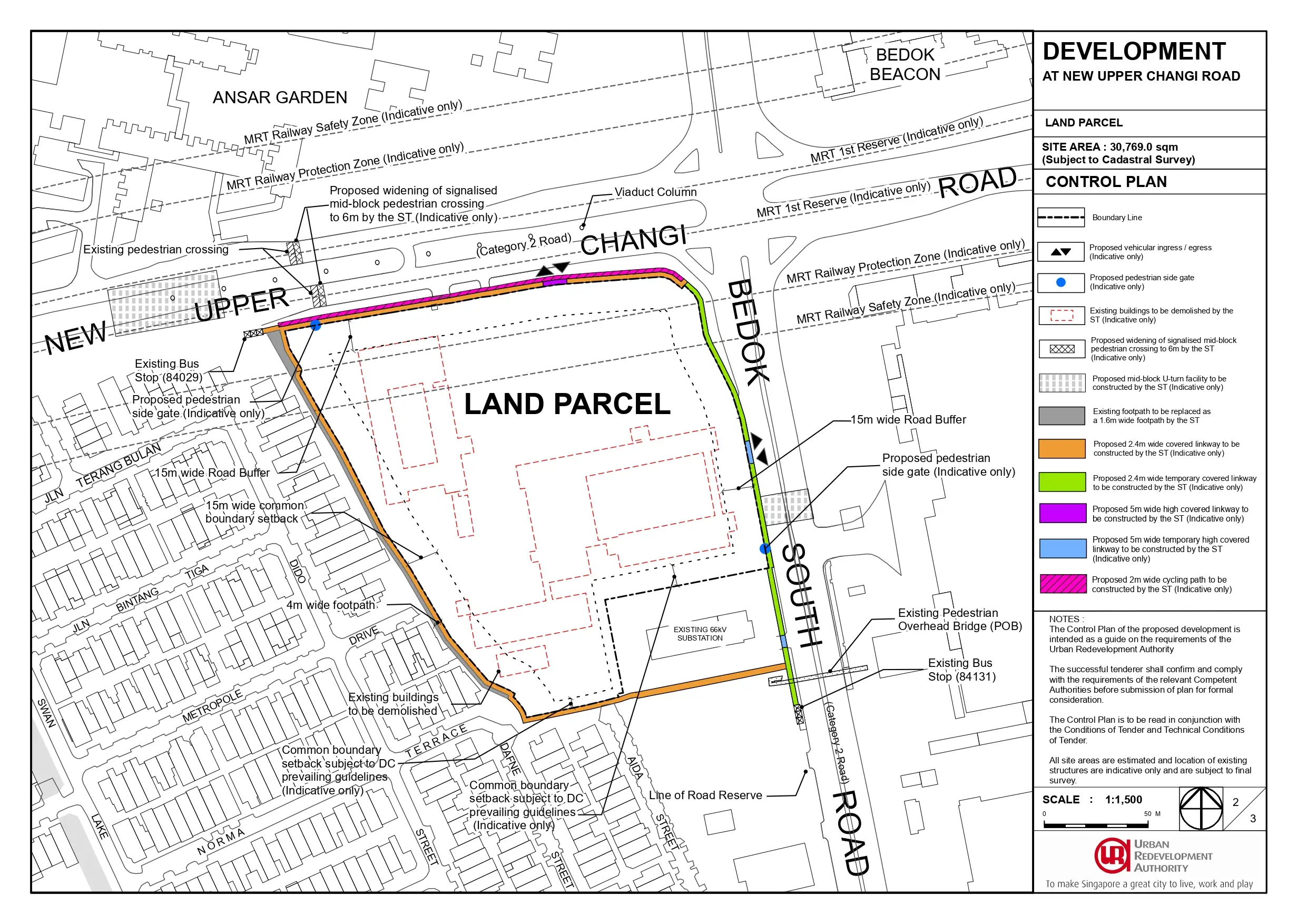
The tender requires pedestrian side gates and sheltered connections toward the bus stops along New Upper Changi Road and Bedok South Road. It also calls for covered linkways, a cycling path along part of New Upper Changi Road and improvements to pedestrian-crossing infrastructure.
However, pedestrian openings are not permitted along the western and southern boundaries next to Opera Estate when the development is completed, unless separate planning permission is obtained later.
This means residents are likely to enter and leave mainly from the New Upper Changi Road and Bedok South Road sides. Blocks at the western or southern end of the site could therefore have a longer internal walk to the MRT than the headline location suggests.
The project will also have two left-in-left-out vehicular access points, one from each main road. Internal circulation, arrival courts and peak-hour traffic management will be important for a development of this size.
What Could the Future Project Need to Sell For?
The S$1,537 psf ppr land rate is only the first layer of cost. The developer must still account for construction, professional fees, financing, marketing, site preparation, common facilities, and the risk of selling more than 1,000 homes.
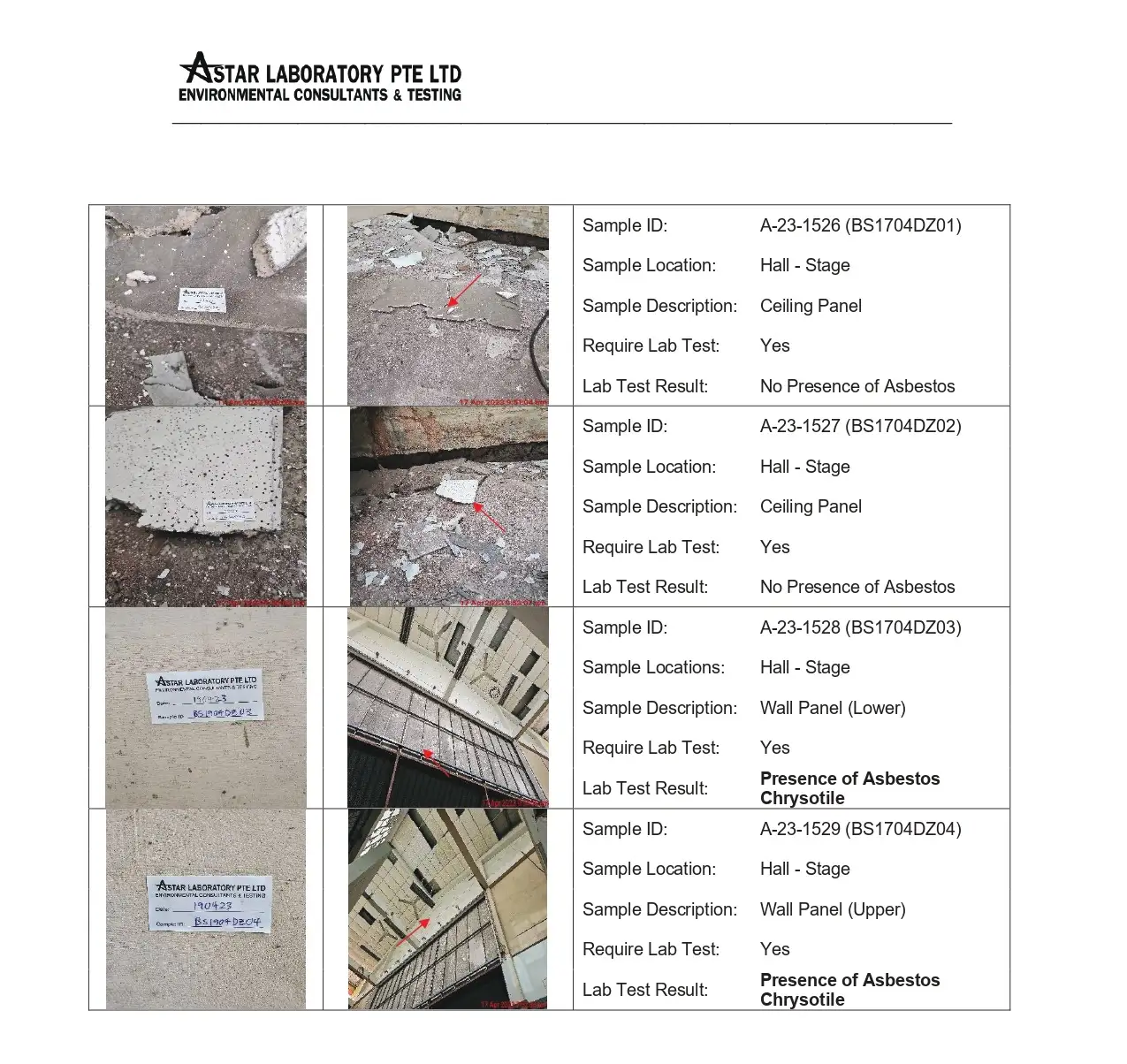
The project also requires demolishing existing buildings. The tender documents include an asbestos survey of the existing premises, meaning removal and demolition must be managed in accordance with required safety procedures. This does not necessarily make the project uneconomic, but it reinforces that the land rate is not the complete development cost.
An exact break-even price cannot be calculated without the consortium’s design, construction contracts, financing assumptions and saleable-area efficiency. Nevertheless, a broad sensitivity illustrates the challenge.
| Illustrative average selling price | Premium over land rate alone | Overall Interpretation |
|---|---|---|
| S$2,500 psf | 62.7% | May leave very little room after construction, finance and other costs |
| S$2,700 psf | 75.7% | More plausible, but profitability would still depend on cost control and mix |
| S$2,900 psf | 88.7% | Provides more headroom, but tests buyer affordability and resale comparisons |
These figures are not forecasts of the eventual launch price. They simply show why a land rate of S$1,537 psf ppr is likely to require pricing well above older resale condominiums in Bedok.
The developer may manage the headline quantum by offering compact one- and two-bedroom units, but the project’s natural upgrader market also requires practical family-sized homes. If three- and four-bedroom units become too compact, the project risks weakening the very family appeal that helps justify the land bid.
The eventual pricing strategy will therefore balance psf, unit size, and total purchase quantum.
The Nearby Bedok Rise Site Will Be Both a Benchmark and a Competitor
The New Upper Changi Road bid was about 15.6% higher on a psf ppr basis than the S$1,330 psf ppr paid for the Bedok Rise GLS site.
That difference does not automatically translate into a 15.6% difference in selling price. Construction timing, project size, efficiency, unit mix and positioning will also matter. But the lower land basis at Bedok Rise gives its developer more flexibility if the two projects compete within a similar sales window.
New Upper Changi Road arguably offers the stronger connection to the established Bedok town centre and a prominent frontage. Bedok Rise may counter with a lower cost base and a different residential environment.
For buyers, the eventual comparison should focus on absolute quantum, layout quality, walking route, facing and available inventory—not merely which project posts the lower launch psf.
Does the Record Bid Make Financial Sense?
Strategically, the bid is understandable.
The site is large, highly visible and difficult to replicate. It sits beside a mature town centre, has strong public-transport access and can draw demand from HDB upgraders, landed-home right-sizers and families seeking an established East-side location. The consortium structure also spreads the capital commitment among three experienced developers.
Financially, however, the result leaves little room for complacency.
The winning bid sits well above the other three offers. The project must absorb a record OCR residential land rate, manage a large inventory and work around height, setback, access and demolition requirements. Its eventual success will depend not only on how high a psf buyers accept, but also on whether the developers can produce layouts and total quantums that remain convincing against nearby resale homes and competing new launches.
The key takeaway is not that future Bedok condominiums must automatically sell at a new record.
It is that UOL, SingLand and CapitaLand have made a substantial bet on the depth of demand in mature estates. When the project eventually reaches the market, its take-up rate—particularly for family-sized units—will test how far Bedok buyers are prepared to stretch for a new home near an established MRT town centre.
Disclaimer: This article is for general information and discussion only. It does not constitute investment, financial, legal or property-purchase advice, nor an offer or recommendation to buy or sell any property. Calculations and potential selling-price ranges are illustrative and are based on publicly available information and broad assumptions. Actual development costs, unit mix, launch timing, prices and project specifications may differ. Readers should verify the latest information with the relevant authorities and seek independent professional advice before making any property decision.
Article contributed by Jerry Wong.

Jerry Wong is a realtor at Propnex Realty, bringing a rich background in interior and lighting design to his work. He loves exploring diverse spaces and observing the transformative power of real estate. Beyond his professional role, Jerry finds his greatest fulfillment in connecting people with the right properties, gaining immense satisfaction from helping clients achieve their dreams.