Boat Quay’s conserved shophouses have long been valued as scarce commercial assets. Their appeal rests on a combination of central location, architectural character, freehold or long-tenure ownership in many cases, and limited supply.
Yet scarcity does not necessarily produce a strong income return.
When acquisition prices rise faster than rents, even a well-located shophouse can deliver a relatively modest rental yield. This helps explain why several owners are now exploring hotel conversions after the Urban Redevelopment Authority (URA) relaxed its planning rules for selected street blocks near Boat Quay and Beach Road.
At least seven applications have reportedly been submitted since the change: six for properties in the Upper Circular Road street block and one in the Beach Road street block. The level of interest suggests owners see accommodation use as a way to extract more income from properties that may no longer be optimised as conventional offices, shops, or food-and-beverage premises.
The early estimates appear encouraging. A commercially leased shophouse in the affected areas may generate a gross rental yield of about 2.7% to 2.9%, while a converted hotel could potentially produce a net operating-income yield of approximately 3.1% to 3.8% if it achieves an average daily room rate of S$350 to S$400.
However, that comparison does not yet establish that conversion is financially worthwhile.
The hotel yield estimates exclude conversion costs. They also depend on room count, occupancy, operating efficiency and the rates guests are willing to pay. Once buyer’s stamp duty, construction expenditure, financing costs and income lost during the conversion period are added, the apparent yield advantage can narrow substantially—or disappear entirely.
The more important question is therefore not whether hotel use can produce more revenue, but whether it can produce enough additional income to compensate the owner for the capital, complexity and risk involved.
The Policy Change Created a New Use Option
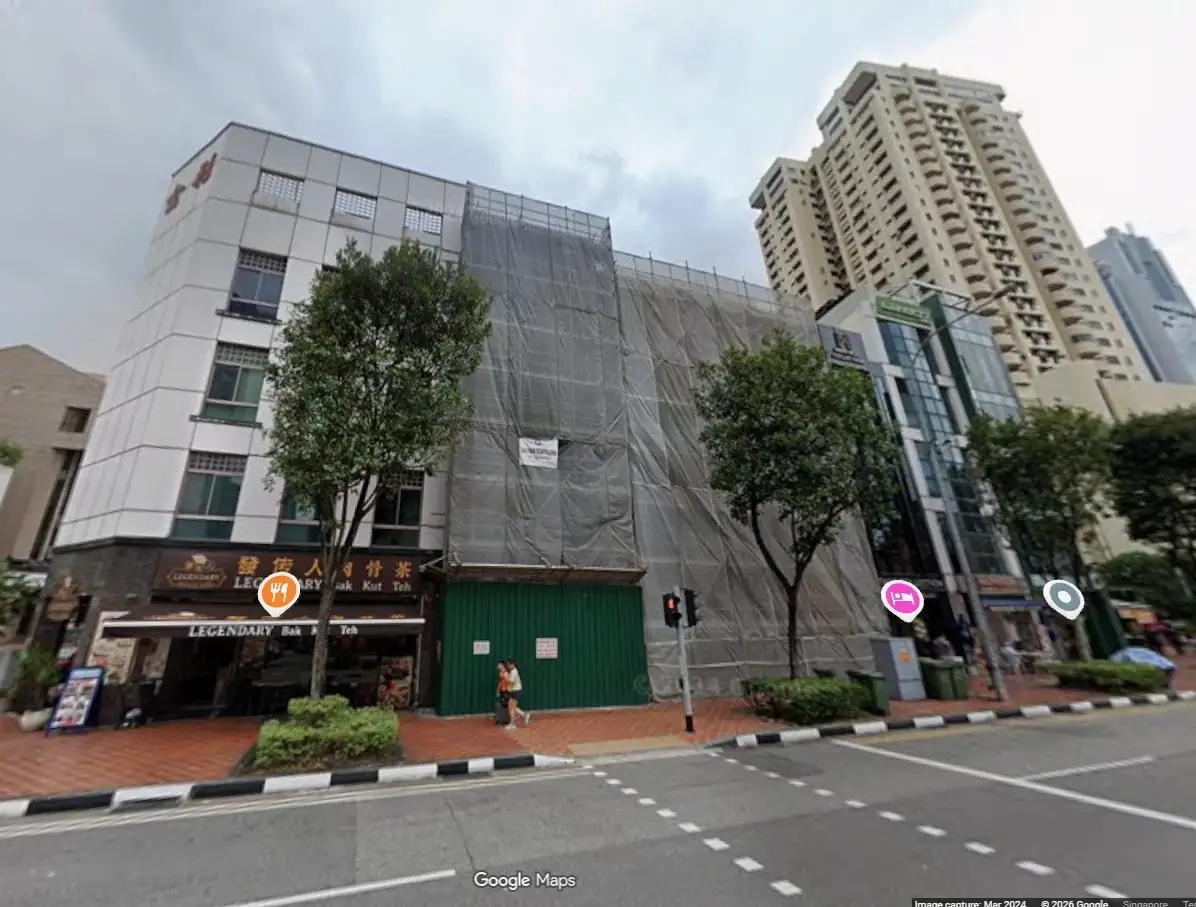
Under the previous planning approach, new hotels, backpackers’ hostels and serviced apartments were generally not allowed in the Upper Circular Road and Beach Road street blocks. The restriction was intended to prevent an overconcentration of short-term accommodation and preserve the mixed-use character of the neighbourhoods.
On 5 June 2026, URA revised this approach. URA may now consider new applications for hotel, hostel and serviced-apartment use in the two designated street blocks. The relaxation applies to applications received between 5 June 2026 and 31 May 2028 and forms part of a broader pro-enterprise review of business regulations. It is not a blanket approval for every property; individual proposals remain subject to assessment.
The Upper Circular Road street block is bounded by New Bridge Road, North Canal Road and South Bridge Road, with Carpenter Street and Hongkong Street running through it. The Beach Road area covers selected shophouses around Liang Seah Street, Middle Road and Purvis Street.
Applications have reportedly been made for properties including 38 and 40 South Bridge Road, 54 and 60 South Bridge Road, 13 and 15 New Bridge Road, 41 Hongkong Street and 30 North Canal Road.
The response was swift. This suggests some owners were not merely waiting for stronger commercial rents; they were already looking for a different way to reposition their assets.
Why Hotel Use Appeals to Shophouse Owners
Four main reasons make accommodation use attractive.
First, the commercial leasing market has become more demanding for some occupiers. Retailers, service businesses and food-and-beverage operators face labour, utility and operating-cost pressures. Even where asking rents remain high, leasing activity can moderate if tenants cannot support those rents sustainably.
Second, hotel income is not fixed by a conventional three-year lease. Room rates can be adjusted daily according to demand, major events, weekends and holiday periods. That gives a well-managed hotel more revenue flexibility than a landlord receiving a predetermined monthly rent.
Third, Boat Quay has a credible hospitality proposition. It is close to Raffles Place, Clarke Quay, the Singapore River and several cultural and entertainment districts. A small hotel could serve leisure travellers, short-stay business visitors and guests who prefer a heritage setting to a standard tower hotel.
Finally, planning optionality may increase the property’s appeal even before any conversion. A shophouse with credible hotel potential can attract hospitality operators, private investors and family offices that may not have considered it as a conventional commercial investment.
This means some owners may be pursuing approval for two possible outcomes: operating or leasing the property as a hotel, or selling it to a buyer willing to pay for the repositioning opportunity.
The Headline Yield Advantage Looks Meaningful—but It Is Not Yet Conclusive
According to the estimates reported by The Business Times, properties around the proposed sites may deliver a gross commercial rental yield of about 2.7% to 2.9%, based on asking rents of roughly S$8 to S$9 per sq ft per month.
A hotel could begin to outperform that commercial case at an average daily rate (ADR) of around S$300, assuming 80% occupancy and a 30% net operating-income margin. At an ADR of S$350 to S$400, its net operating-income yield could rise to around 3.1% to 3.8%, representing an estimated income uplift of 16% to 35% over the commercial-rental case.
That sounds persuasive, but three qualifications matter.
The comparison uses different income measures
The commercial return is described as a gross rental yield, while the hotel return is based on net operating income. They are not perfectly equivalent.
A commercial landlord still bears expenses such as property tax, repairs, insurance, vacancy and leasing costs, so the net commercial return will be below the gross figure. Conversely, a 30% hotel net operating-income margin already assumes that operating expenses absorb a large portion of room revenue.
The hotel estimate may therefore remain competitive on a like-for-like operating basis, but the quoted percentages should not be read as a precise apples-to-apples comparison.
The yield excludes conversion expenditure
If the estimated hotel income is divided only by the property’s existing value or purchase price, the calculation ignores the additional capital required to create the hotel.
The relevant denominator for a new buyer should include at least:
- The acquisition price or market value
- Buyer’s stamp duty and transaction expenses
- Design, consultancy and approval costs
- Structural, mechanical and electrical works
- Guest-room bathrooms and plumbing
- Fire-safety and accessibility upgrades
- Lifts, staircases or circulation improvements where required
- Reception, back-of-house and staff areas
- Furniture, fittings and equipment
- Financing and holding costs during the conversion period
- Pre-opening, marketing and operator-related expenses
The greater the conversion bill, the more income the completed hotel must produce merely to maintain the initially projected yield.
Hotel income is more volatile
A commercial lease transfers much of the operating risk to the tenant. A hotel owner or operator must continually generate bookings, manage prices and control costs.
Occupancy can weaken during economic slowdowns or periods of softer travel demand. At the same time, payroll, housekeeping, utilities, booking-platform commissions and maintenance expenses continue. A hotel may have more upside, but it is also more operationally intensive.
What the S$38 Million South Bridge Road Property Tells Us
The proposed conversion of 38 South Bridge Road provides a useful case study.
The property was marketed at a guide price of S$38 million after its owner sought outline planning permission for a hotel estimated to contain approximately 35 to 40 rooms.
Using 40 rooms, 80% occupancy and a 30% net operating-income margin, the indicative economics are as follows:
| Average daily rate | Annual room revenue | Estimated net operating income | Yield on S$38 million guide price |
|---|---|---|---|
| S$300 | S$3.50 million | S$1.05 million | 2.77% |
| S$350 | S$4.09 million | S$1.23 million | 3.23% |
| S$400 | S$4.67 million | S$1.40 million | 3.69% |
These calculations broadly support the reported proposition: at around S$300 per room, the hotel approaches the quoted commercial yield; at S$350 to S$400, the operating return becomes more attractive.
But this is only true when the yield is calculated against the S$38 million guide price alone.
For a direct acquisition of a non-residential property at S$38 million, buyer’s stamp duty would be approximately S$1.87 million under the prevailing marginal rates. That increases the acquisition basis to about S$39.87 million before legal fees or any conversion works are included.
The table below shows the ADR required for a 40-room hotel to generate net operating income equal to 2.8% of different cost bases. It retains the same assumptions of 80% occupancy and a 30% margin.
| Illustrative cost basis | Amount invested | ADR needed to generate a 2.8% NOI yield |
|---|---|---|
| Guide price only | S$38.00 million | S$304 |
| Guide price plus estimated buyer’s stamp duty | S$39.87 million | S$319 |
| Above, plus S$5 million conversion cost | S$44.87 million | S$359 |
| Above, plus S$10 million conversion cost | S$49.87 million | S$399 |
The S$5 million and S$10 million figures are sensitivity assumptions, not reported project budgets. They show how quickly the required room rate rises when the full investment basis is recognised.
Under the S$44.87 million scenario, an ADR of about S$359 is needed simply to produce a 2.8% net operating-income yield. At S$49.87 million, the required ADR approaches S$399.
This does not mean the proposed hotel is unviable. It means the S$300 break-even room rate applies only to a much narrower calculation that excludes the full capital commitment.
Room Count May Matter as Much as Room Rate
The economics also depend heavily on how many rooms the conserved building can accommodate without compromising circulation, safety, service areas and guest experience.
At an ADR of S$350, 80% occupancy and a 30% net operating-income margin:
- A 35-room hotel would generate estimated net operating income of about S$1.07 million a year.
- A 40-room hotel would generate approximately S$1.23 million.
That five-room difference adds roughly S$153,000 in annual net operating income under the stated assumptions.
However, maximising room count is not always the correct strategy. Smaller rooms or awkward layouts may weaken guest reviews and make premium pricing more difficult. Conversely, sacrificing several rooms to create better layouts, a more convincing arrival experience or larger premium rooms could support a higher ADR.
The most profitable design is therefore not necessarily the one with the most keys. It is the configuration that best balances room count, achievable rates, and operating efficiency.
S$350 to S$400 Requires a Genuine Product Premium
Singapore’s hotel market provides a supportive backdrop, but the upper-end room-rate assumptions should still be tested carefully.
The Singapore Tourism Board reported that the hotel sector achieved an average occupancy rate of 81.9% in 2025, an average room rate of S$273.56 and revenue per available room of S$224.04. International visitor arrivals reached 16.9 million, while tourism receipts for the first nine months hit a record S$23.9 billion.
Against that national benchmark, an ADR of S$300 is about 10% higher than the 2025 industry average. S$350 represents a premium of approximately 28%, while S$400 is around 46% higher.
Nearby Room Rates Suggest the S$350–S$400 Assumption Is Demanding
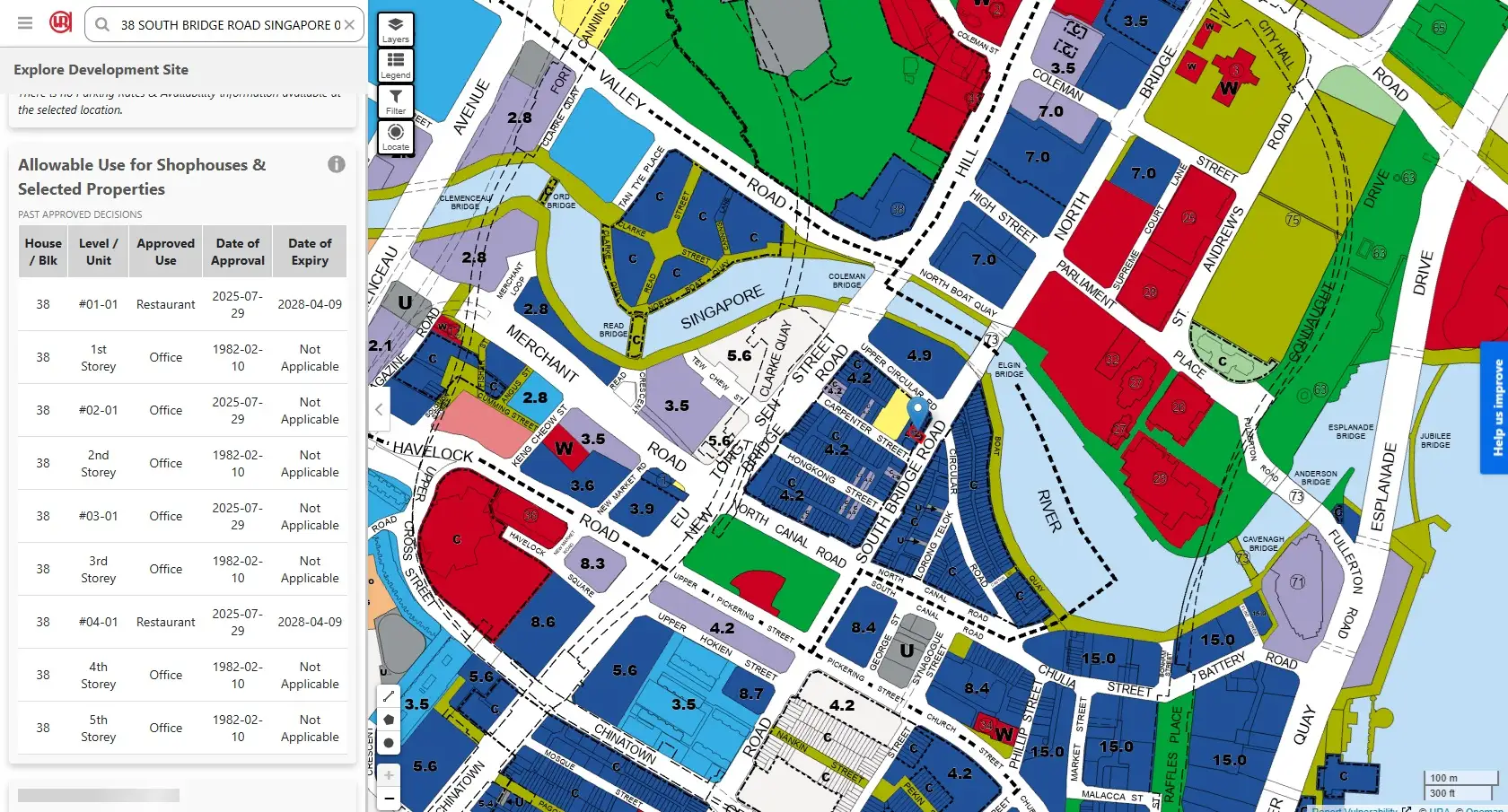
The surrounding competition also suggests that an ADR of S$350 to S$400 should not be assumed simply because the property is located near Boat Quay. Heritage Collection on Boat Quay operates immediately beside 38 South Bridge Road, yet a Google Hotels snapshot taken on 19 September 2026 showed one of its Boat Quay listings at approximately S$169 per night. The same search displayed numerous nearby rooms at roughly S$52 to S$169, although the newer five-star 21 Carpenter was priced substantially higher at S$374. These advertised rates are not directly equivalent to achieved ADRs, as room categories, taxes, cancellation terms and demand conditions may differ. The search was also configured for a 19–20 October stay. Nevertheless, the comparison shows that a converted hotel at 38 South Bridge Road would need a genuinely differentiated product, strong branding and superior room quality to sustain S$350–S$400 consistently rather than relying on location alone.
Boat Quay’s location and heritage character could justify a premium, particularly for a distinctive boutique property. Yet location alone will not guarantee it. The hotel would need to offer a product strong enough to compete with established full-service hotels, lifestyle brands and other boutique accommodation in the city centre.
That means interior design, acoustics, natural light, room proportions, service standards and brand positioning become part of the financial model. Spending less on conversion may protect the initial yield, but an underwhelming product may not achieve the ADR that yield depends on.
A Conserved Shophouse Is Not an Empty Hotel Shell
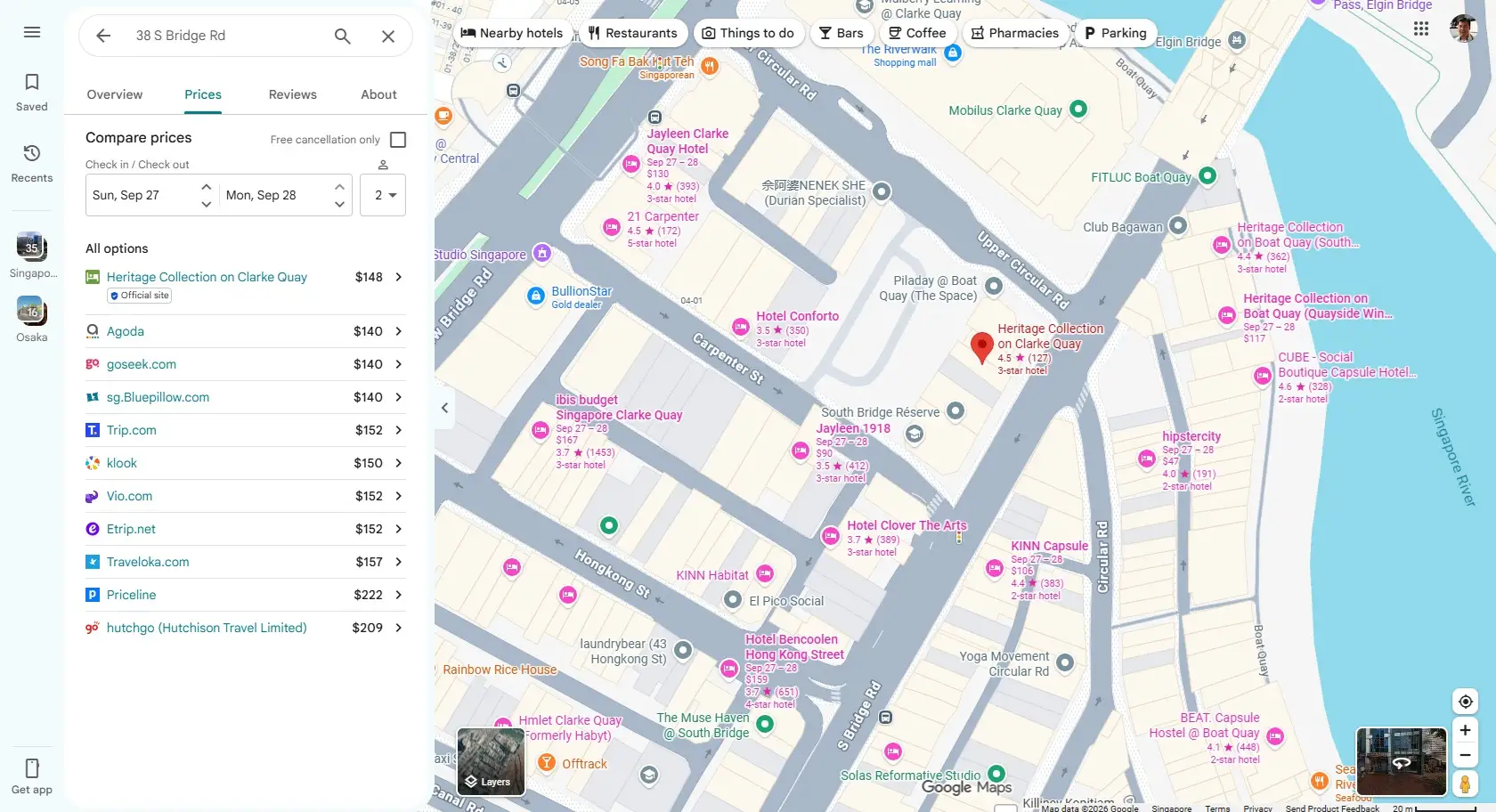
Conversion may be especially complicated because the buildings are conserved.
URA requires Conservation Permission for additions and alterations to conserved properties. Works affecting roofs, façades, floor structures, staircases, lifts, party walls, rear courts and mechanical services may require submissions by registered architects or professional engineers. Building plans may also require approval from the Building and Construction Authority.
Existing non-barrier-free buildings undergoing qualifying addition and alteration works may have to incorporate accessibility provisions. These can include a wheelchair-accessible entrance, an accessible toilet and a barrier-free route on the entrance level.
Before a hotel can operate, it must also obtain a Certificate of Registration and a Hotel-Keeper’s Licence. The Hotels Licensing Board requires documents including URA permission, the relevant building-completion or structural-inspection records, and applicable fire-safety approvals. A pre-opening inspection examines matters such as rooms, signage, reception facilities and surveillance coverage.
None of these requirements necessarily prevents a conversion, but each can affect the design, construction cost, programme and number of revenue-producing rooms.
Older shophouses can also present site-specific difficulties: narrow frontages, long internal plans, limited window positions, uneven floor levels, constrained staircases, and limited back-of-house space. Plumbing enough en-suite bathrooms into a historic structure can be significantly more difficult than fitting out an ordinary office.
The Cost of Downtime Should Not Be Ignored
Conversion requires more than construction expenditure. It also creates an opportunity cost.
If an existing commercial building must be vacated before work begins, the owner loses rental income during design, approvals, construction and pre-opening. Interest may continue to accrue throughout that period, while professional fees and property-related expenses remain payable.
Suppose a property previously produced gross rent equivalent to 2.8% of S$38 million. That represents about S$1.06 million a year before landlord expenses. An 18-month period without rental income would mean roughly S$1.6 million in foregone gross rent, even before financing costs.
The exact development period will vary, and this is only an illustration. Nevertheless, downtime belongs in the investment assessment because the owner gives up a relatively predictable income stream in exchange for a future, less certain one.
Financing Can Further Narrow the Spread
The proposed hotel yields are unlevered property-level returns before financing.
If the effective cost of debt is close to or above the hotel’s stabilised yield, borrowing may not improve the investor’s cash return. A property producing a low-3% operating yield offers limited protection against higher interest expense, cost overruns or weaker-than-expected occupancy.
This is why a modest increase from a 2.8% commercial yield to a 3.2% hotel yield may not be enough. The investor is accepting construction risk, approval risk and hotel operating risk for only a small initial spread.
The investment becomes more convincing when at least one of the following is true:
- The owner already acquired the property at a substantially lower historical cost.
- The existing commercial space is difficult to lease effectively.
- The building can accommodate enough rooms without an excessive conversion budget.
- The operator can demonstrate sustainable room rates above the market average.
- A long-term master lease shifts some operating risk to a credible hotel operator.
- Hotel approval can increase the property’s resale value.
This also explains why the conversion may make more sense to a long-standing owner than to a new buyer paying today’s guide price. The former may assess returns against a much lower capital base, whereas the latter must underwrite the purchase price, stamp duty and the entire redevelopment bill.
Operating Structure Could Be More Important Than Ownership
Owners considering conversion do not necessarily need to operate the hotel themselves.
A master lease can provide a more predictable rental stream, with the operator taking responsibility for the hotel business. This reduces the owner’s exposure to day-to-day volatility, although the rent must still be affordable for the operator and the owner remains exposed to counterparty risk.
A management contract gives the owner more direct participation in hotel revenue and profit, but it also leaves the owner with more operating exposure. Management fees, incentive fees and required capital expenditure must be reflected in the projections.
For investors accustomed to passive commercial property, this distinction is crucial. A hotel is not simply a shophouse with rooms. It is an operating business attached to real estate.
Planning Approval May Create Value Even Without Conversion
One of the more interesting effects of the rule change may occur in the investment-sales market rather than the hotel market.
A property marketed only as a commercial shophouse appeals mainly to buyers comfortable with office, retail or food-and-beverage leasing. A property with credible hotel potential can be presented to a wider group, including hotel operators, living-sector investors, and buyers pursuing heritage hospitality concepts.
The owner may therefore benefit from securing planning clarity even if it does not carry out the project. Approval reduces one layer of uncertainty for a future buyer and lets the property be marketed with a more tangible repositioning strategy.
However, buyers should distinguish between outline planning potential and a fully costed, technically deliverable hotel. The value of an approval depends on whether the proposed room count, fire-safety solution, accessibility strategy and construction budget can actually be achieved.
Could Too Many Conversions Change Boat Quay?
URA’s temporary, case-by-case approach suggests the authority is testing market demand while retaining control over the district’s use mix.
Hotels could add footfall, support restaurants and extend activity beyond office hours. They could also bring more investment into conserved buildings and encourage owners to undertake substantial restoration works.
But an excessive concentration of accommodation could reduce the variety of offices, shops and services that gives the area its mixed-use character. It may also push investors to price shophouses according to optimistic hotel projections rather than their existing commercial income.
The seven early applications are therefore important, but they should not be interpreted as proof that Boat Quay is about to become a predominantly hotel district. They are better viewed as the market’s first attempt to determine which buildings can support accommodation use economically and physically.
So, Does the Higher Yield Justify the Cost?
For some properties, yes—but the decision is much less straightforward than the headline yields suggest.
A hotel conversion appears most compelling where the existing commercial income is weak relative to the asset’s value, the building can support an efficient room count, conversion costs are controlled, and the location can sustain an ADR comfortably above S$300.
The case weakens when a buyer pays a high present-day acquisition price, undertakes extensive structural and services work, and relies on S$350 to S$400 room rates merely to produce a low 3% operating yield on the full cost.
Using 38 South Bridge Road as an illustration, a 40-room hotel charging S$350 could generate about S$1.23 million in annual net operating income under these assumptions. That equates to roughly 3.23% on the S$38 million guide price—but only about 2.73% if buyer’s stamp duty and an illustrative S$5 million conversion budget lift the investment basis to approximately S$44.87 million.
At S$400 per room, the corresponding yield on that expanded cost basis would be about 3.12%. This may still be acceptable to an investor expecting long-term capital appreciation or strategic value, but it is not an obviously generous return for a project involving planning, construction and operating risk.
The strongest financial case may therefore belong to existing owners with a low historical cost, properties that can be converted efficiently, or investors able to secure a favourable master lease with an experienced operator.
For everyone else, hotel approval should be regarded as valuable optionality—not automatic evidence of a profitable conversion.
Disclaimer: This article is intended solely for general information and discussion. The figures are based on publicly available information and simplified assumptions and do not represent the actual acquisition, conversion, financing or operating costs of any property. Hotel performance can vary materially depending on planning approval, room configuration, occupancy, room rates, management structure, expenses, and market conditions. Nothing in this article constitutes property, financial, investment, tax, legal or planning advice. Readers should obtain independent professional advice and conduct their own due diligence before making any property or investment decision.
Article contributed by Jerry Wong.

Jerry Wong is a realtor at Propnex Realty, bringing a rich background in interior and lighting design to his work. He loves exploring diverse spaces and observing the transformative power of real estate. Beyond his professional role, Jerry finds his greatest fulfillment in connecting people with the right properties, gaining immense satisfaction from helping clients achieve their dreams.