Hougang Central GLS: A Landmark Mixed-Use Site That Could Redefine District 19
The award of the Hougang Central Government Land Sales (GLS) site marks one of the most significant suburban land transactions in recent years. At S$1.5007 billion, the consortium comprising CapitaLand Development (CLD), CapitaLand Integrated Commercial Trust (CICT), UOL Group, Singapore Land Group (SingLand), and Kheng Leong secured a massive mixed-use site directly above Hougang MRT station and the future Hougang Integrated Transport Hub.
For investors and homebuyers, this site is important for several reasons:
- It is arguably the most transformative development ever undertaken in Hougang.
- It will create the largest retail hub in the town.
- It sits directly above an MRT interchange and future transport node.
- It may establish a new pricing benchmark for District 19 integrated developments.
- It introduces a complex valuation challenge because the land parcel contains both residential and commercial components.
This article breaks down the bidding results, land economics, plot ratio implications, commercial specifications, and potential future launch prices.

The Site at a Glance
| Item | Details |
|---|---|
| Location | Hougang Central / Hougang Avenue 10 |
| Tenure | 99 years |
| Site Area | 46,899.4 sqm (504,820 sqft) |
| Gross Floor Area (GFA) | 118,268 sqm (1.273 million sqft) |
| Plot Ratio | 2.52 (approximately 2.5) |
| Winning Bid | S$1,500,738,338 |
| Land Rate | S$1,179 psf ppr |
| Estimated Homes | ~830 to 835 units |
| Commercial Component | Over 430,000 sqft gross retail space; approximately 300,000 sqft NLA |
| Expected Completion | Around 2032–2033 |
| Integrated With | Hougang MRT (NEL), future Cross Island Line interchange, bus interchange, civic plaza |
The site occupies the current Hougang Bus Interchange and extends across the heart of Hougang town centre. Based on URA planning maps, it falls within a commercial-and-residential zoning envelope with a plot ratio of 2.5. Its location is arguably superior to most suburban GLS sites because it brings together several major advantages in one parcel: direct MRT station integration, future bus interchange connectivity, immediate access to mature-town amenities, a sizeable residential catchment, and future uplift from the Cross Island Line interchange.

Understanding the Tender Results
Only three bids were submitted despite the strategic location.
| Bidder | Bid Price | Land Rate |
|---|---|---|
| CapitaLand / CICT / UOL Consortium | S$1.5007b | S$1,179 psf ppr |
| Sim Lian | S$1.4705b | S$1,155 psf ppr |
| Frasers Property / Sekisui House / Lum Chang | S$1.4010b | S$1,101 psf ppr |
Why Only Three Bidders?
The answer lies largely in scale. At S$1.5 billion, the Hougang Central site ranks among Singapore’s largest suburban GLS acquisitions, which immediately limits the pool of serious bidders. A development of this size requires more than residential experience; it demands deep balance sheets, strong retail expertise, experience managing integrated developments, and the ability to handle a long and complex construction timeline. While many developers can build condominiums, far fewer can successfully deliver a full mixed-use project that combines a transport hub, a major suburban mall, civic spaces, and more than 800 residential units within a single integrated development.
This naturally narrowed the bidder pool.
The Most Interesting Part: The Bid Gap
The top bid exceeded Sim Lian’s offer by only about 2%, which is a remarkably tight margin for a S$1.5 billion transaction. Such a narrow spread usually suggests that multiple developers arrived at broadly similar assumptions on pricing, demand, and project feasibility. It also indicates that the market recognises measurable long-term value in the development’s commercial component. This suggests that the winning consortium was not dramatically overpaying; rather, the leading bidders appeared to have a fairly consistent view of the value of the Hougang Central site.
Why the Commercial Component Changes Everything
Most analysts focus on the headline land rate of S$1,179 psf ppr, but this figure can be misleading when viewed in isolation. Unlike a pure residential GLS site, Hougang Central includes multiple non-residential and public-use components such as a retail mall, F&B spaces, a bus interchange, a public plaza, civic facilities, and transport integration works.
The commercial component will be retained by CICT rather than sold, allowing the consortium to monetise the site through both residential sales and long-term commercial income. The residential component is expected to generate profit from the sale of approximately 830 to 835 condominium units, while the commercial component is expected to provide recurring rental income, asset appreciation, and future growth in REIT valuation. This dual-income model gives the consortium more flexibility and may allow it to bid more aggressively than a developer relying solely on residential sales.
Estimating the Residential Land Cost
This is where the analysis becomes more nuanced. The project is expected to have a total gross floor area of roughly 1.27 million sqft, of which more than 430,000 sqft could be allocated to commercial space, translating to about 300,000 sqft of net lettable retail area. If around 430,000 sqft of gross floor area is set aside for commercial use, the remaining residential gross floor area could be approximately 840,000 to 850,000 sqft after accounting for the commercial component.
If we hypothetically allocate land cost proportionally:
The residential share of the land cost could be estimated at S$990 million to S$1.05 billion, while the commercial share could be S$450 million to S$510 million. This allocation is not exact, as integrated developments are typically assessed using more sophisticated residual land value models that account for the different revenue profiles of residential and commercial components. However, it provides a useful framework for understanding how the overall land cost may be split between the two uses.
What Does This Mean in PSF Terms?
Typical integrated developments currently incur:
| Cost Component | Approximate |
|---|---|
| Land | S$1,179 psf ppr |
| Construction | S$500–650 psf |
| Financing | S$80–120 psf |
| Professional Fees | S$70–100 psf |
| Marketing | S$30–50 psf |
| Developer Margin | 15–20% |
Assuming the retained commercial component helps offset part of the residential land cost, the effective residential breakeven could fall to around S$2,050-S$2,250 psf, rather than the S$2,300 psf or higher that a straight-line land-cost allocation might suggest. This helps explain why analysts are projecting future launch prices in the region of S$2,500 to S$2,600 psf.
Could Prices Go Even Higher?
Potentially yes. There are three major reasons.
1. Parktown Residence Effect
The same developer ecosystem has already tested the market through Parktown Residence. Parktown achieved approximately 87% of sales during launch weekend at an average of S$2,360 psf. Developers now have evidence that integrated transport-hub projects command substantial premiums.
2. Cross Island Line Upside
Hougang is currently served by the North-East Line, but the future Cross Island Line will transform it into a full MRT interchange. Historically, interchange stations tend to enjoy stronger rental demand, wider catchment appeal, and higher resale liquidity because they offer greater connectivity and convenience for both residents and tenants.
3. Lack of Direct Competition
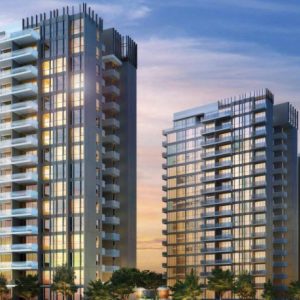
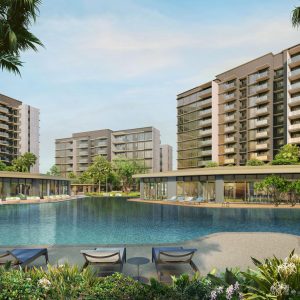
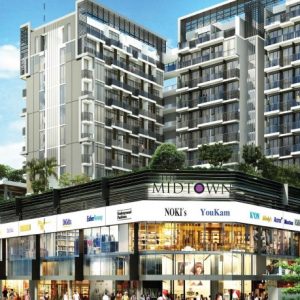
Hougang has not seen many major private residential launches in recent years. While nearby projects such as The Florence Residences, Stars of Kovan, Midtown Residences, and Parc Centros provide useful pricing benchmarks, none offer the same combination of direct MRT integration, a major retail mall, and bus interchange connectivity. This places the Hougang Central development in a much higher positioning tier than existing nearby comparables.
The Commercial Component: The Real Strategic Prize
The residential units may attract most of the attention, but the commercial component could ultimately become the more valuable long-term asset. CICT has confirmed that it will own 100% of the commercial segment, which is expected to include over 430,000 sqft of commercial space, approximately 300,000 sqft of net lettable retail area, the largest shopping mall in Hougang, significant F&B offerings, public event spaces, and direct transport integration. For context, Hougang Mall currently serves as the town’s main retail node, but the new integrated development could fundamentally reshape the district’s retail hierarchy.
What Might the Commercial Mix Look Like?
Based on current integrated development trends, investors can reasonably expect the commercial mix to be centred around daily convenience, F&B, lifestyle services, community uses, and transport-oriented retail. This could include supermarkets, pharmacies, household goods stores, family dining restaurants, cafés, quick-service restaurants, fitness operators, beauty services, education centres, civic spaces, public gathering areas, event programming, convenience-focused shops, grab-and-go food concepts, and transit-linked services. With direct integration into the transport hub, the development is likely to see strong pedestrian traffic throughout the day, supporting both weekday commuter demand and weekend family-oriented spending.
Why CICT Wants This Asset
From a REIT perspective, Hougang fills an important strategic gap for CICT. Its strongest retail assets are currently concentrated in Downtown Singapore, the Central Region, and major regional malls, while the Hougang development expands its footprint into the North-East. This gives CICT exposure to the residential and commuter catchments of Hougang, Sengkang, and Punggol, as well as to future Cross Island Line passengers. In essence, the commercial component could become a suburban, transport-oriented retail asset that provides long-term recurring income.
Risks Investors Should Watch
No GLS project is risk-free, and Hougang Central is no exception. The integration with a transport hub increases construction complexity and may lengthen the development timeline, while the retail mall will still need to compete with existing nearby malls such as Hougang Mall, Heartland Mall, and NEX. The S$1.5 billion land commitment is also substantial, and a slower residential market at launch could affect sales absorption. In addition, future GLS supply in the North-East region could moderate pricing power if more competing projects enter the market.
Final Thoughts
The Hougang Central GLS site is not simply another suburban condominium plot. It is effectively an integrated transport hub, regional retail centre, civic destination, and premium residential project rolled into one development. While the winning bid of S$1,179 psf ppr appears high compared with older OCR benchmarks, the economics become clearer once the retained commercial value is factored in. For homebuyers, the project is likely to command launch prices in the S$2,500 to S$2,700 psf range, with premium stacks potentially moving higher depending on market conditions at launch. For investors, the real story is not just the condominium component, but the long-term value creation from the commercial asset that CICT will hold. Over time, this could transform Hougang from a traditional heartland town centre into a fully integrated regional hub connected by both the North-East Line and the future Cross Island Line. In that sense, the consortium may not have been bidding solely for 830 homes; it was bidding for control of Hougang’s future centre.
Disclaimer: This article is for general information only and should not be taken as financial, investment, legal, or property advice. All pricing, cost, and valuation estimates are indicative and based on publicly available information and market assumptions at the time of writing. Readers should conduct their own due diligence and seek professional advice before making any property decision.
Article contributed by Jerry Wong.

Jerry Wong is a realtor at Propnex Realty, bringing a rich background in interior and lighting design to his work. He loves exploring diverse spaces and observing the transformative power of real estate. Beyond his professional role, Jerry finds his greatest fulfillment in connecting people with the right properties, gaining immense satisfaction from helping clients achieve their dreams.