When we previously examined the proposed acquisition of Scotts Square, the central argument was that Royal Holdings and RB Capital might see something in the Orchard Road mall that its existing owner, Wharf Real Estate Investment Company (Wharf REIC), no longer considered worth pursuing.
At the time, Raj Kumar and his son Kishin RK were reportedly in exclusive due diligence at around S$320 million. We argued that the attraction was unlikely to be Scotts Square’s existing rental income alone. Instead, the opportunity appeared to lie in acquiring a freehold, under-optimised Orchard Road retail asset and then applying a value-add strategy through refurbishment, repositioning and tenant remixing.
We now have something much more concrete to work with.
Royal Holdings and RB Capital have signed a sale-and-purchase agreement to acquire all the shares in Wharf Estates Singapore, the company that owns the four-storey Scotts Square retail mall, for S$310 million. The purchase is expected to be completed by the end of 2026, and The Business Times reports that the new owners are expected to overhaul the mall after completion.
More importantly, S$310 million is not just lower than the S$320 million previously reported.
It is dramatically below where the Scotts Square sale process began.
In 2024, the mall was marketed at S$450 million. CBRE subsequently brought it back to market in 2026 at S$380 million. The eventual transaction price is S$310 million.
That raises the obvious question:
Did Royal Holdings and RB Capital just get a bargain?
The answer is more complicated than the S$140 million headline discount suggests. But at S$310 million, the investment proposition looks considerably more interesting.
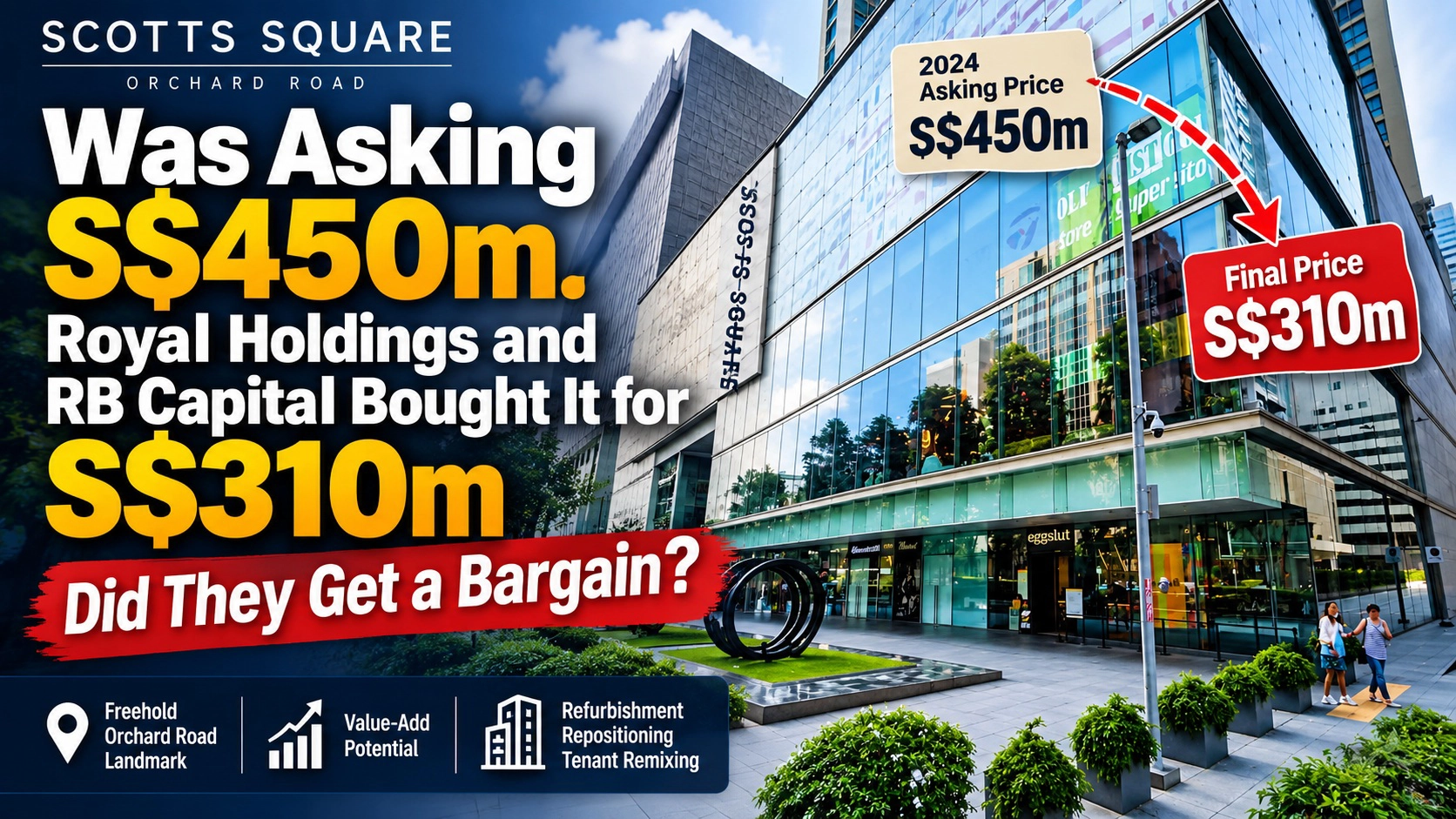
From S$450 Million to S$310 Million: The Price Reset Is Substantial
Scotts Square’s pricing evolution tells much of the story.
| Stage | Price | Approx. price on 130,875 sq ft GFA | Difference from S$450m |
|---|---|---|---|
| 2024 guide price | S$450m | S$3,438 psf | — |
| 2026 guide price | S$380m | S$2,904 psf | -15.6% |
| Reported due-diligence price | ~S$320m | ~S$2,445 psf | -28.9% |
| Final transaction | S$310m | S$2,369 psf | -31.1% |
The S$450 million 2024 guide translates to approximately S$3,438 psf based on the mall’s 130,875 sq ft GFA. The final S$310 million transaction works out to S$2,369 psf.
That means Royal Holdings and RB Capital are buying Scotts Square for S$140 million less than the 2024 asking price, a reduction of approximately 31.1%.
Even compared with the more recent S$380 million guide price, they are paying S$70 million less, or about 18.4% below the guide.
And they have apparently negotiated another S$10 million off the approximately S$320 million price reported during exclusive due diligence.
That last S$10 million may look small relative to a S$310 million acquisition, but it is still capital that could potentially be deployed towards refurbishment, leasing incentives or other asset-enhancement expenditure.
The acquisition basis has therefore moved substantially in the buyers’ favour compared with where the seller originally hoped to transact.
But that does not automatically mean Scotts Square is cheap.
S$2,369 psf Sounds Attractive — Until We Look at the NLA
One number needs careful scrutiny. The reported S$2,369 psf transaction rate is calculated against Scotts Square’s approximately 130,875 sq ft gross floor area.
The mall’s current net lettable area is only around 76,660 sq ft.
Measured against that existing NLA, the S$310 million acquisition works out to approximately:
S$310 million ÷ 76,660 sq ft = S$4,044 psf of NLA.
That is a very different number from S$2,369 psf.
It also highlights a central issue with evaluating commercial property purely through a headline psf figure. Buyers are not purchasing 130,875 sq ft of rentable shop space.
They are acquiring a building that includes circulation areas, common spaces, services, and other non-lettable components in addition to its revenue-producing retail space.
The relationship between GFA and NLA therefore becomes important.
At present, the mall’s approximately 76,660 sq ft NLA represents only around 58.6% of its 130,875 sq ft GFA.
This does not necessarily mean that the remaining area can simply be converted into rentable space. Building configuration, planning requirements, circulation, fire-safety requirements, services and other constraints all matter.
But it does raise an important question for the incoming owners:
Can Scotts Square’s existing space be made more commercially productive?
That could prove just as important as negotiating lower rents or attracting better tenants.
The S$140 Million “Discount” Is Not Free Money
Another reason we should be careful about calling S$310 million a bargain is that Royal Holdings and RB Capital are almost certainly not finished spending.
The Business Times reports that the buyers are expected to overhaul Scotts Square after the acquisition.
That supports one of the central arguments from our earlier analysis: this appears much more like a value-add acquisition than a passive “buy the mall and collect rent” investment.
The relevant calculation is therefore not:
S$450m asking price – S$310m purchase price = S$140m bargain.
It is closer to:
Acquisition price + transaction costs + financing + refurbishment + leasing incentives + carrying costs + other asset-enhancement expenditure = total investment basis.
Only then can that figure be compared with the stabilised income and eventual value of the repositioned property.
If Royal Holdings and RB Capital subsequently spend a substantial amount repositioning Scotts Square, some of that S$140 million difference effectively becomes the financial buffer required to execute the strategy.
This is precisely why the entry price matters.
At S$450 million, an extensive asset-enhancement programme would have been layered on top of a much higher acquisition basis.
At S$310 million, there is considerably more room to invest in the property before total cost approaches the original S$450 million guide.
What Would Scotts Square Need to Earn to Justify S$310 Million?
Another way to look at the transaction is through hypothetical income hurdles.
The transaction announcement does not state the stabilised return Royal Holdings and RB Capital are targeting, so these figures should not be interpreted as estimates of Scotts Square’s current or future NOI.
They simply illustrate the acquisition math.
| Illustrative yield on S$310m | Required annual NOI |
|---|---|
| 3.0% | S$9.30m |
| 3.5% | S$10.85m |
| 4.0% | S$12.40m |
| 4.5% | S$13.95m |
| 5.0% | S$15.50m |
At a hypothetical 4% return on the purchase price alone, the property would need to generate approximately S$12.4 million of annual NOI.
At 4.5%, that rises to about S$13.95 million.
However, the hurdle changes once you include refurbishment expenditure. If the all-in investment eventually became S$350 million, for example, a 4% return would require S$14 million of annual NOI.
At S$400 million, it becomes S$16 million.
That is why S$310 million alone cannot determine whether Scotts Square is ultimately a bargain.
We need to know what the new owners spend next — and what that spending does to the mall’s income.
The Most Important Confirmation: Scotts Square Is Getting an Overhaul
This is arguably the most significant development since our previous article. Previously, we could only analyse what Royal Holdings and RB Capital might do with Scotts Square.
Now, The Business Times reports that the new owners are expected to embark on an overhaul after the transaction is completed.
That is remarkably consistent with the investment thesis we previously identified.
Our earlier argument was that Scotts Square’s weaknesses could actually be part of its attraction to a value-add investor.
A perfectly optimised mall offers relatively little low-hanging fruit.
An underperforming mall in an exceptional location presents a different proposition.
Scotts Square sits between the Grand Hyatt Singapore and Singapore Marriott Tang Plaza, immediately off Orchard Road. Yet it has historically struggled to establish the destination status of some of its larger neighbours.
Mingtiandi also reported that passing rents had fallen below market levels as some fashion tenants moved elsewhere, and footfall suffered during the multi-year renovation of the neighbouring Grand Hyatt.
Those are clearly negatives for the existing asset.
But for a buyer specialising in repositioning property, they can also represent potential upside. If the fundamental problem were the location, Royal Holdings and RB Capital would have relatively little to do.
But if the problems involve tenant mix, physical configuration, visibility, circulation, positioning and the customer proposition, those are precisely the variables an active owner can attempt to change.
What Could Royal Holdings and RB Capital Actually Do?
We should distinguish between what has been reported and what remains our analysis.
An overhaul has been reported. The details of that overhaul have not yet been publicly established.
Nevertheless, several areas are worth watching.
1. Rebuild the tenant proposition
Trying to turn Scotts Square into another ION Orchard would make little sense. At roughly 76,660 sq ft of NLA, Scotts Square simply does not possess the scale of Orchard Road’s major destination malls. (The Business Times)
Its smaller scale may instead favour a much more tightly curated proposition.
Rather than trying to maximise the number of conventional retail tenants, the owners could potentially combine selected premium retail with destination F&B, wellness, beauty, services, lifestyle concepts and experiential uses.
The goal does not necessarily have to be maximum footfall.
It could be higher-value footfall and higher productivity per square foot.
2. Improve how shoppers move through the mall
For a compact shopping centre, circulation matters enormously. A shopper needs a reason to move beyond the most visible ground-floor spaces.
An overhaul creates an opportunity to reconsider entrances, vertical circulation, sightlines, shopfront visibility, wayfinding and how different levels relate to one another.
This is particularly important because attracting excellent tenants is not enough if large portions of the mall remain commercially secondary.
3. Give Scotts Square a reason to exist
This may ultimately be the most important challenge. Orchard Road shoppers already have enormous choice.
Scotts Square therefore needs to answer a deceptively simple question:
Why should someone specifically go there?
Being located beside Orchard Road is not a retail strategy in itself.
A successful repositioning would need to establish an identity sufficiently distinctive that Scotts Square becomes a destination rather than simply somewhere shoppers happen to pass.
That is where RB Capital’s experience across property, hospitality, F&B, and lifestyle-oriented assets becomes especially relevant. Our previous analysis highlighted how the group has used destination-making rather than passive property ownership in parts of its portfolio.
But There Is a Major Constraint: RB Capital Does Not Own All of Scotts Square
This is perhaps the most important caveat to the long-term investment thesis. Royal Holdings and RB Capital are buying the company that owns the retail mall, not the entire Scotts Square mixed development.
The mall represents approximately 43.3% of the share value of the strata-titled development.
Owners of the apartments in Scotts Square’s two residential towers hold the remaining 56.7%.
That significantly limits the redevelopment story. Royal Holdings and RB Capital cannot simply buy the mall, demolish Scotts Square and independently redevelop the entire freehold site.
Earlier reporting indicated that redevelopment is not expected in the medium term because such an exercise would involve the entire mixed development.
Consequently, our base case should remain asset enhancement rather than redevelopment. The freehold tenure still matters because it provides an unusually long investment horizon and potentially valuable strategic optionality.
But buyers should not confuse “freehold Orchard Road property” with “unrestricted redevelopment site”.
Those are very different things.
The Cuppage Terrace Sale Makes the Timing Even More Interesting
Another transaction deserves attention.
On 31 August 2026, Royal Holdings completed the sale of Cuppage Terrace to Frasers Property for S$175 million. Cuppage Terrace comprises 17 conservation shophouses beside The Centrepoint.
Only days later, Royal Holdings and RB Capital’s S$310 million Scotts Square acquisition became public. We should not assume the S$175 million proceeds directly financed the Scotts Square purchase unless the parties say so.
But from a portfolio perspective, the timing is fascinating.
Royal Holdings has effectively:
exited one Orchard Road-area asset while simultaneously acquiring a substantially larger freehold Orchard Road retail asset with repositioning potential.
Cuppage Terrace also provides an interesting comparison because Royal Holdings is selling to another owner with its own value-creation strategy.
Frasers Property already has substantial control over The Centrepoint, owns 51 Cuppage Road and acquired The Centrepoint’s rear plot for S$391.9 million earlier this year. Frasers says adding Cuppage Terrace enables a more coordinated approach to asset enhancement across the precinct.
In other words, Cuppage Terrace may simply be worth more strategically to Frasers because of what Frasers already owns around it.
That sounds remarkably similar to the thesis behind Scotts Square. The value of property does not exist independently of its owner.
Different owners can create different amounts of value from the same real estate.
Wharf REIC’s Decision to Sell Doesn’t Necessarily Mean Scotts Square Is a Bad Asset
This distinction becomes even clearer when we look at the seller. Scotts Square was Wharf REIC’s last remaining Singapore asset.
Wharf had already agreed to sell Wheelock Place for approximately S$1.1 billion, and the Scotts Square disposal completes its exit from Singapore.
That means the S$310 million sale should not necessarily be interpreted as Wharf concluding that Scotts Square has little future.
Its incentives are different.
Wharf can crystallise its investment, exit Singapore and concentrate its capital elsewhere rather than spending more money and management resources repositioning a relatively small mall.
Royal Holdings and RB Capital can take the opposite view. For them, Scotts Square can be an asset where additional capital and active management potentially create value.
This is the central argument from our first article, and the completed transaction arguably strengthens it.
Orchard Road Is Undergoing a Much Bigger Ownership Reshuffle
Scotts Square also needs to be considered in the context of what is happening around it. The transaction is not occurring in isolation.
Mingtiandi estimates that Orchard Road-area shopping-centre transactions in 2026 have approached S$5.8 billion, including the S$3.9 billion Paragon transaction and the Wheelock Place sale.
Frasers Property, meanwhile, has been consolidating its position around The Centrepoint and Cuppage Road.
The pattern is interesting. These are not simply buildings changing names on their title deeds.
In several cases, assets are moving into the hands of owners that have a clear reason to do something different with them.
That could make the current cycle on Orchard Road less about who owns the malls and more about what the new owners intend to do with them.
Scotts Square may become one of the most interesting tests of that idea.
So, Did Royal Holdings and RB Capital Get a Bargain?
Our answer is:
Potentially — but the S$310 million purchase price alone does not prove it.
Several reasons make the acquisition look compelling.
The buyers have secured a freehold retail asset in one of Singapore’s most valuable shopping districts for S$140 million below its S$450 million 2024 guide price.
The final S$310 million price is also S$70 million below the more recent S$380 million guide and S$10 million below the approximately S$320 million figure reported during due diligence.
That lower acquisition basis gives Royal Holdings and RB Capital significantly more room to invest in Scotts Square.
But the discount should not be mistaken for guaranteed profit.
Scotts Square still needs improvement.
The mall has only around 76,660 sq ft of current NLA against approximately 130,875 sq ft of GFA. The S$310 million purchase therefore represents roughly S$4,044 psf of existing NLA, despite the much lower S$2,369 psf figure when measured against GFA.
A major refurbishment will require additional capital.
New tenants may require incentives.
Repositioning could temporarily disrupt income. And the residential component prevents the buyers from treating the entire Scotts Square site as their own redevelopment canvas.
The real bargain therefore isn’t necessarily that Royal Holdings and RB Capital bought S$450 million of property for S$310 million.
The more compelling possibility is that they bought S$310 million of existing property with the potential to create something worth considerably more.
The S$310 Million Price Is Only the Beginning
Our previous article ended with a simple idea:
The acquisition price tells us what Scotts Square is worth in its present form. What RB Capital does after acquiring it will tell us what they believe it can be worth in the future.
The latest news makes that statement even more relevant. The proposed S$320 million acquisition has become an actual S$310 million sale-and-purchase agreement.
The S$450 million asking price has become history.
And an overhaul of Scotts Square is now reportedly expected after completion.
So the next numbers worth watching are no longer S$450 million, S$380 million, S$320 million or even S$310 million.
They are the amounts Royal Holdings and RB Capital subsequently invest in the mall, the rents they can eventually achieve, the occupancy and tenant mix after repositioning, the productivity of the existing space and ultimately the stabilised income produced by the transformed asset.
If the new owners merely refurbish Scotts Square cosmetically and its commercial performance changes little, S$310 million may eventually look like a fair price rather than an extraordinary bargain.
But if they can turn an under-optimised four-storey mall into a distinctive premium destination, improve the productivity of its space, and materially increase sustainable income, the 31% gap between the original S$450 million asking price and the final S$310 million purchase price could prove extremely important.
Wharf REIC has decided that S$310 million is an acceptable price at which to exit Scotts Square.
Royal Holdings and RB Capital have decided that S$310 million is an acceptable price at which to enter.
The next chapter will determine which side of that transaction ultimately extracted more value from the property.
Disclaimer: This article is provided for general informational and educational purposes only and does not constitute investment, financial, legal, tax or professional advice. Calculations are based on publicly reported transaction figures and property areas and may be rounded. Illustrative yield and NOI scenarios are hypothetical and do not represent the actual current or projected financial performance of Scotts Square or the investment return targeted by Royal Holdings or RB Capital. References to possible refurbishment, repositioning, tenant remixing, space optimisation or longer-term strategic options represent analysis unless specifically attributed to publicly reported information. The acquisition is expected to complete by year-end 2026, and future plans, costs and outcomes may differ materially from the scenarios discussed. Readers should conduct their own independent research and seek appropriate professional advice before making investment or financial decisions.
Article contributed by Jerry Wong.

Jerry Wong is a realtor at Propnex Realty, bringing a rich background in interior and lighting design to his work. He loves exploring diverse spaces and observing the transformative power of real estate. Beyond his professional role, Jerry finds his greatest fulfillment in connecting people with the right properties, gaining immense satisfaction from helping clients achieve their dreams.