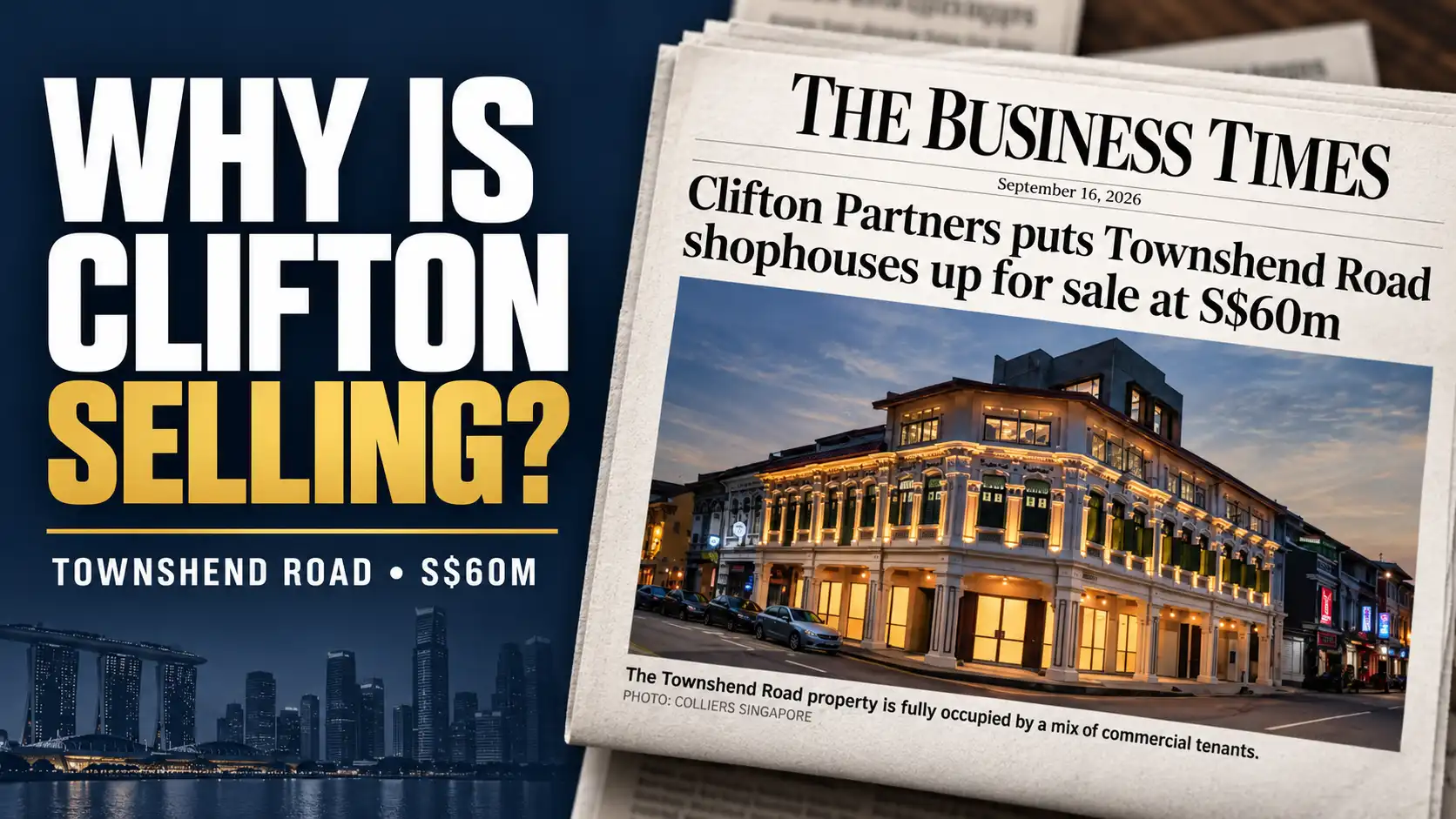
Clifton Partners’ decision to put 5, 7 and 9 Townshend Road on the market for S$60 million may seem surprising at first.
After all, Clifton is one of Singapore’s best-known specialist owners and restorers of conservation shophouses. Its usual playbook appears to be acquiring heritage buildings, improving them, curating tenants, and collecting rent over long holding periods. They have a portfolio of more than S$2 billion, focused heavily on conservation shophouses, while their portfolio language emphasises tenant curation, active management and sustainable returns.
Yet Townshend Road is now the third Clifton shophouse asset or cluster publicly offered for sale in 2026, following 277-279 South Bridge Road in February and 38 Circular Road in March.
That pattern matters.
After reviewing Clifton’s recent acquisitions, fundraising activities, refurbishment projects and the broader shophouse market, we do not see the proposed Townshend Road sale as a sign that Clifton is losing confidence in either the shophouse sector or the Jalan Besar area.
Instead, the sale appears to fit a more conventional value-add real estate strategy. Clifton has already undertaken much of the difficult work: upgrading the property, improving its positioning, securing tenants and transforming it into a stabilised, institutional-quality asset. Having created that value, the next logical step may be to test the market and determine whether another investor will pay a sufficiently attractive price for the completed, income-producing property.
Seen from this perspective, the sale is less about exiting the shophouse market and more about potentially crystallising the value Clifton has created, freeing up capital that could then be recycled into its next acquisition or value-add opportunity.
Just as importantly, Clifton has recently deployed substantial capital into another generation of heritage assets. A Townshend sale could therefore be part of a broader rotation from completed projects into properties with more value still to unlock.
Townshend Road is being sold at almost the ideal point in a value-add cycle
The most important clue is the property’s condition when it comes on the market.
This is not an underperforming, half-empty building that Clifton appears desperate to offload. It is almost the opposite.
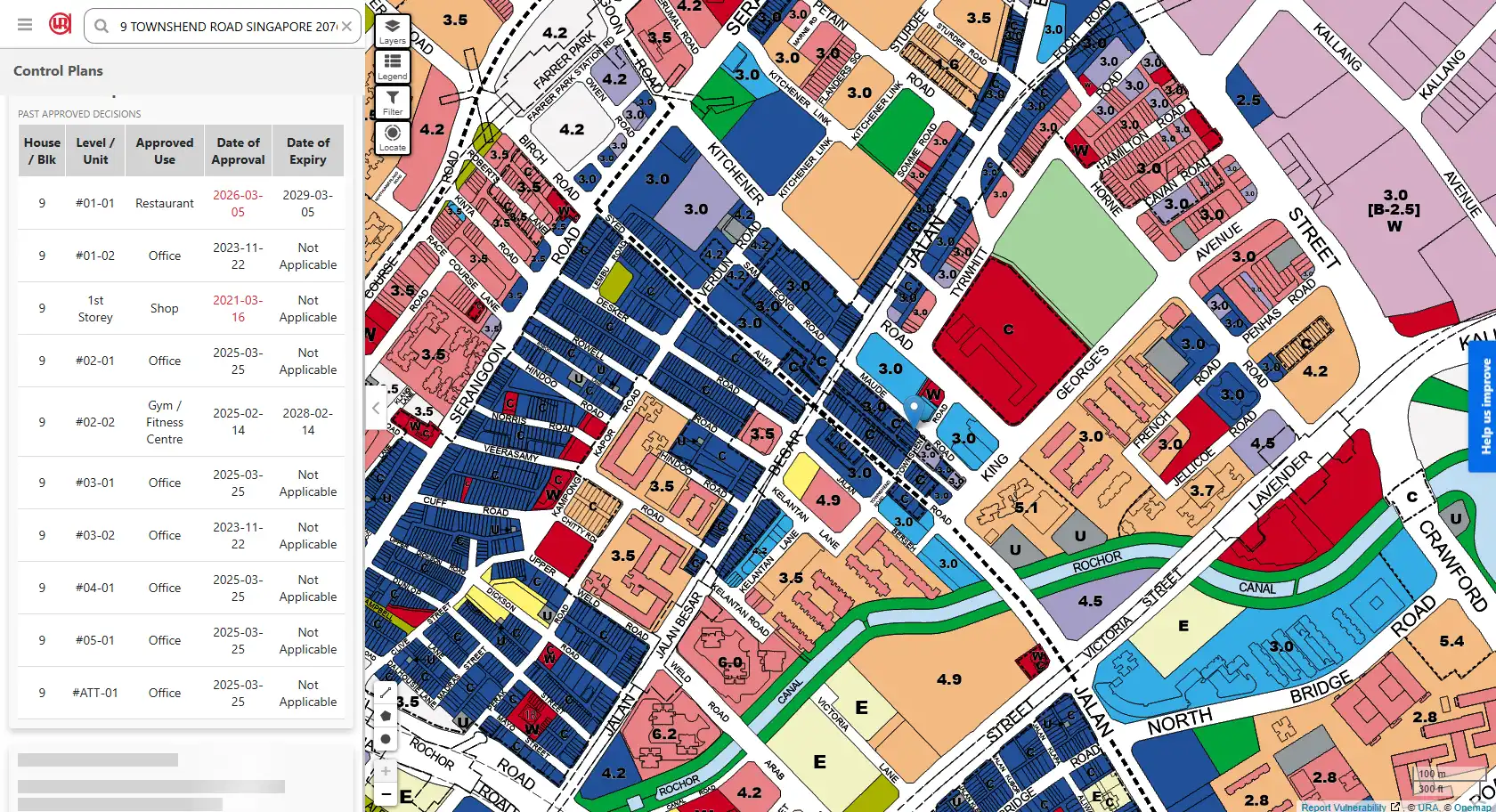
The three adjoining freehold conservation shophouses at 5, 7 and 9 Townshend Road have been combined into one commercial asset. Clifton carried out a three-year enhancement programme, adding a new five-storey rear extension and lift, as well as new floors and wall finishes, lighting, air-conditioning, plumbing and pantry facilities. The completed property has approximately 16,298 sq ft of built-up area and sits on a 4,673 sq ft site.
The Business Times also highlighted that Clifton spent about S$5 million on the enhancement programme; subsequent coverage of the sale also reported the same figure. At the S$60 million indicative price, that enhancement expenditure alone is equivalent to roughly 8.3% of the current asking value.
Most importantly, the building is fully occupied. Lion City Chicken Rice and Hotpot occupies the restaurant-approved ground floor, while fitness and office tenants occupy other parts of the building. That gives a buyer an immediate income stream rather than a lease-up problem.
The S$60 million price translates to approximately S$3,681 psf on built-up area. Colliers is marketing the property through an expression-of-interest closing on October 29, 2026.
That sequence is therefore:
acquire → invest capital → add floor area → modernize → lease up → stabilize → sell.
Selling after stabilisation is not inconsistent with being a sophisticated landlord. It is precisely how a value-add real estate investor crystallises the value created during the project’s difficult phase.
In fact, Clifton’s own investment team makes this explicit. Its investment lead, Laura Teo, handles acquisitions, strategic asset enhancement, project management, leasing, and disposition. Clifton therefore does not define its business model as permanent ownership. Disposition is formally part of the investment lifecycle.
That distinction changes how Townshend should be interpreted. Clifton is a landlord, but it is first an investment manager.
The rental income is a means of improving and stabilising an asset. It does not necessarily mean every building is intended to remain in the portfolio indefinitely.
What Clifton has bought recently is probably the bigger part of the story
The clearest indication that the sale may be part of a broader capital-recycling strategy comes from Clifton’s acquisition activity in the period leading up to its 2026 sale programme.
Clifton made two particularly significant heritage-property moves in 2025.
| Period | Property | Clifton’s move | Reported consideration/status | Why it matters |
| Feb-Jul 2025 | 8, 15, 16, 17, 29 and 30 Stanley Street | Acquired by Clifton affiliates | S$82.4m, completed in July | The six-property acquisition created a new portfolio requiring leasing, refurbishment, and management capital. |
| Jul 2025 onward | 50 Eu Tong Sen Street, former Thong Chai Medical Institution | Acquisition by Clifton-linked entity reported; property now appears in Clifton portfolio | S$45m-S$50m reported all-in cost | A major national-monument restoration/repositioning opportunity. |
| Feb 2026 | 277-279 South Bridge Road | Offered for sale | No guide price | Refurbishment had been completed around April 2025, and the building was tenanted. |
| Mar 2026 | 38 Circular Road | Offered for sale | S$28m guide | Clifton had already spent about S$800,000 refurbishing and repositioning it. |
| Sep 2026 | 5-9 Townshend Road | Offered for sale | S$60m indicative | Three-year enhancement complete and asset fully occupied. |
The Stanley Street acquisition is particularly noteworthy. Of the six properties acquired, five are freehold, while 29 Stanley Street is held on a 99-year lease commencing in December 1990. The transactions were agreed in February and March 2025, before all six properties were completed in July 2025 for a combined purchase price of S$82.4 million.
Then there is 50 Eu Tong Sen Street, the former Thong Chai Medical Institution.
The Business Times reported in July 2025 that an entity linked to Clifton was taking over the property at an all-in cost of roughly S$45 million to S$50 million. The building is a national monument on approximately 11,733 sq ft of land and now appears on Clifton’s own portfolio website, making the evidence of Clifton’s ownership considerably stronger than when the original transaction was first reported.
Together, those two publicly identified 2025 acquisition programmes represent roughly S$127.4 million to S$132.4 million of property purchases.
A Townshend exit at the full S$60 million asking price would recycle cash equivalent to about 45% to 47% of that acquisition value.
That does not prove Clifton needs S$60 million to finance those acquisitions. We do not have Clifton’s asset-level financing, fund allocation or cash-flow records, and it would be wrong to imply financial pressure without them. But it makes the capital-recycling hypothesis economically plausible: a single mature asset can release a meaningful amount of equity after a year in which the manager bought a large new batch of buildings.
Clifton also appears to be buying something qualitatively different from what it is trying to sell.
The 2026 sale candidates are largely assets where Clifton has already done the value-creation work. The recent acquisitions give it another set of buildings on which that work can begin again.
That is exactly the rotation a value-add manager would normally want.
The S$258 million fund changes how Clifton should be viewed
The other major development happened in June 2025.
Clifton closed its inaugural institutional real-estate fund, Clifton Heritage Partners I, with US$258 million in total commitments including co-investments, according to its placement agent Hodes Weill. The vehicle targets value-add commercial property investments in Singapore. PERE reported that the fund was seeded with shophouse assets and that its investors included pensions, foundations, endowments and family offices from multiple regions.
That is a structural change for the business.
Clifton historically built its track record through deal-by-deal capital and joint ventures. An institutional value-add fund introduces a more formal investment cycle: capital is raised, deployed into properties, asset-management plans are executed, and eventually investments must generate realisations and distributions.
This does not mean Townshend Road necessarily belongs to Clifton Heritage Partners I. We could not find reliable public disclosure identifying the exact ownership vehicle behind Townshend or stating that its sale proceeds will flow into that fund.
But at the firm level, the timing is notable:
Fund closes in mid-2025 → Clifton completes a sizeable Stanley Street acquisition → adds the former Thong Chai monument to its portfolio → begins marketing multiple enhanced legacy assets for sale in 2026.
That makes the 2026 dispositions look less like isolated decisions and more like the behaviour of a manager increasingly operating an institutional buy-improve-stabilise-realise model.
It also explains why Clifton can advertise properties for rent while putting other buildings up for sale. They feature a current portfolio of more than 20 assets and actively market leasing opportunities. For example, Clifton is currently advertising a newly renovated 1,087 sq ft office at 38 Circular Road for immediate occupancy, even though that building launched for sale earlier in the year.
So this is not a wholesale exit from the landlord business.
It is a portfolio manager doing both things at once: leasing assets while selectively monetising them when pricing becomes attractive.
The three 2026 sale attempts reveal a common pattern
Looking at Townshend Road by itself can make the decision seem anomalous. Looking at it beside South Bridge Road and Circular Road makes the strategy much clearer.
South Bridge Road
Clifton launched 277 and 279 South Bridge Road for sale in February 2026 without a guide price.
The adjoining properties have about 8,259 sq ft of built-up area, with a 99-year tenure from 1992 and roughly 65 years remaining. Clifton had completed refurbishment around April 2025. By the time they were offered for sale, Gunkee Claypot Restaurant occupied the lower floors and office tenants occupied the mezzanine and upper floors.
Again, that looks like:
refurbish → tenant → stabilise → test exit.
Circular Road
At 38 Circular Road, the pattern is even clearer.
Clifton acquired what was reportedly a poorly maintained property around 2022. It then spent about S$800,000 on a comprehensive refurbishment between late 2022 and the end of 2023, restoring the facade and upgrading the interiors. After repositioning the building with restaurant, wellness and creative-office occupiers, Clifton brought it to market in March 2026 with a S$28 million guide price, or approximately S$6,361 psf on built-up area.
Townshend is effectively a larger version of that same playbook.
Its three-year enhancement programme is complete, the major five-storey extension is built, modern building services are installed, and the property is fully let.
However, there is an important distinction: putting a property on the market does not necessarily mean a sale will ultimately take place.
We did not find reliable public evidence showing that either the February South Bridge Road EOI or the March Circular Road EOI has culminated in a completed disposal. In fact, Clifton is still actively advertising space at 38 Circular Road for immediate lease. That means the 2026 pattern is more accurately described as a series of monetisation attempts or price-discovery exercises, rather than three confirmed exits.
That tells us something else about Clifton’s behaviour: management may be quite willing to test the market without being forced to transact.
For a scarce shophouse asset, there is little downside to discovering what family offices and private investors will pay if the owner can continue collecting or seeking rent.
Why Townshend Road may be particularly sellable right now
Several factors make Townshend a logical asset on which to test pricing in late 2026.
First, freehold shophouses remain the segment buyers value most heavily.
Singapore Realtors Inc reported that only 25 caveated shophouse transactions occurred in the first half of 2026, down from 34 a year earlier, but aggregate value increased 14.9% to S$269.5 million. Freehold properties accounted for 76% of transaction value, with freehold and 999-year assets together accounting for 84%.
That is almost tailor-made for Townshend: a rare freehold, contiguous three-building cluster rather than a short-lease single unit.
Knight Frank’s research similarly found that although transaction activity had been relatively measured, scarce freehold shophouses continued to command firm pricing. Its 2025 study recorded 96 sales worth S$879.7 million and said a lower interest-rate backdrop should continue to support acquisitions, although buyers would remain selective because of price premiums.
Second, the building is being offered in a condition that reduces execution risk for the next owner.
A wealthy individual or family office buying an old shophouse typically has to worry about conservation constraints, contractors, structural works, building services, leasing and tenant selection. At Townshend, Clifton has already carried out much of that work. Colliers can therefore market a turnkey, fully occupied heritage asset rather than a renovation project.
This matters because it allows Clifton potentially to transfer the asset from one category of capital to another:
Clifton takes redevelopment and leasing risk; a family office pays for the finished income-producing trophy asset.
That is an economically rational division of labour.
Third, fully commercial zoning expands the buyer pool. Colliers notes that eligible foreign purchasers can acquire the property without Additional Buyer’s Stamp Duty, making it marketable to both Singapore and international private capital.
At a S$60 million quantum, that broad international wealth pool is particularly relevant.
The asking price should be viewed as a test, not necessarily Clifton’s minimum acceptable value. An EOI lets the seller see whether scarcity, full occupancy, and the new extension create enough competitive tension to justify exiting. If bids disappoint, a long-term landlord can simply retain an income-producing freehold asset.
Jalan Besar’s co-living potential may actually strengthen the case to sell
The Business Times article offers another interesting angle: a buyer could explore converting Townshend to co-living, subject to the necessary regulatory approvals.
That is more than a theoretical marketing idea because something very similar has already happened next door.
In November 2025, Coliwoo entered a 50:50 joint venture with Macritchie Developments to acquire the freehold REHAU Building at 1 King George’s Avenue for S$40 million. Oxley Holdings’ Ching Chiat Kwong and his son, Shawn Ching, own Macritchie Developments. The JV intends to convert the commercial building into co-living accommodation while retaining commercial uses on the ground floor.
The property’s locational pitch is strikingly similar to Townshend’s: within walking distance of Jalan Besar and Lavender MRT stations, close to central Singapore, educational institutions, and urban amenities. Coliwoo explicitly characterised the acquisition as an opportunity to convert an under-utilised commercial property into a higher-yielding co-living asset.
So a new buyer looking at Townshend does not only see the existing restaurant, fitness and office rent.
They may also price in future use optionality.
That is potentially valuable to Clifton because an owner does not necessarily need to undertake the next redevelopment itself to capture some of its expected value. Once a nearby transaction has demonstrated investor appetite for commercial-to-co-living conversions, Clifton can market that optionality to the next buyer and try to reflect it in today’s sale price.
The area is also receiving more demand generators. Colliers points to almost 400 BTO homes along King George’s Avenue scheduled for completion by 2027, more than 1,600 new homes across the broader precinct, and a Kitchener Road hotel development adding 1,625 rooms and about 13,000 sq ft of retail space.
Those changes can support demand for F&B, services, flexible accommodation, and office space.
Paradoxically, therefore, Clifton may be selling because the story around the location is getting better, not worse. The ideal time for a value-add investor to realise an asset is often when the purchaser can see another leg of upside.
So what is most likely triggering the Townshend sale?
Putting the evidence together, we would rank the explanations this way.
The most compelling explanation is that Townshend Road has reached the end of Clifton’s asset-enhancement cycle. What began as a conservation-property redevelopment has been transformed into a substantially larger, fully occupied and stabilised commercial asset. Much of the execution risk has therefore been addressed, and the most intensive phase of value creation is largely complete.
The second is portfolio capital recycling after a major acquisition year. Clifton affiliates spent S$82.4 million on six Stanley Street properties in 2025, while the firm also appears to have taken over the former Thong Chai Medical Institution in a deal reported at S$45 million-S$50 million. A S$60 million Townshend sale would release capital equal to roughly 45%-47% of those two publicly reported acquisition amounts alone.
The third is Clifton’s evolution into an institutional fund manager. Its US$258 million inaugural fund is explicitly a value-add Singapore commercial-property vehicle. A manager operating that strategy needs both acquisitions and realisations; permanent ownership of every successful renovation would eventually trap equity in low-risk stabilised assets instead of redeploying it into higher-return value-add opportunities. This is an analytical inference from Clifton’s fund strategy rather than a disclosed reason for the Townshend sale.
The fourth is favourable exit-market positioning. In 1H2026, transaction values rose even as deal counts fell, with capital increasingly concentrated in larger, longer-tenure properties. Townshend’s freehold tenure, large contiguous footprint, full occupancy and completed extension place it squarely in that preferred category.
The fifth is Jalan Besar’s emerging redevelopment and co-living story. The S$40 million Coliwoo/Oxley-linked transaction at 1 King George’s Avenue gives potential buyers a nearby reference point for adaptive reuse and may make them willing to underwrite upside beyond Townshend’s existing commercial leases.
We do not see evidence supporting a distress-sale thesis.
Townshend is fully leased; Clifton reports a portfolio exceeding S$2 billion; it raised US$258 million of institutional capital in 2025; and it has recently been buying large heritage assets. Even a S$60 million Townshend transaction would represent less than about 3% of Clifton’s stated S$2 billion-plus portfolio. Those facts align more with selective asset rotation than with a wholesale need to shrink.
One crucial unknown remains: we do not know Clifton’s original purchase price and total cost basis for Townshend Road. Without that figure, current debt, rent roll and transaction costs, it is impossible to calculate the actual development profit or IRR. That means any claim that Clifton is taking a specific profit should be treated sceptically unless caveat or ownership records establish the cost basis.
The bigger takeaway: Clifton is not abandoning shophouses—it is becoming more systematic about trading the lifecycle
The Townshend listing makes more sense once Clifton is viewed not simply as a collector of Singapore shophouses but as a heritage-focused real-estate investment manager.
Its own portfolio page distinguishes between “past and present properties”, showing 52 properties across that wider history while stating that the current portfolio contains more than 20. Its investment team explicitly performs both leasing and disposition.
And there is no evidence that the company has stopped investing in the sector. Quite the opposite: the six-property Stanley Street purchase and addition of the former Thong Chai national monument significantly expanded its heritage exposure just before the 2026 disposal programme.
So our central thesis would be:
Clifton is probably not selling Townshend Road because it no longer wants rental income. It is selling because it has already created much of the value that its active-management strategy was designed to create.
Townshend has been enlarged, refurbished and leased. That makes it attractive to the type of private-wealth buyer who wants a finished freehold heritage asset and is willing to accept a lower, steadier return in exchange for scarcity, income and long-term capital preservation. Clifton, meanwhile, can potentially take the released equity and put it into the next building where physical improvement, tenant repositioning or adaptive reuse can generate a higher return.
The recent transaction timeline reinforces that interpretation:
2025 was predominantly an acquisition and fundraising year. 2026 is increasingly looking like a realisation and portfolio-rotation year.
Townshend is therefore better understood not as an exception to Clifton’s leasing strategy, but as its end product.
The real signal to watch is not merely whether Clifton achieves the S$60 million asking price. It is what Clifton buys next—and whether capital continues moving from already-restored, fully leased shophouses into larger or more complicated heritage assets such as Stanley Street and the former Thong Chai building.
That would confirm the model now visible across the portfolio: buy heritage, create modern utility, stabilise income, sell selectively when scarcity commands the right price, and recycle the capital into the next restoration.
Disclaimer: This article is based on publicly available information and represents the author’s analysis and interpretation. Clifton Partners has not publicly disclosed the reasons for marketing the Townshend Road property, and any discussion of capital recycling, portfolio strategy or investment motives should therefore be regarded as informed analysis rather than confirmed fact. The S$60 million figure is an indicative asking price, and the sale offering does not constitute a completed transaction. This article is for general information only and should not be considered financial, investment or property advice. Readers should conduct their own due diligence and seek professional advice before making any investment decision.
Article contributed by Jerry Wong.

Jerry Wong is a realtor at Propnex Realty, bringing a rich background in interior and lighting design to his work. He loves exploring diverse spaces and observing the transformative power of real estate. Beyond his professional role, Jerry finds his greatest fulfillment in connecting people with the right properties, gaining immense satisfaction from helping clients achieve their dreams.