Omnicom’s reported lease of close to 50,000 sq ft at 51 Merchant Road may initially look like another large office transaction in a relatively resilient Singapore market.
It is more revealing than that.
The space represents roughly three-quarters of the building’s expected net lettable area, making Omnicom the defining occupier of the refurbished property rather than simply one tenant among many. The reported five-year lease, with an option to renew, also comes shortly after Omnicom completed its acquisition of rival Interpublic Group in November 2025.
Together, these details suggest the transaction is more than adding office space. It appears to combine corporate integration, portfolio consolidation, rental discipline and the desire for a more distinctive headquarters environment.
For the owners of 51 Merchant Road, Elevate Capital Group and LaSalle Investment Management, securing such a substantial anchor tenant before refurbishment is completed represents an important reduction in leasing risk. More broadly, the deal provides an early test of whether Singapore’s boutique-office market can offer large occupiers a credible alternative to conventional Grade A towers.
What Is 51 Merchant Road?
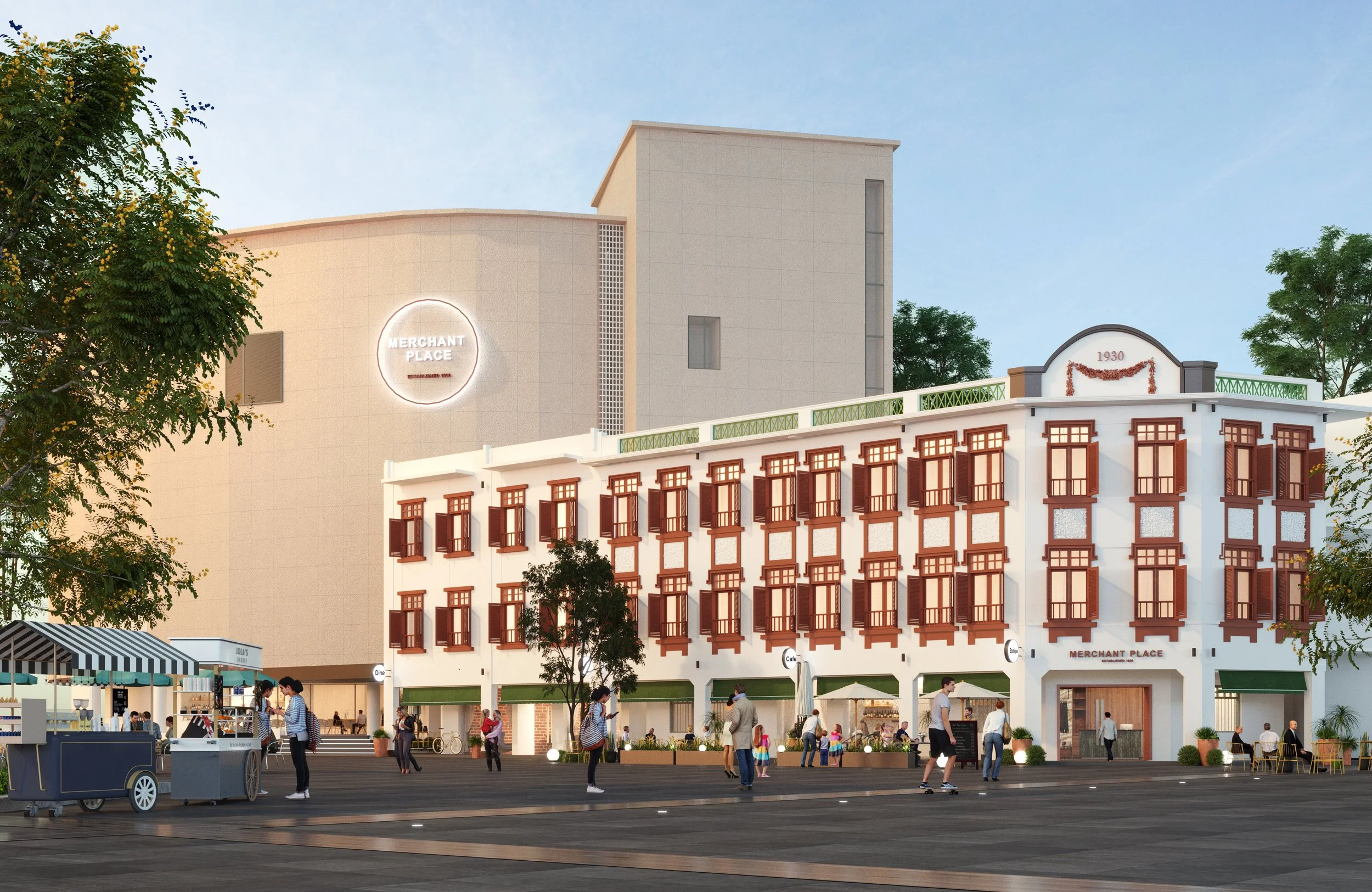
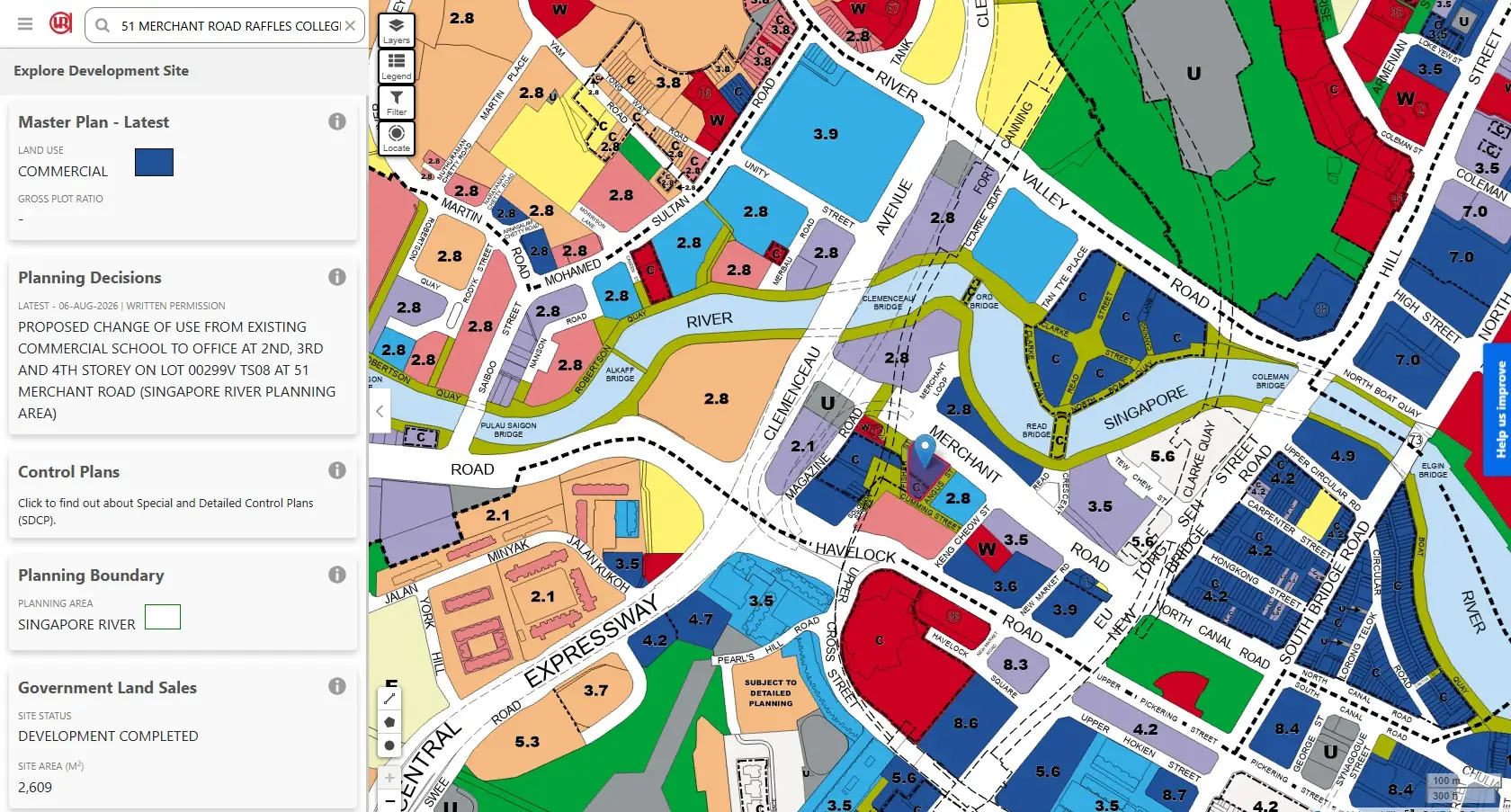
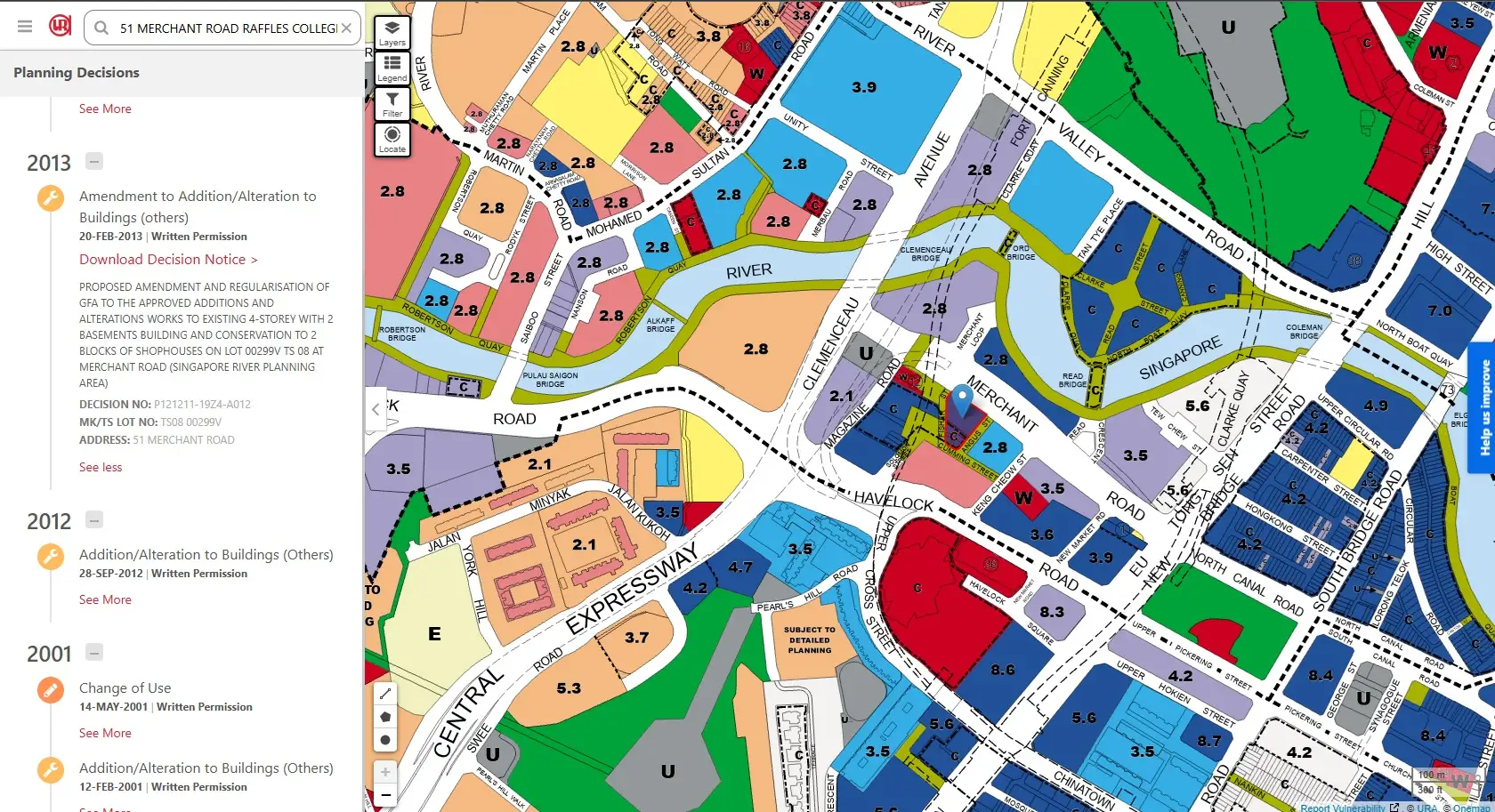
Formerly known as Raffles Education Square, 51 Merchant Road occupies a prominent site near Clarke Quay MRT station. It comprises a four-storey commercial building, two basement parking levels and two rows of conserved shophouses facing Fisher Street and Angus Street.
Elevate Capital and LaSalle acquired the property for S$121.8 million with vacant possession from Raffles Education. The property, originally developed in 1996, contains approximately 71,338 sq ft of gross floor area on a site of about 27,669 sq ft.
Following refurbishment, its net lettable area is expected to reach approximately 63,000 to 65,000 sq ft. The works include upgrades to the façade, interiors and common areas, while the ground floor is being reconfigured for dining, retail and wellness uses.
If Omnicom occupies close to 50,000 sq ft, it would account for approximately 77% to 79% of the completed property’s expected net lettable area. This means the building is effectively being shaped around one major corporate occupier, with the remaining space expected to support the wider office environment.
That structure is central to understanding why the transaction matters.
This Looks More Like Consolidation Than Expansion
Omnicom completed its acquisition of Interpublic Group in November 2025, creating a combined company with more than US$25 billion in pro forma revenue. In Singapore, the combined group is expected to retain a presence at MacDonald House while reportedly leaving premises at Alice@Mediapolis and 991C Alexandra Road.
The move to 51 Merchant Road should therefore not automatically be interpreted as 50,000 sq ft of entirely new demand.
Some of the space will probably replace offices already occupied elsewhere. The transaction appears to bring different teams and agencies into a more consolidated workplace following the merger.
That distinction matters when assessing Singapore’s office market. A large new lease can look impressive in isolation, but the net increase in occupied space may be smaller once you account for vacated premises.
The real signal is that Omnicom still sees value in committing to a sizeable physical workplace even after hybrid working has become established. The company may be reducing the number of locations it occupies, but it is also concentrating more employees in a property that supports collaboration and integration.
For a newly combined advertising and marketing group, this has operational logic. Office consolidation can reduce duplicated facilities, improve communication between teams and help form a common corporate culture. Real estate becomes part of the merger-integration strategy rather than merely an overhead to be minimised.
A Meaningful Rental Discount Without Leaving the City Centre
Industry observers reportedly estimate Omnicom’s rent at approximately S$9 to S$10 psf per month of net lettable area.
Comparable mid-level space in Grade A CBD office buildings was estimated at approximately S$11 to S$13 psf per month. This is broadly consistent with JLL’s Q2 2026 estimate of S$12.19 psf per month for CBD Grade A gross effective rents.
On close to 50,000 sq ft, the difference is significant
| Illustrative calculation | Estimated amount |
|---|---|
| Annual rent at S$9 psf per month | S$5.40 million |
| Annual rent at S$10 psf per month | S$6.00 million |
| Annual rent at S$11 psf per month | S$6.60 million |
| Annual rent at S$13 psf per month | S$7.80 million |
| Potential annual difference | S$0.60 million to S$2.40 million |
These figures are illustrative, not an estimate of Omnicom’s actual savings. Lease incentives, service charges, fit-out contributions, rent-free periods, escalation clauses and building specifications may differ materially between properties.
Nevertheless, the scale of the potential difference helps explain why 51 Merchant Road could be attractive. Omnicom secured a central, highly visible location near an MRT station while paying less than it might for a similarly sized office in a conventional Grade A CBD tower.
This is not decentralisation in the usual sense. Clarke Quay remains close to the CBD, the Singapore River and several central transport nodes. The trade-off is therefore not between an expensive central office and a remote suburban business park. It is between two different versions of centrality: a traditional corporate tower and a smaller, character-led building at the CBD fringe.
The Attraction of Being the Building’s Defining Occupier
Large office towers offer modern specifications, extensive facilities and prestigious addresses, but tenants normally share the building with many other companies. Their corporate identity may be limited to lobby directories, lift lobbies and the floors they occupy.
At 51 Merchant Road, Omnicom’s reported share of the lettable area gives it a very different presence.
Occupying most of a standalone boutique building can provide:
- stronger external branding and signage opportunities;
- greater influence over the arrival experience and workplace identity;
- easier movement between teams than a fragmented multi-building portfolio;
- more control over security, events and shared spaces; and
- a headquarters environment that feels associated with the company rather than with the landlord’s tower.
This may be especially relevant to a group operating in advertising, branding, media, public relations and digital commerce. A conserved* shophouse setting integrated with contemporary offices may communicate creativity and cultural character more effectively than a standard glass tower.
The decision is therefore unlikely to be based on rent alone. The property can potentially deliver both economic savings and a more recognisable corporate home.
Why the Lease Matters to Elevate Capital and LaSalle
The owners acquired 51 Merchant Road as a value-add investment: purchase a vacant property, refurbish it, improve the tenant proposition and create a mixed-use destination capable of supporting higher and more durable income.
The reported Omnicom commitment substantially advances that strategy.
| Property indicator | Approximate figure |
|---|---|
| Acquisition price | S$121.8 million |
| Existing gross floor area | 71,338 sq ft |
| Expected post-refurbishment NLA | 63,000–65,000 sq ft |
| Acquisition price per sq ft of GFA | S$1,708 |
| Acquisition price per sq ft of expected NLA | S$1,874–S$1,933 |
| Reported Omnicom space | Nearly 50,000 sq ft |
| Indicative annual Omnicom rent | S$5.4–S$6.0 million |
The estimated annual rent attributable to Omnicom would equal approximately 4.4% to 4.9% of the acquisition price before considering income from the remaining space.
This must not be confused with the property’s investment yield. It excludes refurbishment costs, acquisition expenses, financing, incentives, operating expenditure, property tax and vacancy. The ground-floor commercial space may also command a different rental basis from the offices.
However, it demonstrates the importance of the lease. One occupier could provide a substantial recurring income base while leaving the owners to focus on curating and leasing the remaining ground-floor space.
An anchor tenant can also improve the credibility of the retail and dining component. Operators considering the ground floor will not rely only on passing visitors; they may also benefit from a regular weekday population working immediately above them.
This creates the possibility of a mutually reinforcing ecosystem. The office tenant supports food, beverage and wellness demand, while those amenities make the workplace more attractive to employees.
What This Reveals About Singapore’s Boutique-Office Market
The lease supports the case for boutique offices, but the lesson should not be overgeneralised.
The opportunity is not simply to refurbish any older commercial building and charge near-Grade A rents. 51 Merchant Road possesses a relatively unusual combination of attributes:
- a central location near Clarke Quay MRT;
- almost 50,000 sq ft of contiguous office accommodation for one occupier;
- a standalone identity rather than strata-fragmented ownership;
- conserved shophouses and a recognisable streetscape;
- planned dining, retail and wellness uses; and
- proximity to a major mixed-use redevelopment at Union Square.
Most conserved shophouses offer character but cannot provide the contiguous floor area, vertical circulation, parking or modern building services required by a large multinational. Most large office towers provide functionality but not exclusivity.
51 Merchant Road sits between those two formats.
That may be the most important market signal from the deal. Some occupiers are willing to move outside a conventional Grade A tower if an alternative property can combine connectivity, modern functionality, cost savings and a distinctive identity.
Boutique offices are therefore unlikely to replace Grade A towers. Instead, the strongest examples can compete for a particular group of tenants: companies large enough to value a headquarters presence, but flexible enough to prioritise character and control over a traditional corporate address.
Union Square Could Be Both a Catalyst and a Competitor
The location is also changing.
A short distance away, CDL is redeveloping the former Central Mall and Central Square properties into Union Square. The 735,500 sq ft mixed-use project will include 366 residences, approximately 300,910 sq ft of Grade A office space, retail and dining space, and 134 co-living rooms. The overall development is targeted for completion in 2029.
For 51 Merchant Road, this transformation cuts both ways.
Union Square could increase footfall, improve the surrounding public realm, and introduce a larger residential, working, and visitor population. Planned partial pedestrianisation around Merchant Road and Solomon Street could also make the district more walkable and strengthen its connection with the Singapore River, Chinatown and Fort Canning.
At the same time, Union Square Central will introduce a much newer Grade A alternative nearby. It could compete for occupiers seeking modern specifications and for retail operators targeting the same catchment.
51 Merchant Road therefore needs to establish a differentiated identity rather than compete directly on newness or scale. Its advantage will lie in its lower-rise character, conserved architecture, sense of ownership for a major occupier and potentially lower rental quantum.
The Risks Should Not Be Ignored
The Omnicom lease significantly reduces risk, but it does not eliminate it.
First, the building will have considerable tenant concentration. A major occupier provides income stability while the lease is in force, but it also creates a large future expiry event. The reported renewal option is helpful, although the commercial terms are not publicly known.
Second, a five-year lease may be relatively short when measured against the acquisition, refurbishment and fit-out cycle. The owners must ensure that the building remains competitive when Omnicom eventually reviews its options.
Third, the ground floor’s success will depend on tenant curation and footfall. Retail, dining, and wellness uses can enhance an office environment, but they require demand beyond the captive office population, particularly in the evenings and on weekends.
Fourth, the building must deliver more than a visually appealing refurbishment. Occupiers will also assess air-conditioning performance, lift capacity, digital infrastructure, energy efficiency, ceiling heights, end-of-trip facilities, parking and the efficiency of the floor plates. Character may attract attention, but operational performance will influence retention.
Finally, Omnicom’s relocation appears connected to a broader corporate integration. Future space requirements could change as the combined group restructures, adopts new working patterns or adjusts its headcount. This reinforces why the transaction should be viewed as portfolio optimisation rather than straightforward expansion.
Our Take
Omnicom’s reported lease does not show that companies are abandoning Grade A offices, nor does it prove that Singapore is experiencing 50,000 sq ft of entirely new office demand.
What it demonstrates is more specific—and arguably more useful.
A well-located boutique property can attract a major multinational when it offers the right combination of contiguous space, public-transport access, rental value, visibility and corporate identity. In Omnicom’s case, those advantages appear particularly relevant because the company is integrating businesses after a major acquisition and reportedly consolidating several Singapore locations.
For Elevate Capital and LaSalle, the lease is an early validation of their repositioning strategy. A property acquired vacant for S$121.8 million is expected to emerge from refurbishment with most of its lettable area committed to a global anchor tenant. The remaining challenge is to complete the works well, secure the right ground-floor operators and create a destination that functions beyond office hours.
The wider implication for Singapore’s office market is not that boutique buildings will displace CBD towers. It is that the market is becoming more segmented. Grade A towers will continue to attract occupiers seeking scale, specifications and institutional prestige. At the same time, distinctive city-fringe assets can compete by offering something towers often cannot: a stronger sense of ownership, character and place—potentially at a meaningful rental discount.
That is why the Omnicom lease matters. It is not simply a large space commitment. It is evidence that, for the right occupier and the right building, boutique offices can become credible corporate headquarters rather than merely smaller alternatives to the CBD.
Disclaimer: This article is provided for general information and commentary only. Details concerning Omnicom’s reported lease at 51 Merchant Road, including the leased area, rental rate, lease duration and relocation plans, are based on publicly available information and media reports at the time of writing. The complete lease terms have not been publicly disclosed. All rental, cost-saving and investment-yield calculations are illustrative estimates and may exclude incentives, service charges, refurbishment expenditure, financing costs, taxes, operating expenses and other commercial considerations. This article does not constitute property, financial, legal or investment advice. Readers should conduct their own due diligence and obtain professional advice before making any property or investment decision.
Article contributed by Jerry Wong.

Jerry Wong is a realtor at Propnex Realty, bringing a rich background in interior and lighting design to his work. He loves exploring diverse spaces and observing the transformative power of real estate. Beyond his professional role, Jerry finds his greatest fulfillment in connecting people with the right properties, gaining immense satisfaction from helping clients achieve their dreams.