
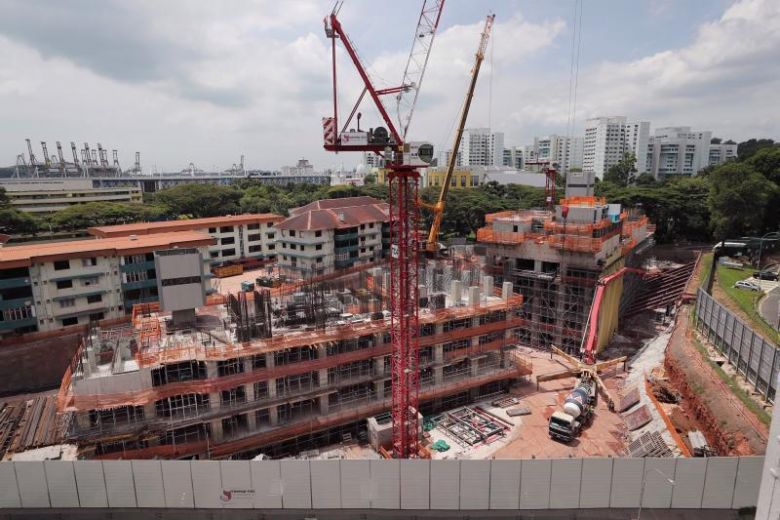
SINGAPORE – The coronavirus outbreak across the world is wreaking havoc on Singapore’s building projects that use prefab building methods.
Take the Avenue South Residence project coming up at Silat Avenue near the Singapore General Hospital. Its construction was stuck at the fifth storey when the virus outbreak in February disrupted deliveries of building supplies from China to its main contractor, United Tec Construction.
Now, just when building supplies resumed this month from China and the 1,074-unit condo project is built up to the sixth storey, construction could again be stalled. This time – because of Malaysia’s partial lockdown to contain the outbreak.
Malaysia on Monday announced restrictions on movement for two weeks from Wednesday (March 18), barring its citizens from travelling overseas and shutting all businesses except shops selling food and daily necessities, to stem the rising number of virus cases.
That has resulted in a number of contractors in Singapore, including United Tec, scrambling to find accommodation for their Malaysian workers so that they won’t be stuck in Malaysia for at least two weeks. Singapore’s construction sector employs 341,200 foreigners – about three-quarters of the construction workforce – but there is no public breakdown of their nationality.
But that’s not the only issue. A bigger problem is possible disruption in supply of prefabricated pre-finished volumetric construction (PPVC) modules or precast concrete carcasses. About 80 per cent of these come from factories in Johor Bahru. PPVC involves building entire units in factory conditions, then assembling them on-site, Lego-style.
The timing couldn’t have been worse as Malaysia’s lockdown comes after the Building and Construction Authority (BCA) allowed 13 ongoing PPVC projects – which had been affected by delayed supplies of building materials from China – to install partially completed PPVC modules on-site first, and finish the work after the materials arrive.
There are a total of 44 PPVC projects, of which 35 are private residential and HDB projects, at various stages of progress, the BCA said.
Now with even the supply of PPVC modules being disrupted, no other work can continue.
“The construction of structural works will come to standstill during the lockdown. Our contractors can (build) up to 3 floors per month using PPVC. So the two-week lock down will affect at least one and half floors,” Mr Ng Yek Meng, president of Singapore Contractors Association (SCAL), said.
This is a bigger problem than disruption in building supplies from China, said Mr Kenneth Loo, executive director of Straits Construction.
At least two Malaysian suppliers have told him that PPVC module shipments would stop as of March 18. “My suppliers also stopped production, which means they will need time to gear up when operations resume. That means more delays,” said Mr Loo.
BCA will work with other government agencies to facilitate measures to minimise delays to construction projects, a spokesman said.
Meanwhile, many contractors continue to incur overhead costs even if their projects are partially stopped, he added.
Mr Allan Tan, managing director of United Tec, fears his Tuas factory, which installs floors, tiles and windows in PPVC modules, may run idle once he runs out of his two-week supply of modules.
“It costs $90,000 a month to rent a tower crane. Now with no fresh carcass supply, that means the crane could idle,” he said.
“On top of that, 20 of our Malaysian workers have to get accommodation here for two weeks. Most are supervisors, foremen, heavy machine operators, crane drivers,” he said. Less than 5 per cent of Singapore’s construction workforce comes from Malaysia, SCAL said.
“But even if you have crane operators, if there’s no carcass, that’s bad. We can work for two weeks more. But after that, it’s Inshallah (God willing),” Mr Tan said.
“Source:[Coronavirus: Singapore housing projects using prefab parts stalled by Malaysia lockdown] © Singapore Press Holdings Limited. Permission required for reproduction”

Let’s Discuss Your Property Plans
Interested in This Property?
Buying, selling or renting? Get a free consultation with realtors with a background in interior and lighting design. We’ll discuss your goals and help you assess your options—from pricing and timelines to layout practicality and space potential.
Share your contact details below, and we will get in touch to understand your needs and suggest the next steps. No pressure. No obligation to proceed.