
Marina One Residences: Premium Pricing, Stronger Rental Story Than Capital Gains
If the question is whether Marina One Residences delivered the strongest capital appreciation over the past decade, the data do not support that conclusion. However, if the lens shifts to whether it evolved into a high-quality, income-generating Marina Bay asset by the mid-2020s, the outlook is considerably more positive. The data points to a clear pattern: Marina One consistently commanded a premium in sale psf, but that premium translated more convincingly into stronger rental performance and yield—particularly in larger units—rather than superior capital gains in smaller formats.
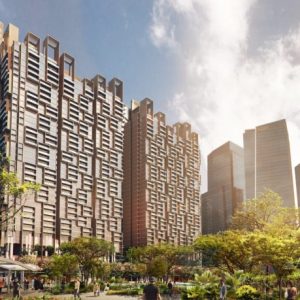
Strategically located within the Marina Bay financial district, Marina One is a 99-year leasehold integrated development that combines residential units, Grade-A office space, and retail, centred on its signature “Green Heart.” With 1,042 residential units, approximately 140,000 sq ft of retail, 65,000 sq ft of landscaped greenery, and seamless underground connectivity to four MRT lines, the project’s design and infrastructure underpin its sustained tenant appeal—even during periods of softer price growth.
The benchmarking framework is deliberate. All four developments—The Sail @ Marina Bay, One Shenton, Marina Bay Residences, and Marina One Residences—share similar attributes: a District 1 location, a 99-year leasehold tenure, and a live-work-play positioning within the CBD/Marina Bay precinct. The Sail (completed 2008, 1,111 units), One Shenton (2011, 341 units), and Marina Bay Residences (2010, 428 units) provide a mature resale baseline against Marina One (2018, 1,042 units), allowing for a like-for-like comparison across product type, location, and tenant profile.

Why this comparison matters
The attached dataset is useful because it compares Marina One not against mass-market condos or fringe CBD projects, but against assets that compete for the same buyer and tenant base: CBD professionals, expatriate households, and investors who want walkability, MRT access, and an amenity-rich address in the downtown core.
That said, there are two important caveats. Firstly, The Sail and Marina Bay Residences contain bay-facing stacks that can distort average psf. Second, the charts aggregate each development as a whole, so floor level, view corridors, furnishing quality, and exact layout efficiency are not separated. That means the analysis is best read as a development-level investment read, not a unit-selection guide.
What the decade says about price performance
The first big takeaway is straightforward: Marina One was usually the most expensive project on a sale-psf basis. On the decade averages shown in the ProNex Protrend charts, Marina One posted the highest average sale psf in 1-bedroom, 2-bedroom, and 3-bedroom units, and the second-highest average sale psf in 4-bedroom-and-larger units, behind only Marina Bay Residences.


That premium was not trivial. Against the average of the three benchmark projects, Marina One’s decade-average sale psf was about 17% higher for 1-bedders, 21% higher for 2-bedders, and roughly 24% higher for both 3-bedders and 4BR+ units. In other words, buyers were paying up for newness, integration, branding, and the project’s stronger physical product.
But paying the most is only a winning strategy if rents or resale values compound fast enough to justify the entry premium. On the attached charts, that did not happen consistently on the capital side.
A clean way to see that is Marina One’s own buy-to-latest price path:
| Marina One unit type | 2015 Average sale psf | 2025 Average sale psf | Price change |
| 1BR | $2,327 | $1,955 | -16.0% |
| 2BR | $2,120 | $2,038 | -3.9% |
| 3BR | $2,580 | $2,097 | -18.7% |
| 4BR+ | $2,608 | $2,197 | -15.8% |
That is the heart of the capital-growth problem. Marina One’s launch-era pricing was rich enough that, over this period, 1BR, 3BR, and 4BR+ owners did not enjoy strong buy-to-latest resale appreciation in psf terms, while 2BR owners roughly preserved value rather than clearly compounding it.
Over the same 10-year period, The Sail and One Shenton generally performed more favourably, benefiting from their position as more established resale assets at the start of the cycle. Marina Bay Residences, on the other hand, exhibited some price softening in the larger-unit segment, which aligns with our earlier caveat: its exposure to premium bay-facing units introduces greater volatility when performance is averaged across the entire development.
There is also a broader market dynamic at play. URA data shows that overall private residential price growth in Singapore slowed to 3.4% in 2025—the weakest pace since 2020—while non-landed CCR prices declined 3.2% quarter-on-quarter in 4Q2025. This macro backdrop helps explain why price momentum in the CBD appears more subdued in the later years of the sales charts, even as the rental trajectory remained comparatively resilient.
What the decade says about rents and yields
If prices were the weak side of Marina One’s story, rents were the repair mechanism. This is where the investment thesis improves materially.
On the decade-average tables, Marina One’s average rent psf was:
- second-highest in 1BR,
- third-highest in 2BR,
- highest in 3BR,
- highest in 4BR+.
That is a striking pattern. Marina One did not dominate the small-unit rental market enough to justify its sale premium, but it did start to dominate in larger-unit rentability.


This table shows how Marina One stacked up against the average of the three surrounding benchmarks on the attached decade averages:
| Unit type | Marina One Avg Sale psf | Peer Avg Sale psf | Marina One Avg Rent psf | Peer Avg Rent psf | Marina One Avg Gross yield | Peer Avg Gross yield |
| 1BR | $2,304 | $1,967 | $6.14 | $6.13 | 3.20% | 3.74% |
| 2BR | $2,363 | $1,957 | $5.87 | $5.64 | 2.98% | 3.46% |
| 3BR | $2,517 | $2,027 | $6.17 | $5.06 | 2.94% | 3.03% |
| 4BR+ | $2,788 | $2,244 | $6.78 | $4.95 | 2.92% | 2.70% |
This is the most important investment table in the whole piece.
It indicates that Marina One’s entry premium overwhelmed its rental advantage in 1BR and 2BR units, leaving it with the weakest average gross yield in both categories. In 3BR units, the rent premium almost fully closed the gap, making Marina One roughly yield-competitive. In 4BR+ units, Marina One’s rental strength was so strong that it actually delivered the best average gross yield among the four projects.
The re-rating in Marina One’s own yield profile is just as notable:
| Marina One unit type | First rental psf | Latest rental psf | Rent change | Gross yield at the early-rent stage | Gross yield at the latest comparable point |
| 1BR | $4.85 | $6.66 | +37.3% | 2.25% | 4.09% |
| 2BR | $4.76 | $6.70 | +40.8% | 2.28% | 3.95% |
| 3BR | $4.78 | $6.82 | +42.7% | 2.28% | 3.90% |
| 4BR+ | $5.17 | $7.24 | +40.0% | 2.33% | 3.95% |
That is a major improvement. Put differently, Marina One did not look like a strong yielding asset at the start, but by the mid-2020s, it had become a much healthier income play.
This also fits the macro picture. URA reported that rentals of private residential properties continued rising in 2025 overall, even as the CCR saw some late-year softness. In the Protrend charts, the broad story is even clearer: the big rental reset happened earlier, from the post-pandemic reopening into the 2022–2024 period, and Marina One benefited meaningfully from it.
The unit types that worked and the ones that did not
The 1-bedroom segment was the weakest Marina One buy. Marina One carried the highest decade-average sale psf at $2,304, but its average rent psf at $6.14 was only marginally above the peer average. That left it with the lowest average gross yield in the group at 3.20%. On a buy-to-latest basis, the sale psf moved from $2,327 to $1,955, which is not what investors want to see from a launch-era small unit.
The 2-bedroom segment was mixed, but still not a clear win. This was Marina One’s closest thing to a “damage-controlled” outcome on the capital side, with sale psf moving from $2,120 to $2,038 rather than collapsing. But it still posted the lowest average gross yield among the four at 2.98%, because the rent premium was too modest relative to the sale premium. By 2025, the yield had recovered to about 3.95%, making it more acceptable today than it was at launch.
The 3-bedroom segment is where Marina One starts to make real strategic sense. It had the highest decade-average sale psf at $2,517, but also the highest average rent psf at $6.17. The average gross yield was still slightly behind The Sail and One Shenton, yet the gap was narrow. More importantly, Marina One’s 3BR rent growth was very strong, and the segment also had relatively healthy turnover in your charts, with 161 sales and 314 rentals, which makes the analysis more reliable than the ultra-thin 4BR+ market.
The 4-bedroom-and-larger segment was Marina One’s strongest investment case. Here, the project had the highest average rent psf of all four at $6.78, while its average sale psf at $2,788 remained below Marina Bay Residences’ $2,988. That translated into the best decade-average gross yield in the group at 2.92% and a roughly 3.95% latest spot yield using the latest visible chart points. The 2023 rental spike to $8.36 psf also shows how powerful premium large-unit demand became in the downtown core. The caution is sample size: large-unit sales and rentals are much thinner everywhere, especially at One Shenton and Marina Bay Residences.
Final verdict
So, was Marina One Residences a sound investment?
The answer is nuanced. It worked well—but primarily for investors focused on asset quality and long-term rental income, rather than short-term capital appreciation from launch to exit.
The Protrend charts suggest that Marina One did not outperform nearby resale developments in terms of capital growth. Entry prices were consistently at a premium psf, and that pricing was not fully supported by subsequent performance, particularly in the 1-bedroom and 2-bedroom segments. In contrast, The Sail and One Shenton often delivered more efficient resale outcomes over the same period.
However, Marina One’s strength lies in its maturation as a rental asset. Its integrated nature—combining residential, office, and retail components—along with strong connectivity, greenery, and overall product quality, contributed to sustained tenant demand. As a result, its rental profile strengthened meaningfully over time, improving overall investment economics by the mid-2020s.
In essence:
Marina One was not the most compelling speculative buy over the decade, but it evolved into a stronger long-term hold as rents caught up.
Based on the data, the unit-type performance can be framed as follows:
- Most compelling: 3-bedroom and 4-bedroom+ units, where stronger rental demand and yield resilience supported the investment case.
- Moderate: 2-bedroom units, which held value relatively better but did not stand out in yield performance.
- Least compelling: 1-bedroom units, where the initial price premium proved hardest to justify over the full cycle.
Disclaimer: This analysis is for educational purposes only and does not constitute financial advice. It is based on development-wide averages and does not account for factors such as views, stack orientation, floor level, or unit specifics. Larger-unit (4BR+) data may be less reliable due to limited transactions, and comparisons are primarily anchored to 2025 for consistency. Conclusions should be interpreted as general observations, not investment recommendations.
Article contributed by Jerry Wong.

Jerry Wong is a realtor at Propnex Realty, bringing a rich background in interior and lighting design to his work. He loves exploring diverse spaces and observing the transformative power of real estate. Beyond his professional role, Jerry finds his greatest fulfillment in connecting people with the right properties, gaining immense satisfaction from helping clients achieve their dreams.
Properties Highlighted In This Article





Let’s Discuss Your Property Plans
Interested in This Property?
Buying, selling or renting? Get a free consultation with realtors with a background in interior and lighting design. We’ll discuss your goals and help you assess your options—from pricing and timelines to layout practicality and space potential.
Share your contact details below, and we will get in touch to understand your needs and suggest the next steps. No pressure. No obligation to proceed.
Other Topics That May Interest You
Enquire About This Property
Check current availability and rental terms, arrange a viewing, or discuss whether the space could meet your business needs.
Share your requirements and we will get in touch. No obligation to proceed.