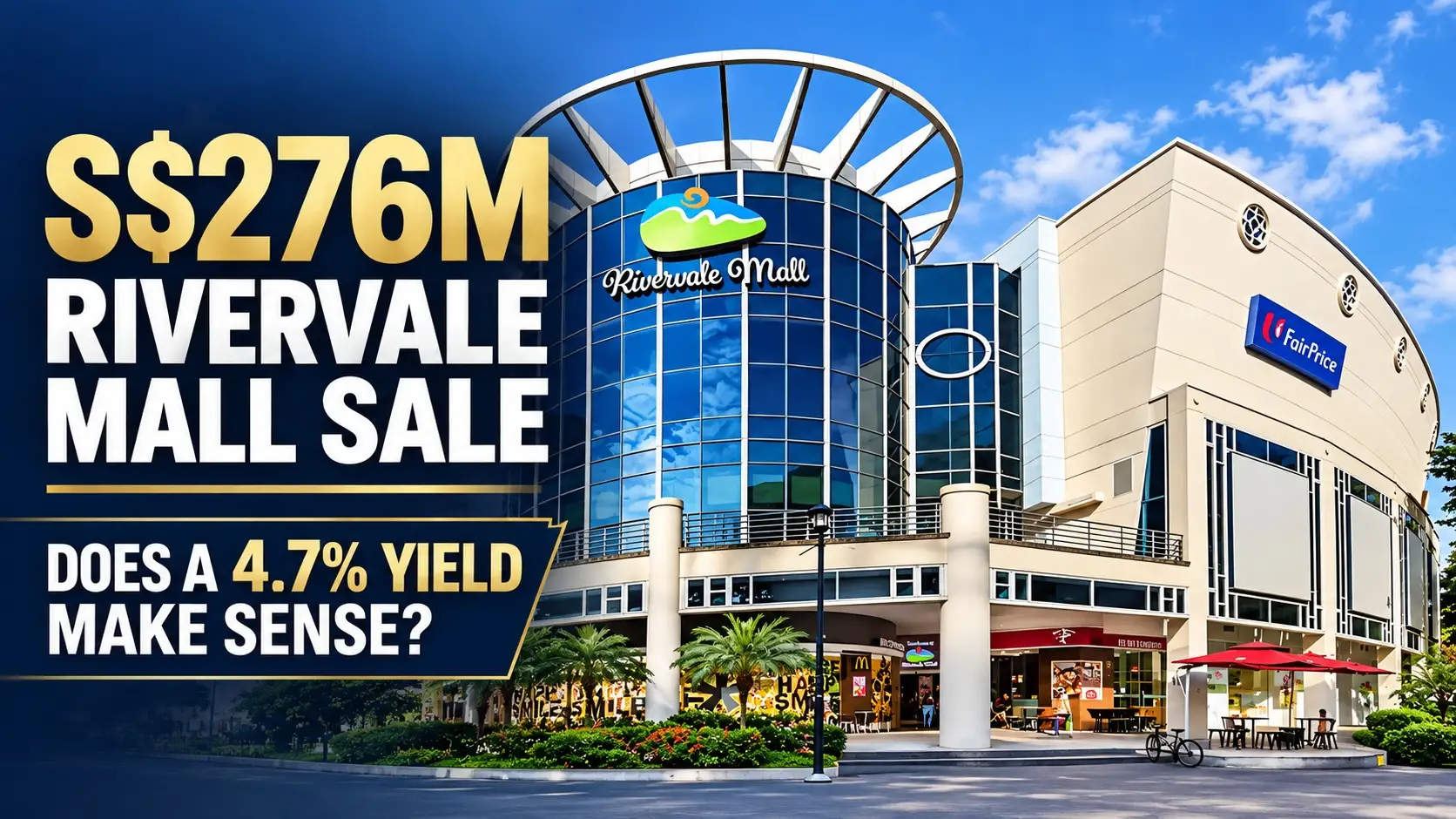
The sale of Rivervale Mall for approximately S$276 million may initially look like a straightforward investment in a suburban shopping centre. The reported numbers are easy to understand: about 81,150 sq ft of net lettable area, a price of approximately S$3,401 psf and a net property yield of around 4.7%.
The more interesting question is why a buyer linked to Master Contract Services would pay that price for a neighbourhood mall with only about 70 years remaining on its lease.
The answer may lie in the buyer’s circumstances rather than in the yield alone. Rivervale Mall provides an immediate stream of recurring income, full control of a relatively compact retail asset, and potential operating advantages for a group with construction, facilities-management, and property-development experience.
However, the 4.7% yield should not automatically be interpreted as cheap. Once you factor in lease decay, financing, future upgrading expenditure, and comparisons with larger suburban malls, the acquisition appears closer to a fair-to-full price than an obvious bargain.
What Exactly Is Being Acquired?
Rivervale Mall is a three-storey suburban shopping centre at the junction of Rivervale Crescent and Rivervale Drive in Sengkang. It also has an adjoining four-storey car park.
The property sits on a 99-year lease that began on 6 December 1997, leaving approximately 70 years at the time of the reported transaction. The S$276 million consideration translates to around S$3,401 psf based on approximately 81,150 sq ft of net lettable area. The deal is reportedly expected to be completed by the end of September 2026. The Business Times reported these transaction details, which Lianhe Zaobao later summarised.
The mall is not a destination retail complex comparable in scale with NEX or Waterway Point. Its proposition is more local: groceries, food and beverage, personal services and other everyday needs for households within the surrounding Sengkang catchment.
That distinction matters. A neighbourhood mall does not require every shopper to make a special trip. Its value comes from repeated visits by nearby residents.
Sheng Siong’s arrival as a supermarket anchor in September 2026 also strengthens this role. A supermarket can generate frequent footfall and support smaller tenants whose businesses depend on regular neighbourhood traffic. Sheng Siong’s Rivervale Mall outlet opened on 4 September 2026, shortly before the reported sale emerged.
What Does a 4.7% Net Yield Actually Mean?
Applying the reported 4.7% net property yield to the S$276 million price gives an implied annual net property income of approximately:
S$276 million × 4.7% = S$12.97 million a year
That is approximately S$1.08 million a month in net property income, or about S$13.32 per sq ft of net lettable area each month.
The last figure should not be confused with the mall’s average gross rent. Net property income is calculated after property-level operating expenses, while gross rent may also include service charges and other components. Nevertheless, it gives us a useful indication of the income supporting the purchase price.
On an unlevered basis, the buyer is therefore acquiring a starting property return of about 4.7% before acquisition expenses, financing costs, taxes and any major future capital expenditure.
This is a relatively stable return if the mall maintains its occupancy and rental income. It is not, however, a particularly wide margin for error.
The NEX Comparison Suggests Rivervale Mall Was Not Cheap
One revealing comparison is NEX in Serangoon.
When Frasers Centrepoint Trust agreed in 2024 to increase its interest in NEX, the mall had an agreed property value of S$2.127 billion, equivalent to approximately S$3,352 psf of net lettable area. Its historical net property income yield was approximately 4.8%. NEX was fully occupied, directly connected to Serangoon MRT station and bus interchange, and had approximately 84 years remaining on its lease. These figures are contained in FCT’s acquisition announcement.
| Property | Transaction or agreed value | Approximate price psf of NLA | Reported NPI yield | Approximate remaining lease at transaction | Positioning |
|---|---|---|---|---|---|
| Rivervale Mall | S$276 million | S$3,401 | 4.7% | 70 years | Neighbourhood mall beside Rumbia LRT |
| NEX | S$2.127 billion | S$3,352 | 4.8% | 84 years | Regional mall integrated with MRT and bus interchange |
| White Sands | S$467 million | About S$3,106 | Not disclosed in the divestment announcement | About 66 years | Suburban mall beside Pasir Ris MRT |
Rivervale Mall’s reported price is therefore slightly higher on a psf-of-net-lettable-area basis than NEX’s 2024 agreed value, while its yield is marginally lower and its remaining lease shorter.
That does not mean the buyer necessarily overpaid. The transactions occurred at different times and involved very different assets and ownership structures. NEX is also far larger, while the ability to acquire complete control of a smaller mall can appeal to a private investor. Nevertheless, the comparison shows that Rivervale Mall was not acquired at an obviously distressed valuation.
White Sands offers another recent reference point. FCT agreed in June 2026 to divest the Pasir Ris mall for S$467 million. Based on its disclosed net lettable area of 150,352 sq ft, that works out to approximately S$3,106 psf. The price was already 8.4% above White Sands’ independent valuation, according to FCT’s announcement.
Rivervale Mall’s S$3,401 psf is around 9.5% higher than that figure. The two properties are not directly interchangeable, and White Sands has a shorter remaining lease, but the comparison again suggests that the Rivervale buyer paid for income resilience and scarcity rather than securing a visibly low entry price.
Why the Acquisition May Still Make Sense for Master Contract Services
1. It Converts Capital Into Recurring Income
Construction and property-development earnings can be project-based and cyclical. An operating mall provides a different return profile: recurring rental income from multiple tenants over a series of lease periods.
For a privately controlled group, this can be attractive even where the initial yield is not especially high. The objective may be to hold a durable income-producing asset rather than achieve a rapid resale profit.
At the reported yield, Rivervale Mall could contribute close to S$13 million in annual net property income from the start. That income could help diversify the group’s exposure away from development completions and construction contracts.
2. The Buyer Is Not New to Property
Master Contract Services should not be viewed simply as a contractor making an unrelated property purchase.
The company began in facilities maintenance, holds a BCA Grade A1 classification for general building work and moved into property development in 2011. Its reported track record includes Skies Miltonia, The Amore executive condominium, Tag.A at Tagore Lane and hospitality-related developments in Beach Road and East Coast Road.
This experience may give the buyer an advantage in assessing building condition, future upgrading requirements and the cost of maintaining an ageing mall. That does not eliminate capital expenditure, but it can make it easier to estimate, procure, and manage.
3. Full Ownership Creates Operating Flexibility
Whole-mall transactions are relatively uncommon. Buying an entire mall gives the owner control over tenant selection, leasing strategy, refurbishment, marketing and the timing of capital works.
That flexibility may be especially useful in a compact neighbourhood asset. The owner can adjust the mix toward groceries, food and beverage, healthcare, education, fitness and personal services without having to negotiate with multiple strata owners.
Rivervale Mall’s value may therefore lie partly in control. The buyer is not merely acquiring a passive rental stream; it is acquiring an operating platform that can be actively managed.
4. A Necessity-Led Tenant Mix Can Be Defensive
Neighbourhood malls have one important advantage over destination shopping centres: much of their demand is tied to everyday consumption rather than occasional discretionary spending.
Supermarkets, dining, pharmacies, enrichment businesses and personal services are difficult to replace entirely with online shopping. Their leases are not risk-free, but they can produce more regular footfall than fashion-heavy retail formats.
The broader suburban retail market also provides some support. In the first quarter of 2026, retail vacancy in Singapore’s Outside Central Region tightened to 4.1%, while suburban leasing recorded the strongest net absorption among the major submarkets, according to market commentary based on URA data.
The qualification is that suburban performance is not uniform. A neighbourhood mall must still defend its immediate catchment against competing supermarkets, nearby malls, online delivery and changing consumer habits.
5. It May Be Part of a Broader Property Strategy
The Rivervale Mall transaction follows the reported S$273 million acquisition of Orchid Hotel by a joint venture majority controlled by an entity linked to one of Master Contract Services’ owners. The hotel transaction reportedly involved Westmont Hospitality Group as a minority partner and anticipated asset manager.
The two acquisitions total approximately S$549 million in headline property value, although they involve different buying entities and should not automatically be treated as purchases made from the same balance sheet.
Taken together, they nevertheless suggest a deliberate expansion into sizeable income-producing real estate. The two assets also complement each other conceptually:
- Orchid Hotel offers possible upside from rebranding and repositioning, but carries hospitality operating risk.
- Rivervale Mall offers a more defensive, neighbourhood-based rental stream, but has less obvious transformational upside.
This resembles a balance between value-add potential and steady income rather than two isolated acquisitions.
How Sensitive Is the S$276 Million Valuation?
Capitalisation rates strongly affect the value of an income-producing property. If Rivervale Mall continues to generate approximately S$12.97 million of annual net property income, its theoretical value changes as follows:
| Assumed capitalisation rate | Implied value | Difference from S$276 million price |
|---|---|---|
| 4.50% | S$288.3 million | +4.4% |
| 4.70% | S$276.0 million | — |
| 5.00% | S$259.4 million | -6.0% |
| 5.50% | S$235.9 million | -14.5% |
This table demonstrates the central risk. If investors later require a 5.5% yield for a mall of this age and tenure, and its income does not grow, the implied value could fall by about S$40 million.
Conversely, if the new owner increases net property income through higher occupancy, positive rental reversions, tenant remixing or better cost control, that income growth can offset some yield expansion and lease decay.
The buyer is therefore not purchasing a fixed 4.7% return. It is purchasing a stream of income whose future value depends on both operating performance and the yield required by the next buyer.
Does Borrowing Make the Return More Attractive?
The financing structure has not been publicly disclosed. A simple illustration shows why it matters.
If the acquisition were funded with 50% debt, the buyer would contribute approximately S$138 million of equity. Before principal repayment, tax, capital expenditure and transaction costs, the cash return after interest could look approximately like this:
| Illustrative interest cost | Annual interest on S$138 million debt | NPI after interest | Illustrative return on S$138 million equity |
|---|---|---|---|
| 3.5% | S$4.83 million | S$8.14 million | 5.9% |
| 4.0% | S$5.52 million | S$7.45 million | 5.4% |
| 4.5% | S$6.21 million | S$6.76 million | 4.9% |
These are simplified illustrations, not forecasts of the buyer’s actual return. They exclude loan amortisation, acquisition expenses, asset-management costs, taxation and major upgrading expenditure.
They show that leverage can lift equity returns when borrowing costs remain below the property’s yield, but the increase may not be dramatic. If debt becomes expensive or income weakens, the advantage narrows quickly.
For this reason, the transaction makes more sense for a buyer with patient capital and a manageable financing structure than for one relying on aggressive leverage.
The Remaining Lease Cannot Be Ignored
Approximately 70 years is still a substantial operating horizon. Lease expiry is not an immediate threat to the mall’s ability to generate income.
However, the land tenure will become increasingly relevant over a long holding period. If the buyer owns the asset for 15 years, the next purchaser may be evaluating a mall with only around 55 years remaining.
That future buyer may demand a higher yield or discount the property more heavily, particularly if substantial upgrading is also required. Rental growth and active management must therefore do more than maintain current income; over time, they must also help offset the shorter lease.
The building’s age creates a related risk. A mall can remain commercially useful for many decades, but lifts, air-conditioning systems, façades, waterproofing, fire-safety systems and common areas require periodic replacement or upgrading. These costs may not appear in the reported 4.7% yield if they are treated as capital expenditure rather than ordinary property expenses.
Master Contract Services’ construction and facilities background may help manage this risk, but it does not eliminate it.
What Did SC Capital Partners Achieve?
SC Capital Partners acquired Rivervale Mall for approximately S$230 million in 2019. A sale at S$276 million produces a gross increase of S$46 million, or 20%, before transaction costs, financing expenses and any additional capital expenditure.
Over a holding period of roughly seven to seven-and-a-half years, that equates to annualised gross capital appreciation of approximately 2.5% to 2.6%. SC Capital would also have received the mall’s rental income during its ownership.
The change in reported yield is noteworthy. The 2019 purchase was said to reflect a yield of slightly above 4%, while the latest transaction reflects about 4.7%. Despite the outward movement in yield, the mall’s value still increased by 20%. This suggests that its net property income may have risen materially during the period, although the two reported yield figures may not have been calculated using precisely identical assumptions.
The asset’s history also shows how value was created before SC Capital’s ownership. AEW bought Rivervale Mall for S$190.5 million in 2015, upgraded its common areas and increased the proportion of food-and-beverage space. It then sold the property to SC Capital for S$230 million in 2019. Details of that transaction and earlier repositioning were reported by Mingtiandi.
The lesson is that the mall’s returns have not come purely from passive market appreciation. Tenant remixing, refurbishment and income growth have played an important role. The new owner may need to continue that approach.
So, Does the 4.7% Yield Make Financial Sense?
The answer is yes—but only under the right ownership assumptions.
The acquisition makes sense if the buyer:
- intends to hold the asset for recurring income rather than seek a quick resale;
- can finance it without allowing interest expense to consume most of the income;
- believes the new supermarket anchor and necessity-led tenant mix will protect footfall;
- can use its construction and facilities expertise to control upgrading and operating costs; and
- has a credible plan to grow net property income sufficiently to offset lease decay.
The transaction looks less compelling if the buyer is relying only on the current yield. At 4.7%, there is limited protection against weaker rents, vacancies, major capital expenditure or higher future capitalisation rates. The comparison with NEX also indicates that the entry valuation is not obviously cheap.
The most reasonable interpretation is therefore that Master Contract Services is not merely buying a 4.7% yield. The buyer is acquiring full control of a scarce suburban retail asset, a recurring income stream and an operating platform that fits its existing capabilities.
For a passive investor, S$276 million could look demanding. For an owner-operator who can manage the building, reshape the tenant mix, and hold through market cycles, the price may still be rational.
The 4.7% yield supports the acquisition—but the long-term investment case will ultimately depend on what the new owner does with the mall after completion.
Disclaimer: This article is for general information and commentary only. It does not constitute investment, financial, legal, tax or property advice, nor is it an offer or recommendation to buy or sell any asset. Transaction figures, yields, areas, ownership relationships and completion details are based on publicly reported information and may be subject to revision. Calculations and financing scenarios are illustrative and may not reflect the actual acquisition structure, borrowing terms, operating expenses, capital expenditure or future performance of Rivervale Mall. Readers should conduct their own due diligence and obtain advice from suitably qualified professionals before making any investment decisions.
Article contributed by Jerry Wong.

Jerry Wong is a realtor at Propnex Realty, bringing a rich background in interior and lighting design to his work. He loves exploring diverse spaces and observing the transformative power of real estate. Beyond his professional role, Jerry finds his greatest fulfillment in connecting people with the right properties, gaining immense satisfaction from helping clients achieve their dreams.