
URA adjusts monthly developers’ sales figures to account for lapsed options to purchase
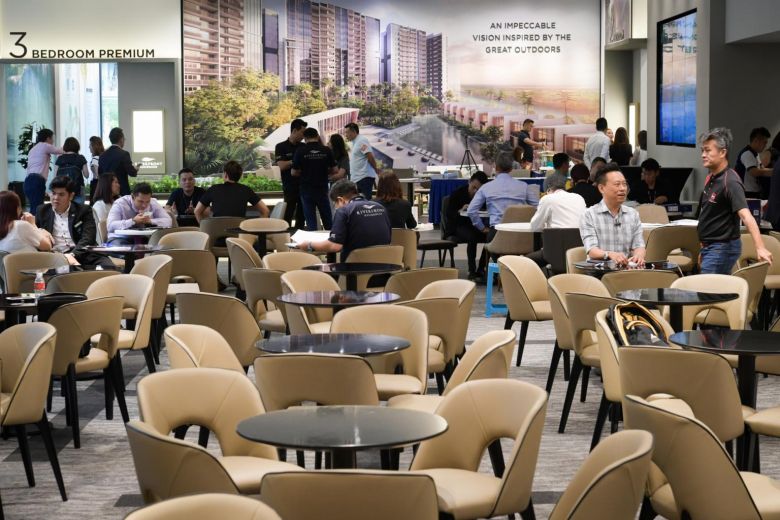
Faced with a slow residential market and competition from a multitude of new launches this year, some developers are reportedly adopting an “ingenious sales tactic” to lock in potential buyers who may not be ready to commit to their purchases, according to a report by Credit Suisse’s equity research arm.
This has resulted in what it called “the curious case of the rising number of returned units” at some new launches after the July 6 cooling measures last year.
In a typical transaction for a newly launched project, the buyer of a unit who is issued an option to purchase (OTP) must pay 5 per cent of the purchase price as a booking fee, of which 25 per cent may be forfeited should the buyer fail to complete the purchase and return the unit to the developer.
The buyer would then have forfeited the equivalent of 1.25 per cent of the purchase price.
But in many cases here, buyers have not given up on their purchases.
Instead, the key reason for the high implied number of returned units is what Credit Suisse analyst Louis Chua called “the emergence of an ingenious sales tactic adopted by some developers, where options to purchase are continually reissued to buyers upon expiry of a three-week validity period, without any forfeiture of booking fees”.
While there are no official statistics on the number of returned units at new launches, Credit Suisse said the number spiked to 398 in December last year, compared with fewer than 150 in November.
It worked out the implied number of returned units from the Urban Redevelopment Authority’s (URA) monthly sales data for developer launches.
Credit Suisse noted that the trend was limited to projects such as Riverfront Residences, Park Colonial, Stirling Residences, Parc Esta and Whistler Grand.
In response to The Straits Times, URA said developers should grant OTPs only to purchasers who are ready to exercise them within the validity period. It said it was monitoring the situation.
URA said if the purchaser needs more time to exercise the OTP, he or the developer can apply to the Controller of Housing for an extension of the validity period by up to eight weeks from the date of OTP.
“This period will be sufficient for the purchaser to make the necessary arrangements to exercise the OTP, e.g. obtain a bank loan,” the URA spokesman said.
“To ensure the accuracy of our data, we have started to make adjustments to the monthly developers’ sales figures from January 2019 to account for lapsed OTPs that were declared by developers to URA.”
Asked about the report, Mr Chng Chee Beow, executive director of Logan Property Singapore, the joint developer of Stirling Residences, said: “If there is a genuine buyer, we will extend the OTP. Some developers may allow extensions up to two or three times.”
Mr Chia Ngiang Hong, City Developments’ group general manager, said: “To date, 262 OTPs have been issued (for Whistler Grand) and more than half have been exercised, with the rest progressively to be exercised.
“As with most projects, OTPs typically lapsed or were re-issued due to various reasons such as (buyers’) change of mind, request for addition and/or deletion of name, or change of unit. Moreover, (following the cooling measures), some home buyers including HDB upgraders required more time to arrange their finances and loans.”
Mr Chia said the adjustment URA made to reflect the actual number of units sold is a positive move that provides greater accuracy and prevents misunderstanding of the sales data.
“Source:[Some developers using ‘ingenious sales tactic’ to lock in home buyers] © Singapore Press Holdings Limited. Permission required for reproduction”


Let’s Discuss Your Property Plans
Interested in This Property?
Buying, selling or renting? Get a free consultation with realtors with a background in interior and lighting design. We’ll discuss your goals and help you assess your options—from pricing and timelines to layout practicality and space potential.
Share your contact details below, and we will get in touch to understand your needs and suggest the next steps. No pressure. No obligation to proceed.